


16 Results for "

polylysine

" in MedChemExpress (MCE) Product Catalog:
Products (16)

16 Results for "polylysine" in MCE Product Catalog:

Cat. No.: HY-W250308
CAS No.: 28211-04-3
Synonyms: Epsilon-polylysine (MW 3800-4200); ε-polylysine (MW 3800-4200); ε-PL (MW 3800-4200)
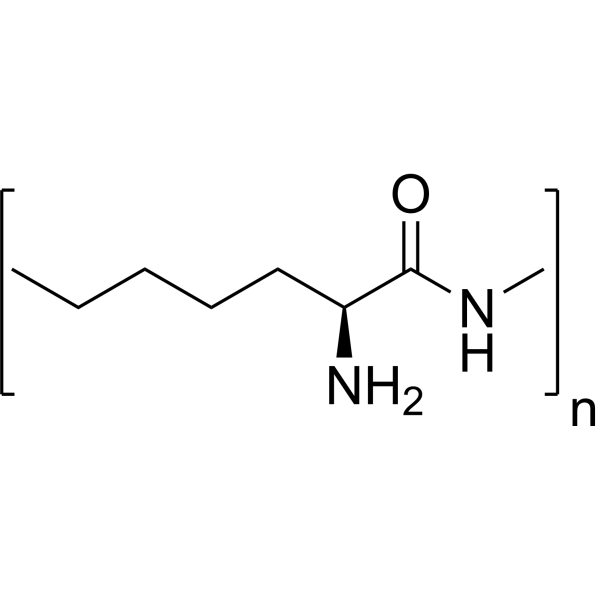
Epsilon-polylysine is an antimicrobial peptide that can be produced by bacteria such as Streptomyces. Epsilon-polylysine inhibits the growth of microorganisms such as bacteria, yeasts and molds and is therefore often used as a green food additive and preservative in various food and beverage products. Epsilon-polylysine has a variety of properties, including thermal stability, resistance to acidic conditions, and broad-spectrum antimicrobial activity. Epsilon-polylysine can be loaded on other materials to form nanoparticles or form nanofiber membranes for targeted delivery to exert sustained antibacterial efficacy. Epsilon-polylysine is also used as a liposome stabilizer .
loading...
    loading...
Cat. No.: HY-126436A
CAS No.: 27378-49-0
Synonyms: L-Ornithine homopolymer hydrobromide (MW 30000-70000)
Poly-L-ornithine hydrobromide (MW 30000-70000) is a poly-lysine derivative with a molecular weight of 30000-70000. Poly-L-ornithine hydrobromide (MW 30000-70000) binds to the surface of cell culture vessels through positively charged amino acid residues to form a coating that promotes cell adhesion and provides cells with a matrix environment required for growth. Poly-L-ornithine hydrobromide (MW 30000-70000) is used as a coating agent in cell culture and can be used for the study of primary culture of neurons (such as dopaminergic neurons and oligodendrocytes) .
loading...
    loading...
Cat. No.: HY-W250308A
Synonyms: Epsilon-polylysine hydrochloride (MV 2000-5000); ε-polylysine hydrochloride (MV 2000-5000); ε-PL hydrochloride (MV 2000-5000)
ε-Poly-L-lysine (Epsilon-polylysine; ε-Polylysine) hydrochloride (MV 2000-5000) is a polycationic antibacterial agent with broad-spectrum activity against Gram-positive bacteria, Gram-negative bacteria, fungi, yeasts and specific bacteriophages. ε-Poly-L-lysine hydrochloride (MV 2000-5000) exerts bactericidal effects through mechanisms such as disrupting microbial membranes, inducing ROS production, inhibiting metabolism and spore germination. ε-Poly-L-lysine hydrochloride (MV 2000-5000) also regulates the expression of multiple key genes including sodA, oxyR and recA. ε-Poly-L-lysine hydrochloride (MV 2000-5000) exhibits properties such as low eukaryotic cytotoxicity, thermal stability and pH stability, and supports tissue regeneration and anti-tumor applications. ε-Poly-L-lysine hydrochloride (MV 2000-5000) can be applied in research fields including bacterial and fungal infections, diabetic ulcers, and methicillin-resistant Staphylococcus aureus infections .
loading...
    loading...
Cat. No.: HY-P4116
CAS No.: 2293160-09-3
Synonyms: pHLIP
Target:  

Peptides

Research Areas:  

Metabolic Disease Cancer

pH-Low Insertion Peptide (pHLIP) is a short, pH-responsive peptide capable of inserting across a cell membrane to form a transmembrane helix at acidic pH. pH-Low Insertion Peptide targets the acidic tumor microenvironment for tumors at early and metastatic stages with high specificity, used as a specific ligand. pH-Low Insertion Peptide successfully modify polylysine polymers to have the pH-responsive capability. pH-Low Insertion Peptide-based targeting of cancer presents an opportunity to monitor metabolic changes, and to selectively deliver imaging and therapeutic agents to tumors .
loading...
    loading...
Cat. No.: HY-P2895
CAS No.: 9028-00-6
Synonyms: Clostridiopeptidase B
Target:  

Endogenous Metabolite

Research Areas:  

Others

Clostripain (Clostridiopeptidase B) is a thiol protease isolated from Clostridium histolyticum. Clostripain exhibits proteolytic activity as well as amidase-esterase activity. The specificity of Clostripain is primarily restricted to arginine residues, but it also shows minor hydrolytic activity toward most lysine-containing substrates. Clostripain catalyzes the ammonolysis of Carbobenzoxyarginyl methyl ester to generate various dipeptides .
loading...
    loading...
Cat. No.: HY-158228
Synonyms: PLMA
Poly-L-lysine Methacryloyl (PLMA) is methacrylated polylysine. When Poly-L-lysine Methacryloyl is cross-linked on polyetheretherketone (PEEK) through UV-induced cross-linking, it can improve the hydrophilicity of PEEK and retain its own degradation bioinertness . Poly-L-lysine Methacryloyl needs to self-assemble into fibrous hydrogel under the action of photoinitiator LAP (HY-44076), and target bioactive adhesion sites, play an inherent supporting role for tissue cells and biodegradable activity.
Application: cell culture, biological 3D printing, tissue engineering, etc.
loading...
    loading...
Cat. No.: HY-P4116A
Synonyms: pHLIP TFA
Target:  

Peptides

Research Areas:  

Metabolic Disease Cancer

pH-Low Insertion Peptide TFA (pHLIP TFA) is a short, pH-responsive peptide capable of inserting across a cell membrane to form a transmembrane helix at acidic pH. pH-Low Insertion Peptide TFA targets the acidic tumor microenvironment for tumors at early and metastatic stages with high specificity, used as a specific ligand. pH-Low Insertion Peptide TFA successfully modifys polylysine polymers to have the pH-responsive capability. pH-Low Insertion Peptide TFA -based targeting of cancer presents an opportunity to monitor metabolic changes and to selectively deliver imaging and therapeutic agents to tumors .
loading...
    loading...
Cat. No.: HY-D2817
FITC-PLL is a fluorescent dye composed of poly-lysine (PLL) and FITC (HY-66019). FITC-PLL can be used for cell labeling and has nucleic acid binding ability .
loading...
    loading...
Cat. No.: HY-W763546A
CAS No.: 26403-72-5
Poly (ethylene glycol) diglycidyl ether (MW 500) is a crosslinker with epoxy functional groups at both ends . Poly (ethylene glycol) diglycidyl ether (MW 500) undergoes epoxy ring-opening reactions with the amino groups of ε-polylysine and the hydroxyl groups of hyaluronic acid to form a crosslinked network. Poly (ethylene glycol) diglycidyl ether (MW 500) helps endow materials with procoagulant, antibacterial and wound-healing properties .
loading...
    loading...
Cat. No.: HY-173241
Poly-L-lysine-Ahx-FITC (MW 15000-30000) is a cationic polymer, which is a polylysine modified with FITC (HY-66019). Poly-L-lysine-Ahx-FITC (MW 15000-30000) is used to fix cells on glass substrates or negatively charged substrates for subsequent labeling and localization experiments.
loading...
    loading...
Cat. No.: HY-173241A
Poly-L-lysine-Ahx-FITC (MW 30000-70000) is a cationic polymer, which is a polylysine modified with FITC (HY-66019). Poly-L-lysine-Ahx-FITC (MW 30000-70000) is used to fix cells on glass substrates or negatively charged substrates for subsequent labeling and localization experiments.
loading...
    loading...
Cat. No.: HY-N16282
Synonyms: N,N-Ditetradecylamine-polylysine(40) TFA
Category:  

Lipids

N-Tetamine-pLys40 (N,N-Ditetradecylamine-polylysine(40)) TFA is a multivalent cationic lipid.
loading...
    loading...
Cat. No.: HY-184636
PLL coated Fe2O3 nanoparticles (Polylysine-modified ferric oxide magnetic nanoparticles) consist of a polylysine (PLL)-modified ferric oxide (Fe2O3) core and pure water.
loading...
    loading...
Cat. No.: HY-184630
Polylysine-modified magnetite nanoparticles are a composite material. Modifying Fe3O4 nanoparticles with PLL can form Fe3O4@PLL composite material, which combines the magnetic properties of Fe3O4 with the biocompatibility and multifunctionality of PLL.
loading...
    loading...
Cat. No.: HY-184626
Thiol-modified magnetite nanoparticles are prepared via high-temperature pyrolysis and surface-modified with thiol functional groups. Magnetite is widely used in magnetic resonance imaging, magnetic separation, targeted drug delivery, tumor hyperthermia, cell labeling and separation, as a contrast agent, and in retinal detachment repair surgery due to its stable properties, good biocompatibility, high strength, and lack of toxicity. It is also used as a catalyst carrier, microwave absorbing material, and magnetic recording material. Xianfeng has developed numerous derivatives of magnetite, including oleic acid-modified magnetite, magnetite with different PEG ends, DMSA-modified magnetite, polylysine-modified magnetite, carboxylated dextran-modified magnetite nanoparticles, streptavidin-modified magnetite particles, thiol-modified magnetite magnetic nanoparticles, and polyethyleneimine (PEI)-modified magnetic magnetite nanoparticles, among others.
loading...
    loading...
Cat. No.: HY-184620
Ferric oxide (Fe3O4) is widely used in magnetic resonance imaging (MRI), magnetic separation, targeted drug delivery, tumor hyperthermia, cell labeling and separation, and as a contrast agent and enhancement agent in retinal detachment repair surgery due to its stable material properties, good biocompatibility, high strength, and lack of toxic side effects. It is also used as a catalyst carrier, microwave absorbing material, and magnetic recording material. Xianfeng has developed numerous derivatives of ferric oxide, including oleic acid-modified ferric oxide, PEG-terminated ferric oxide, DMSA-modified ferric oxide, polylysine-modified ferric oxide, carboxylated dextran-modified ferric oxide nanoparticles, streptavidin-modified ferric oxide particles, thiol-modified ferric oxide magnetic nanoparticles, and polyethyleneimine (PEI)-modified magnetic ferric oxide nanoparticles, among others. This wide range of modifications provides numerous options for subsequent experiments.
loading...
    loading...
  • 1

