14 Results for "

retinal toxicity

" in MedChemExpress (MCE) Product Catalog:
Products (14)

14 Results for "retinal toxicity" in MCE Product Catalog:

  • Targets Recommended:
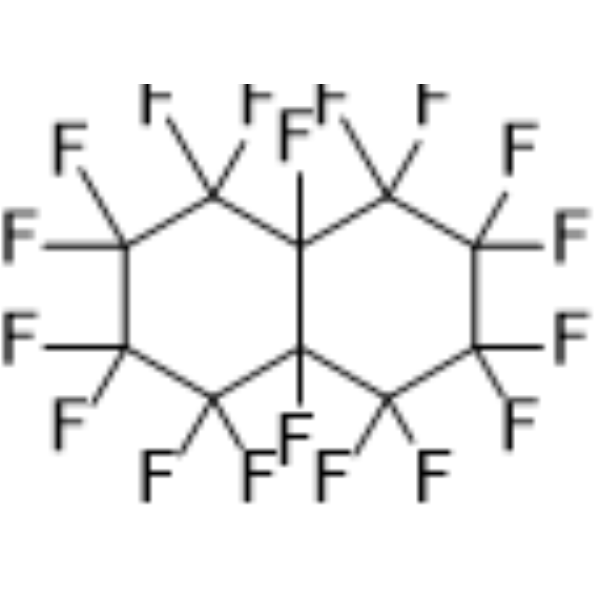
Cat. No.: HY-108298
CAS No.: 306-94-5
Purity:  ≥98.0%
Synonyms: PP 5; Perfluorodecahydronaphthalene
Research Areas:  

Others

Perfluorodecalin liquids are largrly used in vitreoretinal surgery. Perfluorodecalin with tamponade lasting more than two days is detrimental to the retina in the case of rabbit. Perfluorodecalin can be used for the research of giant retinal tears . Perfluorodecalin is a non-toxic, non-flammable, thermally stable, non-bio-accumulating O2-carrier and used as artificial blood . Perfluorodecalin enhances bone regeneration and cell viability .
loading...
    loading...
Cat. No.: HY-124717
CAS No.: 748778-73-6
Purity:  99.43%
YC-001 is an inverse agonist and antagonist of rod opsin. YC-001 reversibly binds rod opsin and stabilizes the rod opsin structure. YC-001 protects mice from bright light-induced retinal degeneration. YC-001 has the potential for the research of retinal degeneration .
loading...
    loading...
Cat. No.: HY-119715
CAS No.: 486414-35-1
Target:  

CDK Apoptosis

Research Areas:  

Inflammation/Immunology Cancer

AG-012986 is a pan-CDK inhibitor with Ki values of 44 nM (CDK1), 9.2 nM (CDK4), 94 nM (CDK2), and IC50 values of 22 nM (CDK5), 4 nM (CDK9). AG-012986 causes apoptosis of T-cells by targeting upstream kinases in the p38 Mitogen-activated protein kinase (MAPK) pathway and impairing cellular survival. AG-012986 induces cell cycle arrest, retinoblastoma protein hypophosphorylation, and reduces Ki-67 expression. AG-012986 exerts antiproliferative activity in tumor cells, demonstrates antitumor efficacy in human xenograft models, and causes retinal and peripheral neurotoxicity, plus immune cell toxicity. AG-012986 can be used for the research of colon carcinoma, non-small cell lung carcinoma, lung carcinoma, breast carcinoma, ovarian tumor, pancreatic carcinoma, osteosarcoma, lymphoma, leukemia, retinotoxicity .
loading...
    loading...
Cat. No.: HY-116910
CAS No.: 640897-20-7
Target:  

GABA Receptor

Research Areas:  

Neurological Disease

CPP-115 is a GABA transaminase inactivator with higher affinity and lower retinal toxicity than Vigabatrin (HY-15399). CPP-115 increases brain GABA levels by inhibiting GABA transaminase catabolism. CPP-115 can be used in the study of drug addiction and infantile spasms .
loading...
    loading...
Cat. No.: HY-125859E
Myeloperoxidase, Human Neutrophil is a peroxidase. Myeloperoxidase, Human Neutrophil is a potent antibacterial agent by catalyzing the H2O2-dependent oxidation of chloride anion to generate hypochlorous acid. Myeloperoxidase, Human Neutrophil catalyzes the degradation of N-retinyl-idene-N-retinylethanolamine, a toxic form of retinal lipofuscin. Myeloperoxidase, Human Neutrophil also triggers lysosomal stress and cell death. Myeloperoxidase, Human Neutrophil can be used for the researches of inflammation and infection .
loading...
    loading...
Cat. No.: HY-111159
CAS No.: 909576-25-6
Target:  

Autophagy

Research Areas:  

Neurological Disease

CP-467688 is an orally active retinotoxic agent. CP-467688 induces increased lysosome volume, phagocytosis inhibition and autophagy inhibition in retinal cells. CP-467688 is applicable to the research of retinopathy .
loading...
    loading...
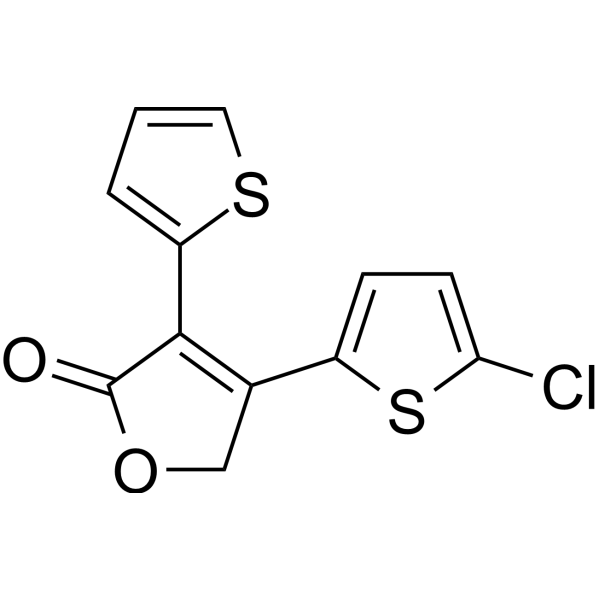
Cat. No.: HY-110057
CAS No.: 138472-01-2
Synonyms: NOR 3
Target:  

NO Synthase

Research Areas:  

Cardiovascular Disease

FR 409 (NOR3) is a NO donor and vasodilator. FR 409 increases the diameter of retinal arterioles. FR 409 is toxic to a variety of cells. FR 409 can be used in research on pain and retinopathy .
loading...
    loading...
Cat. No.: HY-W035445
CAS No.: 102010-61-7
Target:  

Parasite

Research Areas:  

Infection

Antiparasitic agent-42 is an orally active p-aminophenoxyalkane derivative with anti-Schistosoma mansoni activity. Antiparasitic agent-42 exerts retinal toxicity in cats. Antiparasitic agent-42 can be used in the research of schistosomiasis .
loading...
    loading...
Cat. No.: HY-182372
CAS No.: 1638153-78-2
Target:  

Epoxide Hydrolase

Research Areas:  

Neurological Disease

SH-11037 is a potent inhibitor of soluble epoxide hydrolase (sEH) and docks to the substrate binding cleft in the sEH hydrolase domain. SH-11037 dose-dependently suppresses angiogenesis in the choroidal sprouting assay ex vivo and inhibited ocular developmental angiogenesis in zebrafish larvae. SH-11037 reduces choroidal neovascularisation lesion volume in the laser-induced CNV mouse model. SH-11037 synergises with anti-VEGF treatments in vitro and in vivo. SH-11037 induces G2/M phase blockade and retains retinal endothelial cell viability at active concentrations without overt toxicity. SH-11037 can be used for the research of retinal neovascularization and ocular neovascularization .
loading...
    loading...
Cat. No.: HY-108298R
CAS No.: 306-94-5
Synonyms: PP 5 (Standard); Perfluorodecahydronaphthalene (Standard)
Research Areas:  

Others

Perfluorodecalin (Standard) is the analytical standard of Perfluorodecalin (HY-108298). This product is intended for research and analytical applications. Perfluorodecalin liquids are largrly used in vitreoretinal surgery. Perfluorodecalin with tamponade lasting more than two days is detrimental to the retina in the case of rabbit. Perfluorodecalin can be used for the research of giant retinal tears . Perfluorodecalin is a non-toxic, non-flammable, thermally stable, non-bio-accumulating O2-carrier and used as artificial blood . Perfluorodecalin enhances bone regeneration and cell viability .
loading...
    loading...
Cat. No.: HY-119753
CAS No.: 68284-69-5
Synonyms: SC-31828
Target:  

Others

Research Areas:  

Cardiovascular Disease

Disobutamide (SC-31828) is an orally active, blood-brain barrier permeable cationic amphiphilic ditertiary amine piperidine ring compound with antiarrhythmic properties. Disobutamide induces lysosomal phospholipid accumulation, which triggers extensive cytoplasmic vacuolization and leads to cell death. Disobutamide prolongs multiple electrocardiographic intervals in canine hearts, induces cardiac arrest at high doses, and causes decreased retinal reflectivity. Disobutamide can be used in studies related to arrhythmias, and also serves as a model drug for investigating the storage mechanisms and toxicity thresholds of intracellular amphiphilic compounds .
loading...
    loading...
Cat. No.: HY-184626
Thiol-modified magnetite nanoparticles are prepared via high-temperature pyrolysis and surface-modified with thiol functional groups. Magnetite is widely used in magnetic resonance imaging, magnetic separation, targeted drug delivery, tumor hyperthermia, cell labeling and separation, as a contrast agent, and in retinal detachment repair surgery due to its stable properties, good biocompatibility, high strength, and lack of toxicity. It is also used as a catalyst carrier, microwave absorbing material, and magnetic recording material. Xianfeng has developed numerous derivatives of magnetite, including oleic acid-modified magnetite, magnetite with different PEG ends, DMSA-modified magnetite, polylysine-modified magnetite, carboxylated dextran-modified magnetite nanoparticles, streptavidin-modified magnetite particles, thiol-modified magnetite magnetic nanoparticles, and polyethyleneimine (PEI)-modified magnetic magnetite nanoparticles, among others.
loading...
    loading...
Cat. No.: HY-182470
CAS No.: 486414-32-8
Target:  

CDK

AG-012986 (dihydrochloride) is a pan-CDK inhibitor with Ki values of 44 nM (CDK1), 9.2 nM (CDK4), 94 nM (CDK2), and IC50 values of 22 nM (CDK5), 4 nM (CDK9). AG-012986 (dihydrochloride) causes apoptosis of T-cells by targeting upstream kinases in the p38 Mitogen-activated protein kinase (MAPK) pathway and impairing cellular survival. AG-012986 (dihydrochloride) induces cell cycle arrest, retinoblastoma protein hypophosphorylation, and reduces Ki-67 expression. AG-012986 (dihydrochloride) exerts antiproliferative activity in tumor cells, demonstrates antitumor efficacy in human xenograft models, and causes retinal and peripheral neurotoxicity, plus immune cell toxicity. AG-012986 (dihydrochloride) can be used for the research of colon carcinoma, non-small cell lung carcinoma, lung carcinoma, breast carcinoma, ovarian tumor, pancreatic carcinoma, osteosarcoma, lymphoma, leukemia, retinotoxicity .
loading...
    loading...
Cat. No.: HY-184620
Ferric oxide (Fe3O4) is widely used in magnetic resonance imaging (MRI), magnetic separation, targeted drug delivery, tumor hyperthermia, cell labeling and separation, and as a contrast agent and enhancement agent in retinal detachment repair surgery due to its stable material properties, good biocompatibility, high strength, and lack of toxic side effects. It is also used as a catalyst carrier, microwave absorbing material, and magnetic recording material. Xianfeng has developed numerous derivatives of ferric oxide, including oleic acid-modified ferric oxide, PEG-terminated ferric oxide, DMSA-modified ferric oxide, polylysine-modified ferric oxide, carboxylated dextran-modified ferric oxide nanoparticles, streptavidin-modified ferric oxide particles, thiol-modified ferric oxide magnetic nanoparticles, and polyethyleneimine (PEI)-modified magnetic ferric oxide nanoparticles, among others. This wide range of modifications provides numerous options for subsequent experiments.
loading...
    loading...
  • 1

