1. Search Result
Search Result
Results for "

sinoatrial node

" in MedChemExpress (MCE) Product Catalog:

7

Inhibitors & Agonists

1

Fluorescent Dyes

2

Peptides

1

Natural
Products

Cat. No. Product Name Target Research Areas Chemical Structure
  • HY-P3269

    Calcium Channel Cardiovascular Disease
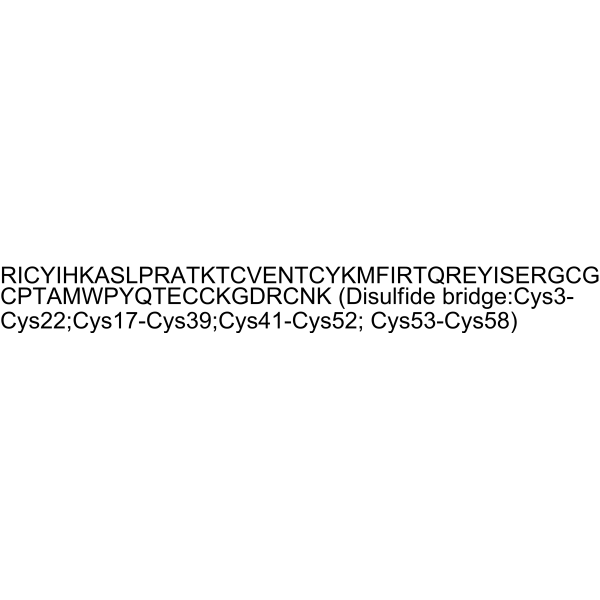
    Calciseptine is a natural polypeptide toxin found in the venom of the black mamba snake (Dendroaspis p. polylepis). Calciseptine is a highly effective and selective blocker of the L-type channel of the Cav1.2 subtype, with an IC50 value of 92 nM. Calciseptine has no effect on Cav3.1, Cav2.2, Cav2.1, Cav1.1, voltage-sensitive sodium channels and potassium channels. Calciseptine exhibits negative inotropic and negative relaxant effects on mice, and does not affect heart rate or the action potential of sinoatrial node pacemaker cells. Calciseptine can be used for research on cardiovascular diseases[1].
    Calciseptine
  • HY-151801

    mAChR Others
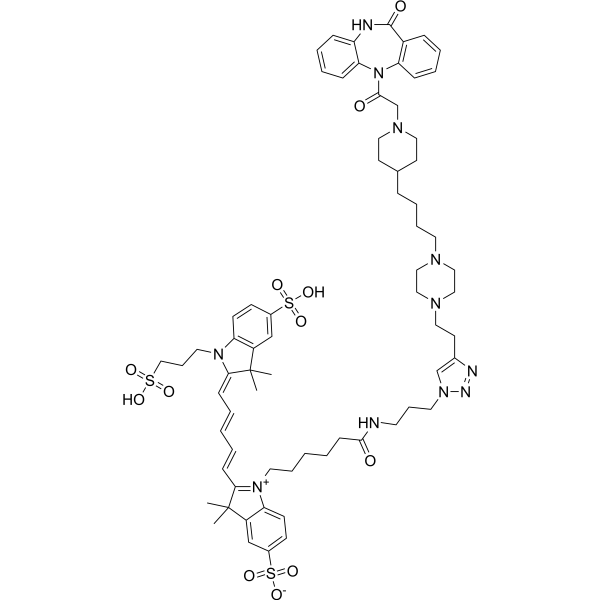
    DIBA-Cy5 is a fluorescent DIBA antagonist made up be DIBA-alkyne binding Cyanine5 fluorophores (Cy5) and polyethylene glycol (PEG) biomolecules. DIBA-Cy5 can serve as a fluorescent ligand, suitable for probe attachment through click chemistry. DIBA-Cy5 exerts a high binding affinity to type-2 mAChR (M2R) with the Kd value of 1.80 nM, can directly stain M2R receptors in the sinoatrial node of a mouse heart .
    DIBA-Cy5
  • HY-105454

    Wy-42362

    Sodium Channel Cardiovascular Disease
    Recainam (Wy-42362) is a potent orally active antiarrhythmic agent and a sodium channel inhibitor. Recainam elevates ventricular fibrillation threshold, suppresses induced cardiac dysrhythmias, and may accentuate cardiac tissue refractoriness heterogeneity. Recainam can be used for the research of arrhythmias .
    Recainam
  • HY-18940

    Cilo

    Endogenous Metabolite Cardiovascular Disease
    Cilobradine (Cilo) is a HCN channel blocker with heart rate reducing activity. Cilobradine blocks the slow inward current of human HCN1, HCN2, HCN3, and HCN4 channels. Cilobradine has a slightly higher efficiency in blocking endogenous If in mouse sinoatrial node cells (IC50 value is 0.62μM). Cilobradine can dose-dependently reduce the heart rate from 600 to 200 bpm with an ED50 value of 1.2 mg/kg. Cilobradine induces arrhythmias at doses greater than 5 mg/kg, which are characterized by periodic fluctuations between T waves and P waves .
    Cilobradine
  • HY-105454A

    Wy-42362 hydrochloride

    Sodium Channel Cardiovascular Disease
    Recainam (Wy-42362) hydrochloride is a potent orally active antiarrhythmic agent and a sodium channel inhibitor. Recainam hydrochloride elevates ventricular fibrillation threshold, suppresses induced cardiac dysrhythmias, and may accentuate cardiac tissue refractoriness heterogeneity. Recainam hydrochloride can be used for the research of arrhythmias .
    Recainam hydrochloride
  • HY-N8421

    Potassium Channel Cardiovascular Disease
    Tabernanthine is a negative chronotropic and negative inotropic agent that selectively acts on sinoatrial node receptors, regulating heart rhythm and myocardial contractility. Tabernanthine exhibits atropine resistance and direct non-cholinergic binding properties, acting directly on the sinoatrial node rather than relying on vagal nerve or cholinergic pathways to exert its key activity of slowing heart rate and weakening myocardial contractility. Tabernanthine is useful in cardiovascular pharmacology research, particularly in the areas of sinoatrial node function regulation, mechanisms related to bradycardia, and studies of cardiac receptor subtype differences .
    Tabernanthine
  • HY-P3269A

    Calcium Channel Cardiovascular Disease
    Calciseptine TFA, a polypeptide found in black mamba venom, is a selcetive Cav1.2 L-type calcium channel inhibitor with an IC50 of 92 nM. Calciseptine TFA binds to the pore domain shoulder at repeats III and IV of Cav1.2, stabilizing an inactivated conformation. Calciseptine TFA exhibits negative inotropic and negative relaxant effects on mice, and does not affect heart rate or the action potential of sinoatrial node pacemaker cells. Calciseptine TFA can be used for the research of cardiovascular diseases .
    Calciseptine TFA

Inquiry Online

Your information is safe with us. * Required Fields.

Salutation


Country or Region *

Applicant Name *


Organization Name *

Department *


Email Address *


Product Name *

Cat. No.


Requested quantity *

Phone Number *


Remarks

Inquiry Online

Inquiry Information

Product Name:
Cat. No.:
Quantity:
MCE Japan Authorized Agent:

