
1. Search Result
Search Result
Results for "

social preference

" in MedChemExpress (MCE) Product Catalog:

9

Inhibitors & Agonists

1

Peptides

2

Natural
Products

2

Isotope-Labeled Compounds

Cat. No. Product Name Target Research Areas Chemical Structure
  • HY-108677
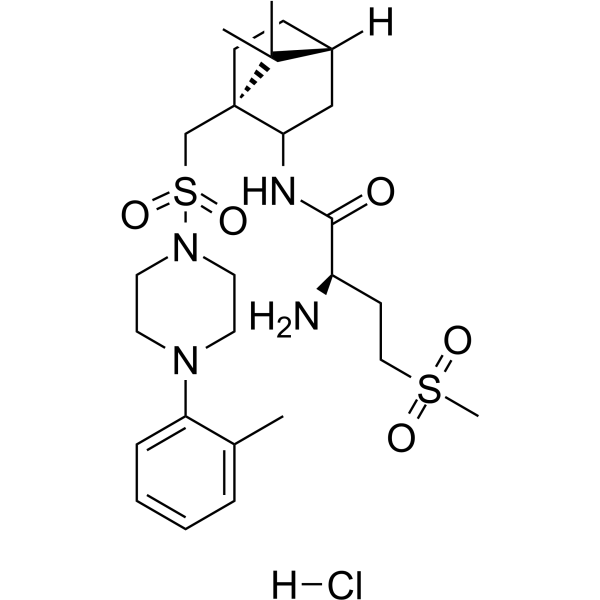
    L-368,899 hydrochloride
    5+ Cited Publications

    Oxytocin Receptor Endocrinology
    L-368,899 hydrochloride is a potent, selective, orally bioavailable, non-peptide oxytocin receptor antagonist, with IC50s of 8.9 nM and 26 nM for rat uterus and human uterus oxytocin receptor, respectively. L-368,899 hydrochloride used as a tocolytic agent .
    L-368,899 hydrochloride
  • HY-W014901

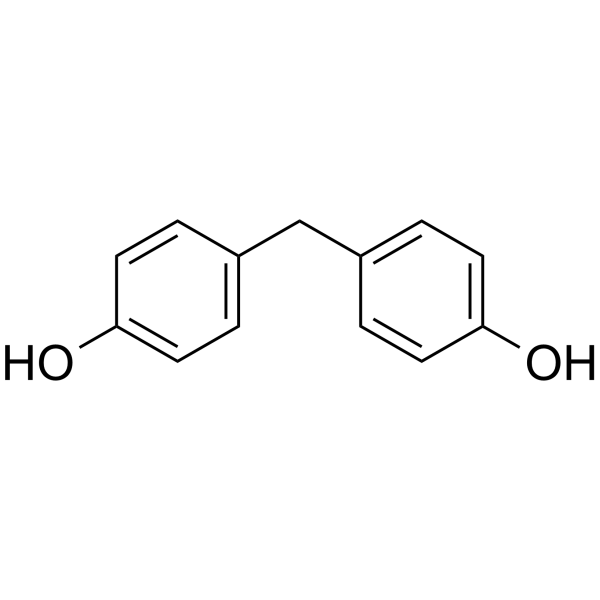
    BPF; 4,4'-Dihydroxydiphenylmethane

    Reactive Oxygen Species (ROS) Akt GSK-3 Apoptosis Cardiovascular Disease Neurological Disease Metabolic Disease Endocrinology
    Bisphenol F is an orally active endocrine disruptor. Bisphenol F promotes ROS generation, upregulates p-AKT/p-GSK3β, and induces Apoptosis. Bisphenol F interferes with glucose metabolism, affects neurodevelopment and reproductive function. Bisphenol F reduces social novelty preference in mouse offspring. Bisphenol F can be used in bone, blood, and fat-related studies. Bisphenol F is used as a substitute for Bisphenol A (HY-18260) .
    Bisphenol F
  • HY-172550

    HCN Channel Neurological Disease
    MS7710 is a hyperpolarization-activated cyclic nucleotide-gated (HCN) channel inhibitor with blood-brain barrier permeability and an excellent brain/plasma concentration ratio. MS7710 inhibits HCN channel-mediated Ih current, and reduces the firing frequency and burst activity of dopaminergic neurons in the ventral tegmental area. MS7710 ameliorates chronic social defeat stress-induced deficits in social interaction and impairments in reward-related cognitive flexibility in mice. MS7710 exerts only limited effects on ventral tegmental area dopaminergic neuron activity, social interaction, exploratory behavior, locomotor activity or sucrose preference in control mice. MS7710 is applicable to the research of major depressive disorder .
    MS7710
  • HY-P1480

    Neuropeptide Y (13-36), human

    Neuropeptide Y Receptor Neurological Disease Endocrinology
    Neuropeptide Y (13-36), amide, human is a selective neuropeptide Y2 receptor agonist .
    Neuropeptide Y (13-36), amide, human
  • HY-W014901S

    BPF-13C6; 4,4'-Dihydroxydiphenylmethane-13C6

    Isotope-Labeled Compounds Reactive Oxygen Species (ROS) Akt GSK-3 Apoptosis Cardiovascular Disease Neurological Disease Metabolic Disease Endocrinology
    Bisphenol F- 13C6 is the 13C labeled Bisphenol F (HY-W014901). Bisphenol F is an orally active endocrine disruptor. Bisphenol F promotes ROS generation, upregulates p-AKT/p-GSK3β, and induces Apoptosis. Bisphenol F interferes with glucose metabolism, affects neurodevelopment and reproductive function. Bisphenol F reduces social novelty preference in mouse offspring. Bisphenol F can be used in bone, blood, and fat-related studies. Bisphenol F is used as a substitute for Bisphenol A (HY-18260) .
    Bisphenol F-13C6
  • HY-W014901S1

    BPF-13C12; 4,4'-Dihydroxydiphenylmethane-13C12

    Isotope-Labeled Compounds Reactive Oxygen Species (ROS) Akt GSK-3 Apoptosis Cardiovascular Disease Neurological Disease Metabolic Disease Endocrinology
    Bisphenol F- 13C12 is the 13C labeled Bisphenol F (HY-W014901). Bisphenol F is an orally active endocrine disruptor. Bisphenol F promotes ROS generation, upregulates p-AKT/p-GSK3β, and induces Apoptosis. Bisphenol F interferes with glucose metabolism, affects neurodevelopment and reproductive function. Bisphenol F reduces social novelty preference in mouse offspring. Bisphenol F can be used in bone, blood, and fat-related studies. Bisphenol F is used as a substitute for Bisphenol A (HY-18260) .
    Bisphenol F-13C12
  • HY-W014901R

    BPF (Standard); 4,4'-Dihydroxydiphenylmethane (Standard)

    Reference Standards Reactive Oxygen Species (ROS) Akt GSK-3 Apoptosis Neurological Disease Metabolic Disease Endocrinology
    Bisphenol F (Standard) is the analytical standard of Bisphenol F (HY-W014901). This product is intended for research and analytical applications. Bisphenol F is an orally active endocrine disruptor. Bisphenol F promotes ROS generation, upregulates p-AKT/p-GSK3β, and induces Apoptosis. Bisphenol F interferes with glucose metabolism, affects neurodevelopment and reproductive function. Bisphenol F reduces social novelty preference in mouse offspring. Bisphenol F can be used in bone, blood, and fat-related studies. Bisphenol F is used as a substitute for Bisphenol A (HY-18260) .
    Bisphenol F (Standard)
  • HY-108677R

    Reference Standards Oxytocin Receptor Endocrinology
    L-368,899 hydrochloride (Standard) is the analytical standard of L-368,899 hydrochloride (HY-108677). This product is intended for research and analytical applications. L-368,899 hydrochloride is a potent, selective, orally bioavailable, non-peptide oxytocin receptor antagonist, with IC50s of 8.9 nM and 26 nM for rat uterus and human uterus oxytocin receptor, respectively. L-368,899 hydrochloride used as a tocolytic agent .
    L-368,899 hydrochloride (Standard)
  • HY-186170B

    5-HT Receptor Neurological Disease
    (R,S)-MDMA acts as a partial agonist of 5-HT2A, 5-HT2B and 5-HT2C receptors. (R,S)-MDMA belongs to psychoactive substances. (R,S)-MDMA exhibits antidepressant activity. (R,S)-MDMA can be used for research on mental disorders such as post-traumatic stress disorder and depression .
    (R,S)-MDMA

Inquiry Online

Your information is safe with us. * Required Fields.

Salutation


Country or Region *

Applicant Name *


Organization Name *

Department *


Email Address *


Product Name *

Cat. No.


Requested quantity *

Phone Number *


Remarks

Inquiry Online

Inquiry Information

Product Name:
Cat. No.:
Quantity:
MCE Japan Authorized Agent:

