9 Results for "

soluble phenolic

" in MedChemExpress (MCE) Product Catalog:
Products (9)

9 Results for "soluble phenolic" in MCE Product Catalog:

Cat. No.: HY-Y1885
CAS No.: 7722-88-5
Tetrasodium pyrophosphate is a water-soluble inorganic salt commonly used as a buffering agent, emulsifier, and sequestrant. Tetrasodium pyrophosphate is an antimicrobial agent that can reduce microbial colonization. Tetrasodium pyrophosphate blocks IPP translocation, enhances astaxanthin, phenol, flavonoid, and H2O2 levels, activates PAL and DPPH scavenging activity. Tetrasodium pyrophosphate can be used for the research of alleviating symptoms post COVID-19 .
loading...
    loading...
Cat. No.: HY-W115789
CAS No.: 1344-09-8
Sodium silicate is a water-soluble silicate. Sodium silicate is widely used as a binder, particularly in the production of detergents, soaps, and cleaners. Sodium silicate promotes the deposition of suberin polyphenols and lignin at wound sites of potato tubers, accelerates callus structure formation, enhances ROS production, and induces the synthesis of total phenols and flavonoids. Sodium silicate reduces the weight loss rate and disease index of wounded potato tubers during storage .
loading...
    loading...
Cat. No.: HY-P10629
CAS No.: 1092844-32-0
Target:  

Peptides

Research Areas:  

Inflammation/Immunology

PSMα2 is a potent PSM (phenol-soluble modulin) peptide toward mouse neutrophils, led to strong influx of leukocytes .
loading...
    loading...
Cat. No.: HY-P4211
Target:  

Bacterial

Research Areas:  

Infection

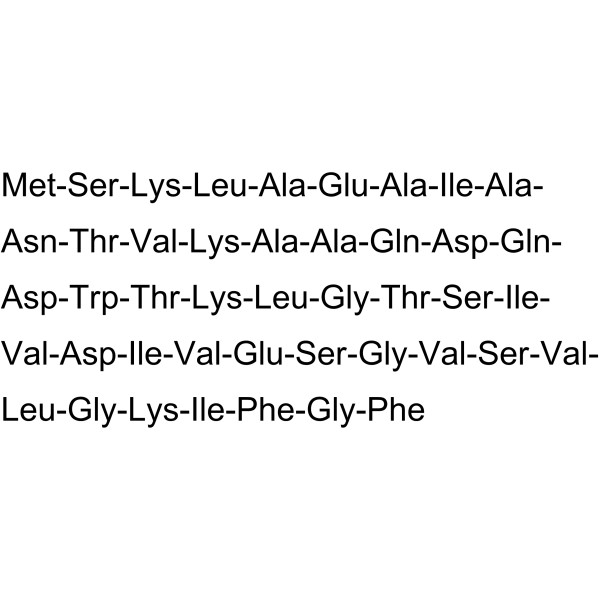
PSM-β is a active peptide , which can be isolated from Staphylococcus epidermidis. PSM-β is an analog of staphylococcal toxins, as well as a termed phenol-soluble modulin. PSM-β has bacteriostatic and poorly hemolytic properties .
loading...
    loading...
Cat. No.: HY-W009993
CAS No.: 2373-80-0
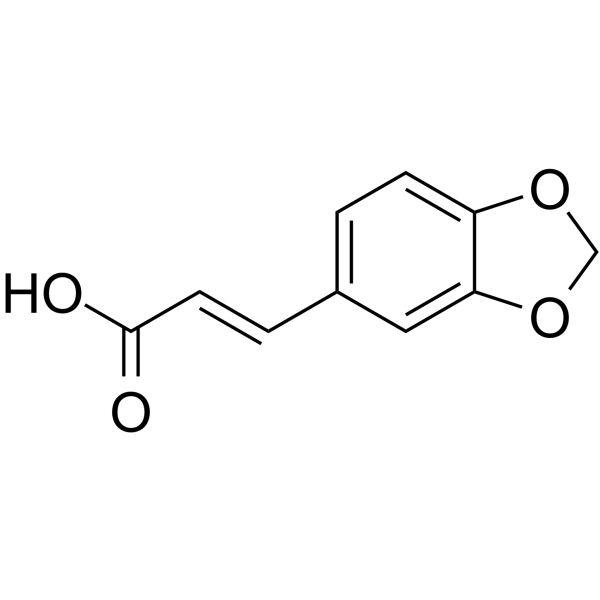
3,4-Methylenedioxycinnamic acid is an inhibitor of the 4-hydroxycinnamoyl-CoA ligase (4CL) with a Ki of 100 μM. 3,4-Methylenedioxycinnamic acid exhibits the Km value for the substrate ferulic acid of 4CL is 8.4 μM.3,4-Methylenedioxycinnamic acid increases the formation of soluble phenolics in particular of vanillic acid. 3,4-Methylenedioxycinnamic acid demonstrates larvicidal activity .
loading...
    loading...
Cat. No.: HY-P11454
CAS No.: 1708928-71-5
Target:  

Bacterial

Research Areas:  

Infection

PSM-mec peptide is a peptide toxin belonging to the phenol-soluble modulin (PSM) superfamily. PSM-mec peptide is encoded by the psm-mec gene and associated with the methicillin resistance gene element (SCCmec). PSM-mec peptide has pro-inflammatory, cytolytic functions and the role of regulating the structure of biofilms. PSM-mec peptide can be mainly used for the pathogenic mechanism and drug resistance research of canine pseudo-intermediate Staphylococcus (S. pseudintermedius) related infections and zoonotic diseases .
loading...
    loading...
Cat. No.: HY-W009993R
CAS No.: 2373-80-0
3,4-Methylenedioxycinnamic acid (Standard) is the analytical standard of 3,4-Methylenedioxycinnamic acid (HY-W009993). This product is intended for research and analytical applications. 3,4-Methylenedioxycinnamic acid is an inhibitor of the 4-hydroxycinnamoyl-CoA ligase (4CL) with a Ki of 100 μM. 3,4-Methylenedioxycinnamic acid exhibits the Km value for the substrate ferulic acid of 4CL is 8.4 μM.3,4-Methylenedioxycinnamic acid increases the formation of soluble phenolics in particular of vanillic acid. 3,4-Methylenedioxycinnamic acid demonstrates larvicidal activity .
loading...
    loading...
Cat. No.: HY-N17650
CAS No.: 3038746-92-5
Salviamarinic acid A is a water-soluble phenolic acid that can be extracted from Salvia miltiorrhiza with potent anti-pulmonary fibrosis activity. Salviamarinic acid A significantly increases cell viability, cell index, cell motility and E-cadherin expression, and reduces TGF-β1, α-SMA and Collagen I levels. Salviamarinic acid A can be used for pulmonary fibrosis research .
loading...
    loading...
Cat. No.: HY-L021P
6,287 compounds

Natural products are small molecules produced naturally by any organism including primary and secondary metabolites. Natural sources may lead to basic research on potential bioactive components for commercial development as lead compounds in drug discovery.

Nature has been a source of medicinal agents for thousands of years, and an impressive number of modern drugs have been isolated from natural sources, many based on their use in traditional medicine. With the development of new molecular targets, there is an increasing demand for novel molecular diversity for screening. Natural products will play a crucial role in meeting this demand through the continued investigation of world’s bio-diversity, much of which remains unexplored.

MCE provides a unique collection of 6,287 natural compounds that contains Saccharides and Glycosides, Phenylpropanoids, Quinones, Flavonoids, Terpenoids and Glycosides, Steroids, Alkaloid, Phenols, Acids and Aldehydes. Natural Product Library Plus, with more powerful screening capability, further complements Natural Product Library (HY-L021) by adding some compounds with low solubility or solution stability (Part B) to this library. All those supplementary are supplied in powder form.

