



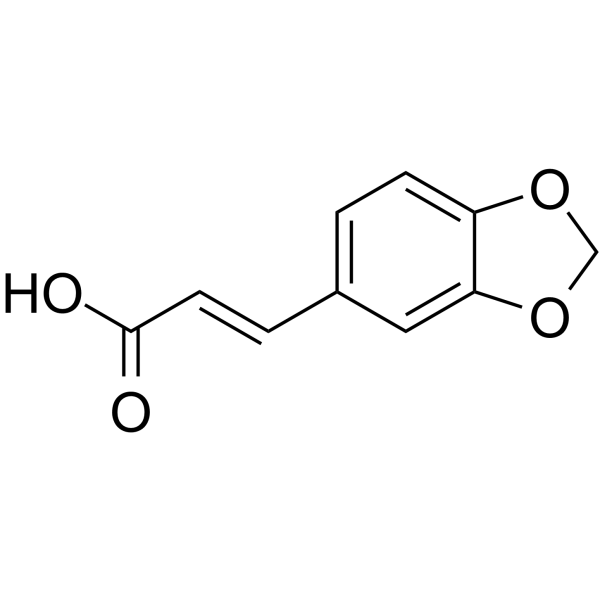
3,4-Methylenedioxycinnamic acid

Based on 1 Customer Validation
3,4-Methylenedioxycinnamic acid is an inhibitor of the 4-hydroxycinnamoyl-CoA ligase (4CL) with a Ki of 100 μM. 3,4-Methylenedioxycinnamic acid exhibits the Km value for the substrate ferulic acid of 4CL is 8.4 μM.3,4-Methylenedioxycinnamic acid increases the formation of soluble phenolics in particular of vanillic acid. 3,4-Methylenedioxycinnamic acid demonstrates larvicidal activity.
For research use only. We do not sell to patients.
- Purity : 99.70%
- CAS No.: 2373-80-0
- Formula: C10H8O4
- Molecular Weight:192.17
-
Storage:Powder -20°C, 3 years , 4°C, 2 years ; In solvent -80°C, 6 months , -20°C, 1 month

To place orders, for customer services and technical support, please contact: MedChemExpress USA
Tel: 609-228-6898 E-mail: [email protected] [email protected]


-
 Biological Activity
-
Chemical Information
-
Solvent & Solubility
- Purity & Documentation
- References
-
 Help & FAQs



All Parasite Isoforms
More

Biological Activity
Description
Cellular Effect
|
Cell Line

|
Type | Value | Description | References |
|---|---|---|---|---|
| HeLa | IC50 |
>30 μM
Compound: 7
|
Inhibition of proteasomal turnover of p97-independent ODD-luciferase reporter substrate in human HeLa cells incubated for 120 mins by luciferase reporter gene assay
Inhibition of proteasomal turnover of p97-independent ODD-luciferase reporter substrate in human HeLa cells incubated for 120 mins by luciferase reporter gene assay
|
[PMID: 33476933] |
| HepG2 2.2.15 | CC50 |
503.46 μM
Compound: 2c
|
Cytotoxicity against human HepG2.2.15 cells assessed as cell death after 9 days by MTT assay
Cytotoxicity against human HepG2.2.15 cells assessed as cell death after 9 days by MTT assay
|
[PMID: 25847765] |
| HepG2 2.2.15 | IC50 |
433.15 μM
Compound: 2c
|
Antiviral activity against Hepatitis B virus infected in human HepG2.2.15 cells assessed as inhibition of HBsAg secretion by ELISA
Antiviral activity against Hepatitis B virus infected in human HepG2.2.15 cells assessed as inhibition of HBsAg secretion by ELISA
|
[PMID: 25847765] |
| HepG2 2.2.15 | IC50 |
526.25 μM
Compound: 2c
|
Antiviral activity against Hepatitis B virus infected in human HepG2.2.15 cells assessed as inhibition of HBeAg secretion by ELISA
Antiviral activity against Hepatitis B virus infected in human HepG2.2.15 cells assessed as inhibition of HBeAg secretion by ELISA
|
[PMID: 25847765] |
| MDCK | EC50 |
>100000 nM
Compound: MCA
|
Antiviral activity against Influenza A virus (A/WSN/1933(H1N1)) infected in MDCK cells assessed as inhibition of virus induced cytopathic effect
Antiviral activity against Influenza A virus (A/WSN/1933(H1N1)) infected in MDCK cells assessed as inhibition of virus induced cytopathic effect
|
[PMID: 22963087] |
| MT4 | CC50 |
>90 μM
Compound: 12c
|
Cytotoxicity against human MT4 cells assessed as reduction in cell viability after 2 days by CytoTox-Glo assay
Cytotoxicity against human MT4 cells assessed as reduction in cell viability after 2 days by CytoTox-Glo assay
|
[PMID: 27676157] |
| MT4 | IC50 |
>90 μM
Compound: 12c
|
Antiviral activity against wild type HIV1 NL4-3 infected in human MT4 cells by p24 ELISA
Antiviral activity against wild type HIV1 NL4-3 infected in human MT4 cells by p24 ELISA
|
[PMID: 27676157] |
| Oocyte | IC50 |
28.8 μM
Compound: 3,4-OCH2O-Cin-COOH
|
Antagonist activity at Gloeobacter violaceus ligand-gated ion channel expressed in Xenopus oocytes assessed as inhibition of MES buffer pH 5.5 -induced currents after 30 secs by voltage clamp technique
Antagonist activity at Gloeobacter violaceus ligand-gated ion channel expressed in Xenopus oocytes assessed as inhibition of MES buffer pH 5.5 -induced currents after 30 secs by voltage clamp technique
|
[PMID: 23682762] |
| RAW264.7 | GI50 |
2774 μM
Compound: 1e
|
Cytotoxicity against mouse RAW264.7 cells assessed as growth inhibition after 48 hrs by trypan blue assay
Cytotoxicity against mouse RAW264.7 cells assessed as growth inhibition after 48 hrs by trypan blue assay
|
10.1039/C3MD00251A |
In Vitro
3,4-Methylenedioxycinnamic acid (1-1000 μM, 24 h) exhibits LC50 and LC90 values of 28.9 and 162.7 μM against Aedes aegypti, respectively[2].
3,4-Methylenedioxycinnamic acid (5.2-5200 μM, 1-24 h) does not exhibit acetylcholinesterase inhibitory activity and is not cytotoxic to PBMCs[2].
MedChemExpress (MCE) has not independently confirmed the accuracy of these methods. They are for reference only.
In Vivo
MedChemExpress (MCE) has not independently confirmed the accuracy of these methods. They are for reference only.
-
Animal Model:Acute oral toxicity established in female Swiss mice (8 weeks old, weighing 35 g)[2]
-
Dosage:2000 mg/kg
-
Administration:Oral administration (p.o.), single dose
-
Result:Observed mild central nervous system (CNS) excitatory effect and mild CNS inhibitory effect at 30 minutes after the initial administration.
Observed no effect on the autonomic nervous system (ANS).
Showed no structural signs of toxicity in the histological analysis of the kidneys, liver, spleen, and lungs.
Caused only slight increases in all renal (BUN, creatinine) and hepatic (AST, ALT) serum biochemical parameters.


Chemical Information
-
CAS No. 2373-80-0
-
Appearance Solid
-
Molecular Weight 192.17
-
Formula C10H8O4
-
Color Off-white to light yellow
-
SMILES
O=C(O)/C=C/C1=CC=C(OCO2)C2=C1
-
Structure Classification
-
Initial Source
-
Shipping
Room temperature in continental US; may vary elsewhere.
-
Storage
Powder -20°C 3 years 4°C 2 years In solvent -80°C 6 months -20°C 1 month


Solvent & Solubility
In Vitro:
DMSO : ≥ 100 mg/mL (520.37 mM; Hygroscopic DMSO has a significant impact on the solubility of product, please use newly opened DMSO)
* "≥" means soluble, but saturation unknown.
Please refer to the solubility information to select the appropriate solvent. Once prepared, please aliquot and store the solution to prevent product inactivation from repeated freeze-thaw cycles.
Storage method and period of stock solution: -80°C, 6 months; -20°C, 1 month. When stored at -80°C, please use it within 6 months. When stored at -20°C, please use it within 1 month.
Please refer to the solubility information to select the appropriate solvent. Once prepared, please aliquot and store the solution to prevent product inactivation from repeated freeze-thaw cycles.
Storage method and period of stock solution: -80°C, 6 months; -20°C, 1 month. When stored at -80°C, please use it within 6 months. When stored at -20°C, please use it within 1 month.
Concentration (start) × Volume (start) = Concentration (final) × Volume (final)
In Vivo:
Select the appropriate dissolution method based on your experimental animal and administration route.
- For the following dissolution methods, please ensure to first prepare a clear stock solution using an In Vitro approach and then sequentially add co-solvents:
- To ensure reliable experimental results, the clarified stock solution can be appropriately stored based on storage conditions. As for the working solution for In Vivo experiments, it is recommended to prepare freshly and use it on the same day.
- The percentages shown for the solvents indicate their volumetric ratio in the final prepared solution. If precipitation or phase separation occurs during preparation, heat and/or sonication can be used to aid dissolution.
Add each solvent one by one: 10% DMSO 40% PEG300 5% Tween-80 45% Saline
Solubility: ≥ 1 mg/mL (5.20 mM); Clear solution
This protocol yields a clear solution of ≥ 1 mg/mL (saturation unknown).
Taking 1 mL working solution as an example, add 100 μL DMSO stock solution (10.0 mg/mL) to 400 μL PEG300, and mix evenly; then add 50 μL Tween-80 and mix evenly; then add 450 μL Saline to adjust the volume to 1 mL.
Preparation of Saline: Dissolve 0.9 g sodium chloride in ddH₂O and dilute to 100 mL to obtain a clear Saline solution.
In Vivo Dissolution Calculator
Please enter the basic information of animal experiments:
-
-
-
-
Recommended: Prepare an additional quantity of animals to account for potential losses during experiments.
Please enter your animal formula composition:
-
%DMSO +
Recommended: Keep the proportion of DMSO in working solution below 2% if your animal is weak.
-
%+
-
+%Tween-80 + +
-
%Saline +
The co-solvents required include: DMSO, . All of co-solvents are available by MedChemExpress (MCE). , Tween 80. All of co-solvents are available by MedChemExpress (MCE).
Working solution concentration: 0.22 mg/mL
Method for preparing stock solution: mg drug dissolved in μL DMSO. Stock solution concentration: mg/mL.
1. Take μL DMSO stock solution;
2. Add μL .
μL , mix evenly;
3. Then add μL Tween 80, mix evenly;
4. Then add μL
Please ensure that the stock solution in the first step is dissolved to a clear state, and add co-solvents in sequence. You can use ultrasonic heating (ultrasonic cleaner, recommended frequency 20-40 kHz), vortexing, etc. to assist dissolution.


Purity & Documentation
-
Data Sheet (273 KB)
-
SDS (393 KB)
- English - EN (393 KB)
- Français - FR (393 KB)
- Deutsch - DE (393 KB)
- Norwegian - NO (393 KB)
- Español - ES (393 KB)
- Swedish - SV (393 KB)
- Italian - IT (393 KB)
- Korean - KR (393 KB)
- Portuguese - PT (393 KB)
-
Handling Instructions (2659 KB)
References
[1]. Funk C, Brodelius PE. Phenylpropanoid Metabolism in Suspension Cultures of Vanilla planifolia Andr. : II. Effects of Precursor Feeding and Metabolic Inhibitors. Plant Physiol. 1990 Sep;94(1):95-101. [Content Brief]
[2]. Silva MSL, et al. Biological evaluation of 1,3-benzodioxole acids points to 3,4-(methylenedioxy) cinnamic acid as a potential larvicide against Aedes aegypti (Diptera: Culicidae). Exp Parasitol. 2024 Jan;256:108657. [Content Brief]


Complete Stock Solution Preparation Table
Please refer to the solubility information to select the appropriate solvent. Once prepared, please aliquot and store the solution to prevent product inactivation from repeated freeze-thaw cycles.
Storage method and period of stock solution: -80°C, 6 months; -20°C, 1 month. When stored at -80°C, please use it within 6 months. When stored at -20°C, please use it within 1 month.
| Optional Solvent | Concentration Solvent Mass | 1 mg | 5 mg | 10 mg | 25 mg |
|---|---|---|---|---|---|
| DMSO | 1 mM | 5.2037 mL | 26.0186 mL | 52.0373 mL | 130.0931 mL |
| 5 mM | 1.0407 mL | 5.2037 mL | 10.4075 mL | 26.0186 mL | |
| 10 mM | 0.5204 mL | 2.6019 mL | 5.2037 mL | 13.0093 mL | |
| 15 mM | 0.3469 mL | 1.7346 mL | 3.4692 mL | 8.6729 mL | |
| 20 mM | 0.2602 mL | 1.3009 mL | 2.6019 mL | 6.5047 mL | |
| 25 mM | 0.2081 mL | 1.0407 mL | 2.0815 mL | 5.2037 mL | |
| 30 mM | 0.1735 mL | 0.8673 mL | 1.7346 mL | 4.3364 mL | |
| 40 mM | 0.1301 mL | 0.6505 mL | 1.3009 mL | 3.2523 mL | |
| 50 mM | 0.1041 mL | 0.5204 mL | 1.0407 mL | 2.6019 mL | |
| 60 mM | 0.0867 mL | 0.4336 mL | 0.8673 mL | 2.1682 mL | |
| 80 mM | 0.0650 mL | 0.3252 mL | 0.6505 mL | 1.6262 mL | |
| 100 mM | 0.0520 mL | 0.2602 mL | 0.5204 mL | 1.3009 mL |


3,4-Methylenedioxycinnamic acid Related Classifications
HY-W009993 Related Classifications
 Powered by Bioz