




26 Results for "

thermostability

" in MedChemExpress (MCE) Product Catalog:
Products (26)

26 Results for "thermostability" in MCE Product Catalog:

3
3 Cited Publications
Cat. No.: HY-P1748
CAS No.: 9073-78-3
Synonyms: EC 3.4.24.27; TML
Research Areas:  

Others

Thermolysin, Bacillus thermoproteolyticus rokko (EC 3.4.24.27) (TML) is a thermostable neutral metalloproteinase enzyme secreted by the Gram-positive bacteria Bacillus thermoproteolyticus. Thermolysin catalyzes the hydrolysis of peptide bonds containing hydrophobic residues .

Optimal pH: 8.0. Considerably stable from pH 5 to 9.5.
Optimal temperature : 70 °C
loading...
    loading...
Cat. No.: HY-E70086
CAS No.: 2304873-37-6
Target:  

DNA/RNA Synthesis

Research Areas:  

Infection

Taq DNA polymerase is a thermostable DNA polymerase that can be used in PCR .
loading...
    loading...
Cat. No.: HY-169947
CAS No.: 2648334-53-4
Target:  

CDK

Research Areas:  

Cancer

DDO-6079 is a potent CDC37 inhibitor. DDO-6079 inhibits HSP90-CDC37 and CDC37-CDK4/6 chaperone complex by binding to an allosteric site on CDC37. DDO-6079 decreases the thermostability of CDK6 .
loading...
    loading...
Cat. No.: HY-12400
CAS No.: 2135595-04-7
Purity:  99.75%
Target:  

Akt

Research Areas:  

Cancer

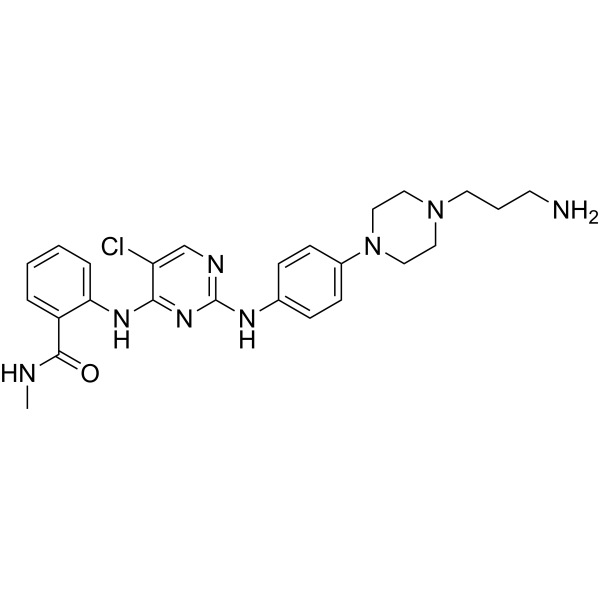
GSK3182571 is a non-selective broad-spectrum kinase inhibitor with similar structure to CTx-0294885 (HY-15985). GSK3182571 can induce changes in the thermostability of target proteins in cells. GSK3182571 can be used to explore the effects of drugs on kinase networks and off-target effects in leukemia cell models .
loading...
    loading...
Cat. No.: HY-E70376
CAS No.: 2304873-45-6
Target:  

DNA/RNA Synthesis

Research Areas:  

Others

Pfu DNA Polymerase is an important enzyme in PCR-related experiments, which is initially found in Pyrococcus furiosus. Pfu DNA Polymerase exhibits thermostability and high fidelity .
loading...
    loading...
Cat. No.: HY-157524
CAS No.: 82188-61-2
Purity:  ≥98.0%
Research Areas:  

Others

1,2-O-Dioctadecyl-sn-glycerol (Compound 7b) is a lipid molecule that can be used to synthesize thermostable lipid nanoparticle .
loading...
    loading...
Cat. No.: HY-P2769A
CAS No.: 37288-57-6
Research Areas:  

Others

Thermostable β-Agarase is a hydrolase that can hydrolyze the β-1,4 linkages in agarose to produce neoagaro-oligosaccharides, and it can be used to extract DNA and RNA from gels. Compared to conventional β-Agarase, Thermostable β-Agarase exhibits higher heat resistance and stronger hydrolytic activity. The thermostable properties of Thermostable β-Agarase simplify experimental procedures and make it suitable for the rapid purification of intact large DNA molecules .
loading...
    loading...
Cat. No.: HY-B2220B
CAS No.: 9012-54-8
Research Areas:  

Others

Thermostable cellulase recombinant is a cellulose hydrolase present in hyperthermophiles, which catalyzes the hydrolysis of β-1,4 glycosidic bonds in cellulose. Thermostable cellulase recombinant targets carboxymethyl cellulose (CMC) as its primary substrate, and retains high residual activity even after incubation at high temperatures. The activity of Thermostable cellulase recombinant is inhibited by ionic and non-ionic detergents, and can be enhanced by cobalt ions. Thermostable cellulase recombinant can be applied in the paper industry .
loading...
    loading...
Cat. No.: HY-P4984
CAS No.: 137593-46-5
Target:  

Endogenous Metabolite

Research Areas:  

Infection

Toxic Shock Syndrome Toxin-1 (TSST-1) (58-78) is a superantigen exotoxin produced by Staphylococcus aureus. Toxic Shock Syndrome Toxin-1 (TSST-1) (58-78) binds to TCR and MHC II outside the antigen-presenting site, thereby inducing unconventional polyclonal lymphocyte activation, excessive cytokine production, rapid shock, multiple organ failure syndrome and even death. Toxic Shock Syndrome Toxin-1 (TSST-1) (58-78) exacerbates mammary gland inflammation and further induces mastitis. Toxic Shock Syndrome Toxin-1 (TSST-1) (58-78) is thermostable and can be transmitted to humans via food, causing toxic shock syndrome. Toxic Shock Syndrome Toxin-1 (TSST-1) (58-78) can be used in studies related to toxic shock syndrome and staphylococcal food poisoning .
loading...
    loading...
Cat. No.: HY-P2917B
CAS No.: 9030-66-4
Synonyms: GyK, Flavobacterium meningosepticum
Target:  

Endogenous Metabolite

Research Areas:  

Metabolic Disease

Glycerol kinase, Flavobacterium meningosepticum (GyK, Flavobacterium meningosepticum) is a thermostable glycerol kinase isolated from Flavobacterium meningosepticum. Glycerol kinase, Flavobacterium meningosepticum catalyzes the first step in glycerol metabolism by converting triol to glycerol-3-p (G3P). Glycerol kinase, Flavobacterium meningosepticum is essential for regulating glycerol uptake in cells that is independent of channels or facilitators and is useful for biochemical studies .
loading...
    loading...
Cat. No.: HY-E70379
Target:  

DNA/RNA Synthesis

Research Areas:  

Others

Tte UvrD Helicase is a thermostable UvrD helicase initially isolated from Thermoanaerobacter tengcongensis. Tte UvrD Helicase can unwind DNA duplexes with 3’ or 5’ single-stranded DNA tails, and DNA substrates with blunt ends .
loading...
    loading...
Cat. No.: HY-E70087
Target:  

DNA/RNA Synthesis

Research Areas:  

Others

Taq DNA polymerase 2.0 is a thermostable DNA polymerase that can be used in PCR .
loading...
    loading...
Cat. No.: HY-E70086A
CAS No.: 2304873-37-6
Target:  

DNA/RNA Synthesis

Research Areas:  

Others

Taq DNA Polymerase, Glycerol-free is a thermostable DNA polymerase that can be used in PCR .
loading...
    loading...
Cat. No.: HY-171035
CAS No.: 2377770-85-7
PRL-295 is an orally active inhibitor targeting Keap1-Nrf2 interaction. PRL-295 increases the thermal stability of Keap1 and disrupts its interaction with Nrf2, thereby activating the Nrf2-dependent transcriptional target NAD(P)H:quinone oxidoreductase 1 (NQO1). PRL-295 protects against Acetaminophen (HY-66005)-induced liver injury in mice .
loading...
    loading...
Cat. No.: HY-116559
CAS No.: 1196457-06-3
Purity:  99.62%
Target:  

RIO Kinase

Research Areas:  

Others

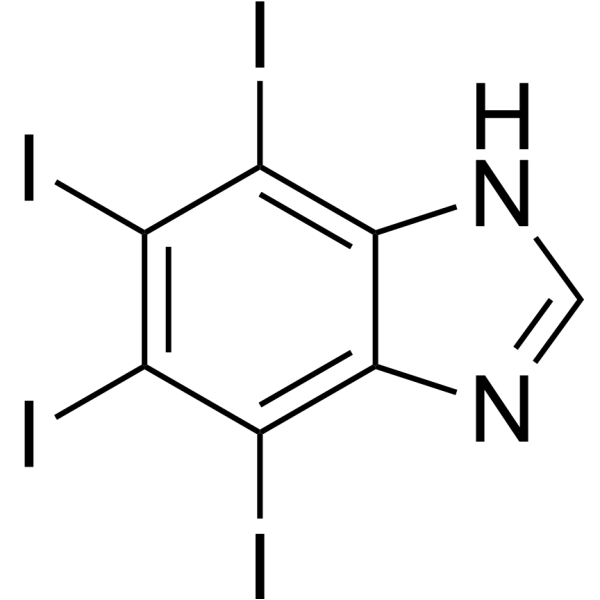
TIBI is a potent and ATP-competitive inhibitor of Rio1 (IC50: 0.09 μM, Ki: 0.05 μM). TIBI enhances the thermostability of the enzyme Rio1 .
loading...
    loading...
Cat. No.: HY-154871
CAS No.: 2152-75-2
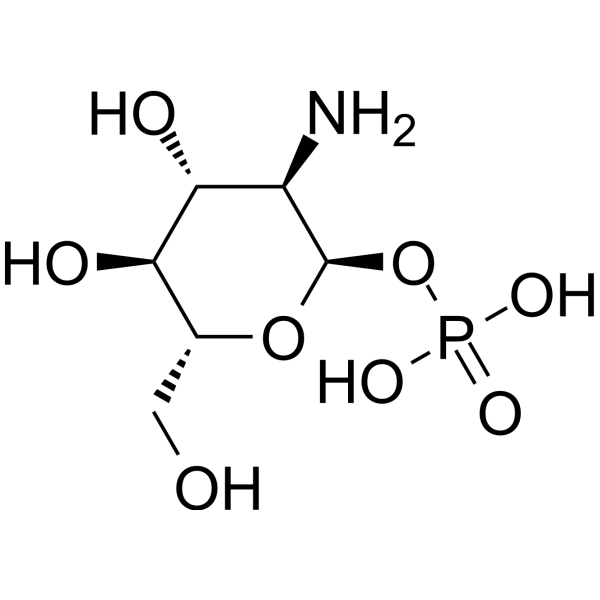
α-D-Glucosamine 1-phosphate is a glycosyl donor analog of Glc-1-P. α-D-Glucosamine 1-phosphate acts as a glycosyl donor to produce α(1→4)-linked glucosamine chains in the enzyme-catalyzed polymerization reaction mediated by thermostable α-glucan phosphorylase. α-D-Glucosamine 1-phosphate serves as a glycosyl donor analog to generate a pentasaccharide with a glucosamine residue at the non-reducing end in the maltotetraose glucosamination reaction catalyzed by potato α-glucan phosphorylase. α-D-Glucosamine 1-phosphate is used for the synthesis of amphiphilic block polysaccharides with pH-responsive assembly/disassembly properties .
loading...
    loading...
Cat. No.: HY-P2937A
Target:  

DNA/RNA Synthesis

Research Areas:  

Others

DNA polymerase, NeoApollonia Thermophilus is a thermostable DNA polymerase from Streptococcus thermophilus that can be used in PCR reactions. DNA polymerase, NeoApollonia Thermophilus has 3’→5’ and 5’→3’ exonuclease activities.
loading...
    loading...
Cat. No.: HY-E70400
Target:  

DNA/RNA Synthesis

Research Areas:  

Infection

Thermostable T7 RNA Polymerase is a thermostable version of T7 RNA Polymerase (HY-E70090). Compared with T7 RNA Polymerase, it has high temperature resistance and stable activity. T7 RNA polymerase is a polymerase expressed by Escherichia coli from the RNA polymerase gene of T7 bacteriophage. T7 RNA polymerase is highly specific and involved in in vitro transcription (IVT) of mRNA. In the presence of Mg 2+, T7 RNA polymerase only uses the single-stranded or double-stranded DNA containing the T7 promoter sequence as a template, and uses NTP as a substrate to synthesize RNA complementary to the single-stranded DNA downstream of the promoter .
loading...
    loading...
Cat. No.: HY-P2763A
Target:  

Glycosidase

Research Areas:  

Metabolic Disease

β-Glucanase 2(thermostable) is a glucosidase enzyme located in on the brush border of the small intestine that acts upon β1->4 bonds linking two glucose or glucose-substituted molecules (i.e., the disaccharide cellobiose). β-Glucanase 2 (thermostable) is an exocellulase with specificity for a variety of beta-D-glycoside substrates. It catalyzes the hydrolysis of terminal non-reducing residues in beta-D-glucosides with release of glucose.
loading...
    loading...
Cat. No.: HY-P2763B
Target:  

Glycosidase

Research Areas:  

Metabolic Disease

β-Glucanase 1(thermostable) is a glucosidase enzyme located in on the brush border of the small intestine that acts upon β1->4 bonds linking two glucose or glucose-substituted molecules (i.e., the disaccharide cellobiose). β-Glucanase 1 (thermostable) is an exocellulase with specificity for a variety of beta-D-glycoside substrates. It catalyzes the hydrolysis of terminal non-reducing residues in beta-D-glucosides with release of glucose.
loading...
    loading...

