10 Results for "

transferrin uptake

" in MedChemExpress (MCE) Product Catalog:
Products (10)

10 Results for "transferrin uptake" in MCE Product Catalog:

1
1 Cited Publications
Cat. No.: HY-131683
CAS No.: 55854-43-8
Purity:  99.87%
Target:  

Dynamin Clathrin

Research Areas:  

Others

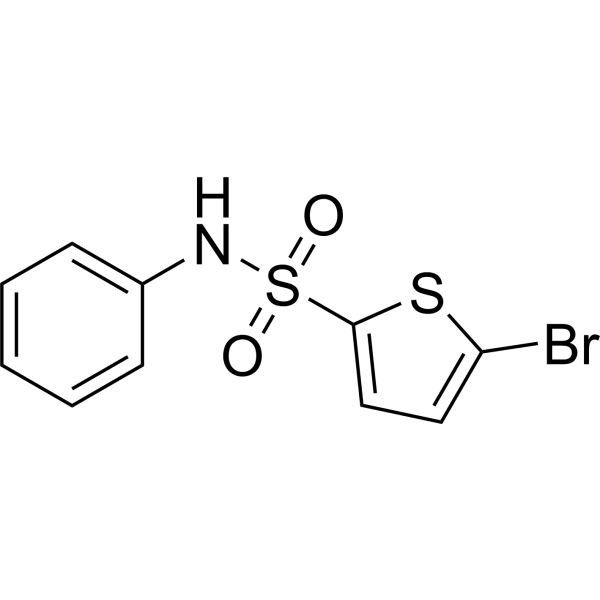
ES9-17 is an analog of ES9 (endosidin9), which is an inhibitor of clathrin heavy chain (CHC). ES9-17 is an inhibitor of clathrin-mediated endocytosis (CME), a major route for internalization of plasma membrane proteins and molecules from the extracellular environment in plants. ES9-17 inhibits the uptake of transferrin and FM4-64. ES9-17 also inhibits root growth of Arabidopsis seedings .
loading...
    loading...
Cat. No.: HY-P991381
Synonyms: PPMX-T003; TSP-A18
JST‑TfR09 (PPMX‑T003) is a human monoclonal antibody (mAb) targeting transferrin receptor 1 (TfR1/CD71). JST‑TfR09 blocks the binding of transferrin to TfR1, inhibits TfR1 internalization, and suppresses cellular iron uptake. JST‑TfR09 triggers ferritin degradation via activating the autolysosomal system, promotes ROS production and lipid peroxidation, and ultimately induces ferroptosis. JST‑TfR09 exhibits cytotoxicity toward human erythroblasts differentiated from hematopoietic stem cells. JST-TfR09 can be used in leukemia research. Recommended isotype control: Human IgG1 lambda, Isotype Control (HY-P99992) .
loading...
    loading...
Cat. No.: HY-168943
PLGA nanoparticles, 100nm, are biodegradable tumor-targeting nanocarriers that can serve as drug delivery enhancers and multidrug resistance inhibitors. PLGA nanoparticles, 100nm, passively enriched through the EPR effect and actively targeted via ligand-mediated endocytosis, can encapsulate various antitumor active molecules. PLGA nanoparticles, 100nm can specifically recognize multiple types of tumor cells and improve cellular uptake, cytotoxicity and antiproliferative effects after modification with ligands such as transferrin, folic acid, and RGD. PLGA nanoparticles, 100nm can encapsulate various therapeutic drugs and can be surface modified to achieve targeting, imaging, and prolonged circulation time, making them suitable for cancer-related research .
loading...
    loading...
Cat. No.: HY-186018
Target:  

Clathrin VSV

Research Areas:  

Infection

Pitstop 2d is a clathrin (Clathrin) terminal domain (TD) inhibitor with an IC50 of 1.7 μM. Pitstop 2d occupies the Clathrin box binding site within the clathrin TD, blocking the binding of endocytic protein ligands such as Epsin to clathrin. Pitstop 2d inhibits clathrin-mediated endocytosis (Endocytosis) and the cellular entry of vesicular stomatitis virus (VSV). Pitstop 2d has low cytotoxicity, does not disrupt the nuclear permeability barrier, and does not inhibit clathrin-independent endocytosis. Pitstop 2d can be used in studies related to endocytosis and vesicular stomatitis virus infection .
loading...
    loading...
Cat. No.: HY-168943A
PLGA nanoparticles, 200nm, are biodegradable tumor-targeting nanocarriers that can serve as drug delivery enhancers and multidrug resistance inhibitors. PLGA nanoparticles, 200nm, passively enriched through the EPR effect and actively targeted via ligand-mediated endocytosis, can encapsulate various antitumor active molecules. PLGA nanoparticles, 200nm can specifically recognize multiple types of tumor cells and improve cellular uptake, cytotoxicity and antiproliferative effects after modification with ligands such as transferrin, folic acid, and RGD. PLGA nanoparticles, 200nm can encapsulate various therapeutic drugs and can be surface modified to achieve targeting, imaging, and prolonged circulation time, making them suitable for cancer-related research .
loading...
    loading...
Cat. No.: HY-168943B
PLGA nanoparticles, 500nm, are biodegradable tumor-targeting nanocarriers that can serve as drug delivery enhancers and multidrug resistance inhibitors. PLGA nanoparticles, 500nm, passively enriched through the EPR effect and actively targeted via ligand-mediated endocytosis, can encapsulate various antitumor active molecules. PLGA nanoparticles, 500nm can specifically recognize multiple types of tumor cells and improve cellular uptake, cytotoxicity and antiproliferative effects after modification with ligands such as transferrin, folic acid, and RGD. PLGA nanoparticles, 500nm can encapsulate various therapeutic drugs and can be surface modified to achieve targeting, imaging, and prolonged circulation time, making them suitable for cancer-related research .
loading...
    loading...
Cat. No.: HY-168943C
PLGA nanoparticles, 1μm, are biodegradable tumor-targeting nanocarriers that can serve as drug delivery enhancers and multidrug resistance inhibitors. PLGA nanoparticles, 1μm, passively enriched through the EPR effect and actively targeted via ligand-mediated endocytosis, can encapsulate various antitumor active molecules. PLGA nanoparticles, 1μm can specifically recognize multiple types of tumor cells and improve cellular uptake, cytotoxicity and antiproliferative effects after modification with ligands such as transferrin, folic acid, and RGD. PLGA nanoparticles, 1μm can encapsulate various therapeutic drugs and can be surface modified to achieve targeting, imaging, and prolonged circulation time, making them suitable for cancer-related research .
loading...
    loading...
Cat. No.: HY-D3122
Target:  

Fluorescent Dye

Research Areas:  

Others

Mem-RhoNox is a fluorescent probe used to detect labile Fe (II) on the plasma membrane surface and inside endosomes during iron uptake in live cells. Mem-RhoNox can anchor to the extracellular surface of the plasma membrane; upon contact with Fe (II), its N-oxide group undergoes a deoxygenation reaction, converting weakly fluorescent Mem-RhoNox into strongly fluorescent Mem-Rhodamine. During transferrin-mediated endocytosis, Mem-RhoNox enters endosomes together with the transferrin-transferrin receptor complex, and reacts with Fe (II) released by transferrin to enable detection of endosomal Fe (II) .
loading...
    loading...
Cat. No.: HY-P11918
CAS No.: 2350190-98-4
Target:  

Transferrin Receptor

Research Areas:  

Neurological Disease

D-T7 is a transferrin receptor (TfR) binding peptide that mediates brain-targeted delivery. D-T7 acts as a penetration enhancer and uptake promoter for nanoparticles in glioma tissues and target cells. D-T7 can be used in glioma research .
loading...
    loading...
Cat. No.: HY-181953
CAS No.: 2196106-61-1
STIM1-TFR1-IN-1 is an orally active stromal interaction molecule 1 (STIM1)-transferrin receptor 1 (TFR1) protein complex inhibitor with a Kd of 2.18 μM for STIM1-CD protein. STIM1-TFR1-IN-1 blocks STIM1-TFR1 interaction and reduce TFR1-mediated iron uptake activity. STIM1-TFR1-IN-1 inhibits ferroptosis, lipid peroxidation and ROS production, enhances glutathione peroxidase 4 (GPX4) activity and glutathione/oxidized glutathione ratio, and rescues ferroptosis-associated mitochondrial morphological changes. STIM1-TFR1-IN-1 exhibits neuroprotective
effects and reduces brain injury. STIM1-TFR1-IN-1 can be used for the research of intracerebral hemorrhage .
loading...
    loading...

