



Setmelanotide monoacetate
Based on 8 publication(s) in Google Scholar
Setmelanotide monoacetate (RM-493 monoacetate) is a blood-brain barrier-permeable, selective MC4R agonist with a Ki value of 2.1 nM for hMC4R. Setmelanotide monoacetate activates the CaMKK2/AMPK signaling pathway. Setmelanotide monoacetate mediates body weight homeostasis, feeding regulation and energy expenditure modulation; it reduces food intake, induces weight loss, decreases obesity severity, increases daytime activity and energy expenditure, lowers levels of leptin, triglycerides, fasting insulin and diastolic blood pressure, improves insulin sensitivity, glucose tolerance and fatty liver condition, and reverses respiratory depression. Setmelanotide monoacetate is applicable to research related to obesity, hyperinsulinemia, fatty liver and respiratory depression.
商品は「研究用試薬」です。人や動物の医療用・臨床診断用・食品用の製品ではありません。
研究用途以外に使用した場合、当社は一切の責任を負いかねます。
- 純度 : 99.81%
- CAS 番号: 2759937-80-7
- 分子式: C51H72N18O11S2
- 分子量:1177.36
-
保管条件:
Sealed storage, away from moisture.
Powder -80°C, 2 years , -20°C, 1 year* In solvent : -80°C, 6 months; -20°C, 1 month (sealed storage, away from moisture)


To place orders, for customer services and technical support, please contact: MedChemExpress USA
Tel: 609-228-6898 E-mail: [email protected] [email protected]


-
 生物活性
生物活性
-
化学情報
-
溶剤 & 溶解度
- プロトコル
- 純度とドキュメンテーション
- 参考文献
-
 Help & FAQs


MedChemExpress(MCE)の使用を引用している文献 Setmelanotide monoacetate
More- Sci Transl Med. 2025 Jan 15;17(781):eadr6459. [Abstract]
- J Exp Med. 2021 Jul 5;218(7):e20202484. [Abstract]
- Cell Rep. 2022 Nov 1;41(5):111579. [Abstract]
- J Med Chem. 2017 Nov 9;60(21):8716-8730. [Abstract]
- Front Immunol. 2019 Oct 4:10:2312. [Abstract]
- Mol Metab. 2024 Nov:89:102027. [Abstract]
- J Clin Endocrinol Metab. 2024 Sep 16;109(10):2452-2466. [Abstract]
- Charles University. 2019 Jun.
 Customer Validation & Images

-
In Vivo Efficacy Study
-
Bio/Physico-chemical Assay
-
In Vivo Efficacy Study
-
In Vivo Efficacy Study
-
In Vivo Efficacy Study
AMPK アイソフォーム固有の製品をすべて表示
More

生物活性
製品説明
IC50 & Target
[4]|
MC4R 2.1 nM (Ki) |
MC1R 3.9 nM (Ki) |
MC3R 10 nM (Ki) |
MC5R 430 nM (Ki) |
体外実験
Setmelanotide binds to hMC1R, MC3R, MC4R and rat MC4R with high affinity, while it shows weak binding affinity to hMC5R[1].
Setmelanotide monoacetate (increasing concentrations; treated at 37°C for 40 min) acts as an agonist to stimulate cAMP production in CHO-K1 cells expressing hMC1R, hMC3R, hMC4R, and rat MC4R; it shows weak activity on hMC5R and no activity on mouse MC2R[1].
Setmelanotide is a potent agonist of hMC4R, with a binding Ki of 2.1 nM and a cAMP EC50 of 0.27 nM in CHO-K1 cells, and exhibits low potency against hMC1R, hMC3R and hMC5R[4].
Setmelanotide (>1.0×10⁻⁶ M) has no affinity for the μ-opioid receptor, as its IC50 exceeds 1.0×10⁻⁶ M in competitive radioligand binding assays[5].
MedChemExpress (MCE) has not independently confirmed the accuracy of these methods. They are for reference only.
体内実験
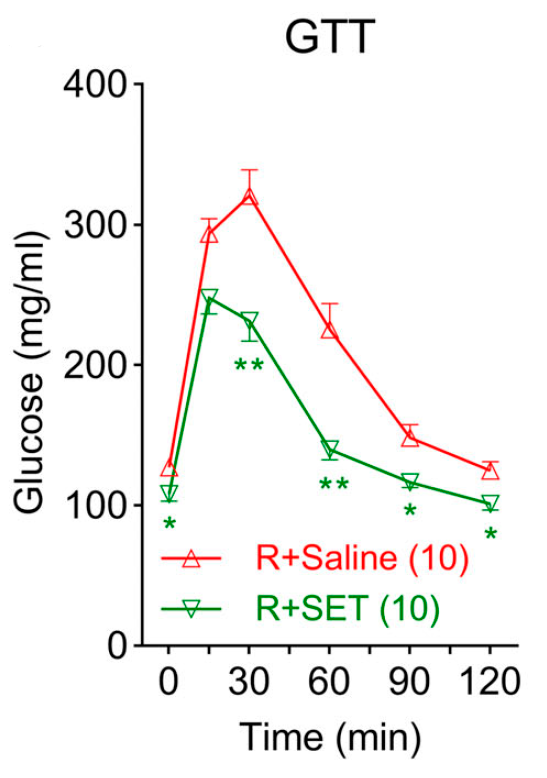
Monoacetate of Setmelanotide (6.4 μmol; intraperitoneal injection; single dose) acutely improves glucose clearance in leptin-deficient obese and glucose-intolerant C57BL/6J mice[1].
Monoacetate of Setmelanotide (6.4 μmol; intraperitoneal injection; single dose) suppresses refeeding-induced food intake in C57BL/6J mice fed a normal diet, and this effect depends on functional MC4R rather than MC3R[1].
Monoacetate of Setmelanotide (0.17-0.5 mg/kg/day; administered via a 2-week minipump every two weeks; for 8 weeks or variable duration) reduces peak body weight by 13.5% in diet-induced obese rhesus monkeys, improves insulin sensitivity and cardiovascular function, and does not cause adverse increases in heart rate or blood pressure; whereas lower doses only improve insulin sensitivity with minimal effects on body weight or cardiovascular parameters[2].
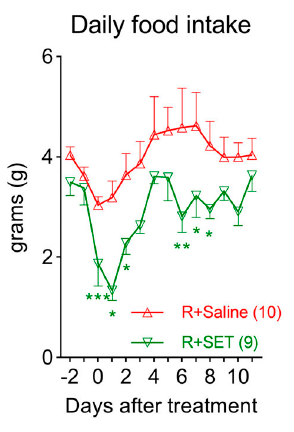
Monoacetate of Setmelanotide (0.05 mg/kg; i.p.; single administration) activates PVN MC4R neurons via the CaMKK2/AMPK signaling pathway, thereby normalizing food intake during short-term refeeding in rats with hypothalamic obesity[3].
Setmelanotide monoacetate (0.05 mg/kg; i.p.; once daily) activates PVN MC4R neurons via the CaMKK2/AMPK signaling pathway, reduces food intake, body weight, Lee index and perirenal adipose tissue weight, thereby reversing hypothalamic obesity in rats[3].
Monoacetate of Setmelanotide (6.4 µmole-1.34 mg/kg/day; intraperitoneal injection, subcutaneous injection; single injection, daily administration; for 14 consecutive days) induces MC4R-dependent feeding suppression and body weight loss in diet-induced obese mice[4].
Monoacetate of Setmelanotide (100-500 nmol/kg; subcutaneous injection; single administration) suppresses food intake in fasted male Sprague-Dawley rats[4].
Monoacetate of Setmelanotide (1 mg/kg; i.p.; single administration) effectively treats morphine-induced opioid-induced respiratory depression (OIRD) in lean male C57BL/6J mice by increasing respiratory rate and reducing apnea index, without impairing opioid analgesic effects[5].
Monoacetate of Setmelanotide (1 mg/kg; i.p.; single administration) effectively treats morphine-induced opioid-related respiratory depression in obese male C57BL/6J mice by increasing respiratory rate and reducing the frequency and duration of apnea, without affecting opioid analgesic effects[5].
MedChemExpress (MCE) has not independently confirmed the accuracy of these methods. They are for reference only.
-
Animal Model:C57BL/6J (male, 10 months old, diet-induced obese)[1]
-
Dosage:300 nmol/kg/day
-
Administration:s.c.; continuous; 14 days
-
Result:Reduced food intake to ~50% of controls on day 1, increasing to 75% of control levels by day 4, with no significant difference by day 12.
Lowered fasting serum insulin, glucose, and HOMA-IR values significantly.
Reduced serum leptin and total cholesterol levels significantly.
Improved liver steatosis significantly (P < 0.05).
Increased liver-specific Cpt1a expression modestly but significantly.
-
Animal Model:C57BL/6J (male, 10 months old, leptin-deficient)[1]
-
Dosage:6.4 μmol
-
Administration:i.p.; single injection
-
Result:Improved glucose clearance significantly compared to saline-treated controls.
-
Animal Model:C57BL/6J (female, 10 months old; wild-type, MC3R knockout, MC4R knockout littermates)[1]
-
Dosage:6.4 μmol
-
Administration:i.p.; single injection
-
Result:Inhibited refeeding-induced food intake in WT and MC3RKO mice.
Showed no inhibitory effect on refeeding-induced food intake in MC4RKO mice.
-
Animal Model:mature adult male (age 9-11 years, body weight 9-19 kg; 9 diet-sensitive/obese, insulin-resistant, hypertensive; 3 diet-resistant/lean, normotensive)[2]
-
Dosage:0.5 mg/kg/day (8-week treatment); 0.17 mg/kg/day (subsequent treatment period)
-
Administration:s.c.; via biweekly 2-week minipumps; 8 weeks (0.5 mg/kg/day); variable duration (0.17 mg/kg/day)
-
Result:Decreased food intake by 35% in the first week, normalized by weeks 4-7, and increased during week 8.
Reached peak weight loss of 13.5% of total body weight (average 1.5 kg lost over 8 weeks), with weight loss persisting for 2 weeks post-treatment before recovery began.
Nearly doubled daytime activity by treatment end (P = 0.037, repeated-measures ANOVA).
Increased energy expenditure (CO2 production) by 14% (P = 0.0134, paired t-test) compared to baseline.
Decreased core body temperature by ~0.5°C (P = 0.0161, repeated-measures ANOVA).
Reduced fat mass by 18.8% (1.04 kg) in diet-sensitive animals and 38.3% (0.75 kg) in diet-resistant animals; fat mass remained significantly reduced in diet-sensitive animals post-washout.
Decreased lean mass by 4.9% in diet-sensitive animals.
Decreased fasting leptin levels significantly in diet-sensitive animals (P < 0.001), with the magnitude of leptin decrease correlating with weight loss (r2 = 0.6634, P = 0.0023).
Reduced fasting serum triglyceride levels significantly at 8 weeks (P = 0.0238, ANOVA).
Improved fasting insulin levels and homeostasis model assessment insulin resistance significantly in diet-sensitive animals, with reduced insulin secretion (area under the curve) and improved glucose clearance (area under the curve) during intravenous glucose tolerance testing; these improvements persisted for 4 weeks post-treatment.
Decreased heart rate significantly overall (P = 0.008, repeated-measures ANOVA), with a 13-bpm reduction in diet-sensitive animals, and reduced diastolic blood pressure significantly (P = 0.02, repeated-measures ANOVA); systolic blood pressure was unchanged.
No acute increases in heart rate or blood pressure were observed.
Improved insulin sensitivity with smaller effects on food intake and body weight at 0.17 mg/kg/day.
No changes to blood pressure or heart rate were observed at 0.17 mg/kg/day.
-
Animal Model:Sprague-Dawley (male)[4]
-
Dosage:100 nmol/kg; 500 nmol/kg
-
Administration:s.c.; single injection
-
Result:Reduced food intake during refeeding after an overnight fast at both 100 nmol/kg and 500 nmol/kg doses.


化学情報
-
CAS 番号 2759937-80-7
-
性状 Solid
-
分子量 1177.36
-
分子式 C51H72N18O11S2
-
Color White to off-white
-
別名
RM-493 monoacetate; BIM-22493 monoacetate; IRC-022493 monoacetate
-
配列
Ac-Arg-Cys-{d-Ala}-His-{d-Phe}-Arg-Trp-Cys-NH2 (Disulfide bridge:Cys2-Cys8)
-
シーケンスの短縮
Ac-RC-{d-Ala}-H-{d-Phe}-RWC-NH2 (Disulfide bridge:Cys2-Cys8)
-
輸送条件
Room temperature in continental US; may vary elsewhere.
-
保管条件
Sealed storage, away from moisture
Powder -80°C 2 years -20°C 1 year * In solvent : -80°C, 6 months; -20°C, 1 month (sealed storage, away from moisture)


Publications (8)
-
Journal Impact Factor
-
Most Recent
-
Sci Transl Med
2025 Jan 15;17(781):eadr6459. PMID: 39813316
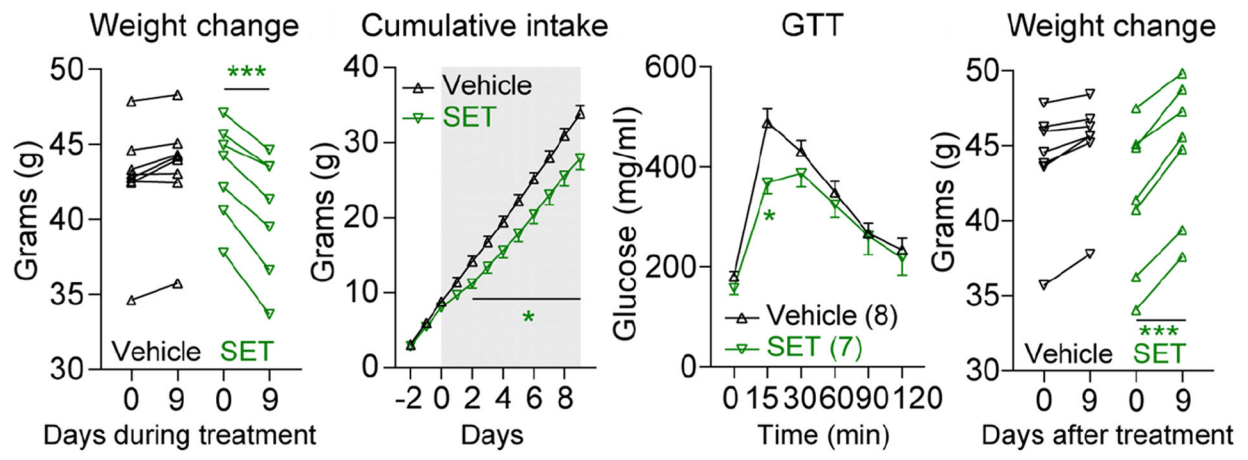
Setmelanotide monoacetate purchased from MedChemExpress. Usage Cited in: Sci Transl Med. 2025 Jan 15;17(781):eadr6459. [Abstract]
Setmelanotide (2 mg/kg; i.p.; once daily for 9 d) reduced body weights and food intake and improved glucose tolerance of HFD-fed OtpQ153R/+ mice, which quickly regained body weight after the treatment was discontinued.
-
J Exp Med
The atypical antipsychotic risperidone targets hypothalamic melanocortin 4 receptors to cause weight gain. [Abstract]2021 Jul 5;218(7):e20202484. PMID: 33978701
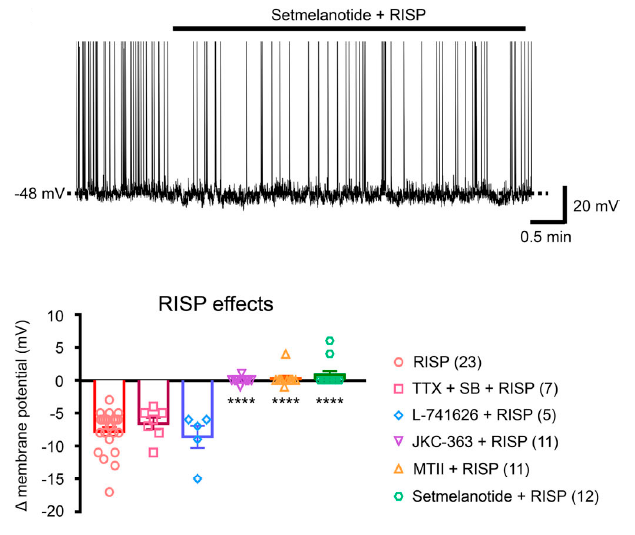
Setmelanotide monoacetate purchased from MedChemExpress. Usage Cited in: J Exp Med. 2021 Jul 5;218(7):e20202484. [Abstract]
Setmelanotide (100 nM) blocked the risperidone-induced hyperpolarization of MC4RPVH neurons.
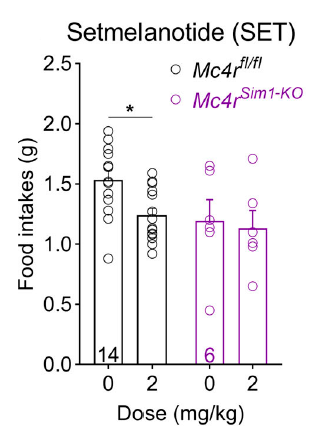
Setmelanotide monoacetate purchased from MedChemExpress. Usage Cited in: J Exp Med. 2021 Jul 5;218(7):e20202484. [Abstract]
A single dose of Setmelanotide (SET) (2 mg/kg; i.p.) suppressed fast-induced refeeding in Mc4rfl/fl mice.
Setmelanotide monoacetate purchased from MedChemExpress. Usage Cited in: J Exp Med. 2021 Jul 5;218(7):e20202484. [Abstract]
Infusion of Setmelanotide (SET) (2 mg/kg; once daily for 14 d) attenuated hyperphagia in C57BL/6 mice fed with risperidone.
Setmelanotide monoacetate purchased from MedChemExpress. Usage Cited in: J Exp Med. 2021 Jul 5;218(7):e20202484. [Abstract]
Setmelanotide (SET) (2 mg/kg; once daily for 14 d) caused accelerated glucose clearance of C57BL/6 mice fed with risperidone in a GTT.
-
Cell Rep
Melanocortin-4 receptors activate sympathetic preganglionic neurons and elevate blood pressure via TRPV1. [Abstract]2022 Nov 1;41(5):111579. PMID: 36323255 -
J Med Chem
2017 Nov 9;60(21):8716-8730. PMID: 28972753 -
Front Immunol
Setmelanotide, a Novel, Selective Melanocortin Receptor-4 Agonist Exerts Anti-inflammatory Actions in Astrocytes and Promotes an Anti-inflammatory Macrophage Phenotype. [Abstract]2019 Oct 4:10:2312. PMID: 31636637 -
Mol Metab
Lead-in calorie restriction enhances the weight-lowering efficacy of incretin hormone-based pharmacotherapies in mice. [Abstract]2024 Nov:89:102027. PMID: 39265725 -
J Clin Endocrinol Metab
MC4R variants modulate α-MSH and setmelanotide induced cellular signaling at multiple levels. [Abstract]2024 Sep 16;109(10):2452-2466. PMID: 38567654 -


溶剤 & 溶解度
体外:
DMSO : 100 mg/mL (84.94 mM; Need ultrasonic; Hygroscopic DMSO has a significant impact on the solubility of product, please use newly opened DMSO)
Please refer to the solubility information to select the appropriate solvent. Once prepared, please aliquot and store the solution to prevent product inactivation from repeated freeze-thaw cycles.
Storage method and period of stock solution: -80°C, 6 months; -20°C, 1 month (sealed storage, away from moisture). When stored at -80°C, please use it within 6 months. When stored at -20°C, please use it within 1 month.
Please refer to the solubility information to select the appropriate solvent. Once prepared, please aliquot and store the solution to prevent product inactivation from repeated freeze-thaw cycles.
Storage method and period of stock solution: -80°C, 6 months; -20°C, 1 month (sealed storage, away from moisture). When stored at -80°C, please use it within 6 months. When stored at -20°C, please use it within 1 month.
濃度 (開始) × 体積 (開始) = 濃度 (終了) × 体積 (終了)
体内:
Select the appropriate dissolution method based on your experimental animal and administration route.
- For the following dissolution methods, please ensure to first prepare a clear stock solution using an In Vitro approach and then sequentially add co-solvents:
- To ensure reliable experimental results, the clarified stock solution can be appropriately stored based on storage conditions. As for the working solution for In Vivo experiments, it is recommended to prepare freshly and use it on the same day.
- The percentages shown for the solvents indicate their volumetric ratio in the final prepared solution. If precipitation or phase separation occurs during preparation, heat and/or sonication can be used to aid dissolution.
Add each solvent one by one: 10% DMSO 40% PEG300 5% Tween-80 45% Saline
Solubility: ≥ 2.5 mg/mL (2.12 mM); Clear solution
This protocol yields a clear solution of ≥ 2.5 mg/mL (saturation unknown).
Taking 1 mL working solution as an example, add 100 μL DMSO stock solution (25.0 mg/mL) to 400 μL PEG300, and mix evenly; then add 50 μL Tween-80 and mix evenly; then add 450 μL Saline to adjust the volume to 1 mL.
Preparation of Saline: Dissolve 0.9 g sodium chloride in ddH₂O and dilute to 100 mL to obtain a clear Saline solution.
Add each solvent one by one: 10% DMSO 90% (20% SBE-β-CD in Saline)
Solubility: ≥ 2.5 mg/mL (2.12 mM); Clear solution
This protocol yields a clear solution of ≥ 2.5 mg/mL (saturation unknown).
Taking 1 mL working solution as an example, add 100 μL DMSO stock solution (25.0 mg/mL) to 900 μL 20% SBE-β-CD in Saline, and mix evenly.
Preparation of 20% SBE-β-CD in Saline (4°C, storage for one week): 2 g SBE-β-CD powder is dissolved in 10 mL Saline, completely dissolve until clear.
In Vivo Dissolution Calculator
Please enter the basic information of animal experiments:
-
-
-
-
Recommended: Prepare an additional quantity of animals to account for potential losses during experiments.
Please enter your animal formula composition:
-
%DMSO +
Recommended: Keep the proportion of DMSO in working solution below 2% if your animal is weak.
-
%+
-
+%Tween-80 + +
-
%Saline +
The co-solvents required include: DMSO, . All of co-solvents are available by MedChemExpress (MCE). , Tween 80. All of co-solvents are available by MedChemExpress (MCE).
Working solution concentration: 0.22 mg/mL
Method for preparing stock solution: mg drug dissolved in μL DMSO. Stock solution concentration: mg/mL. * In solvent : -80°C, 6 months; -20°C, 1 month (sealed storage, away from moisture)
1. Take μL DMSO stock solution;
2. Add μL .
μL , mix evenly;
3. Then add μL Tween 80, mix evenly;
4. Then add μL
Please ensure that the stock solution in the first step is dissolved to a clear state, and add co-solvents in sequence. You can use ultrasonic heating (ultrasonic cleaner, recommended frequency 20-40 kHz), vortexing, etc. to assist dissolution.


純度とドキュメンテーション
-
データシート (295 KB)
-
SDS (254 KB)
- English - EN (254 KB)
- Français - FR (254 KB)
- Deutsch - DE (254 KB)
- Norwegian - NO (254 KB)
- Español - ES (254 KB)
- Swedish - SV (254 KB)
- Italian - IT (254 KB)
- Korean - KR (254 KB)
- Portuguese - PT (254 KB)
-
取扱説明書 (2659 KB)
参考文献
[1]. Kumar KG, et al. Analysis of the therapeutic functions of novel melanocortin receptor agonists in MC3R- and MC4R-deficient C57BL/6J mice. Peptides. 2009 Oct;30(10):1892-900. [Content Brief]
[2]. Kievit P, et al. Chronic treatment with a melanocortin-4 receptor agonist causes weight loss, reduces insulin resistance, and improves cardiovascular function in diet-induced obese rhesus macaques. Diabetes. 2013;62(2):490-497. [Content Brief]
[3]. Peng J, et al. Setmelanotide-mediated MC4R activation improves hypothalamic obesity via CaMKK2/AMPK pathways. Front Pharmacol. 2026;16:1730786. Published 2026 Jan 12. [Content Brief]
[4]. Sharma S, et al. Current Mechanistic and Pharmacodynamic Understanding of Melanocortin-4 Receptor Activation. Molecules. 2019;24(10):1892. Published 2019 May 16. [Content Brief]
[5]. Amorim MR, et al. Melanocortin receptor 4 agonist setmelanotide treats opioid-induced respiratory depression. bioRxiv [Preprint]. 2026 Mar 10:2026.03.08.708886. doi: 10.64898/2026.03.08.708886. PMID: 41959165; PMCID: PMC13061029. [Content Brief]


Complete Stock Solution Preparation Table
Please refer to the solubility information to select the appropriate solvent. Once prepared, please aliquot and store the solution to prevent product inactivation from repeated freeze-thaw cycles.
Storage method and period of stock solution: -80°C, 6 months; -20°C, 1 month (sealed storage, away from moisture). When stored at -80°C, please use it within 6 months. When stored at -20°C, please use it within 1 month.
| Optional Solvent | Concentration Solvent Mass | 1 mg | 5 mg | 10 mg | 25 mg |
|---|---|---|---|---|---|
| DMSO | 1 mM | 0.8494 mL | 4.2468 mL | 8.4936 mL | 21.2339 mL |
| 5 mM | 0.1699 mL | 0.8494 mL | 1.6987 mL | 4.2468 mL | |
| 10 mM | 0.0849 mL | 0.4247 mL | 0.8494 mL | 2.1234 mL | |
| 15 mM | 0.0566 mL | 0.2831 mL | 0.5662 mL | 1.4156 mL | |
| 20 mM | 0.0425 mL | 0.2123 mL | 0.4247 mL | 1.0617 mL | |
| 25 mM | 0.0340 mL | 0.1699 mL | 0.3397 mL | 0.8494 mL | |
| 30 mM | 0.0283 mL | 0.1416 mL | 0.2831 mL | 0.7078 mL | |
| 40 mM | 0.0212 mL | 0.1062 mL | 0.2123 mL | 0.5308 mL | |
| 50 mM | 0.0170 mL | 0.0849 mL | 0.1699 mL | 0.4247 mL | |
| 60 mM | 0.0142 mL | 0.0708 mL | 0.1416 mL | 0.3539 mL | |
| 80 mM | 0.0106 mL | 0.0531 mL | 0.1062 mL | 0.2654 mL |


Setmelanotide monoacetate 関連分類
HY-19870C 関連分類
 Powered by Bioz
Keywords
- Setmelanotide monoacetate
- 2759937-80-7
- RM-493 monoacetate
- BIM-22493 monoacetate
- IRC-022493 monoacetate
- Melanocortin Receptor
- Calmodulin
- AMPK
- PVN MC4R neurons
- Sprague-Dawley rats
- MC4R
- C57BL/6J mice
- rhesus macaques
- melanocortin-4 receptor
- cynomolgus monkeys
- HEK293 cells
- CHO-K1 cells
- CaMKK2/AMPK signaling pathway
- Inhibitor
- inhibitor
- inhibit