



Tinoridine
Based on 1 publication(s) in Google Scholar
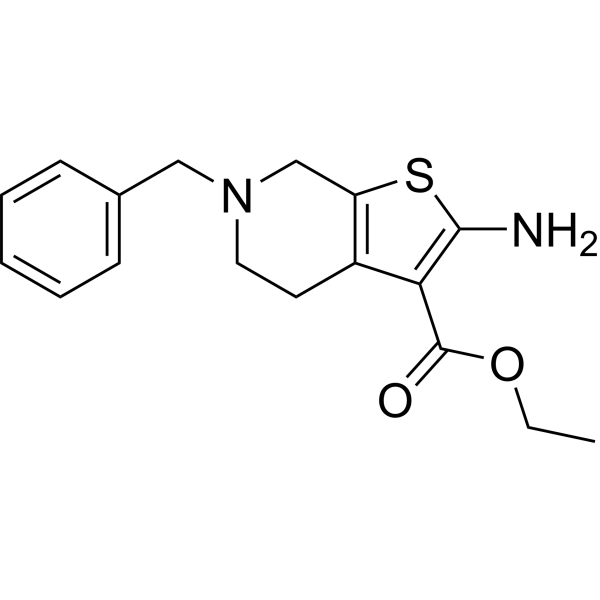
Tinoridine (Y-3642) is an orally active non-steroidal anti-inflammatory agent with potent antiperoxidative ability and radical scavenger activity. Tinoridine acts function by inhibiting COX enzyme, involves in hepatotoxicity inhibition. .
For research use only. We do not sell to patients.
- Purity : 99.00%
- CAS No.: 24237-54-5
- Formula: C17H20N2O2S
- Molecular Weight:316.42
-
Storage:
-20°C, protect from light
* In solvent : -80°C, 6 months; -20°C, 1 month (protect from light)

To place orders, for customer services and technical support, please contact: MedChemExpress USA
Tel: 609-228-6898 E-mail: [email protected] [email protected]


-
 Biological Activity
-
Chemical Information
-
Solvent & Solubility
- Protocols
- Purity & Documentation
- References
-
 Help & FAQs


Publications Citing Use of MedChemExpress (MCE) Tinoridine
More

Biological Activity
Description
In Vitro
Tinoridine (10-100 μM) exerts effect on stability of rat liver and kidney lysosomes, and liver parenchymal cells[3].
Tinoridine (1, 10, and 100 μM; 30 min) inhibits spontaneous release of acid phosphatase from liver lymomoses in vitro[3].
MedChemExpress (MCE) has not independently confirmed the accuracy of these methods. They are for reference only.
In Vivo
Tinoridine (100 mg/kg; i.p.; single dose) protects the stability of rat liver and kidney lysosomes in vivo[3].
MedChemExpress (MCE) has not independently confirmed the accuracy of these methods. They are for reference only.
-
Animal Model:Male Wistar rats (180-220 g)[2]
-
Dosage:100 mg/kg
-
Administration:Oral gavage; single dose; 1 hour before CCl4 (i.p.; 0.25 mL/kg) treatment
-
Result:Inhibited the CCl4-induced enzyme activities increase of serum glutamic-oxaloacetic transaminase and glutamic-pyruvic transaminase, and also rescued the liver microsomal cytochrome P-450 and glucose-6-phosphatase activities.


Chemical Information
-
CAS No. 24237-54-5
-
Appearance Solid
-
Molecular Weight 316.42
-
Formula C17H20N2O2S
-
Color Light yellow to yellow
-
SMILES
NC(SC1=C2CCN(CC3=CC=CC=C3)C1)=C2C(OCC)=O
-
Synonyms
Y-3642
-
Shipping
Room temperature in continental US; may vary elsewhere.
-
Storage
-20°C, protect from light
* In solvent : -80°C, 6 months; -20°C, 1 month (protect from light)


Publications (1)
-
Journal Impact Factor
-
Most Recent
-
Free Radic Biol Med
Screening of NSAIDs library identifies Tinoridine as a novel ferroptosis inhibitor for potential intervertebral disc degeneration therapy. [Abstract]2024 May 26:221:245-256. PMID: 38806104


Solvent & Solubility
In Vitro:
DMSO : 125 mg/mL (395.04 mM; Need ultrasonic; Hygroscopic DMSO has a significant impact on the solubility of product, please use newly opened DMSO)
Please refer to the solubility information to select the appropriate solvent. Once prepared, please aliquot and store the solution to prevent product inactivation from repeated freeze-thaw cycles.
Storage method and period of stock solution: -80°C, 6 months; -20°C, 1 month (protect from light). When stored at -80°C, please use it within 6 months. When stored at -20°C, please use it within 1 month.
Please refer to the solubility information to select the appropriate solvent. Once prepared, please aliquot and store the solution to prevent product inactivation from repeated freeze-thaw cycles.
Storage method and period of stock solution: -80°C, 6 months; -20°C, 1 month (protect from light). When stored at -80°C, please use it within 6 months. When stored at -20°C, please use it within 1 month.
Concentration (start) × Volume (start) = Concentration (final) × Volume (final)


Purity & Documentation
-
Data Sheet (274 KB)
-
SDS (393 KB)
- English - EN (393 KB)
- Français - FR (393 KB)
- Deutsch - DE (393 KB)
- Norwegian - NO (393 KB)
- Español - ES (393 KB)
- Swedish - SV (393 KB)
- Italian - IT (393 KB)
- Korean - KR (393 KB)
- Portuguese - PT (393 KB)
-
Handling Instructions (2659 KB)
References
[1]. da Cruz RMD, et al. Thiophene-Based Compounds with Potential Anti-Inflammatory Activity. Pharmaceuticals (Basel). 2021 Jul 19;14(7):692. [Content Brief]
[2]. Yasuda H, et al. The protective effect of tinoridine against carbon tetrachloride hepatotoxicity. Toxicol Appl Pharmacol. 1980 Mar 15;52(3):407-13. [Content Brief]
[3]. Goto K, et al. Effect of tinoridine on stability of rat liver and kidney lysosomes, and liver parenchymal cells. Biochem Pharmacol. 1977 Jan 1;26(1):11-8. [Content Brief]


Complete Stock Solution Preparation Table
Please refer to the solubility information to select the appropriate solvent. Once prepared, please aliquot and store the solution to prevent product inactivation from repeated freeze-thaw cycles.
Storage method and period of stock solution: -80°C, 6 months; -20°C, 1 month (protect from light). When stored at -80°C, please use it within 6 months. When stored at -20°C, please use it within 1 month.
| Optional Solvent | Concentration Solvent Mass | 1 mg | 5 mg | 10 mg | 25 mg |
|---|---|---|---|---|---|
| DMSO | 1 mM | 3.1604 mL | 15.8018 mL | 31.6036 mL | 79.0089 mL |
| 5 mM | 0.6321 mL | 3.1604 mL | 6.3207 mL | 15.8018 mL | |
| 10 mM | 0.3160 mL | 1.5802 mL | 3.1604 mL | 7.9009 mL | |
| 15 mM | 0.2107 mL | 1.0535 mL | 2.1069 mL | 5.2673 mL | |
| 20 mM | 0.1580 mL | 0.7901 mL | 1.5802 mL | 3.9504 mL | |
| 25 mM | 0.1264 mL | 0.6321 mL | 1.2641 mL | 3.1604 mL | |
| 30 mM | 0.1053 mL | 0.5267 mL | 1.0535 mL | 2.6336 mL | |
| 40 mM | 0.0790 mL | 0.3950 mL | 0.7901 mL | 1.9752 mL | |
| 50 mM | 0.0632 mL | 0.3160 mL | 0.6321 mL | 1.5802 mL | |
| 60 mM | 0.0527 mL | 0.2634 mL | 0.5267 mL | 1.3168 mL | |
| 80 mM | 0.0395 mL | 0.1975 mL | 0.3950 mL | 0.9876 mL | |
| 100 mM | 0.0316 mL | 0.1580 mL | 0.3160 mL | 0.7901 mL |


Tinoridine Related Classifications
HY-W032848 Related Classifications
 Powered by Bioz