209 Results for "

H2O2

" in MedChemExpress (MCE) Product Catalog:
Products (209)

209 Results for "H2O2" in MCE Product Catalog:

Cat. No.: HY-E70385A
Target:  

Endogenous Metabolite

Research Areas:  

Metabolic Disease

Oxalate oxidase, B. subtilis (EC 1.2.3.4) is a redox enzyme that acts on the donor aldehyde or carbonyl group, using oxygen as the acceptor. Oxalate oxidase, B is involved in the metabolism of glyoxylate and dicarboxylic acids. Oxalate oxidase, B has two cofactors: FAD and manganese. Oxalate oxidase, B has three substrates: oxalic acid, O2, and H +, and two products: CO2 and H2O2.
loading...
    loading...
Cat. No.: HY-E70926
Target:  

Endogenous Metabolite

Research Areas:  

Metabolic Disease

Lysine Oxidase, Trichoderma viride (EC 1.4.3.14), is an oxidoreductase that acts on the CH-NHsub>2 group in the donor molecule and uses oxygen as the acceptor. Lysine Oxidase participates in the degradation of lysine. The three substrates of lysine oxidase are L-lysine, O2, and H2O, while its three products are 6-amino-2-oxohexanoic acid, NH3, and H2O2.
loading...
    loading...
Cat. No.: HY-N0501R
CAS No.: 126105-11-1
11-oxo-mogroside V (Standard) is the analytical standard of 11-oxo-mogroside V. This product is intended for research and analytical applications. 11-oxo-mogroside V is a natural sweetener that exhibits strong antioxidant activity. It exhibits significant inhibitory effects on reactive oxygen species (O2-, H2O2 and *OH) with EC50 of 4.79, 16.52, and 146.17 μg/mL, respectively.
loading...
    loading...
Cat. No.: HY-159515
PBE-AMF is a prodrug that activates H2O2 with anticancer activity. PBE-AMF impedes tumor proliferation by inhibiting DNA synthesis, reducing ATP levels, inducing apoptosis, and arresting the cell cycle. PBE-AMF potently and selectively inhibits the proliferation of MDA-MB-231 cells (IC50=6.4 μM) while sparing non-cancerous MCF-10A cells .
loading...
    loading...
Cat. No.: HY-181176
DEMAMP is an antioxidant. DEMAMP exhibits scavenging effects on DPPH and H2O2 free radicals, with IC50 values of 0.60 and 0.48 mg/mL, respectively. Molecular docking simulations show that DEMAMP potently inhibits NADPH oxidase and the Mpro and RdRp proteins of SARS-CoV-2, and ADMET analysis confirms that it has favorable oral bioavailability. DEMAMP can be used in studies related to COVID-19 .
loading...
    loading...
Cat. No.: HY-P2733D
Target:  

Endogenous Metabolite

Research Areas:  

Metabolic Disease

Glycerol 3-phosphate Oxidase, Streptococcus thermophilus (EC 1.1.3.21), is an oxidoreductase that acts on the CH-OH group in donor molecules and uses oxygen as an acceptor. Glycerol 3-phosphate Oxidase participates in glycerophospholipid metabolism and utilizes a cofactor, FAD. The two substrates of Glycerol 3-phosphate Oxidase are sn-glycerol-3-phosphate and O2, while its two products are glycerophosphate and H2O2.
loading...
    loading...
Cat. No.: HY-174460
Target:  

Drug Intermediate

Research Areas:  

Cancer

pCR8 is a prodrug of CR8 (HY-18340). pCR8 is amphiphilic and can self-assemble into nanoparticles. pCR8 can release CR8 under the action of high concentration of H2O2 in the tumor microenvironment. CR8 is a molecular glue degrader that can effectively degrade cell cycle-related proteins and has antitumor activity. pCR8 can be used in the research of tumors such as breast cancer .
loading...
    loading...
Cat. No.: HY-Y1885
CAS No.: 7722-88-5
Tetrasodium pyrophosphate is a water-soluble inorganic salt commonly used as a buffering agent, emulsifier, and sequestrant. Tetrasodium pyrophosphate is an antimicrobial agent that can reduce microbial colonization. Tetrasodium pyrophosphate blocks IPP translocation, enhances astaxanthin, phenol, flavonoid, and H2O2 levels, activates PAL and DPPH scavenging activity. Tetrasodium pyrophosphate can be used for the research of alleviating symptoms post COVID-19 .
loading...
    loading...
Cat. No.: HY-P2936A
CAS No.: 9031-54-3
Sphingomyelin phosphodiesterase, Bacillus cereus is a sphingomyelin hydrolase and Insecticide. Sphingomyelin phosphodiesterase, Bacillus cereus catalyzes the decomposition of sphingomyelin into ceramide and phosphorylcholine. Sphingomyelin phosphodiesterase, Bacillus cereus causes rapid paralysis and death in injected insects, including German cockroaches and black cutworms. Sphingomyelin phosphodiesterase, Bacillus cereus reduces H2O2 production. Sphingomyelin phosphodiesterase, Bacillus cereus can be used in studies related to sepsis and endophthalmitis .
loading...
    loading...
Cat. No.: HY-114809
CAS No.: 126455-04-7
AL-1 is a potent O2 - generation inhibitor (IC50 = 7.6 μM) through the inhibition of leukocytic NADPH oxidase. AL-1 inhibits 12-O-Tetradecanoylphorbol-13-acetate (TPA)-induced H2O2 production. AL-1 reduces tumor incidence in ICR mouse skin. AL-1 can be used for research on oxidative stress-related diseases including cancer .
loading...
    loading...
Cat. No.: HY-141712
CAS No.: 2696407-32-4
Target:  

TRP Channel

ZA18 is a selective TRPM2 channel inhibitor, with an IC50 value of 6.2 μM. ZA18 can effectively suppress intracellular Ca 2+ overload triggered by TRPM2 channel activation. ZA18 significantly reduce the mortality of SH-SY5Y cells induced by H2O2. ZA18 can be used for the study of ischemia-reperfusion injury, inflammation, or other neurodegenerative diseases .
loading...
    loading...
Cat. No.: HY-141713
CAS No.: 2696407-24-4
Target:  

TRP Channel

ZA10 is a selective TRPM2 channel inhibitor, with an IC50 value of 8.1 μM. ZA10 can effectively suppress intracellular Ca 2+ overload triggered by TRPM2 channel activation. ZA10 significantly reduce the mortality of SH-SY5Y cells induced by H2O2. ZA10 can be used for the study of ischemia-reperfusion injury, inflammation, or other neurodegenerative diseases .
loading...
    loading...
Cat. No.: HY-W112021
CAS No.: 3117-03-1
Synonyms: 2,5-Dimethoxybenzoquinone
Research Areas:  

Others

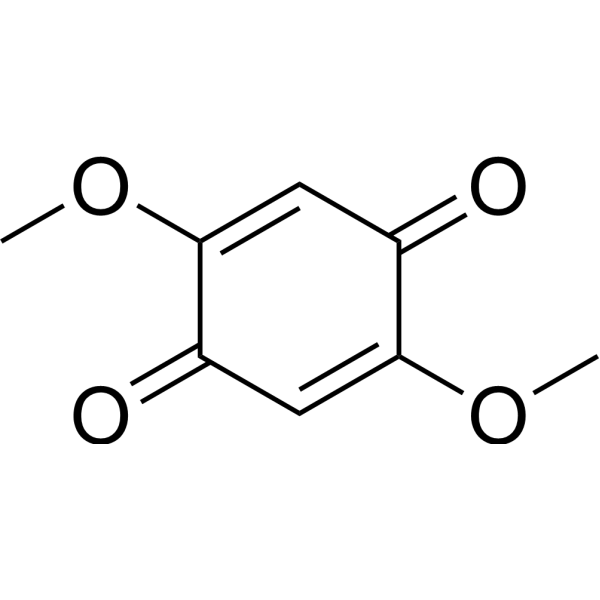
2,5-DMBQ (2,5-Dimethoxybenzoquinone) serves as an extracellular reductant. 2,5-DMBQ is involved in a crucial redox cycle, namely the extracellular hydroquinone-quinone redox cycle. In this cycle, 2,5-DMBQ is capable of reducing extracellular Fe ³⁺ and generating H2O2. 2,5-DMBQ plays a pivotal role in the biodegradation mechanism of brown rot fungal, assisting the fungi in decomposing and utilizing organic matter .
loading...
    loading...
Cat. No.: HY-W112021R
CAS No.: 3117-03-1
Synonyms: 2,5-Dimethoxybenzoquinone (Standard)
Research Areas:  

Others

2,5-DMBQ (2,5-Dimethoxybenzoquinone) serves as an extracellular reductant. 2,5-DMBQ is involved in a crucial redox cycle, namely the extracellular hydroquinone-quinone redox cycle. In this cycle, 2,5-DMBQ is capable of reducing extracellular Fe³⁺ and generating H2O2. 2,5-DMBQ plays a pivotal role in the biodegradation mechanism of brown rot fungal, assisting the fungi in decomposing and utilizing organic matter .
loading...
    loading...
Cat. No.: HY-161783
CAS No.: 3048532-05-1
HDAC6-IN-45 (Compound 15) is a selective inhibitor for HDAC6 with IC50 of 15.2 nM. HDAC6-IN-45 exhibits neurotrophic through the upregulation of GAP43 and Beta-3 tubulin markers. HDAC6-IN-45 activates the Nrf2 signaling pathway, reduces H2O2-induced ROS production, inhibits apoptosis in PC12, and exhibits neuroprotective efficacy in SCOP-induced zebrafish Alzheimer's Disease models. HDAC6-IN-45 exhibits antioxidant activity and good blood-brain barrier (BBB) permeability .
loading...
    loading...
Cat. No.: HY-P11474
FZ1 peptide is a cyclic heptapeptide and also an integrin αvβ3 agonist. FZ1 peptide activates the FAK/PI3K-AKT/ERK pathway and upregulates VEGFC to promote angiogenesis. FZ1 peptide exhibits antibacterial activity in extracts of HA-c-FZ1 hydrogel; it inhibits LPS-induced proinflammatory cytokine secretion in RAW264.7 macrophages; it reduces H2O2-induced ROS levels; it increases the healing rate of scratch wounds. FZ1 peptide can be used in studies related to diabetic skin wounds .
loading...
    loading...
Cat. No.: HY-162860
CAS No.: 1030759-58-0
Target:  

mGluR CaMK Tau Protein

Research Areas:  

Neurological Disease

FO-4-15 is an mGluR1/CaMKIIα activator. FO-4-15 has a protective effect against H2O2 in human neuroblastoma (SH-SY5Y) cells. FO-4-15 can improve cognitive impairment in Alzheimer’s disease mice by activating the mGluR1/CaMKIIα pathway, and can reduce accumulation, hyperphosphorylated Tau, and synaptic damage .
loading...
    loading...
Cat. No.: HY-P5247
Synonyms: PTP20
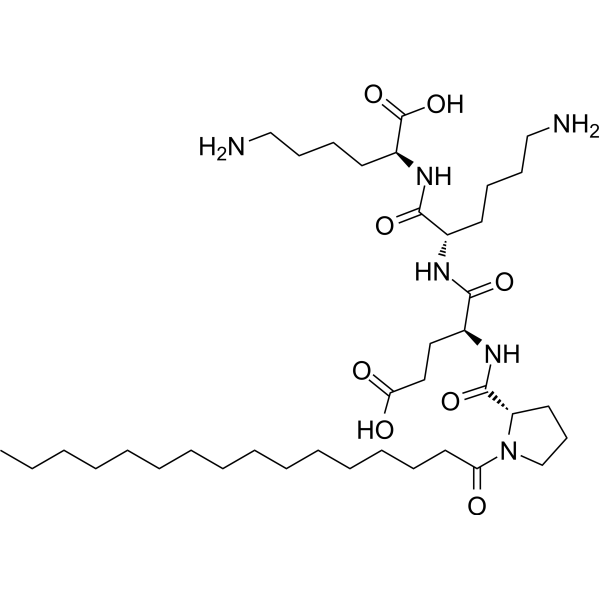
Palmitoyl tetrapeptide-20 (PTP20) is a biomimetic peptide agonist of α-MSH. Palmitoyl tetrapeptide-20 promotes hair pigmentation and delays hair graying by activating the MC1-R pathway (AC50: 0.16 nM), enhancing catalase activity to reduce H2O2 accumulation, and upregulating SIRT1 activity. Palmitoyl tetrapeptide-20 can be used in research on preventing hair loss and improving hair graying .
loading...
    loading...
Cat. No.: HY-P5247A
Synonyms: PTP20 TFA
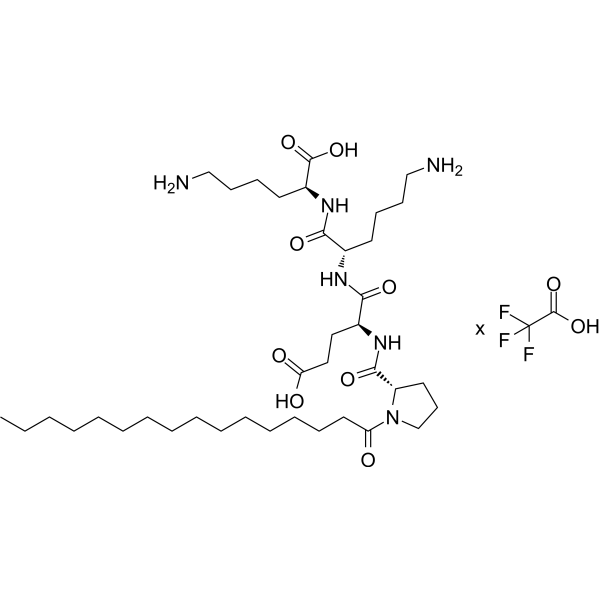
Palmitoyl tetrapeptide-20 (PTP20) TFA is a biomimetic peptide agonist of α-MSH. Palmitoyl tetrapeptide-20 TFA promotes hair pigmentation and delays hair graying by activating the MC1-R pathway (AC50: 0.16 nM), enhancing catalase activity to reduce H2O2 accumulation, and upregulating SIRT1 activity. Palmitoyl tetrapeptide-20 TFA can be used in research on preventing hair loss and improving hair graying .
loading...
    loading...
Cat. No.: HY-W587784
CAS No.: 542-40-5
Norbixin is an orally active natural product with multiple activities such as retinal protection and oxidative stress regulation. Norbixin scavenges ROS, chelates metal ions, regulates plasmid and genomic DNA breakage, inhibits H2O2-induced mutagenesis, activates PPAR-α, modulates lipid levels, restores or regulates antioxidant enzyme activity, and alters NO levels. Norbixin prevents A2E accumulation and protects photoreceptor cells and retinal pigment epithelial cells. Norbixin is a derivative of Bixin (HY-N6884). Norbixin can be used in research related to diseases such as macular degeneration and diabetes, and also serves as a natural textile dye .
loading...
    loading...

