



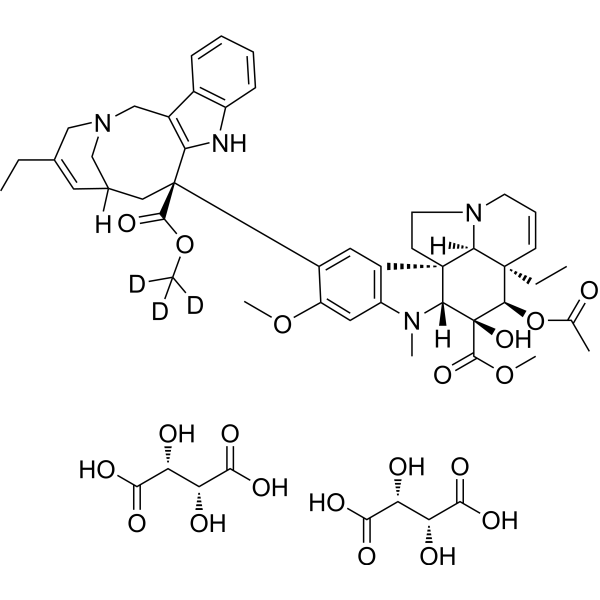
Vinorelbine-d3 ditartrate
Based on 2 publication(s) in Google Scholar
Vinorelbine-d3 (ditartrate) is the deuterium labeled Vinorelbine ditartrate. Vinorelbine (ditartrate) is an anti-mitotic agent which inhibits the proliferation of Hela cells with IC50 of 1.25 nM.
For research use only. We do not sell to patients.
- Purity : 98.0%
- Formula: C53H63D3N4O20
- Molecular Weight:1082.12
-
Storage:
-80°C, protect from light, stored under nitrogen

To place orders, for customer services and technical support, please contact: MedChemExpress USA
Tel: 609-228-6898 E-mail: [email protected] [email protected]


-
 Biological Activity
-
Chemical Information
-
Solvent & Solubility
- Purity & Documentation
- References
-
 Help & FAQs


Publications Citing Use of MedChemExpress (MCE) Vinorelbine-d3 ditartrate
More

Biological Activity
Description
In Vitro
Stable heavy isotopes of hydrogen, carbon, and other elements have been incorporated into drug molecules, largely as tracers for quantitation during the drug development process. Deuteration has gained attention because of its potential to affect the pharmacokinetic and metabolic profiles of drugs[1].
MedChemExpress (MCE) has not independently confirmed the accuracy of these methods. They are for reference only.
Application
1. This compound can be used as a tracer
2. This compound can be used as an internal standard for quantitative analysis by NMR, GC-MS, or LC-MS.


Chemical Information
-
Unlabeled CAS 125317-39-7
-
Appearance Solid
-
Molecular Weight 1082.12
-
Formula C53H63D3N4O20
-
Color White to off-white
-
SMILES
CC[C@@]1(C=CCN2CC3)[C@@]2([H])[C@@]3(C(C=C([C@@](C4=C5C(C=CC=C6)=C6N4)(CC(C=C(CC)C7)([H])CN7C5)C(OC([2H])([2H])[2H])=O)C(OC)=C8)=C8N9C)[C@]9([H])[C@](C(OC)=O)(O)[C@@H]1OC(C)=O.O=C(O)[C@H](O)[C@@H](O)C(O)=O.O=C(O)[C@H](O)[C@@H](O)C(O)=O
-
Synonyms
KW-2307-d3 ditartrate; Nor-5'-anhydrovinblastine-d3 ditartrate
-
Shipping
Shipping with dry ice.
-
Storage
-80°C, protect from light, stored under nitrogen


Publications (2)
-
Journal Impact Factor
-
Most Recent
-
Mol Cancer
Organoids derived from patients provide a new opportunity for research and individualized treatment of malignant peritoneal mesothelioma. [Abstract]2024 Jan 10;23(1):12. PMID: 38200517 -
Transl Lung Cancer Res
Development of a 3D-3 co-culture microbead consisting of cancer-associated fibroblasts and human umbilical vein endothelial cells for the anti-tumor drug assessment of lung cancer. [Abstract]2025 Jun 30;14(6):2159-2179. PMID: 40673102


Solvent & Solubility
In Vitro:
DMSO : 100 mg/mL (92.41 mM; Need ultrasonic; Hygroscopic DMSO has a significant impact on the solubility of product, please use newly opened DMSO)
Please refer to the solubility information to select the appropriate solvent. Once prepared, please aliquot and store the solution to prevent product inactivation from repeated freeze-thaw cycles.
Storage method and period of stock solution: -80°C, 6 months (protect from light, stored under nitrogen). When stored at -80°C, please use it within 6 months.
Please refer to the solubility information to select the appropriate solvent. Once prepared, please aliquot and store the solution to prevent product inactivation from repeated freeze-thaw cycles.
Storage method and period of stock solution: -80°C, 6 months (protect from light, stored under nitrogen). When stored at -80°C, please use it within 6 months.
Concentration (start) × Volume (start) = Concentration (final) × Volume (final)
In Vivo:
Select the appropriate dissolution method based on your experimental animal and administration route.
- For the following dissolution methods, please ensure to first prepare a clear stock solution using an In Vitro approach and then sequentially add co-solvents:
- To ensure reliable experimental results, the clarified stock solution can be appropriately stored based on storage conditions. As for the working solution for In Vivo experiments, it is recommended to prepare freshly and use it on the same day.
- The percentages shown for the solvents indicate their volumetric ratio in the final prepared solution. If precipitation or phase separation occurs during preparation, heat and/or sonication can be used to aid dissolution.
Add each solvent one by one: 10% DMSO 40% PEG300 5% Tween-80 45% Saline
Solubility: ≥ 2.5 mg/mL (2.31 mM); Clear solution
This protocol yields a clear solution of ≥ 2.5 mg/mL (saturation unknown).
Taking 1 mL working solution as an example, add 100 μL DMSO stock solution (25.0 mg/mL) to 400 μL PEG300, and mix evenly; then add 50 μL Tween-80 and mix evenly; then add 450 μL Saline to adjust the volume to 1 mL.
Preparation of Saline: Dissolve 0.9 g sodium chloride in ddH₂O and dilute to 100 mL to obtain a clear Saline solution.
Add each solvent one by one: 10% DMSO 90% (20% SBE-β-CD in Saline)
Solubility: ≥ 2.5 mg/mL (2.31 mM); Clear solution
This protocol yields a clear solution of ≥ 2.5 mg/mL (saturation unknown).
Taking 1 mL working solution as an example, add 100 μL DMSO stock solution (25.0 mg/mL) to 900 μL 20% SBE-β-CD in Saline, and mix evenly.
Preparation of 20% SBE-β-CD in Saline (4°C, storage for one week): 2 g SBE-β-CD powder is dissolved in 10 mL Saline, completely dissolve until clear.
In Vivo Dissolution Calculator
Please enter the basic information of animal experiments:
-
-
-
-
Recommended: Prepare an additional quantity of animals to account for potential losses during experiments.
Please enter your animal formula composition:
-
%DMSO +
Recommended: Keep the proportion of DMSO in working solution below 2% if your animal is weak.
-
%+
-
+%Tween-80 + +
-
%Saline +
The co-solvents required include: DMSO, . All of co-solvents are available by MedChemExpress (MCE). , Tween 80. All of co-solvents are available by MedChemExpress (MCE).
Working solution concentration: 0.22 mg/mL
Method for preparing stock solution: mg drug dissolved in μL DMSO. Stock solution concentration: mg/mL.
1. Take μL DMSO stock solution;
2. Add μL .
μL , mix evenly;
3. Then add μL Tween 80, mix evenly;
4. Then add μL
Please ensure that the stock solution in the first step is dissolved to a clear state, and add co-solvents in sequence. You can use ultrasonic heating (ultrasonic cleaner, recommended frequency 20-40 kHz), vortexing, etc. to assist dissolution.


Purity & Documentation
-
Data Sheet (284 KB)
-
SDS (480 KB)
- English - EN (480 KB)
- Français - FR (480 KB)
- Deutsch - DE (480 KB)
- Norwegian - NO (480 KB)
- Español - ES (480 KB)
- Swedish - SV (480 KB)
- Italian - IT (480 KB)
- Korean - KR (480 KB)
- Portuguese - PT (480 KB)
-
Handling Instructions (2659 KB)
References
[1]. Russak EM, et al. Impact of Deuterium Substitution on the Pharmacokinetics of Pharmaceuticals. Ann Pharmacother. 2019;53(2):211-216. [Content Brief]
[2]. Ngan VK, et al. Mechanism of mitotic block and inhibition of cell proliferation by the semisynthetic Vinca alkaloids vinorelbine and its newer derivative vinflunine. Mol Pharmacol. 2001 Jul;60(1):225-32. [Content Brief]
[3]. Liu XM, et al. Unique induction of p21(WAF1/CIP1)expression by vinorelbine in androgen-independent prostate cancer cells. Br J Cancer. 2003 Oct 20;89(8):1566-73. [Content Brief]
[4]. Poirier VJ, et al. Toxicity, dosage, and efficacy of vinorelbine (Navelbine) in dogs with spontaneous neoplasia. J Vet Intern Med. 2004 Jul-Aug;18(4):536-9. [Content Brief]
[5]. Pierro JA, et al. Phase I clinical trial of vinorelbine in tumor-bearing cats. J Vet Intern Med. 2013 Jul-Aug;27(4):943-8. [Content Brief]


Complete Stock Solution Preparation Table
Please refer to the solubility information to select the appropriate solvent. Once prepared, please aliquot and store the solution to prevent product inactivation from repeated freeze-thaw cycles.
Storage method and period of stock solution: -80°C, 6 months (protect from light, stored under nitrogen). When stored at -80°C, please use it within 6 months.
| Optional Solvent | Concentration Solvent Mass | 1 mg | 5 mg | 10 mg | 25 mg |
|---|---|---|---|---|---|
| DMSO | 1 mM | 0.9241 mL | 4.6206 mL | 9.2411 mL | 23.1028 mL |
| 5 mM | 0.1848 mL | 0.9241 mL | 1.8482 mL | 4.6206 mL | |
| 10 mM | 0.0924 mL | 0.4621 mL | 0.9241 mL | 2.3103 mL | |
| 15 mM | 0.0616 mL | 0.3080 mL | 0.6161 mL | 1.5402 mL | |
| 20 mM | 0.0462 mL | 0.2310 mL | 0.4621 mL | 1.1551 mL | |
| 25 mM | 0.0370 mL | 0.1848 mL | 0.3696 mL | 0.9241 mL | |
| 30 mM | 0.0308 mL | 0.1540 mL | 0.3080 mL | 0.7701 mL | |
| 40 mM | 0.0231 mL | 0.1155 mL | 0.2310 mL | 0.5776 mL | |
| 50 mM | 0.0185 mL | 0.0924 mL | 0.1848 mL | 0.4621 mL | |
| 60 mM | 0.0154 mL | 0.0770 mL | 0.1540 mL | 0.3850 mL | |
| 80 mM | 0.0116 mL | 0.0578 mL | 0.1155 mL | 0.2888 mL |


Vinorelbine-d3 ditartrate Related Classifications
HY-12053AS Related Classifications
 Powered by Bioz