



Forodesine hydrochloride
Based on 21 publication(s) in Google Scholar
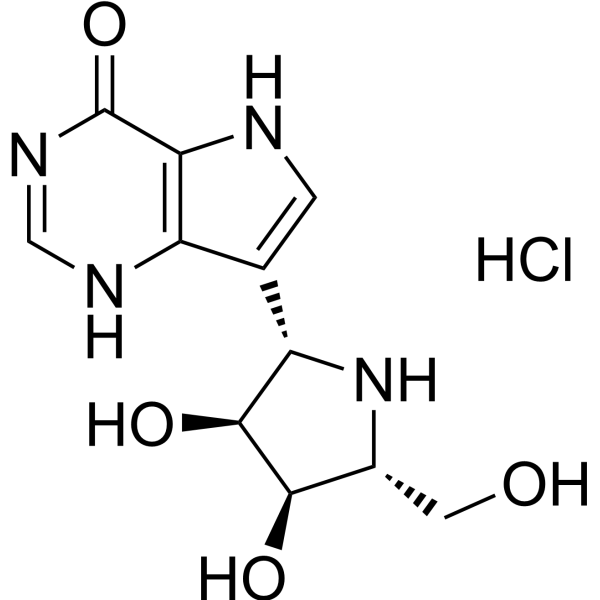
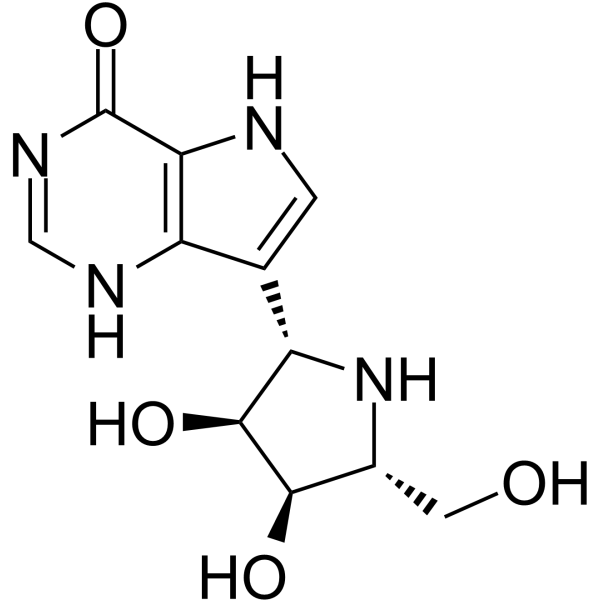
Forodesine hydrochloride (BCX-1777 hydrochloride) is a highly potent and orally active purine nucleoside phosphorylase (PNP) inhibitor with IC50 values ranging from 0.48 to 1.57 nM for human, mouse, rat, monkey and dog PNP. Forodesine hydrochloride is a potent human lymphocyte proliferation inhibitor. Forodesine hydrochloride could induce apoptosis in leukemic cells by increasing the dGTP levels.
For research use only. We do not sell to patients.
- Purity : 98.40%
- CAS No.: 284490-13-7
- Formula: C11H15ClN4O4
- Molecular Weight:302.71
-
Storage:
-20°C, stored under nitrogen, away from moisture
* In solvent : -80°C, 1 year; -20°C, 6 months (stored under nitrogen, away from moisture)

To place orders, for customer services and technical support, please contact: MedChemExpress USA
Tel: 609-228-6898 E-mail: [email protected] [email protected]


-
 Biological Activity
-
Chemical Information
-
Solvent & Solubility
- Protocols
- Purity & Documentation
- References
-
 Help & FAQs


-
HY-16210
ForodesinePNP Inhibitor -
HY-13677
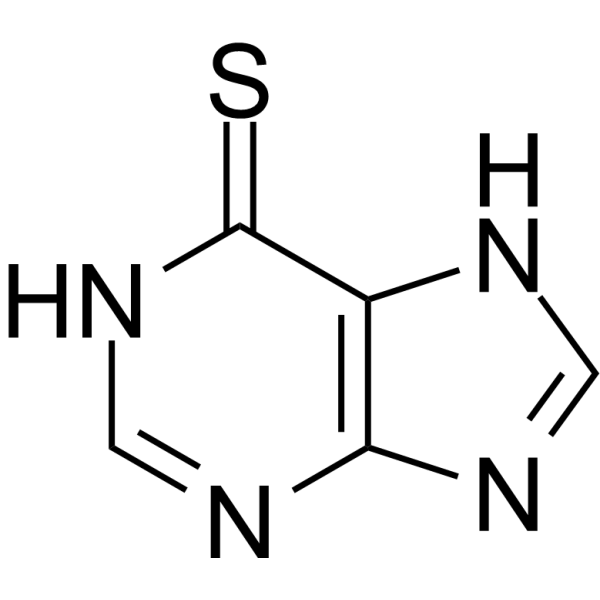
6-Mercaptopurine -
HY-B0078
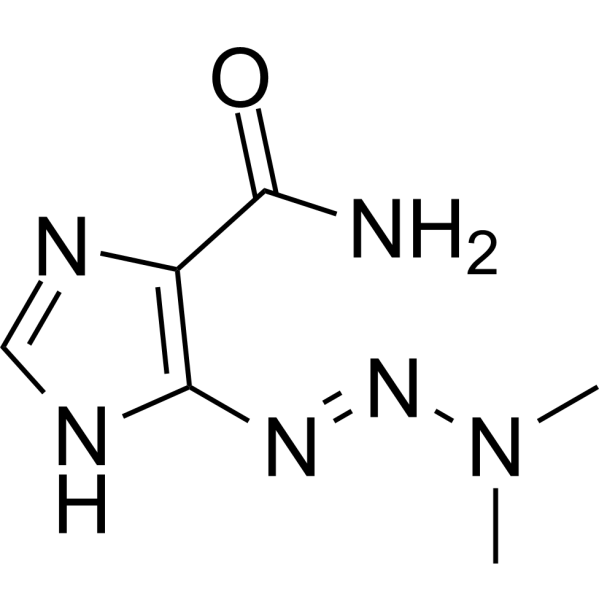
DacarbazineAnticancer Agent -
HY-14519A
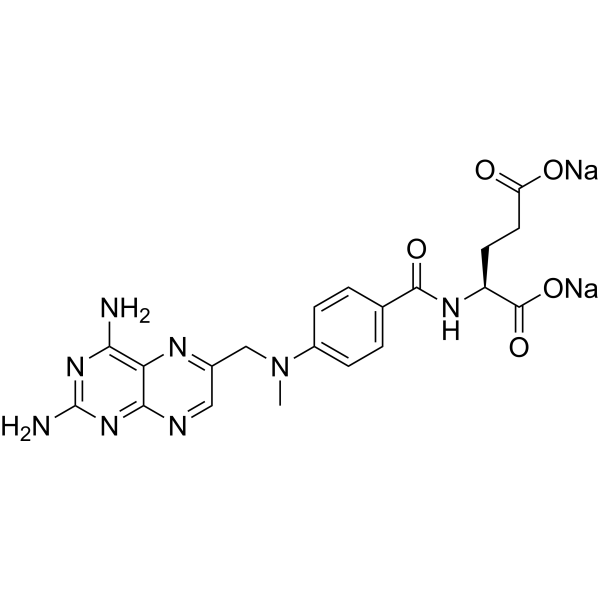
Methotrexate disodiumDihydrofolate Reductase Inhibitor -
HY-13538
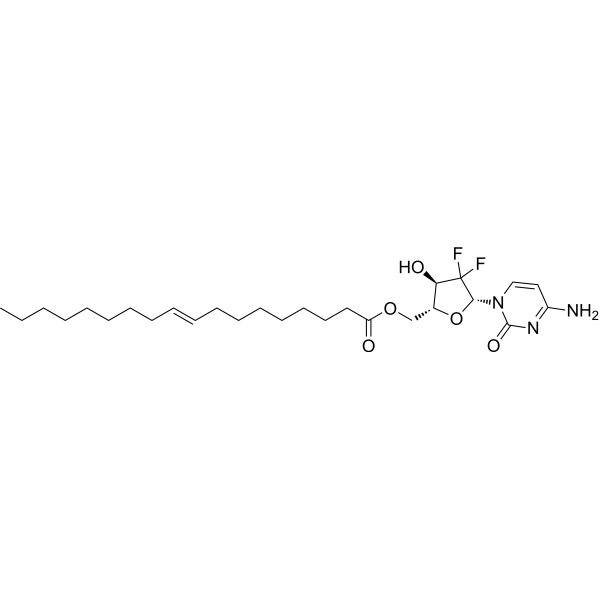
Gemcitabine elaidateGemcitabine Prodrug -
HY-90006
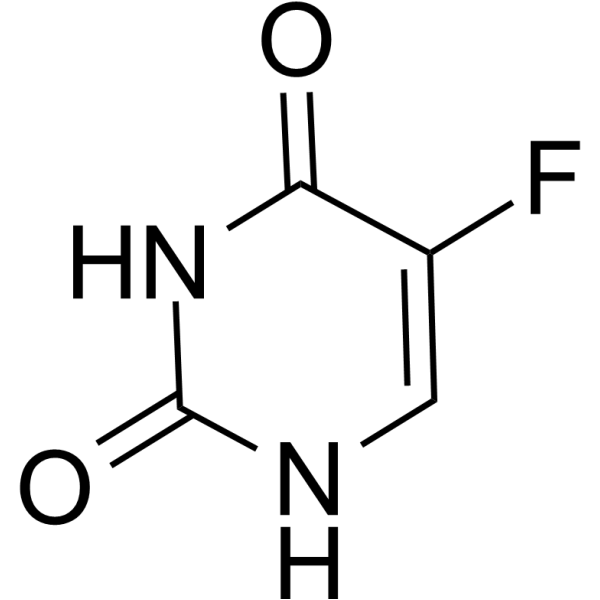
5-FluorouracilThymidylate Synthase Inhibitor -

HY-90006R
5-Fluorouracil (Standard)Thymidylate Synthase Inhibitor -
HY-A0063
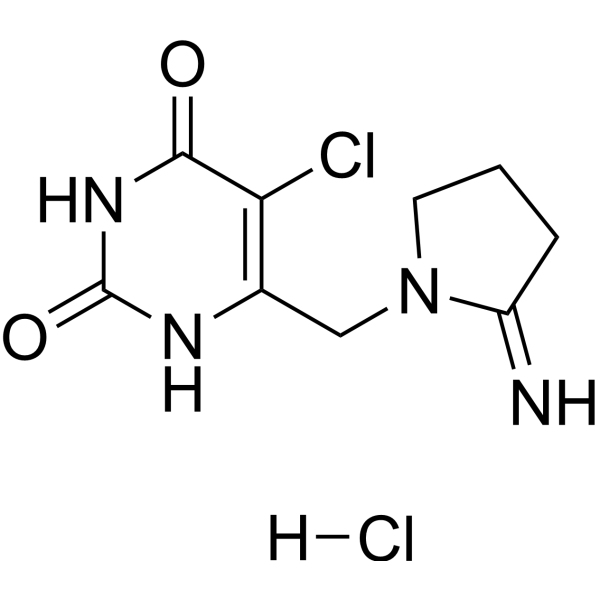
Tipiracil hydrochlorideTPase Inhibitor -
HY-B0228
AdenosineEndogenous Autacoid -

HY-13677R
6-Mercaptopurine (Standard) -
HY-N0157
Orotic acidActive Compound -
HY-B0097
FloxuridineOncology Antimetabolite
Publications Citing Use of MedChemExpress (MCE) Forodesine hydrochloride
More- Cell. 2019 Oct 31;179(4):864-879.e19. [Abstract]
- Cell Metab. 2025 Jan 7;37(1):87-103.e10. [Abstract]
- Nat Metab. 2020 Jul;2(7):635-647. [Abstract]
- Metabolism. 2026 Oct:183:156710.
- Nucleic Acids Res. 2020 Sep 25;48(17):e101. [Abstract]
- Med. 2026 Mar 27:101078. [Abstract]
- Biosens Bioelectron. 2020 Dec 1:169:112616. [Abstract]
- Int J Biol Sci. 2023 Jan 1;19(3):772-788. [Abstract]
- Chem Sci. 2024 May 14;15(23):8922-8933. [Abstract]
- Cell Rep. 2020 May 12;31(6):107640. [Abstract]
- J Med Chem. 2023 May 25;66(10):6652-6681. [Abstract]
- Plant J. 2024 Mar;117(5):1432-1452. [Abstract]
- Am J Physiol Cell Physiol. 2026 Jan 1;330(1):C142-C154. [Abstract]
- Oncol Res. 2025 Dec 30;34(1):13. [Abstract]
- Neurochem Res. 2024 Nov 16;50(1):13. [Abstract]
- J Biol Chem. 2022 May;298(5):101876. [Abstract]
- Biol Reprod. 2026 Jan 12:ioag007. [Abstract]
- bioRxiv. 2026 May 18.
- Blood Immunol Cell Ther. 2026 Jan 12.
- SSRN. 2024 Mar 14.
- bioRxiv. 2019 Oct.
 Customer Validation & Images

-
Histological Imaging/Staining
-
Bio/Physico-chemical Assay
-
WB
-
Cell Proliferation/Viability Assay
-
Bio/Physico-chemical Assay


Biological Activity
Description
IC50 & Target
IC50: 1.19 nM (Human PNP), 0.48 nM (Mouse PNP), 1.24 nM (Rat PNP), 0.66 nM (Monkey PNP) and 1.57 nM (Dog PNP)[2]
Cellular Effect
|
Cell Line

|
Type | Value | Description | References |
|---|---|---|---|---|
| PBMC | IC50 |
<0.1 μM
Compound: Forodesine Hydrochloride
|
Cytotoxicity against PHA stimulated human PBMC cells assessed as cell growth inhibition incubated for 72 hrs by MTT assay
Cytotoxicity against PHA stimulated human PBMC cells assessed as cell growth inhibition incubated for 72 hrs by MTT assay
|
[PMID: 37801827] |
In Vitro
Forodesine (10-30 μM; 24 and 48 hours; RPMI-8226, MOLT-4 and 5T33MM cells) treatment is partially inhibition of proliferation[1].
Forodesine (10-30 μM; 24 and 48 hours; RPMI-8226, MOLT-4 and 5T33MM cells) has no effect on the MM cells at 24 hours, while it could reduce the percentage of living cells in the MOLT-4 cells with 40%[1].
Forodesine (BCX-1777), in the presence of 2'-deoxyguanosine (dGuo, 3-10 μM), inhibits human lymphocyte proliferation activated by various agents such as interleukin-2 (IL-2), mixed lymphocyte reaction (MLR) and phytohemagglutinin (PHA) (IC50 values < 0.1-0.38 μM)[2].
MedChemExpress (MCE) has not independently confirmed the accuracy of these methods. They are for reference only.
-
Cell Line:Human RPMI-8226, human MOLT-4 (T-ALL) cells, 5T33MM (Multiple myeloma, MM).
-
Concentration:10 μM, 20 μM, 30 μM
-
Incubation Time:24 and 48 hours
-
Result:At the effects at 48 hours, a complete block in proliferation in the MOLT-4 cells and 15% reduction in the 5T33MM cells.
-
Cell Line:Human RPMI-8226, human MOLT-4 (T-ALL) cells, 5T33MM (Multiple myeloma, MM).
-
Concentration:10 μM, 20 μM, 30 μM
-
Incubation Time:24 and 48 hours
-
Result:A limited induction of apoptosis.
In Vivo
At a single dose of 10 mg/kg in mice, Forodesine elevates dGuo to approximately 5 μM[2].
n the human peripheral blood lymphocyte severe combined immunodeficiency (hu-PBL-SCID) mouse model, Forodesine is effective in prolonging the life span 2-fold or more[2].
MedChemExpress (MCE) has not independently confirmed the accuracy of these methods. They are for reference only.
Clinical Trial
| NCT Number | Sponsor | Condition | Start Date |
Phase
|
|---|---|---|---|---|
| NCT01329991 | Plexxikon| | 2011-05 | PHASE1 |


Chemical Information
-
CAS No. 284490-13-7
-
Appearance Solid
-
Molecular Weight 302.71
-
Formula C11H15ClN4O4
-
Color Light yellow to brown
-
SMILES
O=C1C(NC=C2[C@@H]3N[C@H](CO)[C@@H](O)[C@H]3O)=C2NC=N1.Cl
-
Synonyms
BCX-1777 hydrochloride; Immucillin-H hydrochloride
-
Shipping
Room temperature in continental US; may vary elsewhere.
-
Storage
-20°C, stored under nitrogen, away from moisture
* In solvent : -80°C, 1 year; -20°C, 6 months (stored under nitrogen, away from moisture)


Publications (21)
-
Journal Impact Factor
-
Most Recent
-
Cell
Stress-Induced Metabolic Disorder in Peripheral CD4+ T Cells Leads to Anxiety-like Behavior. [Abstract]2019 Oct 31;179(4):864-879.e19. PMID: 31675497 -
Cell Metab
Stress triggers irritable bowel syndrome with diarrhea through a spermidine-mediated decline in type I interferon. [Abstract]2025 Jan 7;37(1):87-103.e10. PMID: 39366386 -
Nat Metab
Inosine is an alternative carbon source for CD8+-T-cell function under glucose restriction. [Abstract]2020 Jul;2(7):635-647. PMID: 32694789 -
-
Nucleic Acids Res
2020 Sep 25;48(17):e101. PMID: 32797156 -
Med
Large-scale quantitative metabolomics and mass spectrometry imaging define the metabolic atlas in human acute type A aortic dissection. [Abstract]2026 Mar 27:101078. PMID: 41903544 -
Biosens Bioelectron
A thermophoresis-based biosensor for real-time detection of inorganic phosphate during enzymatic reactions. [Abstract]2020 Dec 1:169:112616. PMID: 32979591 -
Int J Biol Sci
Xanthine dehydrogenase rewires metabolism and the survival of nutrient deprived lung adenocarcinoma cells by facilitating UPR and autophagic degradation. [Abstract]2023 Jan 1;19(3):772-788. PMID: 36778128 -
Chem Sci
2024 May 14;15(23):8922-8933. PMID: 38873061
Forodesine hydrochloride purchased from MedChemExpress. Usage Cited in: Chem Sci. 2024 May 14;15(23):8922-8933. [Abstract]
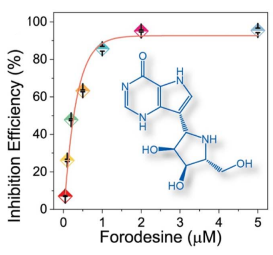
Dose-dependent inhibition of PNP activity (20 U/L) by Forodesine (1-5 μM; 60 min) using MPR-AuNCs as luminescent probes. The inset shows structure of Forodesine.
-
Cell Rep
SAMHD1 Limits the Efficacy of Forodesine in Leukemia by Protecting Cells against the Cytotoxicity of dGTP. [Abstract]2020 May 12;31(6):107640. PMID: 32402273 -
J Med Chem
Design, Synthesis, Biological Evaluation, and Crystallographic Study of Novel Purine Nucleoside Phosphorylase Inhibitors. [Abstract]2023 May 25;66(10):6652-6681. PMID: 37134237 -
Plant J
Plant nucleoside N-ribohydrolases: riboside binding and role in nitrogen storage mobilization. [Abstract]2024 Mar;117(5):1432-1452. PMID: 38044809 -
Am J Physiol Cell Physiol
2026 Jan 1;330(1):C142-C154. PMID: 41269663 -
Oncol Res
PNP as a Metabolic and Prognostic Driver of Breast Cancer Aggressiveness: Insights from Patient Tissue and Cell Models. [Abstract]2025 Dec 30;34(1):13. PMID: 41502507
Forodesine hydrochloride purchased from MedChemExpress. Usage Cited in: Oncol Res. 2025 Dec 30;34(1):13. [Abstract]
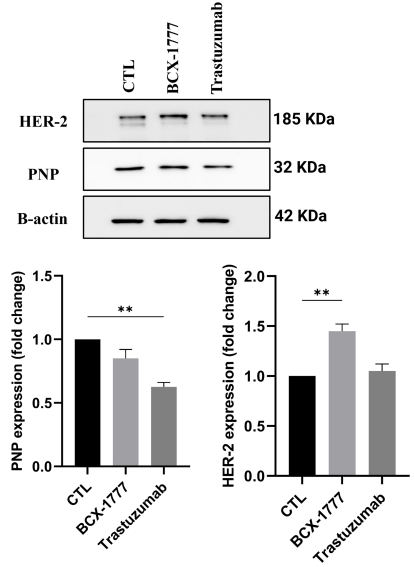
Correlation between PNP and HER-2 in SKBR3 cells. Western blot analysis showing protein expression levels of HER-2 and PNP in SKBR3 cells treated with vehicle control (CTL), Forodesine (BCX-1777, a PNP inhibitor; 10 μM; 48 h), or trastuzumab (a HER-2 inhibitor). The results showed that inhibition of PNP using BCX-1777 resulted in significant (p < 0.01) upregulation of HER-2 by ~1.45 fold.
Forodesine hydrochloride purchased from MedChemExpress. Usage Cited in: Oncol Res. 2025 Dec 30;34(1):13. [Abstract]
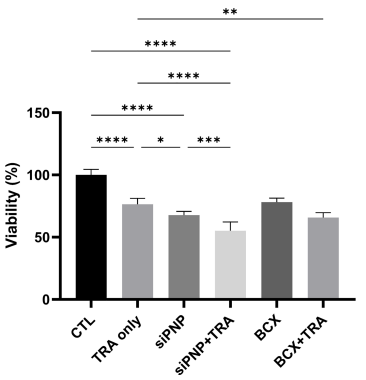
SKBR3 cell viability was assessed using the MTT assay and expressed as a percentage relative to untreated control (CTL) cells. Data shown are representative blots from three independent biological replicates (n = 3). The results showed that treatment with Forodesine (BCX-1777, 10 μM; 48 h) alone, a pharmacological PNP inhibitor, significantly reduced the cell viability by ~30%. A combination of BCX-1777 with trastuzumab resulted in a further reduction in the cell viability (~34%, p < 0.01). These results demonstrated that inhibition of PNP enhanced the cytotoxic effect of HER-2 inhibition.
-
Neurochem Res
2024 Nov 16;50(1):13. PMID: 39549173 -
J Biol Chem
Entecavir competitively inhibits deoxyguanosine and deoxyadenosine phosphorylation in isolated mitochondria and the perfused rat heart. [Abstract]2022 May;298(5):101876. PMID: 35358513 -
Biol Reprod
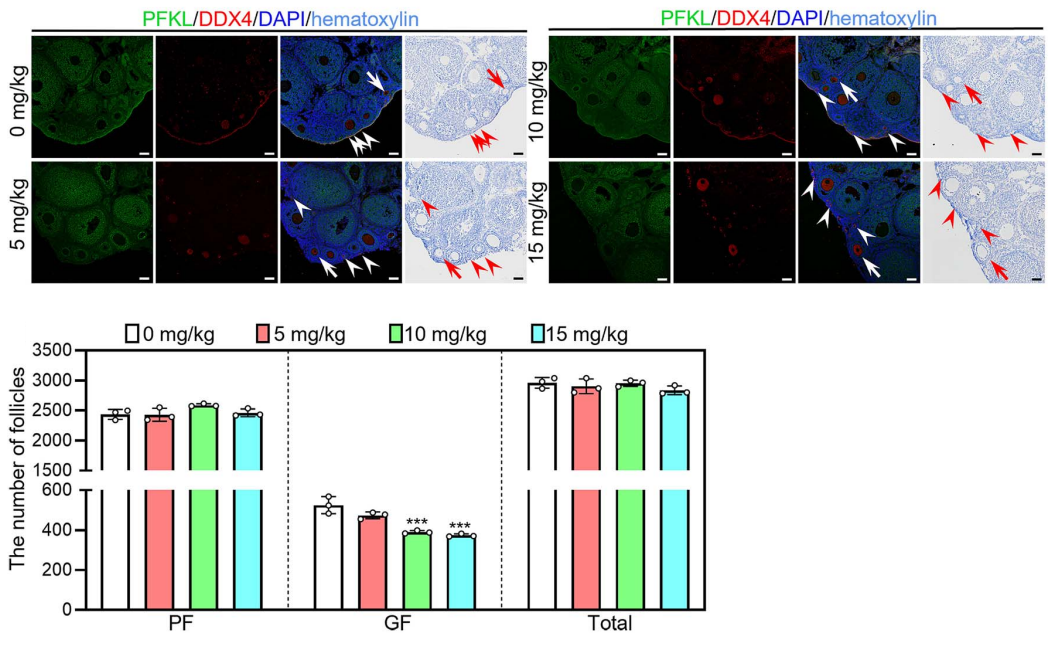
2026 Jan 12:ioag007. PMID: 41524735
Forodesine hydrochloride purchased from MedChemExpress. Usage Cited in: Biol Reprod. 2026 Jan 12:ioag007. [Abstract]
The adolescent mice were administered water either with or without 0-15 mg/kg Forodesine (BCX-1777) for 1 week, and then the ovaries were obtained for immunofluorescence and hematoxylin staining. The results showed that compared with the control, oral administration of 10 and 15 mg/kg BCX-1777 significantly decreased the number of growing follicles in the ovaries.
Forodesine hydrochloride purchased from MedChemExpress. Usage Cited in: Biol Reprod. 2026 Jan 12:ioag007. [Abstract]
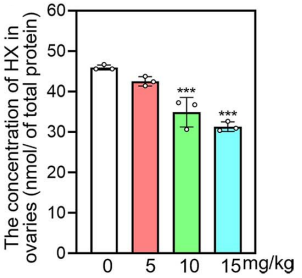
The adolescent mice were administered water either with or without 0-15 mg/kg Forodesine (BCX-1777) for 1 week, and then the ovaries were obtained for hypoxanthine concentration detection. The results showed that, compared with the control, oral administration of 10 and 15 mg/kg BCX-1777 significantly decreased hypoxanthine levels in the ovaries.
-
-
-
-


Solvent & Solubility
In Vitro:
H2O : 100 mg/mL (330.34 mM; Need ultrasonic)
DMSO : 10 mg/mL (33.03 mM; Need ultrasonic; Hygroscopic DMSO has a significant impact on the solubility of product, please use newly opened DMSO)
Please refer to the solubility information to select the appropriate solvent. Once prepared, please aliquot and store the solution to prevent product inactivation from repeated freeze-thaw cycles.
Storage method and period of stock solution: -80°C, 1 year; -20°C, 6 months (stored under nitrogen, away from moisture). When stored at -80°C, please use it within 1 year. When stored at -20°C, please use it within 6 months.
* Note: If you choose water as the stock solution, please dilute it to the working solution, then filter and sterilize it with a 0.22 μm filter before use.
Please refer to the solubility information to select the appropriate solvent. Once prepared, please aliquot and store the solution to prevent product inactivation from repeated freeze-thaw cycles.
Storage method and period of stock solution: -80°C, 1 year; -20°C, 6 months (stored under nitrogen, away from moisture). When stored at -80°C, please use it within 1 year. When stored at -20°C, please use it within 6 months.
* Note: If you choose water as the stock solution, please dilute it to the working solution, then filter and sterilize it with a 0.22 μm filter before use.
Concentration (start) × Volume (start) = Concentration (final) × Volume (final)
In Vivo:
Select the appropriate dissolution method based on your experimental animal and administration route.
- For the following dissolution methods, please ensure to first prepare a clear stock solution using an In Vitro approach and then sequentially add co-solvents:
- To ensure reliable experimental results, the clarified stock solution can be appropriately stored based on storage conditions. As for the working solution for In Vivo experiments, it is recommended to prepare freshly and use it on the same day.
- The percentages shown for the solvents indicate their volumetric ratio in the final prepared solution. If precipitation or phase separation occurs during preparation, heat and/or sonication can be used to aid dissolution.
For the following dissolution methods, please prepare the working solution directly:
It is recommended to prepare fresh solutions and use them promptly within a short period of time.
The percentages shown for the solvents indicate their volumetric ratio in the final prepared solution. If precipitation or phase separation occurs during preparation, heat and/or sonication can be used to aid dissolution.
Add each solvent one by one: PBS
Solubility: 36.67 mg/mL (121.14 mM); Clear solution; Need ultrasonic
In Vivo Dissolution Calculator
Please enter the basic information of animal experiments:
-
-
-
-
Recommended: Prepare an additional quantity of animals to account for potential losses during experiments.
Working solution concentration: 0.22 mg/mL
This product has good water solubility, please refer to the measured solubility data in water/PBS/Saline for details.


Purity & Documentation
-
Data Sheet (283 KB)
-
SDS (479 KB)
- English - EN (479 KB)
- Français - FR (479 KB)
- Deutsch - DE (479 KB)
- Norwegian - NO (479 KB)
- Español - ES (479 KB)
- Swedish - SV (479 KB)
- Italian - IT (479 KB)
- Korean - KR (479 KB)
- Portuguese - PT (479 KB)
-
Handling Instructions (2659 KB)
References
[1]. Bieghs L, et al. The effects of forodesine in murine and human multiple myeloma cells. Adv Hematol. 2010;2010:131895. [Content Brief]
[2]. Bantia S, et al. Purine nucleoside phosphorylase inhibitor BCX-1777 (Immucillin-H)--a novel potent and orally active immunosuppressive agent. Int Immunopharmacol. 2001 Jun;1(6):1199-210. [Content Brief]


Complete Stock Solution Preparation Table
Please refer to the solubility information to select the appropriate solvent. Once prepared, please aliquot and store the solution to prevent product inactivation from repeated freeze-thaw cycles.
Storage method and period of stock solution: -80°C, 1 year; -20°C, 6 months (stored under nitrogen, away from moisture). When stored at -80°C, please use it within 1 year. When stored at -20°C, please use it within 6 months.
| Optional Solvent | Concentration Solvent Mass | 1 mg | 5 mg | 10 mg | 25 mg |
|---|---|---|---|---|---|
| DMSO / H2O | 1 mM | 3.3034 mL | 16.5172 mL | 33.0345 mL | 82.5861 mL |
| 5 mM | 0.6607 mL | 3.3034 mL | 6.6069 mL | 16.5172 mL | |
| 10 mM | 0.3303 mL | 1.6517 mL | 3.3034 mL | 8.2586 mL | |
| 15 mM | 0.2202 mL | 1.1011 mL | 2.2023 mL | 5.5057 mL | |
| 20 mM | 0.1652 mL | 0.8259 mL | 1.6517 mL | 4.1293 mL | |
| 25 mM | 0.1321 mL | 0.6607 mL | 1.3214 mL | 3.3034 mL | |
| 30 mM | 0.1101 mL | 0.5506 mL | 1.1011 mL | 2.7529 mL | |
| H2O | 40 mM | 0.0826 mL | 0.4129 mL | 0.8259 mL | 2.0647 mL |
| 50 mM | 0.0661 mL | 0.3303 mL | 0.6607 mL | 1.6517 mL | |
| 60 mM | 0.0551 mL | 0.2753 mL | 0.5506 mL | 1.3764 mL | |
| 80 mM | 0.0413 mL | 0.2065 mL | 0.4129 mL | 1.0323 mL | |
| 100 mM | 0.0330 mL | 0.1652 mL | 0.3303 mL | 0.8259 mL |
* Note: If you choose water as the stock solution, please dilute it to the working solution, then filter and sterilize it with a 0.22 μm filter before use.


Forodesine hydrochloride Related Classifications
HY-16209 Related Classifications
 Powered by Bioz