



Ditiocarb sodium
Based on 4 publication(s) in Google Scholar
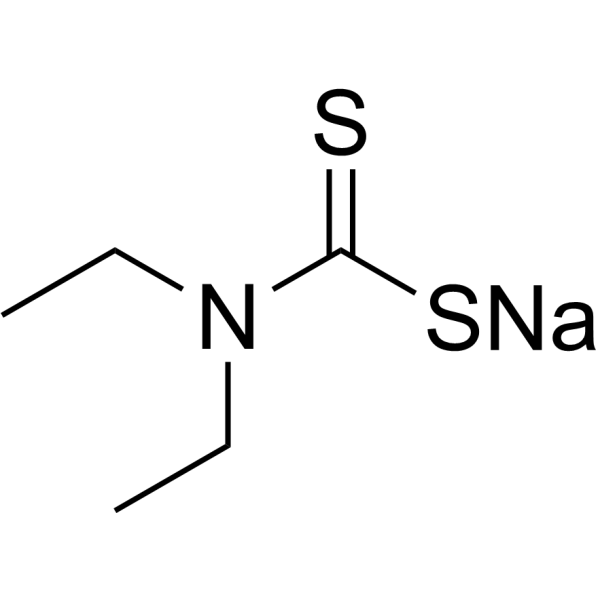
Ditiocarb sodium (Sodium diethyldithiocarbamate) is an orally active copper reagent. Ditiocarb sodium exhibits activities such as antioxidation, chelation, anti-tumor effects, immunomodulation, and anti-HIV properties. Ditiocarb sodium can be used in the research of tumors, inflammatory, and immune-related diseases.
For research use only. We do not sell to patients.
- Purity : 99.78%
- CAS No.: 148-18-5
- Formula: C5H10NNaS2
- Molecular Weight:171.26
-
Storage:
4°C, sealed storage, away from moisture
* In solvent : -80°C, 6 months; -20°C, 1 month (sealed storage, away from moisture)

To place orders, for customer services and technical support, please contact: MedChemExpress USA
Tel: 609-228-6898 E-mail: [email protected] [email protected]


-
 Biological Activity
-
Chemical Information
-
Solvent & Solubility
- Purity & Documentation
- References
-
 Help & FAQs



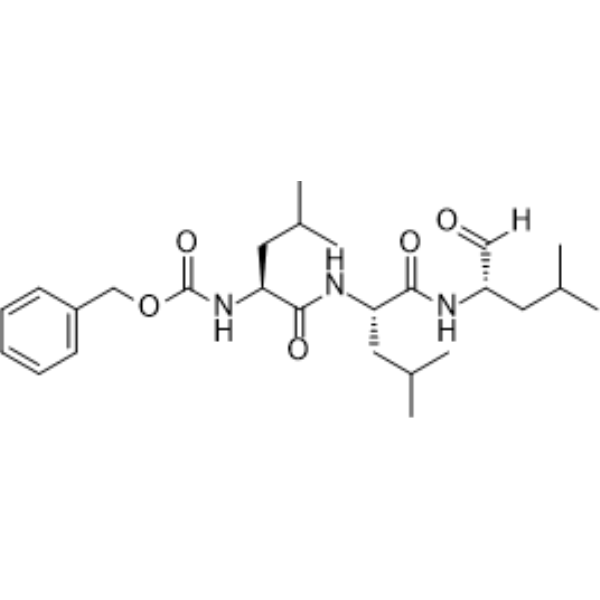
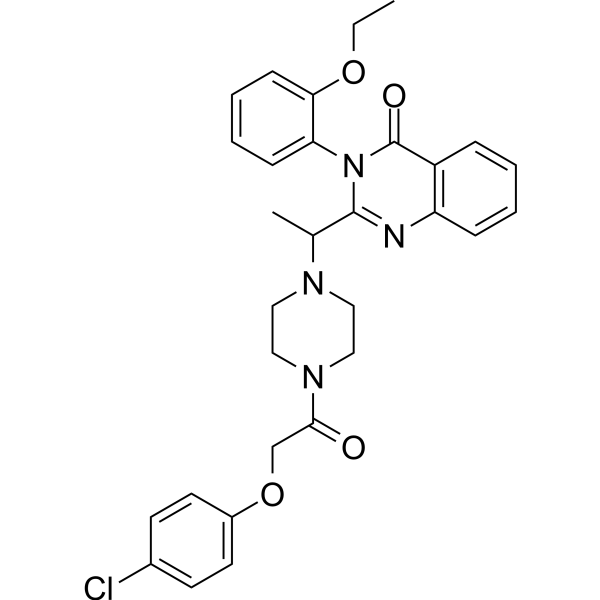
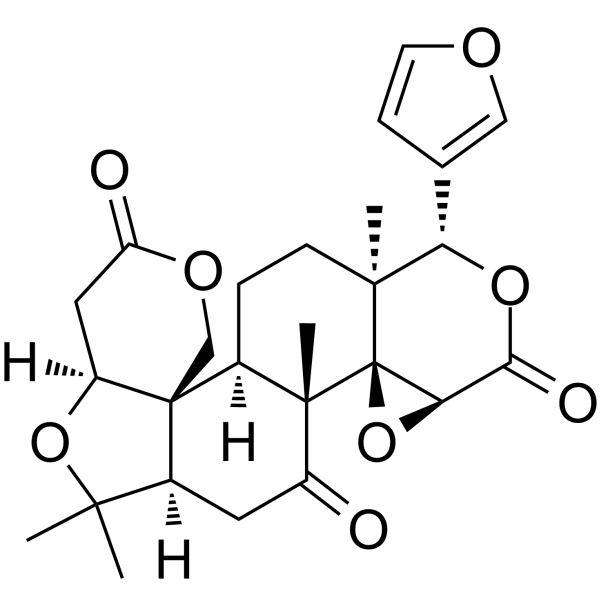


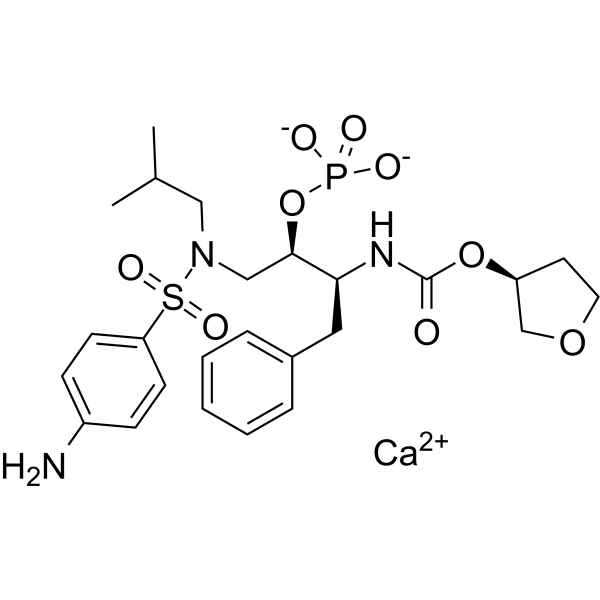

Publications Citing Use of MedChemExpress (MCE) Ditiocarb sodium
More

Biological Activity
Description
Cellular Effect
|
Cell Line

|
Type | Value | Description | References |
|---|---|---|---|---|
| CEM-SS | IC50 |
0.0015 μM
Compound: ddC
|
Inhibitory concentration for anti-HIV activity against HIV-IIIB in CEM-SS cells
Inhibitory concentration for anti-HIV activity against HIV-IIIB in CEM-SS cells
|
[PMID: 9836613] |
| HeLa | IC50 |
>1280 μg/mL
Compound: 4f
|
Cytotoxicity against human HeLa cells after 24 hrs by CCK8 assay
Cytotoxicity against human HeLa cells after 24 hrs by CCK8 assay
|
[PMID: 30262427] |
| MT4 | IC50 |
0.137 μM
Compound: DDC
|
Ability to block replication of HIV-1 virus in mock infected MT-4 cells
Ability to block replication of HIV-1 virus in mock infected MT-4 cells
|
[PMID: 1956037] |
In Vitro
Ditiocarb sodium can act as an accelerator in the cementation of copper from copper sulfate solution on zinc. It reacts with Cu2+ solution to form a copper diethyldithiocarbamate complex, thereby increasing the rate of copper cementation. The higher its concentration, the more significant the increase in the cementation rate[1].
MedChemExpress (MCE) has not independently confirmed the accuracy of these methods. They are for reference only.
In Vivo
Ditiocarb sodium (80-100 μmol; intraperitoneal injection; twice a week; 22 weeks) exhibits antitumor activity in a mouse skin tumor model[4].
MedChemExpress (MCE) has not independently confirmed the accuracy of these methods. They are for reference only.
-
Animal Model:Male F344 rats treated Cisplatin (HY-17394)[3]
-
Dosage:500 and 750 mg/kg
-
Administration:Intraperitoneal injection; single dose: between 1 and 4 hr after Cisplatin administration
-
Result:Significantly reduced serum BUN levels.
Alleviated weight loss, eliminated diarrhea.
Improved renal histology with only minimal degeneration at the corticomedullary junction, while administration at 6 hours after cis-platinum was ineffective.
-
Animal Model:Female CF-1 mice aged 7-9 weeks old treated DMBA (HY-W011845) and TPA (HY-18739) or Mezerein[4]
-
Dosage:80 and 100 μmol
-
Administration:Intraperitoneal injection; twice a week; 22 weeks
-
Result:Significantly inhibited complete tumor promotion by TPA and stage 2 promotion by mezerein.
Reduced TPA-decreased GSH peroxidase and TPA-induced ODC activities.
Suppressed TPA-stimulated DNA synthesis.


Chemical Information
-
CAS No. 148-18-5
-
Appearance Solid
-
Molecular Weight 171.26
-
Formula C5H10NNaS2
-
Color White to off-white
-
SMILES
S=C(S[Na])N(CC)CC
-
Synonyms
Sodium diethyldithiocarbamate
-
Shipping
Room temperature in continental US; may vary elsewhere.
-
Storage
4°C, sealed storage, away from moisture
* In solvent : -80°C, 6 months; -20°C, 1 month (sealed storage, away from moisture)


Publications (4)
-
Journal Impact Factor
-
Most Recent
-
J Exp Clin Cancer Res
Ferroptosis inducers enhanced cuproptosis induced by copper ionophores in primary liver cancer. [Abstract]2023 Jun 6;42(1):142. PMID: 37277863 -
J Hazard Mater
Stereostructure-activity mechanism of cyproconazole by cytochrome P450 in rat liver microsomes: A combined experimental and computational study. [Abstract]2021 Aug 15:416:125764. PMID: 33827004 -
J Agric Food Chem
Enantioselective Metabolic Mechanism and Metabolism Pathway of Pydiflumetofen in Rat Liver Microsomes: In Vitro and In Silico Study. [Abstract]2022 Mar 2;70(8):2520-2528. PMID: 35184556 -
Pest Manag Sci
The native rice leaf folder can enhance rice resistance against the invasive fall armyworm by inducing the jasmonate-mediated tryptophan metabolism pathway. [Abstract]2026 May;82(5):5026-5039. PMID: 41635108


Solvent & Solubility
In Vitro:
H2O : ≥ 100 mg/mL (583.91 mM)
DMSO : 100 mg/mL (583.91 mM; Need ultrasonic; Hygroscopic DMSO has a significant impact on the solubility of product, please use newly opened DMSO)
* "≥" means soluble, but saturation unknown.
Please refer to the solubility information to select the appropriate solvent. Once prepared, please aliquot and store the solution to prevent product inactivation from repeated freeze-thaw cycles.
Storage method and period of stock solution: -80°C, 6 months; -20°C, 1 month (sealed storage, away from moisture). When stored at -80°C, please use it within 6 months. When stored at -20°C, please use it within 1 month.
* Note: If you choose water as the stock solution, please dilute it to the working solution, then filter and sterilize it with a 0.22 μm filter before use.
Please refer to the solubility information to select the appropriate solvent. Once prepared, please aliquot and store the solution to prevent product inactivation from repeated freeze-thaw cycles.
Storage method and period of stock solution: -80°C, 6 months; -20°C, 1 month (sealed storage, away from moisture). When stored at -80°C, please use it within 6 months. When stored at -20°C, please use it within 1 month.
* Note: If you choose water as the stock solution, please dilute it to the working solution, then filter and sterilize it with a 0.22 μm filter before use.
Concentration (start) × Volume (start) = Concentration (final) × Volume (final)
In Vivo:
Select the appropriate dissolution method based on your experimental animal and administration route.
- For the following dissolution methods, please ensure to first prepare a clear stock solution using an In Vitro approach and then sequentially add co-solvents:
- To ensure reliable experimental results, the clarified stock solution can be appropriately stored based on storage conditions. As for the working solution for In Vivo experiments, it is recommended to prepare freshly and use it on the same day.
- The percentages shown for the solvents indicate their volumetric ratio in the final prepared solution. If precipitation or phase separation occurs during preparation, heat and/or sonication can be used to aid dissolution.
Add each solvent one by one: 10% DMSO 40% PEG300 5% Tween-80 45% Saline
Solubility: ≥ 2.5 mg/mL (14.60 mM); Clear solution
This protocol yields a clear solution of ≥ 2.5 mg/mL (saturation unknown).
Taking 1 mL working solution as an example, add 100 μL DMSO stock solution (25.0 mg/mL) to 400 μL PEG300, and mix evenly; then add 50 μL Tween-80 and mix evenly; then add 450 μL Saline to adjust the volume to 1 mL.
Preparation of Saline: Dissolve 0.9 g sodium chloride in ddH₂O and dilute to 100 mL to obtain a clear Saline solution.
Add each solvent one by one: 10% DMSO 90% (20% SBE-β-CD in Saline)
Solubility: ≥ 2.5 mg/mL (14.60 mM); Clear solution
This protocol yields a clear solution of ≥ 2.5 mg/mL (saturation unknown).
Taking 1 mL working solution as an example, add 100 μL DMSO stock solution (25.0 mg/mL) to 900 μL 20% SBE-β-CD in Saline, and mix evenly.
Preparation of 20% SBE-β-CD in Saline (4°C, storage for one week): 2 g SBE-β-CD powder is dissolved in 10 mL Saline, completely dissolve until clear.
In Vivo Dissolution Calculator
Please enter the basic information of animal experiments:
-
-
-
-
Recommended: Prepare an additional quantity of animals to account for potential losses during experiments.
Working solution concentration: 0.22 mg/mL
This product has good water solubility, please refer to the measured solubility data in water/PBS/Saline for details.


Purity & Documentation
-
Data Sheet (277 KB)
-
SDS (394 KB)
- English - EN (394 KB)
- Français - FR (394 KB)
- Deutsch - DE (394 KB)
- Norwegian - NO (394 KB)
- Español - ES (394 KB)
- Swedish - SV (394 KB)
- Italian - IT (394 KB)
- Korean - KR (394 KB)
- Portuguese - PT (394 KB)
-
Handling Instructions (2659 KB)
References
[2]. Hersh EM, et al. Ditiocarb sodium (diethyldithiocarbamate) therapy in patients with symptomatic HIV infection and AIDS. A randomized, double-blind, placebo-controlled, multicenter study. JAMA. 1991 Mar 27;265(12):1538-44. [Content Brief]
[3]. Borch RF, et al. Inhibition of cis-platinum nephrotoxicity by diethyldithiocarbamate rescue in a rat model. Proc Natl Acad Sci U S A. 1979 Dec;76(12):6611-4. [Content Brief]
[4]. Perchellet JP, et al. Inhibition of multistage tumor promotion in mouse skin by diethyldithiocarbamate. Cancer Res. 1987 Dec 1;47(23):6302-9. [Content Brief]


Complete Stock Solution Preparation Table
Please refer to the solubility information to select the appropriate solvent. Once prepared, please aliquot and store the solution to prevent product inactivation from repeated freeze-thaw cycles.
Storage method and period of stock solution: -80°C, 6 months; -20°C, 1 month (sealed storage, away from moisture). When stored at -80°C, please use it within 6 months. When stored at -20°C, please use it within 1 month.
| Optional Solvent | Concentration Solvent Mass | 1 mg | 5 mg | 10 mg | 25 mg |
|---|---|---|---|---|---|
| H2O / DMSO | 1 mM | 5.8391 mL | 29.1954 mL | 58.3908 mL | 145.9769 mL |
| 5 mM | 1.1678 mL | 5.8391 mL | 11.6782 mL | 29.1954 mL | |
| 10 mM | 0.5839 mL | 2.9195 mL | 5.8391 mL | 14.5977 mL | |
| 15 mM | 0.3893 mL | 1.9464 mL | 3.8927 mL | 9.7318 mL | |
| 20 mM | 0.2920 mL | 1.4598 mL | 2.9195 mL | 7.2988 mL | |
| 25 mM | 0.2336 mL | 1.1678 mL | 2.3356 mL | 5.8391 mL | |
| 30 mM | 0.1946 mL | 0.9732 mL | 1.9464 mL | 4.8659 mL | |
| 40 mM | 0.1460 mL | 0.7299 mL | 1.4598 mL | 3.6494 mL | |
| 50 mM | 0.1168 mL | 0.5839 mL | 1.1678 mL | 2.9195 mL | |
| 60 mM | 0.0973 mL | 0.4866 mL | 0.9732 mL | 2.4329 mL | |
| 80 mM | 0.0730 mL | 0.3649 mL | 0.7299 mL | 1.8247 mL | |
| 100 mM | 0.0584 mL | 0.2920 mL | 0.5839 mL | 1.4598 mL |
* Note: If you choose water as the stock solution, please dilute it to the working solution, then filter and sterilize it with a 0.22 μm filter before use.


Ditiocarb sodium Related Classifications
HY-B1637 Related Classifications
 Powered by Bioz