



Bacterial
Anything that destroys bacteria or suppresses their growth or their ability to reproduce. Heat, chemicals such as chlorine, and antibiotic drugs all have antibacterial properties. Many antibacterial products for cleaning and handwashing are sold today. Such products do not reduce the risk for symptoms of viral infectious diseases in otherwise healthy persons. This does not preclude the potential contribution of antibacterial products to reducing symptoms of bacterial diseases in the home.
All Product Categories
-
Bacterial Inhibitors
(7424)
View all products
-
Bacterial Agonists
(3)
View all products
-
Bacterial Antagonists
(9)
View all products
-
Bacterial Activators
(23)
View all products
-
Bacterial Modulators
(20)
View all products
-
Bacterial Chemicals
(2)
View all products
-
Bacterial Inducers
(7)
View all products
-
Bacterial Controls
(14)
View all products
-
Bacterial Substrates
(2)
View all products
-
Bacterial Ligand
(1)
View all products
-
Bacterial Related Products (8720)
Related Products (8720)

-
Antibodies (14)
-
Related Compound Screening Libraries (1)
-
3-(2-Hydroxyethyl)quinazoline-2,4(1H,3H)-dione
 0 ImagesCat. No.: HY-W077690CAS No.: 1207-75-6
-
Sulfatrozole
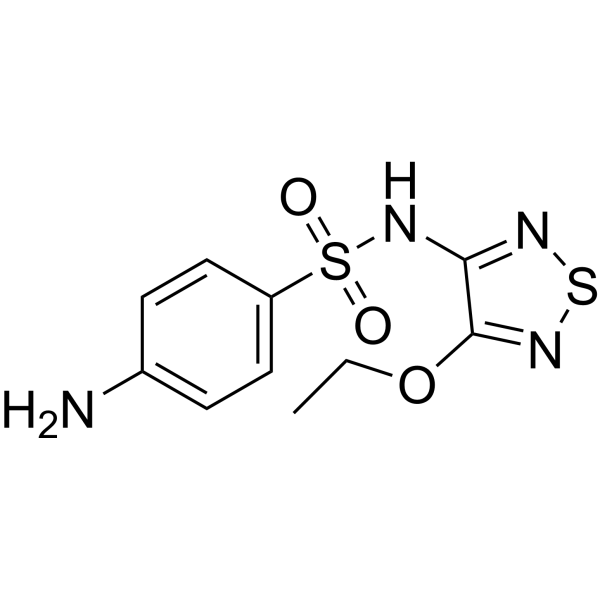 0 ImagesCat. No.: HY-156975CAS No.: 13369-07-8Sulfatrozole is a sulfanilamide derivative. Sulfatrozole is an antimicrobial agent with broad-spectrum activity.
-
Monensin C
 0 ImagesCat. No.: HY-N12866CAS No.: 31980-87-7Monensin C is an oxygen-containing heterocyclic polyether antibiotic. Monensin C has antibacterial, mycobacterial, fungal and protozoan activity, but it has a weaker effect on Gram-negative bacteria and has an inhibitory effect on HeLa cells.
-
Metallo-β-lactamase-IN-9
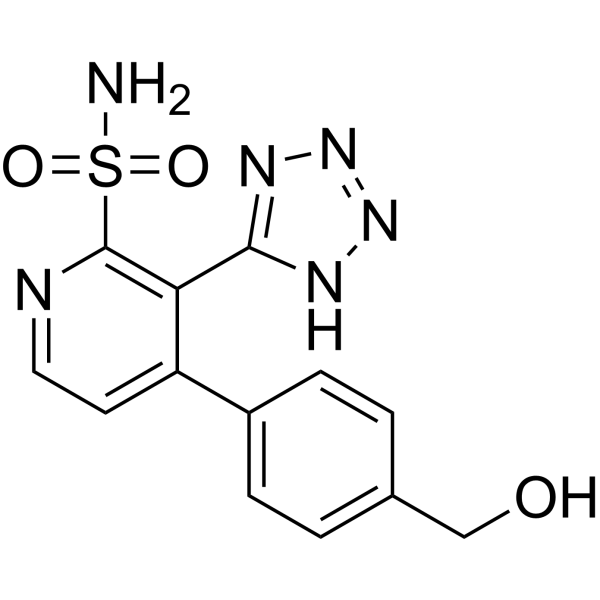 0 ImagesCat. No.: HY-152105CAS No.: 1802363-75-2Metallo-β-lactamase-IN-9 (Compound 23) is a pan metallo-beta-lactamase (MBL) inhibitor with IC50s of 35, 269 and 369 nM against NDM-1, VIM-1 and IMP-1, respectively.
-
Mycinamicin Ⅵ
 0 ImagesCat. No.: HY-N14505CAS No.: 85687-36-1Mycinamicin VI is a macrolide antibiotic. Mycinamicin VI shows activity against Gram-positive bacteria.
-
Emerimicin IV
 0 ImagesCat. No.: HY-N5189CAS No.: 52931-43-8Emerimicin IV mainly has activity against Gram-positive bacteria.
-
Ro 14-1761
 0 ImagesCat. No.: HY-129691CAS No.: 82502-19-0Ro 14-1761 is a third-generation cephalosporin with antibacterial activity.
-
Calanolide E
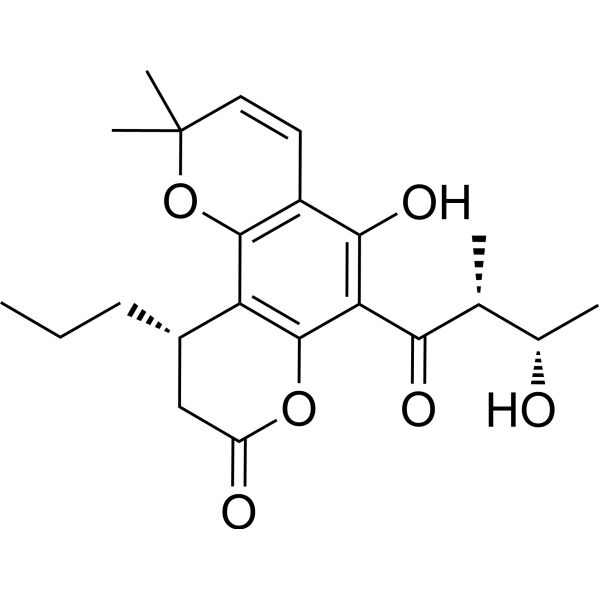 0 ImagesCat. No.: HY-N2984CAS No.: 142566-61-8Calanolide E is a natural coumarin with weakly inhibitory towards the Bacilli strains with MIC values ranging from 0.25-0.50 mg/mL.
-
Antibacterial agent 312
 0 ImagesCat. No.: HY-180812Antibacterial agent 312 (Compound 8c) is a highly effective antibacterial agent that can effectively damage the integrity of bacterial membranes and enhance membrane permeability. Antibacterial agent 312 exhibits MIC values against Vibrio parahaemolyticus and Vibrio alginolyticus of 6 and 16 μg/mL respectively. Antibacterial agent 312 has bactericidal activity against Vibrio parahaemolyticus and can effectively inhibit the formation of biofilms. Antibacterial agent 312 demonstrates excellent biological safety and can be used for research on the infection of the aquatic pathogen Vibrio parahaemolyticus.
-
Lactonamycin
 0 ImagesCat. No.: HY-N14722CAS No.: 182234-02-2Lactonamycin had strong activity against Gram-positive bacteria including Staphylococcus, Streptococcus, Enterococcus, MRSA (MIC of 0.39-0.78 μg/mL) and VRE (MIC of 0.39-0.78 μg/mL). Lactonamycin also has inhibitory effect on L-1210, P388, S180, FS-3, Ehrlich, B16-BL5 and other tumor cell lines (IC50s of 0.06-3.3 μg/mL).
-
Virginiamycin S1 (Standard)
 0 ImagesCat. No.: HY-N6680RCAS No.: 23152-29-6Synonyms: Virginiamycin S (Standard)Virginiamycin S1 (Standard) is the analytical standard of Virginiamycin S1. This product is intended for research and analytical applications. Virginiamycin S1 is a cyclic hexadepsipeptide antibiotic, inhibits bacterial protein synthesis at the level of aminoacyl-tRNA binding and peptide bond formation. Virginiamycin S1 belongs to the type B compounds in the streptogramin family and is produced by Streptomyces virginiae, shows a strong bactericidal activity against a wide range of Gram-positive bacteria. Virginiamycin S1 together with virginiamycin M1 is more effective in treat multidrug-resistant bacterial infections.
-
Lankacyclinol A
 0 ImagesCat. No.: HY-129347CAS No.: 52212-91-6Synonyms: T-2636ELankacyclinol A is an orally active antibiotic isolated from Streptomyces rochei. Lankacyclinol A has broad-spectrum antimicrobial activity against both Gram-positive and Gram-negative bacteria. Lankacyclinol A exhibits low toxicity in mice.
-
Resorstatin
 0 ImagesCat. No.: HY-124106CAS No.: 139552-96-8Resorstatin is a dialkylresorcinol that can be isolated from a liquid culture of Pseudomonas sp. Ki19. Resorstatin exhibits antimicrobial activity.
-
Anti-virulence factor-IN-3
 0 ImagesCat. No.: HY-179376Anti-virulence factor-IN-3 (Compound 21) is a covalent β-aminosulfinyl type anthrax edema factor (EF) inhibitor, with a Ki value of 0.44 μM. Anti-virulence factor-IN-3 generates an active ethylene sulfinyl intermediate, which forms an irreversible covalent bond with the Lys residue at the active center of EF, permanently inhibiting the adenylate cyclase activity of EF. Anti-virulence factor-IN-3 effectively inhibits the cAMP production induced by EF, with an EC50 value of 0.15 μM. Anti-virulence factor-IN-3 can be used for research on anthrax Infection.
-
Vitamin K5 hydrochloride (Standard)
 0 ImagesVitamin K5 (hydrochloride) (Standard) is the analytical standard of Vitamin K5 (hydrochloride). This product is intended for research and analytical applications. Vitamin K5 hydrochloride is a photosensitizer and a antimicrobial agent. Vitamin K5 hydrochloride is a specific PKM2 inhibitor with IC50 values of 28, 191 and 120 μM for PKM2, PKM1 and PKL. Vitamin K5 hydrochloride induces apoptosis of colon 26 cells. Vitamin K5 hydrochloride can be used for the research of infection and cancer, and it also can be used as a preservative for pharmaceuticals, foods, and beverages[1][2][3].
-
Rosoxacin (Standard)
 0 ImagesCat. No.: HY-A0208RCAS No.: 40034-42-2Synonyms: Acrosoxacin (Standard)Rosoxacin (Standard) is the analytical standard of Rosoxacin. This product is intended for research and analytical applications. Rosoxacin (Acrosoxacin) is an orally active and broad-spectrum antibacterial quinolone antibiotic. Rosoxacin inhibits Gram-negative bacteria, including N. gonorrhoeae (MIC range=0.03-0.125 μg/mL).Rosoxacin can be used in studies of urinary tract infections and certain sexually transmitted diseases.
-
Rifapentine-d8
 0 ImagesCat. No.: HY-W739149Rifapentine-d8 is deuterium labeled Rifapentine. Rifapentine (DL 473) is an antibiotic used in tuberculosis research.
-
Antibacterial agent 333
 0 ImagesCat. No.: HY-182310Antibacterial agent 333, Tryptanthrin (HY-N6607) derivative, is a antibacterial agent with antibacterial activity against Vibrio parahaemolyticus (MIC50 = 8 μg/mL) and Vibrio alginolyticus (MIC50 = 16 μg/mL). Antibacterial agent 333 inhibits biofilm formation and maturation. Antibacterial agent 333 exhibits activity against drug-resistant Vibrio strains. Antibacterial agent 333 lacks cytotoxicity toward mammalian cells and has no hemolytic activity. Antibacterial agent 333 can be used for the research of infection.

-
Pks13-IN-2
 0 ImagesCat. No.: HY-168956Pks13-IN-2 (Compound 43) is an orally active inhibitor of Pks13. Pks13-IN-2 exhibits inhibitory activity against Mycobacterium tuberculosis H37Rv, with a MIC of 0.8-1.8 μM. Pks13-IN-2 shows good metabolic stability in mouse liver microsomes and hepatocytes. Pks13-IN-2 can be used for tuberculosis research.




