



CMV
Cytomegalovirus
Cytomegalovirus (CMV) is a double-stranded DNA virus and is a member of the ubiquitous family of herpesviruses. Cytomegaloviruses escape immunological clearance and persist throughout life in the infected host. Yet, the stability of the balance of this virus-host interaction is dependent upon the state of the cellular immune response, and usually requires the function of specific CD8 T lymphocytes.
Human cytomegalovirus is a member of the viral family known as herpesviruses, Herpesviridae, or human herpesvirus-5 (HHV-5). Human cytomegalovirus infections commonly are associated with the salivary glands. CMV infection may be asymptomatic in healthy people, but it can be life-threatening in an immunocompromised patient. Congenital cytomegalovirus infection can cause morbidity and even death. After infection, CMV often remains latent, but it can reactivate at any time. Eventually, it causes mucoepidermoid carcinoma, and it may be responsible for prostate cancer.
All Product Categories
-
CMV Related Products (113)
Related Products (113)

-
AX-7396
 0 ImagesCat. No.: HY-183419CAS No.: 824431-12-1Synonyms: RGB-315389AX-7396 (RGB-315389) is a pUL97 protein kinase inhibitor with an IC50 of 0.35 μM against HCMV pUL97 kinase. AX-7396 inhibits the replication of wild-type and agent-resistant HCMV, GPCMV, MCMV and RCMV in vitro, with the strongest potency against MCMV (IC50 1.6 μM). AX-7396 shows no significant antiviral activity in a mouse cytomegalovirus infection model. AX-7396 can be used in studies related to cytomegalovirus infection.
-
Vidarabine (Standard)
 0 ImagesSynonyms: Ara-A (Standard); Adenine Arabinoside (Standard); 9-β-D-Arabinofuranosyladenine (Standard)Vidarabine (Standard) (Ara-A (Standard)) is the analytical standard of Vidarabine (HY-B0277). This product is intended for research and analytical applications. Vidarabine (Ara-A) is a Purine nucleoside derivative and Antiviral agent. The triphosphate derivative of Vidarabine competitively inhibits DNA polymerase, incorporates into the terminus of elongating DNA molecules, and interferes with the early steps of viral DNA synthesis. Vidarabine inhibits the replication of herpes simplex virus, varicella-zoster virus, cytomegalovirus, Epstein-Barr virus and vaccinia virus, reduces viral shedding, and accelerates skin healing. Vidarabine is metabolized to arabinosyl hypoxanthine, causes minimal impairment of corneal wound healing in rabbit models, and is associated with recurrence of herpes simplex encephalitis. Vidarabine can be used in the research of herpetic keratoconjunctivitis, herpes simplex encephalitis, herpetic uveitis, and chronic active hepatitis associated with hepatitis B virus.
-
SGM8
 0 ImagesCat. No.: HY-21302CAS No.: 882268-09-9SGM8 is a selective HCMV UL44 inhibitor, with an IC50 of 4.5 μM for the interaction between HCMV UL44 and full-length HCMV UL54. SGM8 selectively inhibits UL44-dependent long-strand DNA synthesis, while exerting weak inhibitory effects on UL54-only dependent short-strand DNA synthesis. SGM8 can be used in studies related to cytomegalovirus infection.
-
FIT-039 (Standard)
 0 ImagesFIT-039 (Standard) is the analytical standard of FIT-039. This product is intended for research and analytical applications. FIT-039 is a selective, ATP-competitive and orally active CDK9 inhibitor with an IC50 of 5.8 μM for CKD9/cyclin T1. FIT-039 does not inhibit other CDKs and other kinases. FIT-039 inhibits replication of HSV-1 (IC50 of 0.69 μM), HSV-2, human adenovirus, and human CMV. FIT-039 is a promising antiviral agent for inhibiting drug-resistant HSVs and other DNA viruses.
-
MLS8091
 0 ImagesMLS8091 is a highly selective inhibitor of the human cytomegalovirus (HCMV) helicase-primase complex with antiviral activity. MLS8091 inhibits HCMV replication during the early and late stages of the virus, and suppresses viral DNA replication as well as all HCMV viral proteins. MLS8091 inhibits guinea pig cytomegalovirus replication, and exerts an additive effect when combined with Letermovir (HY-15233). MLS8091 can be used in studies related to human cytomegalovirus infection.
-
Artemisone (Standard)
 0 ImagesCat. No.: HY-19502RCAS No.: 255730-18-8Synonyms: Artemifone (Standard); BAY 44-9585 (Standard)Artemisone (Standard) is the analytical standard of Artemisone. This product is intended for research and analytical applications. Artemisone (Artemifone) is a potent and semi-synthetic antimalarial, inhibits P. falciparum strains, with a mean IC50 of 0.83 nM. Artemisone is also a potent inhibitor of human CMV.
-
PMEDAP (Standard)
 0 ImagesCat. No.: HY-106382RCAS No.: 113852-41-8PMEDAP (Standard) is the analytical standard of PMEDAP (HY-106382). This product is intended for research and analytical applications. PMEDAP is a potent inhibitor of human immunodeficiency virus (HIV) replication. PMEDAP has anti-murine cytomegalovirus (MCMV) activity. PMEDAP is a very potent inhibitor of Moloney murine sarcoma virus (MSV)-induced tumor formation and associated mortality.
-
CBMicro_010679
 0 ImagesCat. No.: HY-W270868CAS No.: 349425-56-5
-
Naphthol AS-BS
 0 ImagesNaphthol AS-BS (Compound 1) is a human cytomegalovirus (HCMV) DNA polymerase alpha inhibitor with an IC50 of 12 μM. Naphthol AS-BS can be used for the research of infection.
-
Valganciclovir
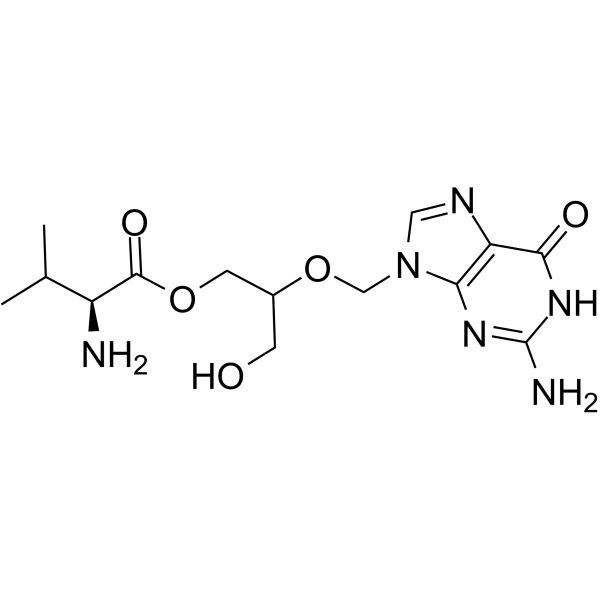 0 ImagesCat. No.: HY-A0032CAS No.: 175865-60-8Valganciclovir is an orally active antiviral agent. Valganciclovir can inhibit the growth of adenoviruses and have a protective effect on immunosuppressed hamsters. Valganciclovir can be used for the research of Cytomegalovirus.
-
PMEG
 0 ImagesCat. No.: HY-185150CAS No.: 114088-58-3Synonyms: 9-(2-Phosphonylmethoxy)ethylguaninePMEG is a nuclear DNA polymerases α, δ, and ε inhibitor that causes DNA chain termination, inhibits DNA synthesis, induces cytotoxicity in dividing cells. PMEG is an acyclic nucleotide phosphonate that forms an active phosphorylated metabolite, PMEG diphosphate, within cells. PMEG has activity against leukemia and melanoma in rodent models. PMEG has poor cell permeability; its prodrug is Rabacfosadine (GS-9219) (HY-13640). PMEG shows antiviral activity against against various DNA virus infections including murine cytomegalovirus (MCMV) and human cytomegalovirus (HCMV). PMEG can be used for the research of non-hodgkin's lymphoma[1][2].

-
Brivudine (Standard)
 0 ImagesSynonyms: Bromovinyldeoxyuridine (Standard); BVDU (Standard)



