



MAP4K5/KHS1
MAP4K5/KHS1, also called GCKR, encodes a human SPS1/STE20-like serine/threonine kinase that activates Jun N-terminal kinase (JNK) in mammalian cells[1]. Mechanistically, TNF-α recruits and activates GCKR through TRAF2, and TNF-induced GCKR/SAPK activation further depends on the Ubc13-Uev1A/TRAF2 complex[2][3]. In B lymphocytes, Wnt3a activates GCKR and JNK through APC-Asef-Rac, while GCKR also supports β-catenin accumulation, linking MAP4K5 to canonical and noncanonical Wnt signaling. Disease evidence remains focused on models and associations: MAP4K5 -822G/A associates with reduced type 2 diabetes risk in Shanghai Han subjects, and low MAP4K5 expression correlates with shorter survival and reduced E-cadherin in pancreatic ductal adenocarcinoma[4][5]. Compared with related MAP4K isoforms, KHS/MAP4K5 is distinguished from MAP4K1/HPK1, MAP4K2/GCK, MAP4K3/GLK, MAP4K4/HGK, MAP4K6/MINK1, and MAP4K7/TNIK within the STE20-like MAP4K family[6]. For research design, CRK-family adaptor binding and STRN4-containing MAP4K interactome data support MAP4K5 studies in kinase signaling, protein-interaction mapping, JNK activation, Wnt biology, and cancer-associated epithelial regulation[7][6][5].
References:
- [1]. Tung RM, et al. A novel human SPS1/STE20 homologue, KHS, activates Jun N-terminal kinase. Oncogene. 1997 Feb 13;14(6):653-9. [Content Brief]
- [2]. Shi CS, et al. TNF-mediated activation of the stress-activated protein kinase pathway: TNF receptor-associated factor 2 recruits and activates germinal center kinase related. J Immunol. 1999 Sep 15;163(6):3279-85. [Content Brief]
- [3]. Lee MJ, et al. Time to HIV rebound after infusion of long-acting broadly neutralising antibodies 3BNC117-LS and 10-1074-LS and analytical treatment interruption (the RIO trial): a double-blind, randomised, placebo-controlled trial. Lancet HIV. 2026 May 27:S2352-3018(26)00059-7. [Content Brief]
- [4]. Gu Y, et al. The -822G/A polymorphism in the promoter region of the MAP4K5 gene is associated with reduced risk of type 2 diabetes in Chinese Hans from Shanghai. J Hum Genet. 2006;51(7):605-10. [Content Brief]
- [5]. Wang OH, et al. Prognostic and Functional Significance of MAP4K5 in Pancreatic Cancer. PLoS One. 2016 Mar 29;11(3):e0152300. [Content Brief]
- [6]. Seo G, et al. MAP4K Interactome Reveals STRN4 as a Key STRIPAK Complex Component in Hippo Pathway Regulation. Cell Rep. 2020 Jul 7;32(1):107860. [Content Brief]
- [7]. Oehrl W, et al. The germinal center kinase (GCK)-related protein kinases HPK1 and KHS are candidates for highly selective signal transducers of Crk family adapter proteins. Oncogene. 1998 Oct 15;17(15):1893-901. [Content Brief]
All Product Categories
-
MAP4K5/KHS1 Related Products (6)
Related Products (6)

-
DMX-5804
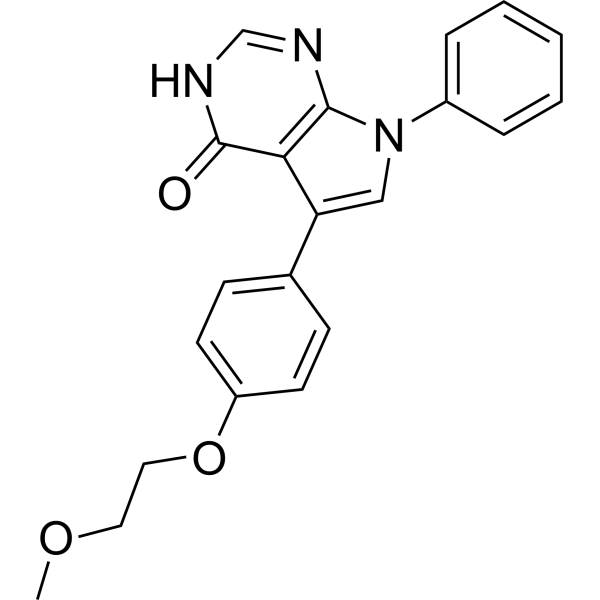 0 ImagesDMX-5804 is a potent, orally active and selective MAP4K4 inhibitor, with an IC50 of 3 nM, a pIC50 of 8.55 for human MAP4K4, less potent on MINK1/MAP4K6 (pIC50, 8.18), and TNIK/MAP4K7 (pIC50, 7.96). DMX-5804 enhances cardiomyocyte survival, and reduces ischemia-reperfusion injury in mice.
-
DB1113
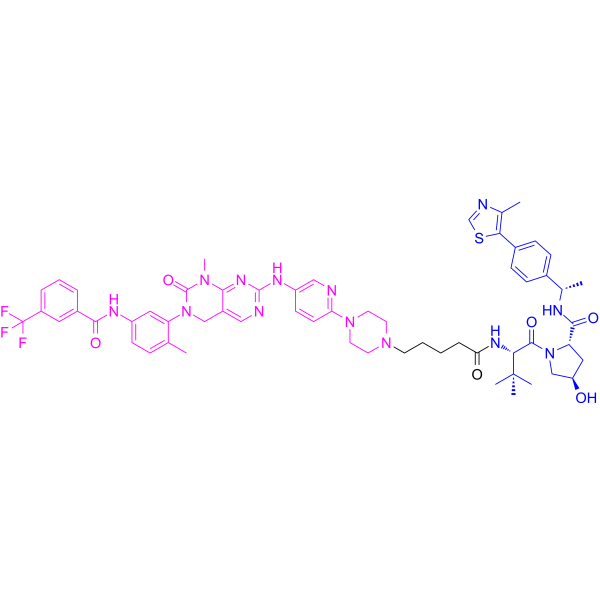 0 ImagesDB1113 is a multi-kinase PROTAC degrader. DB1113 induces the ubiquitination and degradation of ABL1, ABL2, BLK, CDK11B, CDK4, CSK, EPHA3, FER, GAK, LIMK1, MAP3K20, MAP4K1, MAP4K2, MAP4K3, MAP4K5, MAPK14, MAPK7, MAPK8, MAPK9, MAPKAPK2, MAPKAPK3, NLK, PDIK1L, PTK2B, RIPK1, RPS6KA1, RPS6KA3, SIK2, SIK3, STK35, TNK2, and ULK1. DB1113 can be used to study diseases or disorders mediated by aberrant kinase activity.
-
GNE 220 hydrochloride
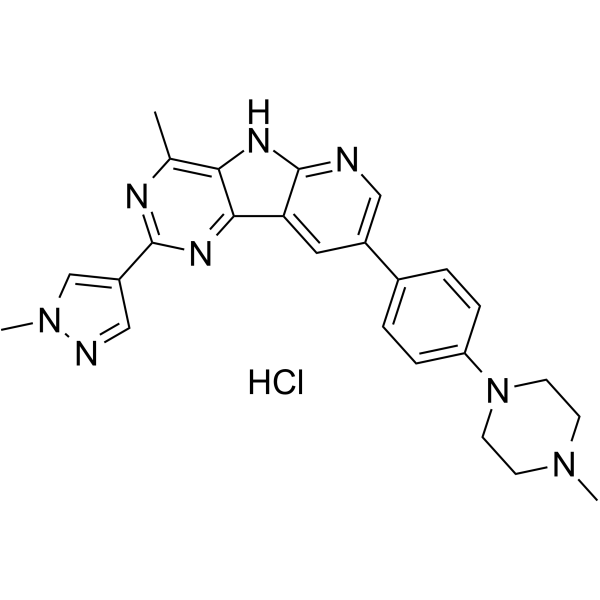 0 ImagesGNE 220 (hydrochloride) is a potent and selective inhibitor of MAP4K4, with an IC50 of 7 nM.
-
GNE 220
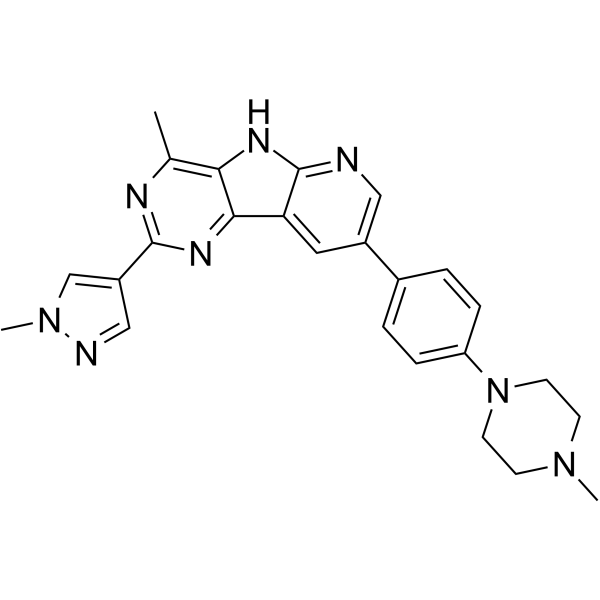 0 ImagesCat. No.: HY-U00428CAS No.: 1199590-75-4GNE-220 is a potent and selective inhibitor of MAP4K4 with an IC50 of 7 nM.
-
HPK1-IN-56
 0 ImagesCat. No.: HY-172107CAS No.: 2901054-39-3HPK1-IN-56 (Compound A29) is a HPK1 inhibitor (IC50: 2.70 nM). HPK1-IN-56 inhibits downstream p-SLP76 (IC50: 8.1 nM in Jurkat T cells). HPK1-IN-56 induces the production of IL-2 in human PBMCs. HPK1-IN-56 has anticancer effect, enhances T-cell killing ability and the antitumor efficacy of anti-PD-1 antibody.
-
HPK1-IN-52
 0 ImagesCat. No.: HY-168110CAS No.: 2994298-66-5HPK1-IN-52 is a potent and orally active hematopoietic progenitor kinase 1 (HPK1) inhibitor with an IC50 value of 10.4 nM. HPK1-IN-52 exhibits anti-tumor activities.



