



Fluorescent Dye
Fluorescence is a phenomenon of photoluminescence in luminescence. When an atom is irradiated by light, some electrons around the nucleus jump from their original orbitals to higher energy orbitals under the influence of light energy, i.e., from the ground state to the first or second excited single-line state, etc. Due to the instability of the first or second excited singlet state, the electron returns from the excited singlet state to the ground state accompanied by released energy, resulting in fluorescence.
Fluorescent dyes can be covalently bound or physically adsorbed in the structure of the substance. The fluorescence properties allow for the characterization, localization and quantitative analysis of the labeled object. Fluorescent dyes have shown great potential for the detection of proteins, nucleic acids, cells, and immunoassays, attributed to the advantages in non-radioactive contamination, simple experimental operation and easy observation.
Fluorescent dyes have penetrated many fields such as pharmacology, physiology, environmental science, and information science, as well as functional studies of proteins and drug screening.
All Product Categories
-
Fluorescent Dye Related Products (4790)
Related Products (4790)

-
Antibodies (4)
-
Benzo Red Violet 4B
 0 ImagesCat. No.: HY-W020211CAS No.: 992-59-6Benzopurpurine 4B is a dis-azo dye. Benzopurpurine 4B Can be used as biological stain.
-
C.I. Acid brown 83
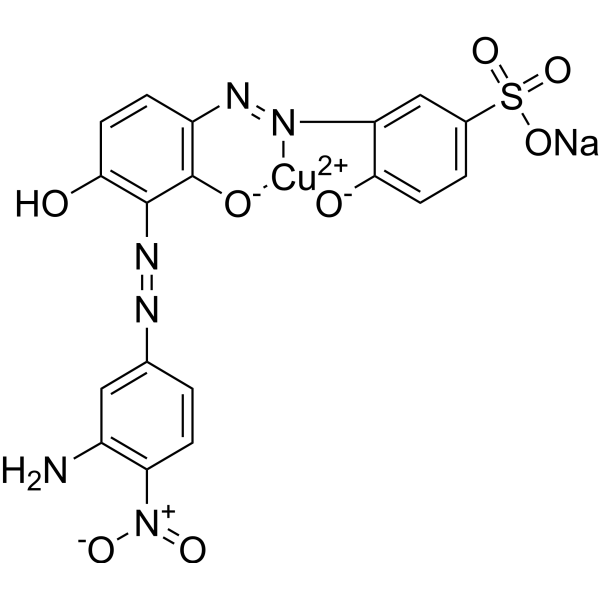 0 ImagesCat. No.: HY-D0495CAS No.: 13011-68-2C.I. Acid brown 83 is an acidic brown dye that can be adsorbed and removed by bentone clay.
-
ROX alkyne, 6-isomer
 0 ImagesCat. No.: HY-D2743CAS No.: 2097422-22-3ROX alkyne, 6-isomer is an alkyne derivative of the bright red-emitting dye ROX (Rhodamine X, Rhodamine 101). Due to its quantum yield approaching unity, ROX is a popular dye for qPCR and microscopy applications. It is used for fluorescent labeling of azide-containing biomolecules via copper-catalyzed click reaction.


-
C.I. Solvent red 179
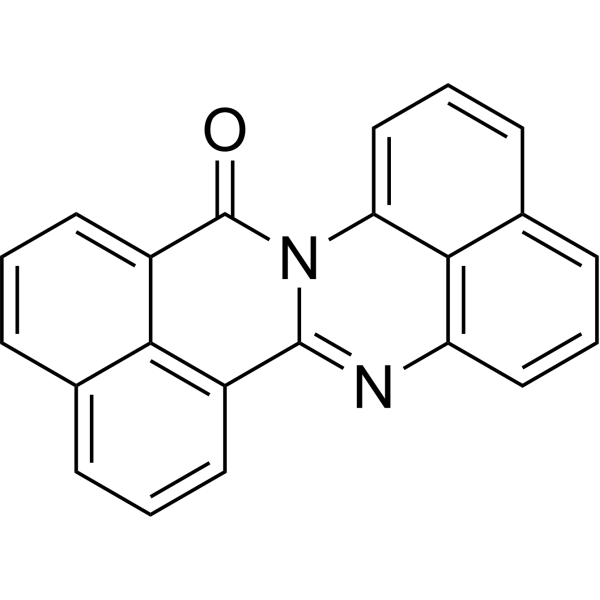 0 ImagesC.I. Solvent red 179 is the most important colorant used to add color or change the color of something and is chemically essentially unaffected by the carrier or medium into which it is incorporated. It can be widely used in textile, medicine, food, cosmetics, plastics, paint, ink, photography and paper industries.
-
BP Fluor 405 alkyne triTEA
 0 ImagesCat. No.: HY-W800694CAS No.: 2006335-63-1BP Fluor 405 alkyne triTEA is a blue-fluorescent dye that often used in multi-color applications, including flow cytometry and super-resolution microscopy using STORM. Its excitation is ideally suited for the 407 nm spectral line of the krypton laser or the 408 nm violet laser diode. BP Fluor 405 alkyne triTEA reacts with azides via a copper-catalyzed click reaction (CuAAC) to form a stable triazole linker. A probe for copper-less detection (BP Fluor 405 DBCO) is also available for application where the presence of copper is not acceptable.
-
N-(Azido-PEG2)-N-fluorescein-PEG4-acid
 0 ImagesCat. No.: HY-140545CAS No.: 2086689-06-5N-(Azido-PEG2)-N-fluorescein-PEG4-acid is a fluorescein lableing reagent containing anazide group and a carboxylic acid. N-(Azido-PEG2)-N-fluorescein-PEG4-acid is a click chemistry reagent. It contains an azide group and can undergo copper-catalyzed azide-alkyne cycloaddition (CuAAc) with molecules containing alkyne groups.
-
ROX azide, 5-isomer
 0 ImagesCat. No.: HY-W800808CAS No.: 2628213-67-0ROX azide, 5-isomer is a red-emitting rhodamine dye possessing high brightness and fluorescence quantum yield. The azide group can react with alkyne, BCN, DBCO via Click Chemistry to yield a stable triazole linkage.

-
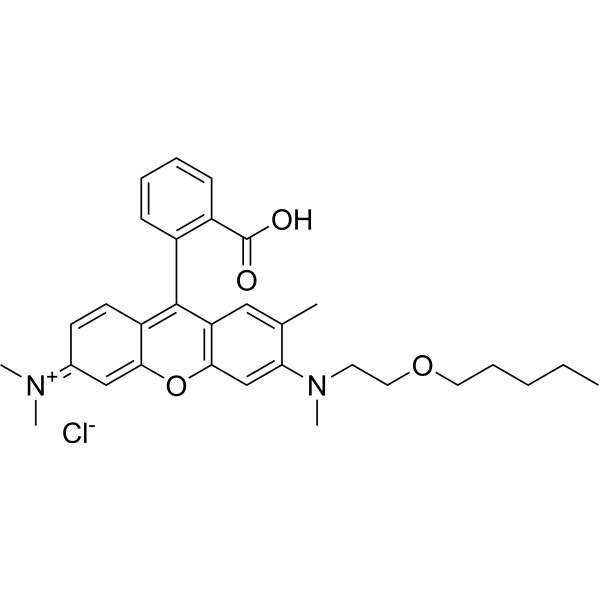
ATTO 610
 0 ImagesCat. No.: HY-D2042CAS No.: 1313437-82-9ATTO 610 is a new type of fluorescent dye with high fluorescence yield, which can be used for most labeling applications, maximum excitation/emission wavelength: 616/633 nm.
-
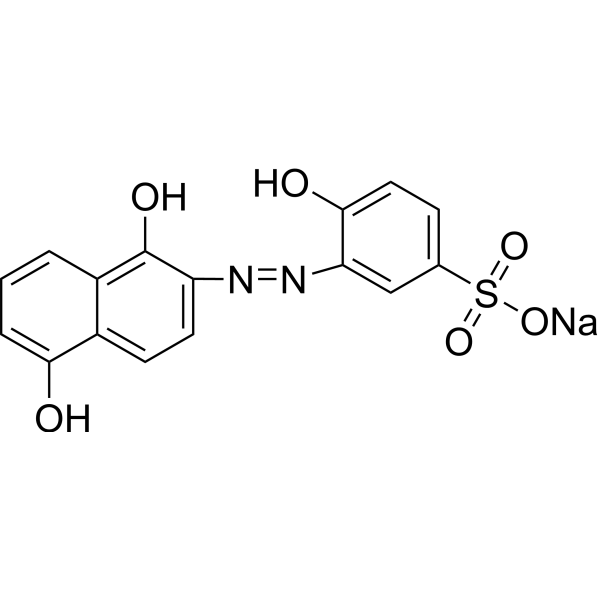
Carmine lithium
 0 ImagesCat. No.: HY-127154CAS No.: 12772-56-4Carmine lithium is a natural red colorant, which belongs to the coccid dye family.
-
BP Fluor 430 DBCO
 0 ImagesCat. No.: HY-W800699CAS No.: 2644752-85-0BP Fluor 430 DBCO reacts with azides via a copper-free click chemistry reaction to form a stable triazole and does not require a Cu-catalyst or elevated temperatures. In applications where the presence of copper is a concern, BP Fluor 430 DBCO is an ideal alternative to copper requiring fluorescent alkynes. BP Fluor 430 is a bright, photostable, green-fluorescent probe optimally excited near its absorption maximum at 432 nm. Its emission peak at 539 nm is pH independent over a wide pH range. BP Fluor DBCO reagent is not suitable for staining intracellular components of fixed and permeabilized cells due to high backgrounds.
-
DSPE-CH2-PEG2000-Fluor 488
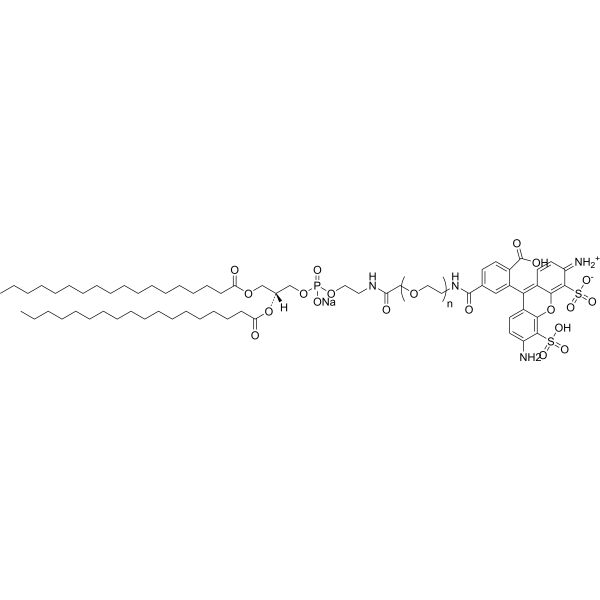 0 ImagesCat. No.: HY-160271DSPE-CH2-PEG2000-Fluor 488 is a PEG lipid conjugate with a DSPE group and a Fluor 488 dye. DSPE is a phosphoethanolamine (PE) lipid that can be used in the synthesis of liposomes. And Fluor 488 is a fluorescent dye.

-
ATTO 590 azide
 0 ImagesCat. No.: HY-D1944ATTO 590 Azide is an azide derivative of ATTO 590 with excitation/emission maxima at 594/622 nm. ATTO 590 azide is a click chemistry reagent, it contains an Azide group and can undergo copper-catalyzed azide-alkyne cycloaddition reaction (CuAAc) with molecules containing Alkyne groups. It can also undergo strain-promoted alkyne-azide cycloaddition (SPAAC) reactions with molecules containing DBCO or BCN groups.




