



Fluorescent Dye
Fluorescence is a phenomenon of photoluminescence in luminescence. When an atom is irradiated by light, some electrons around the nucleus jump from their original orbitals to higher energy orbitals under the influence of light energy, i.e., from the ground state to the first or second excited single-line state, etc. Due to the instability of the first or second excited singlet state, the electron returns from the excited singlet state to the ground state accompanied by released energy, resulting in fluorescence.
Fluorescent dyes can be covalently bound or physically adsorbed in the structure of the substance. The fluorescence properties allow for the characterization, localization and quantitative analysis of the labeled object. Fluorescent dyes have shown great potential for the detection of proteins, nucleic acids, cells, and immunoassays, attributed to the advantages in non-radioactive contamination, simple experimental operation and easy observation.
Fluorescent dyes have penetrated many fields such as pharmacology, physiology, environmental science, and information science, as well as functional studies of proteins and drug screening.
All Product Categories
-
Fluorescent Dye Related Products (4790)
Related Products (4790)

-
Antibodies (4)
-
ICG PEG5000 N3
 0 ImagesCat. No.: HY-D2607ICG PEG5000 N3 is a Indocyanine green (ICG) (HY-D0711)-azide fluorescent dye used to label for protein and nucleic acid. ICG PEG5000 N3 is a click chemistry reagent, it contains an Azide group and can undergo copper-catalyzed azide-alkyne cycloaddition reaction (CuAAc) with molecules containing Alkyne groups. It can also undergo strain-promoted alkyne-azide cycloaddition (SPAAC) reactions with molecules containing DBCO or BCN groups (Ex/Em=785/813 nm).
-
ATTO 740
 0 ImagesCat. No.: HY-D2060CAS No.: 1188422-44-7

-
FITC-PEG-CHOL (MW 3400)
 0 ImagesCat. No.: HY-D2851AFITC-PEG-CHOL (MW 3400) is a fluorescent dye composed of FITC (HY-66019), PEG and cholesterol. FITC-PEG-CHOL (MW 5000) is widely used in cell membrane-related studies, liposome and nanoparticle modification, and biomolecule labeling (Ex/Em = 488/525 nm).

-
PtdIns-(4,5)-P2-fluorescein triethylammonium
 0 ImagesCat. No.: HY-179554Synonyms: PI(4,5)P2-fluorescein triethylammoniumPtdIns-(4,5)-P2-fluorescein (PI(4,5)P2-fluorescein) triethylammonium is a fluorescently labeled phosphatidylinositol-4,5-bisphosphate, which is a marked form of an important phospholipid signaling molecule (PIP2) on the cell membrane. PtdIns-(4,5)-P2-fluorescein triethylammonium can be used to detect proteins that interact with phosphatidylinositol-4,5-bisphosphate, such as PI3K, PTEN, and PH domain proteins, etc.
-
Cy3.5
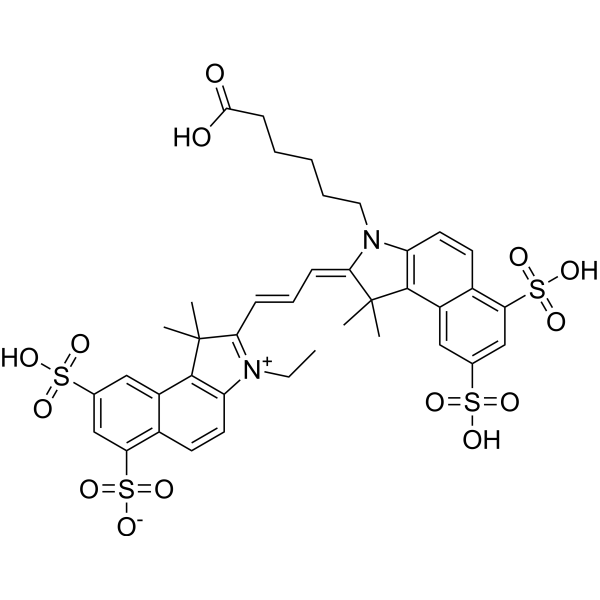 0 ImagesCat. No.: HY-D0922CAS No.: 1284240-77-2Cy3.5 is a fluorescent dye that can be used to label antibodies.
-
7-Methoxycoumarin-3-carboxylic acid, SE
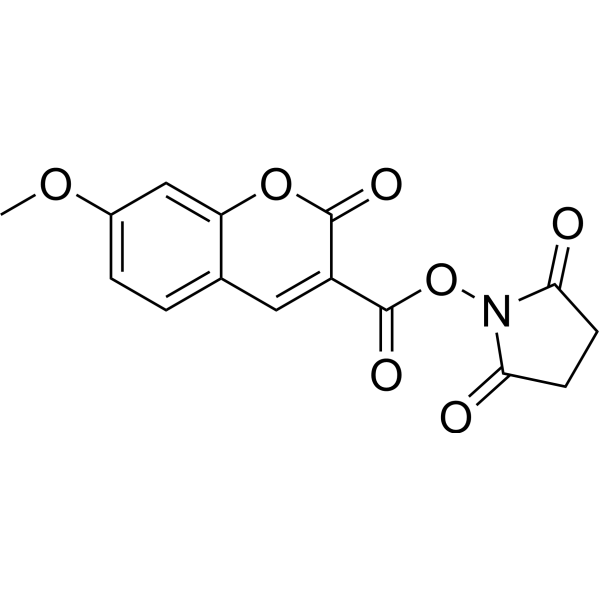 0 ImagesCat. No.: HY-D1083CAS No.: 150321-92-97-Methoxycoumarin-3-carboxylic acid, SE can be used for the synthesis of hydrophilic dye compound 12. Compound 12 shows a homogeneous distribution inside the cell and represents a suitable probe for viscosity measurements in the cytoplasm.




