



Fluorescent Dye
Fluorescence is a phenomenon of photoluminescence in luminescence. When an atom is irradiated by light, some electrons around the nucleus jump from their original orbitals to higher energy orbitals under the influence of light energy, i.e., from the ground state to the first or second excited single-line state, etc. Due to the instability of the first or second excited singlet state, the electron returns from the excited singlet state to the ground state accompanied by released energy, resulting in fluorescence.
Fluorescent dyes can be covalently bound or physically adsorbed in the structure of the substance. The fluorescence properties allow for the characterization, localization and quantitative analysis of the labeled object. Fluorescent dyes have shown great potential for the detection of proteins, nucleic acids, cells, and immunoassays, attributed to the advantages in non-radioactive contamination, simple experimental operation and easy observation.
Fluorescent dyes have penetrated many fields such as pharmacology, physiology, environmental science, and information science, as well as functional studies of proteins and drug screening.
All Product Categories
-
Fluorescent Dye Related Products (4852)
Related Products (4852)

-
Antibodies (4)
-
Cy3 labled Rugonersen sodium
 0 ImagesCat. No.: HY-148130ECy3 labled Rugonersen sodium is a Cy3 labled Rugonersen sodium.

-
Cyanine7.5 carboxylic
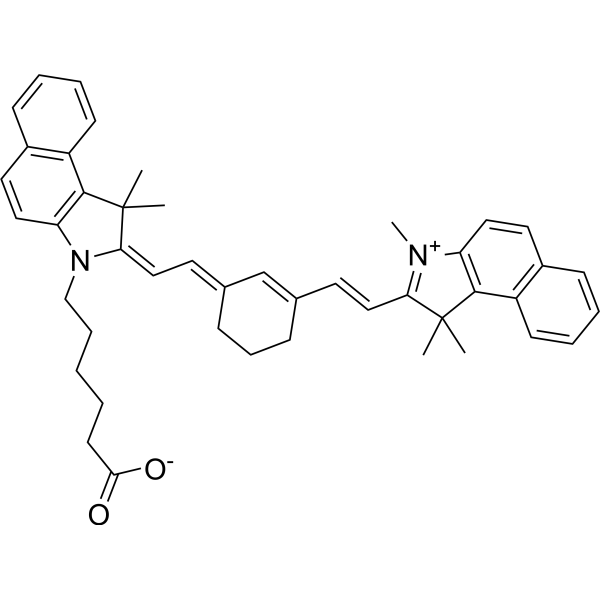 0 ImagesCat. No.: HY-D1317ACAS No.: 1686147-68-1Cyanine7.5 carboxylic is a dye derivative of Cyanine 7.5 (Cy7.5) (HY-D0926) with carboxylic acid functional groups. Cy7.5 is a near-infrared fluorescent dye commonly used in biomedical research areas such as biomarkers and cell imaging. Cyanine7.5 carboxylic can be covalently bound to some biological molecules (especially antibodies, proteins, etc.) to track their location and dynamic changes in biological samples.

-
RB-PEG400-RB
 0 ImagesCat. No.: HY-D2893ASynonyms: Rhodamine B-PEG400-Rhodamine BRB-PEG400-RB (Rhodamine B-PEG400-Rhodamine B) a fluorescent dye composed of two Rhodamine B (HY-Y0016) and PEG. RB-PEG400-RB can be used for fluorescent labeling and imaging (Ex/Em=546/610 nm).
-
Suc-Leu-Leu-Val-Tyr-AMC (solution)
 0 ImagesCat. No.: HY-DY1060CAS No.: 94367-21-2Suc-Leu-Leu-Val-Tyr-AMC (solution) is a membrane-permeable calpain-specific fluorogenic substrate (Ex/Em = 390/480 nm) .
Solvent and concentration: DMSO: 20 mM
-
Solvent orange 62
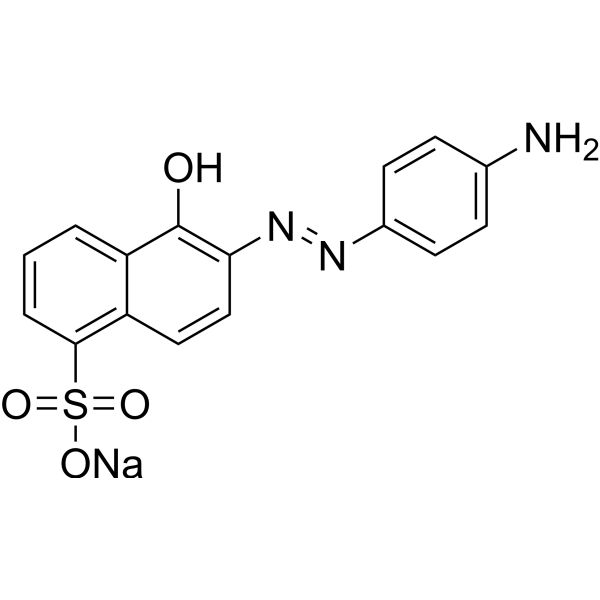
 0 ImagesCat. No.: HY-D1162CAS No.: 52256-37-8Solvent orange 62 is a multifunctional dye. Dyes are important tools in biological experiments. They can help researchers observe and analyze cell structures, track biomolecules, evaluate cell functions, distinguish cell types, detect biomolecules, study tissue pathology and monitor microorganisms. Their applications range from basic scientific research to clinical A wide range of diagnostics. Dyes are also widely used in traditional fields such as textile dyeing, as well as in emerging fields such as functional textile processing, food pigments and dye-sensitized solar cells.
-
RB-PEG400-COOH
 0 ImagesCat. No.: HY-D2881Synonyms: Rhodamine B-PEG400-COOHRB-PEG400-COOH (Rhodamine B-PEG400-COOH) is a fluorescent dye composed of Rhodamine B (HY-Y0016), PEG and a COOH. RRB-PEG400-COOH can be used for fluorescent labeling and imaging (Ex/Em=546/610 nm).
-
BPP
 0 ImagesCat. No.: HY-121426CAS No.: 73671-44-0BPP is an cyclization-based fluorescent probe for imaging native HOBr in live cells and zebrafish.
-
DSPE PEG(2000)-N-Cyanine 7
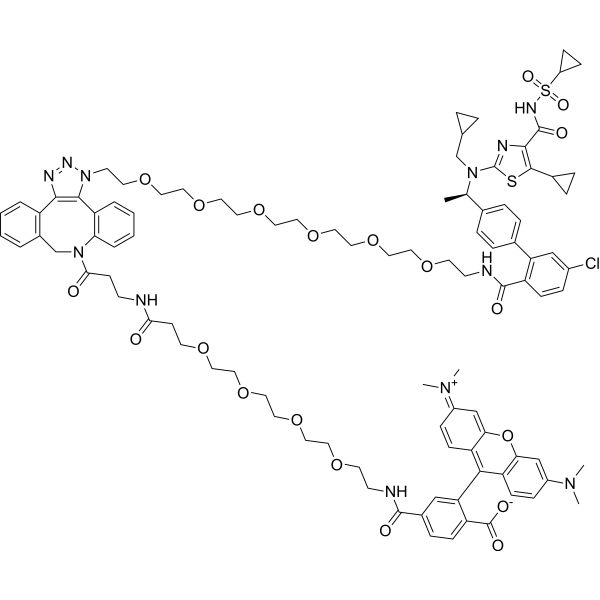
 0 ImagesCat. No.: HY-N15858CAS No.: 2315262-01-0DSPE PEG(2000)-N-Cyanine 7 is a phospholipid. Phospholipids have good biocompatibility and significant amphiphilic characteristics, making them the main and suitable dosage form or excipient in drug formulations, thereby achieving better therapeutic effects. DSPE PEG(2000)-N-Cyanine 7 can be used in drug delivery research.
-
1-(Azidomethyl)pyrene
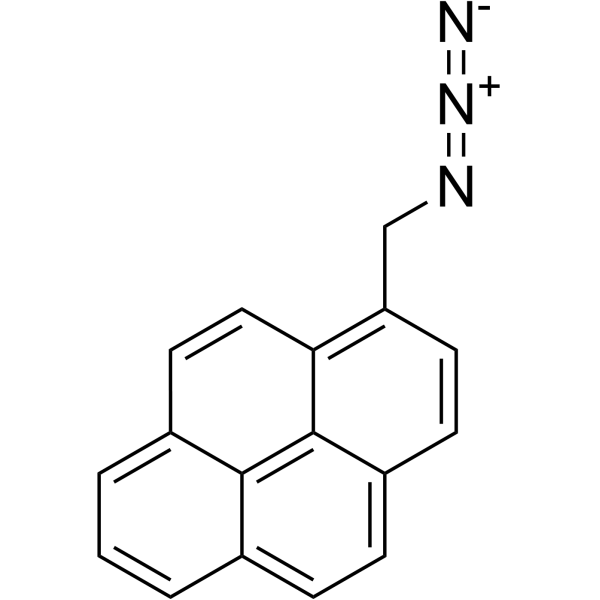 0 ImagesCat. No.: HY-D1548CAS No.: 1006061-57-91-(Azidomethyl)pyrene is a fluorescent dye. 1-(Azidomethyl)pyrene is a click chemistry reagent, it contains an Azide group and can undergo copper-catalyzed azide-alkyne cycloaddition reaction (CuAAc) with molecules containing Alkyne groups. It can also undergo strain-promoted alkyne-azide cycloaddition (SPAAC) reactions with molecules containing DBCO or BCN groups.
-
BG-Kaede chromophore
 0 ImagesCat. No.: HY-D2951CAS No.: 2270958-94-4BG-Kaede chromophore (Compound 4c) is a SNAP-tag-specific fluorescent probe, which is designed and synthesized using the chromophore of the red fluorescent protein Kaede as a template. BG-Kaede chromophore can be used as a tool for visualizing proteins in living cells.
-
FAM labled Apatorsen sodium
 0 ImagesCat. No.: HY-145722EFAM labled Apatorsen sodiumis a FAM labled Apatorsen sodium.
-
Cy5.5-PEG3400-N3
 0 ImagesCat. No.: HY-D2561Cy5.5-PEG3400-N3 is a Cy5.5 (HY-D0924)-azide fluorescent dye used to label for protein and nucleic acid. Cy5.5-PEG3400-N3 is a click chemistry reagent, it contains an Azide group and can undergo copper-catalyzed azide-alkyne cycloaddition reaction (CuAAc) with molecules containing Alkyne groups. It can also undergo strain-promoted alkyne-azide cycloaddition (SPAAC) reactions with molecules containing DBCO or BCN groups.
-
Tetrabromo-o-sulfobenzoic anhydride
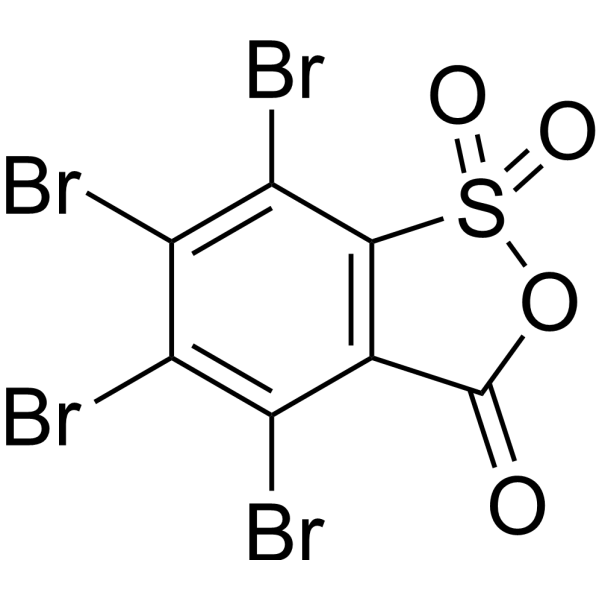 0 ImagesCat. No.: HY-D0230CAS No.: 68460-01-5Tetrabromo-o-sulfobenzoic anhydride is a multifunctional dye. Dyes are important tools in biological experiments. They can help researchers observe and analyze cell structures, track biomolecules, evaluate cell functions, distinguish cell types, detect biomolecules, study tissue pathology and monitor microorganisms. Their applications range from basic scientific research to clinical A wide range of diagnostics. Dyes are also widely used in traditional fields such as textile dyeing, as well as in emerging fields such as functional textile processing, food pigments and dye-sensitized solar cells.
-
NIR‐fluorescent ceramide
 0 ImagesCat. No.: HY-D3198CAS No.: 2351937-34-1NIR-fluorescent ceramide is a neutral near-infrared (NIF) fluorescent probe (λem=650 nm) based on the C-bridged nitrobenzoxadiazole SCOTfluor core, which enables visualization of lipid metabolic processes such as sphingolipid trafficking. The emission signal of NIR-fluorescent ceramide increases significantly in liposomal environments. NIR-fluorescent ceramide acts as an intracellular trafficking tracer, localizing to regions surrounding the endoplasmic reticulum and Golgi apparatus within a short period, and then translocating to recycling lysosomes over a longer period, thus enabling real-time visualization of sphingolipid trafficking and biological lipid functions in living cells. NIR-fluorescent ceramide also generates metabolic uptake profiles and provides multiple metabolic readouts in human cancer cell lines.
-
6-(4-Acetamido-1,8-naphthalamido)hexanoic acid
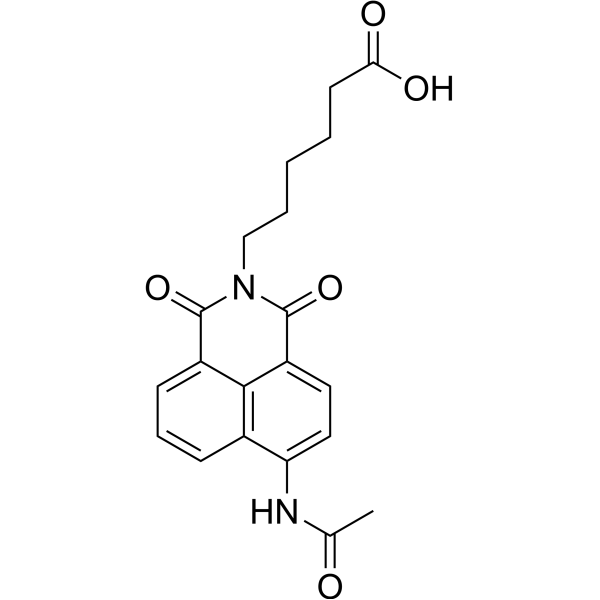 0 ImagesCat. No.: HY-D0028CAS No.: 172227-59-76-(4-Acetamido-1,8-naphthalamido)hexanoic acid is a multifunctional dye. Dyes are important tools in biological experiments. They can help researchers observe and analyze cell structures, track biomolecules, evaluate cell functions, distinguish cell types, detect biomolecules, study tissue pathology and monitor microorganisms. Their applications range from basic scientific research to clinical A wide range of diagnostics. Dyes are also widely used in traditional fields such as textile dyeing, as well as in emerging fields such as functional textile processing, food pigments and dye-sensitized solar cells.
-
1,1',3,3,3',3'-Hexamethylindotricarbocyanine perchlorate
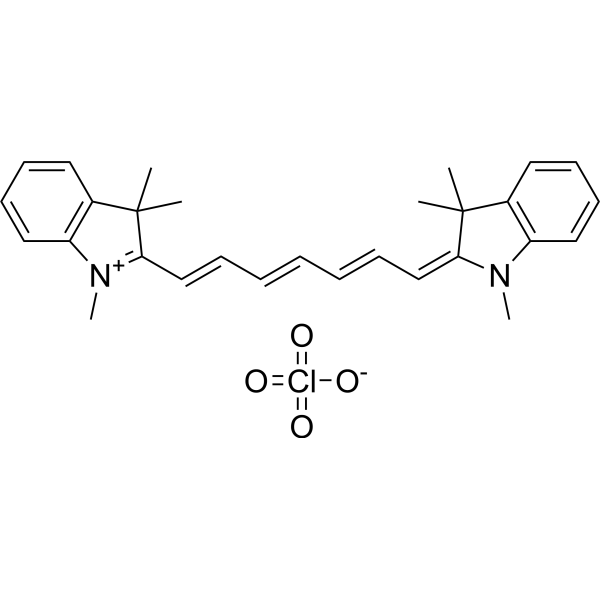 0 ImagesCat. No.: HY-W440303CAS No.: 16595-48-5Synonyms: HITC1,1',3,3,3',3'-Hexamethylindotricarbocyanine perchlorate (HITC) is a long-wavelength, membrane-potential sensitive dye. It is a slow-response potentiometric fluorophore and has also been used as a laser dye for infrared lasers.




