



Fluorescent Dye
Fluorescence is a phenomenon of photoluminescence in luminescence. When an atom is irradiated by light, some electrons around the nucleus jump from their original orbitals to higher energy orbitals under the influence of light energy, i.e., from the ground state to the first or second excited single-line state, etc. Due to the instability of the first or second excited singlet state, the electron returns from the excited singlet state to the ground state accompanied by released energy, resulting in fluorescence.
Fluorescent dyes can be covalently bound or physically adsorbed in the structure of the substance. The fluorescence properties allow for the characterization, localization and quantitative analysis of the labeled object. Fluorescent dyes have shown great potential for the detection of proteins, nucleic acids, cells, and immunoassays, attributed to the advantages in non-radioactive contamination, simple experimental operation and easy observation.
Fluorescent dyes have penetrated many fields such as pharmacology, physiology, environmental science, and information science, as well as functional studies of proteins and drug screening.
All Product Categories
-
Fluorescent Dye Related Products (4851)
Related Products (4851)

-
Antibodies (4)
-
FAM labled Eteplirsen sodium
 0 ImagesCat. No.: HY-108753DFAM labled Eteplirsen sodiumis a FAM labled Eteplirsen (AVI 4658) sodium (HY-108753A). Eteplirsen (AVI 4658) sodium is a phosphorylated diamine morpholino oligonucleotide that targets exon 51 of the human Duchenne muscular dystrophy (DMD) gene. Eteplirsen sodium induces exon 51 skipping, causing it to be skipped during splicing, thereby restoring the translation reading frame and producing a shortened functional dystrophin. Eteplirsen sodium can be used in research on Duchenne muscular dystrophy.
-
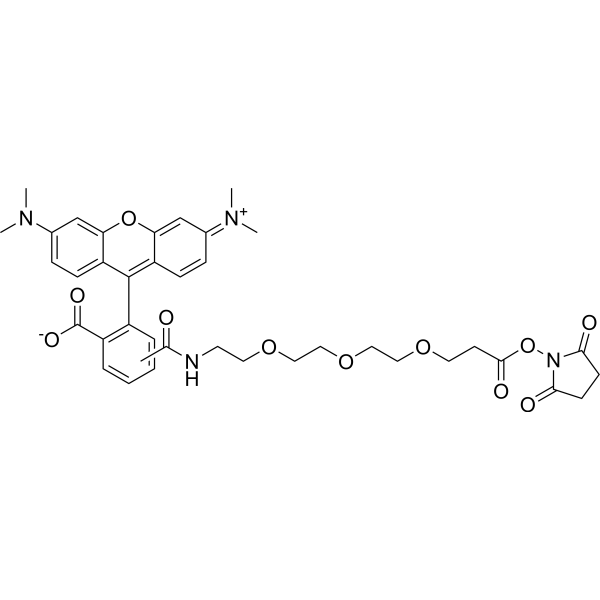
FAM labled Bezeparsen sodium
 0 ImagesCat. No.: HY-147252DFAM labled Bezeparsen sodiumis a FAM labled Bezeparsen sodium.
-
4,4'-Diamino-1,1'-iminodianthraquinone
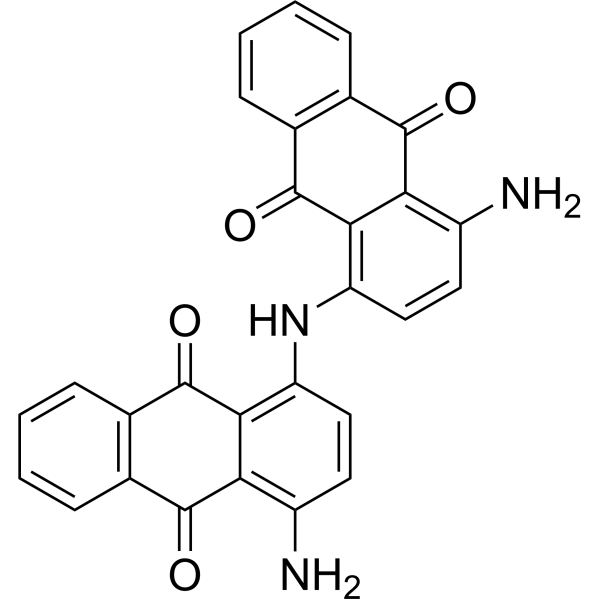 0 Images4,4'-Diamino-1,1'-iminodianthraquinone is a multifunctional dye. Dyes are important tools in biological experiments. They can help researchers observe and analyze cell structures, track biomolecules, evaluate cell functions, distinguish cell types, detect biomolecules, study tissue pathology and monitor microorganisms. Their applications range from basic scientific research to clinical A wide range of diagnostics. Dyes are also widely used in traditional fields such as textile dyeing, as well as in emerging fields such as functional textile processing, food pigments and dye-sensitized solar cells.
-
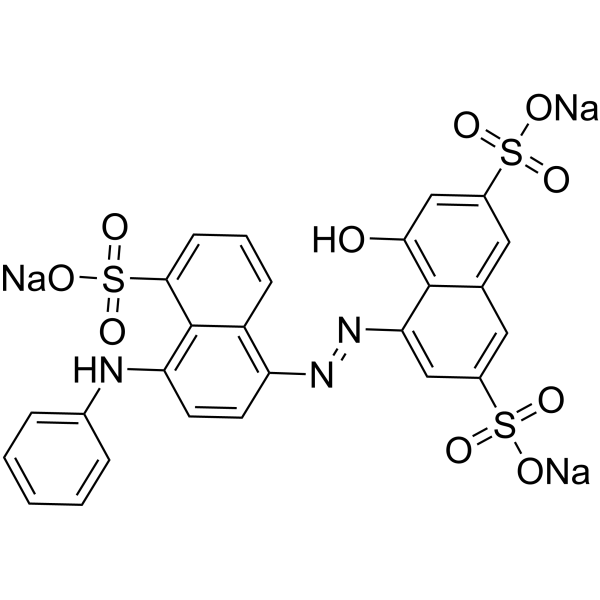
VCAM1 binding peptide, FITC labeled acetate
 0 ImagesCat. No.: HY-P11088FVCAM1 binding peptide, FITC labeled acetate is a FITC-labeled VCAM1 binding peptide acetate (HY-P11088A). VCAM1 binding peptide acetate is a VCAM1 binder with internalization activity. VCAM1 binding peptide acetate serves as a component of biosensing systems for visualizing in vitro VCAM1 endocytic pathways. VCAM1 binding peptide acetate forms the research and development basis for MacroP and NAMP, PET radiotracers targeting VCAM1. VCAM1 binding peptide acetate is applicable to studies related to atherosclerosis.
-
FAM labled Renadirsen sodium
 0 ImagesCat. No.: HY-177658CFAM labled Renadirsen sodiumis a FAM labled Renadirsen sodium.
-
Cyanine 3 Tyramide methyl indole
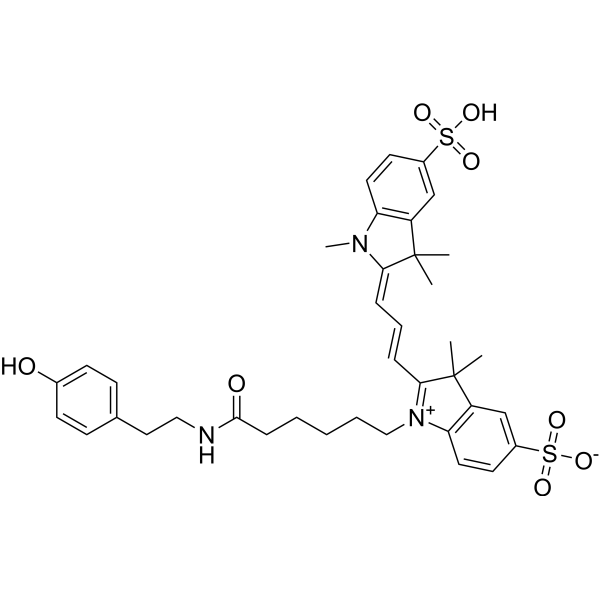 0 ImagesCat. No.: HY-136248APurity: 98.0%Cyanine 3 Tyramide methyl indole is a derivative of Cyanine 3 Tyramide (HY-136248). Cyanine 3 Tyramide is an orange fluorescent dye, and is utilized as reporter fluorescent substrate for horseradish peroxidase (HRP)-catalyzed deposition that is signal amplification technique in immunoassay and in situ hybridization of nucleic acids.


-
Mag-indo-1/AM
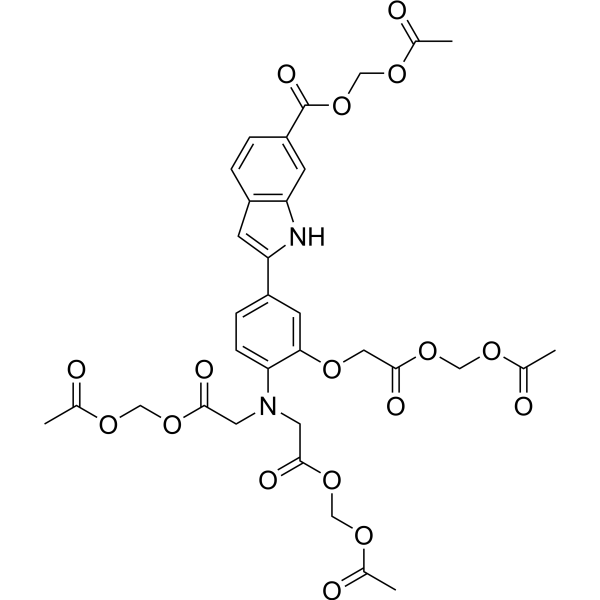 0 ImagesCat. No.: HY-D1700CAS No.: 130926-94-2

-
AF-1
 0 ImagesCat. No.: HY-D2977AF-1 is a azole-based near-infrared fluorescence diagnostic probe with an emission wavelength of 632 nm. AF-1 selectively accumulates in fungal cell membranes at physiological pH. AF-1 targets and induces Autophagy. AF-1 exhibits antifungal activity and sensitivity to autophagy-related pH.
-
PYBG-TMR
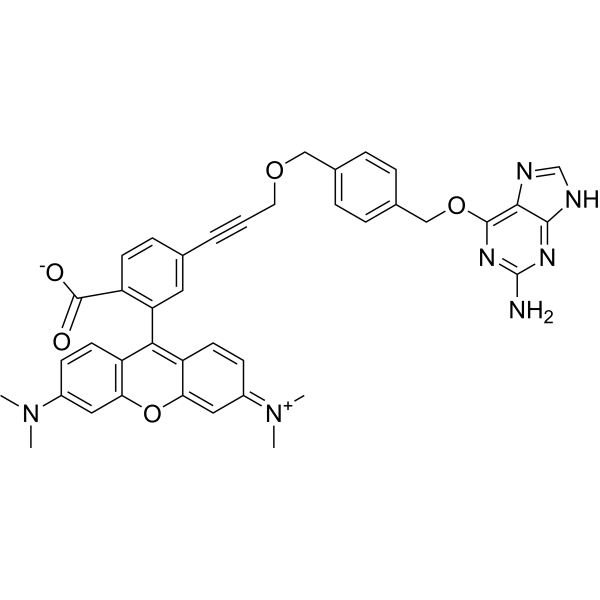 0 ImagesCat. No.: HY-136937CAS No.: 2067339-51-7PYBG-TMR is a dye and has a role as a fluorochrome. PYBG-TMR specifically and efficiently labels the target genetically encoded SNAP-tags in live cells. PYBG-TMR is a click chemistry reagent, it contains an Alkyne group and can undergo copper-catalyzed azide-alkyne cycloaddition (CuAAc) with molecules containing Azide groups.
-
Dansyl chloride-13C2
 0 ImagesCat. No.: HY-D0017S1CAS No.: 274250-28-1Synonyms: DNSCl-13C2Dansyl chloride-13C2 is the 13C labeled Dansyl chloride (HY-D0017). Dansyl chloride is a reagent that produces stable blue or blue-green fluorescent sulfonamide adducts in the reaction of aliphatic and aromatic amines with primary amino groups, and is widely used for modified amino acids, protein sequencing and amino acid analysis.
-
CY3-YNE (solution)
 0 ImagesCat. No.: HY-DY1109CAS No.: 1010386-62-5CY3-YNE (solution) is a fluorescent alkyne dye for click chemistry-based fluorescent labeling of azide functional groups.
-
Cy3-Ova (323-339)
 0 ImagesCat. No.: HY-P5295Cy3-Ova (323-339) is an Cy3 labled OVA Peptide (323-339) (HY-P0286). Cy3 is a fluorescent dye belonging to the Cyanine family and is a fluorescent light product of Cy5. Cyanine is commonly used in fluorescence microscopy, cell imaging, and molecular biology experiments. OVA Peptide (323-339) represents the T and B cell epitopes of ovalbumin (OVA). OVA Peptide (323-339) has limited immunogenic efficacy in activating OVA-sensitized and attacked mouse spleen cells.
-
Cy3 labled Agazisiran sodium
 0 ImagesCat. No.: HY-177611DCy3 labled Agazisiran sodium is a Cy3 labled Agazisiran sodium.
-
Cy3 labled Rugonersen sodium
 0 ImagesCat. No.: HY-148130ECy3 labled Rugonersen sodium is a Cy3 labled Rugonersen sodium.




