Fluorescent Dye
Fluorescence is a phenomenon of photoluminescence in luminescence. When an atom is irradiated by light, some electrons around the nucleus jump from their original orbitals to higher energy orbitals under the influence of light energy, i.e., from the ground state to the first or second excited single-line state, etc. Due to the instability of the first or second excited singlet state, the electron returns from the excited singlet state to the ground state accompanied by released energy, resulting in fluorescence.
Fluorescent dyes can be covalently bound or physically adsorbed in the structure of the substance. The fluorescence properties allow for the characterization, localization and quantitative analysis of the labeled object. Fluorescent dyes have shown great potential for the detection of proteins, nucleic acids, cells, and immunoassays, attributed to the advantages in non-radioactive contamination, simple experimental operation and easy observation.
Fluorescent dyes have penetrated many fields such as pharmacology, physiology, environmental science, and information science, as well as functional studies of proteins and drug screening.
All Product Categories
-
Fluorescent Dye Related Products (4888)
Related Products (4888)

-
Antibodies (4)
-
Mem-pH
 0 ImagesCat. No.: HY-D3130Mem-pH is a ratiometric fluorescent probe used for measuring vesicular pH. Mem-pH inserts into the plasma membrane bilayer and localizes to the vesicular lumen, switching between its basic and acidic forms via protonation during vesicular acidification to enable ratiometric pH readout. In aqueous media, Mem-pH forms non-emissive aggregates through aggregation-induced quenching, and then depolymerizes and recovers its fluorescent activity upon binding to the plasma membrane. The excitation/emission wavelengths of the basic form of Mem-pH are 405/450-550 nm, while those of the acidic form are 488/500-700 nm.
-
Cy3 labled Pivicasiran sodium
 0 ImagesCat. No.: HY-177656DCy3 labled Pivicasiran sodium is a Cy3 labled Pivicasiran sodium.
-
D 131
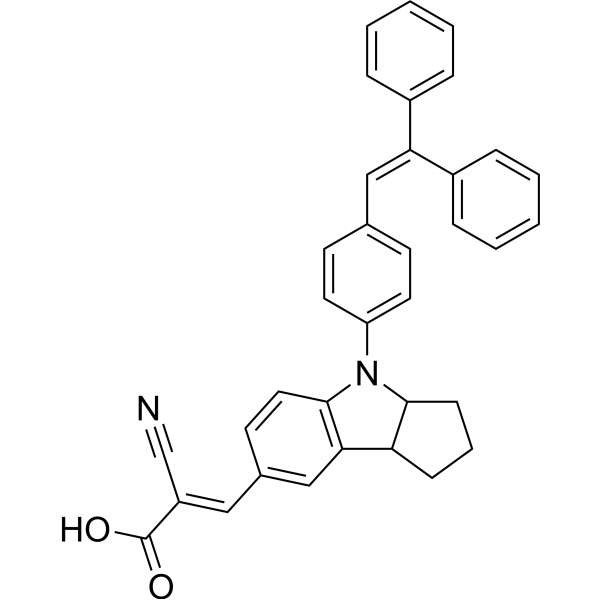 0 ImagesCat. No.: HY-W247614CAS No.: 652145-29-4D 131 is an orange organic indoline dye. The absorption maxima of D131 in solution is λ=425 nm.

-
Cy3-PEG2000-N3
 0 ImagesCat. No.: HY-D2537Cy3-PEG2000-N3 is a Cy3 (HY-D0822)-azide fluorescent dye used to label for protein and nucleic acid. Cy3-PEG2000-N3 is a click chemistry reagent, it contains an Azide group and can undergo copper-catalyzed azide-alkyne cycloaddition reaction (CuAAc) with molecules containing Alkyne groups. It can also undergo strain-promoted alkyne-azide cycloaddition (SPAAC) reactions with molecules containing DBCO or BCN groups.
-
N-Butylfluorescein
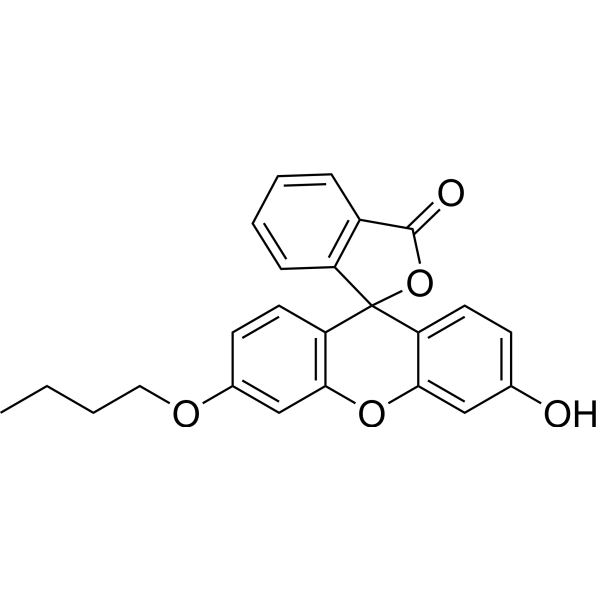 0 ImagesCat. No.: HY-127008CAS No.: 335193-91-4N-Butylfluorescein is an alkyl-substituted fluorescein, can be used for synthesis of fluorogenic substrates for assaying phosphatidylinositol-specific phospholipase C.
-
Cy3 labled Teprasiran sodium
 0 ImagesCat. No.: HY-132595ECy3 labled Teprasiran sodium is a Cy3 labled Teprasiran sodium.
-
Cy3 labled Nucresiran sodium
 0 ImagesCat. No.: HY-177650DCy3 labled Nucresiran sodium is a Cy3 labled Nucresiran sodium.
-
TAMRA DBCO, 5-isomer
 0 ImagesCat. No.: HY-D2758CAS No.: 1911598-65-6TAMRA DBCO, 5-isomer is a derivative of TAMRA fluorescent isomer with a DBCO functional group. TAMRA DBCO, 5-isomer undergoes strain-promoted azide-alkyne cycloaddition (SPAAC) under copper-free catalytic conditions. TAMRA DBCO, 5-isomer serves as a FRET acceptor for FAM fluorophores. TAMRA DBCO, 5-isomer can label proteins, peptides, nucleic acids and all azide-modified biomolecules, and is suitable for fluorescence imaging and flow cytometry to quantify intracellular SPAAC reactions.
-
Bz-RGFFL-4MβNA
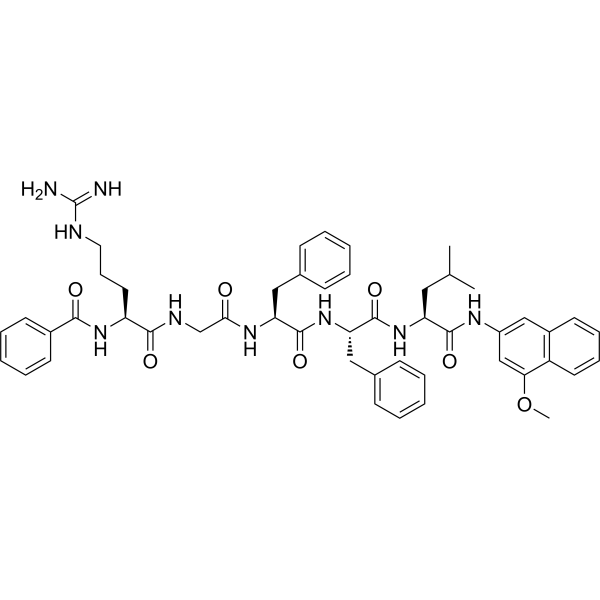 0 ImagesCat. No.: HY-P4334CAS No.: 99112-24-0Synonyms: Bz-Arg-Gly-Phe-Phe-Leu-4MβNABz-RGFFL-4MβNA (Bz-Arg-Gly-Phe-Phe-Leu-4MβNA) is a peptide and can be used fluorogenic substrate.
-
Thalidomide-cyanine 5
 0 ImagesCat. No.: HY-D3392Thalidomide-cyanine 5 is a fluorescent probe prepared by conjugating the CRBN binder Thalidomide (HY-14658) with the near-infrared fluorescent dye Cy5. Thalidomide-cyanine 5 binds to DDB1-CRBN protein complex with a Kd of 121.6 nM. Thalidomide-cyanine 5 binds to CRBN to form a binary complex, and is mainly used for the visual tracking research of degradants such as PROTAC (Ex/Em = 650/665 nm).
-
YQGN-7
 0 ImagesCat. No.: HY-P11265YQGN-7 is a targeted fluorescent probe for the gonadotropin-releasing hormone receptor (RnRHR). YQGN-7 exhibits high selectivity and affinity for breast cancer cells (KD = 217.8 nM). YQGN-7 achieves precise visualization of the primary and metastatic lesions of breast cancer by targeting the highly expressed GnRHR in tumor cells. YQGN-7 can be used in the research of breast cancer breast-conserving surgery (BCS).
-
Cy3 labled AZD8701 sodium
 0 ImagesCat. No.: HY-159692ECy3 labled AZD8701 sodium is a Cy3 labled AZD8701 sodium.
-
Rhodamine 6G perchlorate
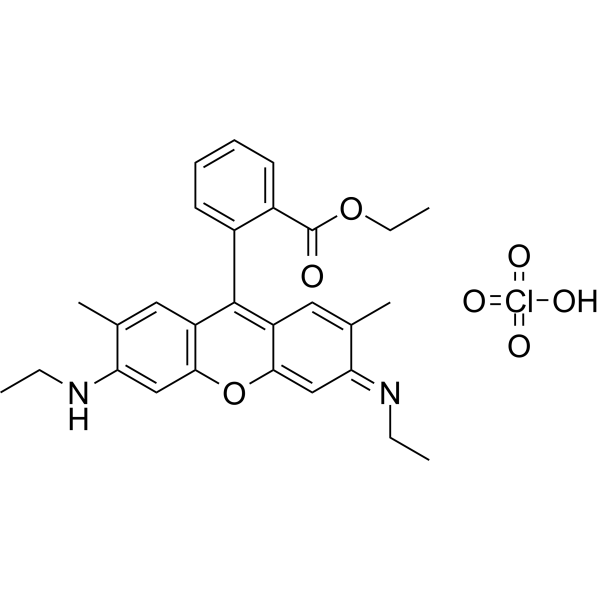 0 ImagesCat. No.: HY-W127780CAS No.: 13161-28-9Synonyms: Basic Red 1 perchlorateRhodamine dyes are membrane-permeable cationic fluorescent probes that specifically recognize mitochondrial membrane potentials, thereby attaching to mitochondria and producing bright fluorescence, and at certain concentrations, rhodamine dyes have low toxicity to cells, so they are commonly used to detect mitochondria in animal cells, plant cells, and microorganisms.
-
A4 glycan, 2-AB labelled
 0 ImagesCat. No.: HY-158541Synonyms: A4 N-linked oligosaccharide, 2-AB labelledA4 glycan, 2-AB labelled (A4 N-linked oligosaccharide, 2-AB labelled) is a N-polysaccharide protein and a multifunctional fluorescent linker. The resulting conjugates exhibit high sensitivity and specificity by mimicking the antennal elements of N-glycans.
-
FAM labled ISIS 449884 sodium
 0 ImagesCat. No.: HY-159696CFAM labled ISIS 449884 sodiumis a FAM labled ISIS 449884 sodium.
-
4-Nitro-m-phenylenediamine
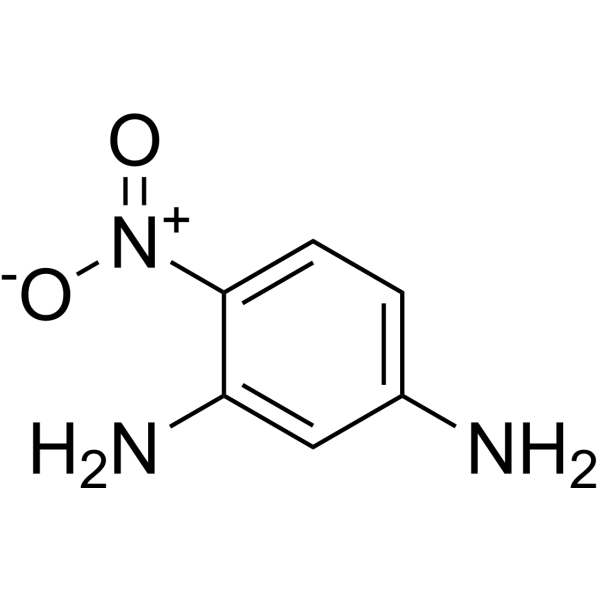 0 Images4-Nitro-m-phenylenediamine is a multifunctional dye. Dyes are important tools in biological experiments. They can help researchers observe and analyze cell structures, track biomolecules, evaluate cell functions, distinguish cell types, detect biomolecules, study tissue pathology and monitor microorganisms. Their applications range from basic scientific research to clinical A wide range of diagnostics. Dyes are also widely used in traditional fields such as textile dyeing, as well as in emerging fields such as functional textile processing, food pigments and dye-sensitized solar cells.
-
AF 568 carboxylic acid
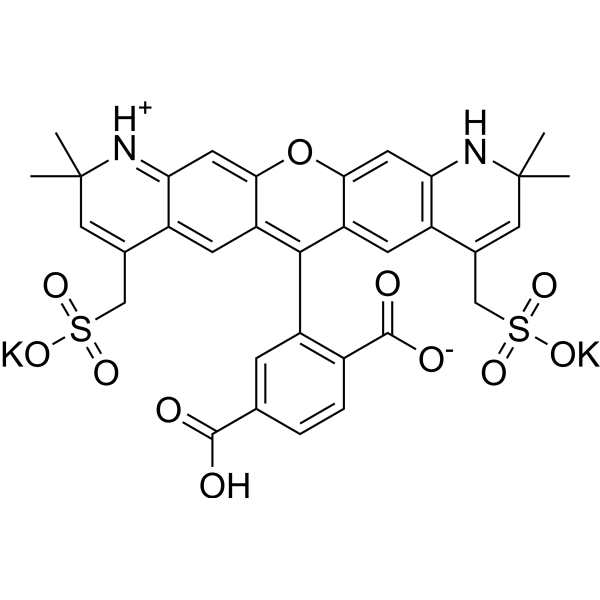 0 ImagesCat. No.: HY-D2169AF 568 carboxylic acid is the non-reactive form of the orange fluorescent dye AF 568. AF 568 has an absorption wavelength of 590-720 nm (FRET) and an emission wavelength of 515-720 nm. AF 568 alkyne forms stable covalent bonds by reacting carboxylic acid groups with molecules bearing amino groups. Copper-catalyzed azide-alkyne cycloaddition (CuAAc) can occur with molecules containing Alkyne groups. Strain-promoted alkyne-azide cycloaddition (SPAAC) can also occur with molecules containing DBCO or BCN groups.