



Fluorescent Dye
Fluorescence is a phenomenon of photoluminescence in luminescence. When an atom is irradiated by light, some electrons around the nucleus jump from their original orbitals to higher energy orbitals under the influence of light energy, i.e., from the ground state to the first or second excited single-line state, etc. Due to the instability of the first or second excited singlet state, the electron returns from the excited singlet state to the ground state accompanied by released energy, resulting in fluorescence.
Fluorescent dyes can be covalently bound or physically adsorbed in the structure of the substance. The fluorescence properties allow for the characterization, localization and quantitative analysis of the labeled object. Fluorescent dyes have shown great potential for the detection of proteins, nucleic acids, cells, and immunoassays, attributed to the advantages in non-radioactive contamination, simple experimental operation and easy observation.
Fluorescent dyes have penetrated many fields such as pharmacology, physiology, environmental science, and information science, as well as functional studies of proteins and drug screening.
All Product Categories
-
Fluorescent Dye Related Products (4888)
Related Products (4888)

-
Antibodies (4)
-
FAM labled Pelacarsen sodium
 0 ImagesCat. No.: HY-151123DFAM labled Pelacarsen sodiumis a FAM labled Pelacarsen sodium.
-
FITC-Dextran (MW 4000) (solution)
 0 ImagesCat. No.: HY-DY1018CAS No.: 60842-46-8FITC-Dextran (MW 4000) (solution) is a fluorescent probe for fluorescein isothiocyanate (FITC) dextran (Ex=495 nm; Em=525 nm). FITC-Dextran (MW 4000) can be used as a marker to reveal heat shock-induced cell damage and to study the early and late stages of apoptosis. FITC-Dextran (MW 4000) can also be used for cell permeability studies, such as blood-brain barrier permeability and determination of the extent of blood-brain barrier disruption.
Solvent and Concentration: Sterile water: 2 mM
-
Cyanine5.5 NHS ester chloride TEA
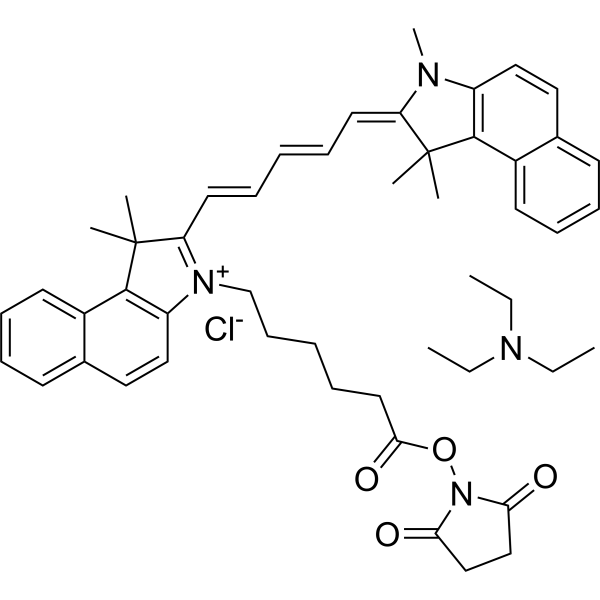 0 ImagesCat. No.: HY-135415ACyanine5.5 NHS ester chloride TEA is a reactive dye for the labeling of proteins, and antibodies and small molecular compounds.
-
Cy3 labled Volanesorsen sodium
 0 ImagesCat. No.: HY-145727ECy3 labled Volanesorsen sodium is a Cy3 labled Volanesorsen sodium.
-
Biotin-β-Amyloid (1-40)
 0 ImagesCat. No.: HY-P2549CAS No.: 183906-14-1Biotin-β-Amyloid (1-40) is a N-terminal-labelled biotinylated amyloid-β-(1-40) peptide.
-
4Arm-PEG10000-RB
 0 ImagesCat. No.: HY-D2894BSynonyms: 4Arm-PEG10000-Rhodamine B4Arm-PEG10000-RB (4Arm-PEG10000-Rhodamine B) is a fluorescent dye composed of Rhodamine B (HY-Y0016) and PEG with a four-arm structure. 4Arm-PEG10000-RB can be used for drug delivery and fluorescence imaging (Ex/Em=546/610 nm).
-
Ponatinib Acid
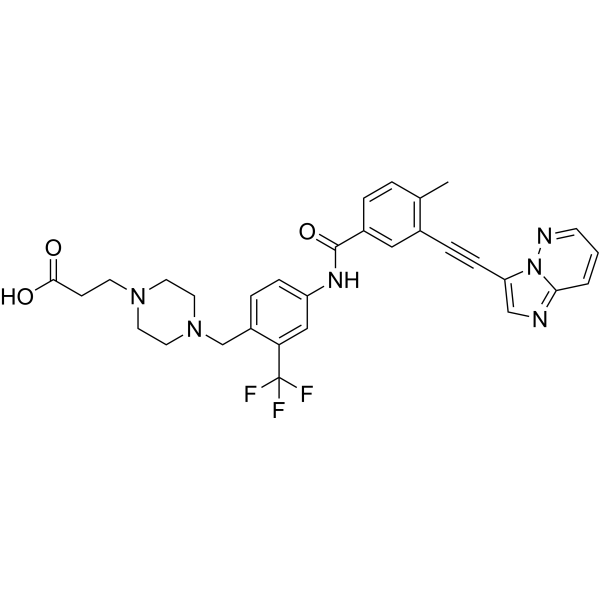 0 ImagesCat. No.: HY-135636CAS No.: 2748500-17-4Ponatinib Acid, an analogue of Ponatinib, is usually used as a labeled chemical or fluorescent probe. Ponatinib Acid is a click chemistry reagent, it contains an Alkyne group and can undergo copper-catalyzed azide-alkyne cycloaddition (CuAAc) with molecules containing Azide groups.
-
18:1-C11 BODIPY 505/515-C11 BODIPY 505/515 TG
 0 ImagesCat. No.: HY-N15883CAS No.: 2260795-51-318:1-C11 BODIPY 505/515-C11 BODIPY 505/515 TG is a fluorescently-labeled triglyceride that can be used to measure triacylglycerol hydrolases (Ex/Em = 495/503 nm).
-
Trisulfo-Cy3-acid disodium
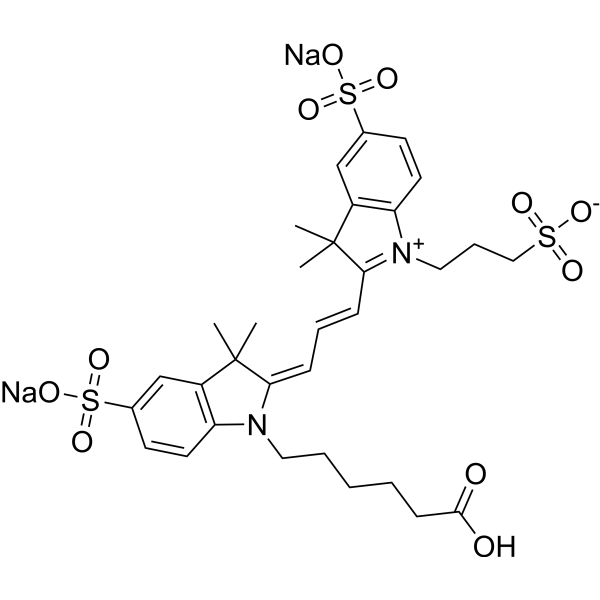 0 ImagesCat. No.: HY-133424ATrisulfo-Cy3-acid disodium is a derivative of Cy3 (Cyanine3) dye. Trisulfo-Cy3-acid disodium contains three sulfonate ions and has improved water solubility.
-
Cy3 labled Gatuzosiran sodium
 0 ImagesCat. No.: HY-177634DCy3 labled Gatuzosiran sodium is a Cy3 labled Gatuzosiran sodium.
-
Cyanine 3.18 TEA (solution)
 0 ImagesCat. No.: HY-DY1115Cyanine 3.18 (TEA) (solution) is a cyanine dye and fluorescent label for biomolecules. Cyanine 3.18 (TEA) (solution) interacts with double helical DNA via intercalation, minor groove binding, or DNA-templated aggregation.
Solvent and concentration: DMSO: 10 mM
-
Cy3 labled Cibrigirsen sodium
 0 ImagesCat. No.: HY-177622DCy3 labled Cibrigirsen sodium is a Cy3 labled Cibrigirsen sodium.
-
ATTO 425 maleimide
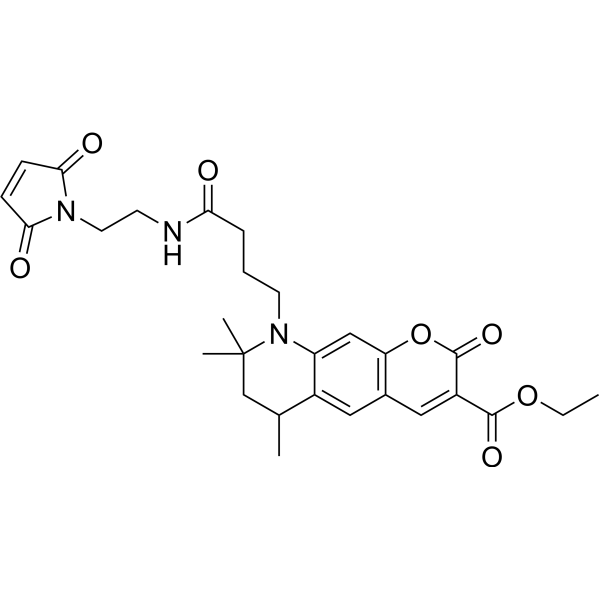 0 ImagesCat. No.: HY-D1925CAS No.: 892156-52-4ATTO 425 Maleimide is a maleimide ester derivative of ATTO 425, which can be used to label proteins or antibodies. The maximum excitation emission wavelength: 439/489 nm.
-
Alkyne cyanine dye 718
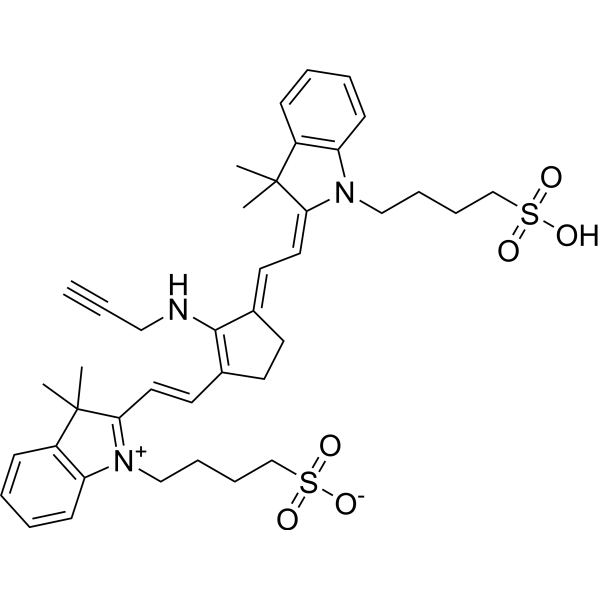 0 ImagesCat. No.: HY-D1361CAS No.: 1188292-54-7Alkyne cyanine dye 718 is a multifunctional dye. Dyes are important tools in biological experiments. They can help researchers observe and analyze cell structures, track biomolecules, evaluate cell functions, distinguish cell types, detect biomolecules, study tissue pathology and monitor microorganisms. Their applications range from basic scientific research to clinical A wide range of diagnostics. Dyes are also widely used in traditional fields such as textile dyeing, as well as in emerging fields such as functional textile processing, food pigments and dye-sensitized solar cells.

-
NIR-ASM
 0 ImagesCat. No.: HY-D3209CAS No.: 2646628-35-3NIR-ASM is a near-infrared fluorescent probe that can cross cell membranes and be activated by NQO1. NIR-ASM can distinguish NQO1-expressing cancer cells from normal cells via fluorescence microscopy and flow cytometry. NIR-ASM generates near-infrared fluorescence with a high signal-to-noise ratio in tumor models with NQO1 activity, enabling the detection of endogenous NQO1 activity in vivo. NIR-ASM is applicable to the research of lung cancer and breast cancer.
-
BTBCT
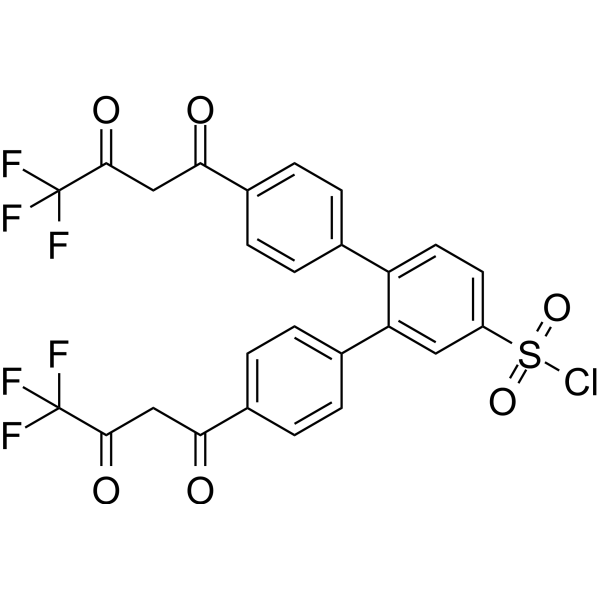 0 ImagesCat. No.: HY-D0038CAS No.: 525560-81-0BTBCT is mainly used as a label in time-resolved fluorescence immunoassays (TRFIA). The lower limit of detection for TSH TR-IFMA is 0.011 mIU/L in a 10 μl sample volume. The high fluorescence intensity and stability of BTBCT improves the sensitivity of the assay.
-
INDO 1 pentapotassium (solution)
 0 ImagesCat. No.: HY-DY1118CAS No.: 132319-56-3INDO 1 pentapotassium solution is a cell-impermeable, dual-emission ratiometric fluorescent calcium indicator with a KD·β value of 0.44 μM. INDO 1 pentapotassium solution binds to intracellular free calcium ions and undergoes wavelength-dependent fluorescence changes. In the unbound state (free form) without Ca2+, its fluorescence emission peak is at 485 nm upon excitation with ultraviolet light (350 nm). When INDO 1 pentasodium binds to Ca2+ (bound state), the emission peak shifts to 405 nm (Ex = 350 nm; dual emission at Em= 405/485 nm).
Solvent and concentration: ddH2O: 1 mM




