



Fluorescent Dye
Fluorescence is a phenomenon of photoluminescence in luminescence. When an atom is irradiated by light, some electrons around the nucleus jump from their original orbitals to higher energy orbitals under the influence of light energy, i.e., from the ground state to the first or second excited single-line state, etc. Due to the instability of the first or second excited singlet state, the electron returns from the excited singlet state to the ground state accompanied by released energy, resulting in fluorescence.
Fluorescent dyes can be covalently bound or physically adsorbed in the structure of the substance. The fluorescence properties allow for the characterization, localization and quantitative analysis of the labeled object. Fluorescent dyes have shown great potential for the detection of proteins, nucleic acids, cells, and immunoassays, attributed to the advantages in non-radioactive contamination, simple experimental operation and easy observation.
Fluorescent dyes have penetrated many fields such as pharmacology, physiology, environmental science, and information science, as well as functional studies of proteins and drug screening.
All Product Categories
-
Fluorescent Dye Related Products (4888)
Related Products (4888)

-
Antibodies (4)
-
FAM labled Ultevursen sodium
 0 ImagesCat. No.: HY-147412DFAM labled Ultevursen sodiumis a FAM labled Ultevursen sodium (HY-147412A). Ultevursen sodium (QR-421a) is a splice-modulating antisense oligonucleotide targeting exon 13 of the USH2A gene, which restores the functional expression of Usherin protein by inducing exon skipping. Ultevursen sodium binds to USH2A pre-mRNA and modulates the splicing process to specifically skip exon 13 carrying the pathogenic mutation c.2299delG, generating an in-frame transcript and a truncated yet functionally normal protein. Ultevursen sodium exhibits concentration-dependent exon skipping activity in human cells and retinal organoid models, and restores Usherin expression and retinal function in zebrafish and gene-edited mouse models. Ultevursen sodium can be used for related research on type 2 Usher syndrome and non-syndromic retinitis pigmentosa.
-
FAM labled Ulefnersen sodium
 0 ImagesCat. No.: HY-147410DFAM labled Ulefnersen sodiumis a FAM labled Ulefnersen sodium.
-
Cy3 labled Ultevursen sodium
 0 ImagesCat. No.: HY-147412ECy3 labled Ultevursen sodium is a Cy3 labled Ultevursen sodium (HY-147412A). Ultevursen sodium (QR-421a) is a splice-modulating antisense oligonucleotide targeting exon 13 of the USH2A gene, which restores the functional expression of Usherin protein by inducing exon skipping. Ultevursen sodium binds to USH2A pre-mRNA and modulates the splicing process to specifically skip exon 13 carrying the pathogenic mutation c.2299delG, generating an in-frame transcript and a truncated yet functionally normal protein. Ultevursen sodium exhibits concentration-dependent exon skipping activity in human cells and retinal organoid models, and restores Usherin expression and retinal function in zebrafish and gene-edited mouse models. Ultevursen sodium can be used for related research on type 2 Usher syndrome and non-syndromic retinitis pigmentosa.
-
Cy2 DiC18
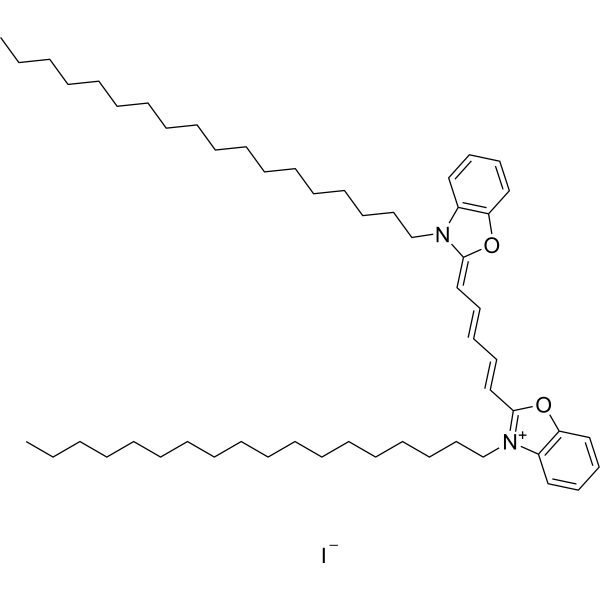 0 ImagesCat. No.: HY-D1047CAS No.: 68006-80-4Cy2 DiC18 belongs to the cyanine dye series and is a common fluorescent marker for biomolecules that can interact with biomolecules. Cyanine dyes may also bind to double-helical DNA through intercalation and exhibit enhanced fluorescence upon binding.
-
FAM labled Cemdisiran sodium
 0 ImagesCat. No.: HY-145720DFAM labled Cemdisiran sodiumis a FAM labled Cemdisiran sodium.
-
FAM labled Custirsen sodium
 0 ImagesCat. No.: HY-143230EFAM labled Custirsen sodiumis a FAM labled Custirsen sodium.
-
PerCP
 0 ImagesCat. No.: HY-D0992CAS No.: 422551-33-5Synonyms: Peridinin-chlorophyll-protein complexPerCP is a peridinin-chlorophyll protein complex derived from the dinoflagellate *Glenodinium*, suitable for immunofluorescence staining of formalin-fixed, paraffin-embedded human tumor sections. As a red fluorescent dye, PerCP enables clear differentiation between antibody-bound tumor regions and yellow-green autofluorescence of tissues. PerCP allows simultaneous observation of tissue morphology without counterstaining. PerCP can be used in cancer research (Ex/Em = 482/677 nm).
-
FAM labled Danvatirsen sodium
 0 ImagesCat. No.: HY-145729HFAM labled Danvatirsen sodiumis a FAM labled Danvatirsen sodium.
-
Cy3 labled Trabedersen sodium
 0 ImagesCat. No.: HY-142118ECy3 labled Trabedersen sodium is a Cy3 labled Trabedersen sodium.
-
Cy3 labled Cemdisiran sodium
 0 ImagesCat. No.: HY-145720ECy3 labled Cemdisiran sodium is a Cy3 labled Cemdisiran sodium.
-
FAM labled Alicaforsen sodium
 0 ImagesCat. No.: HY-145728EFAM labled Alicaforsen sodiumis a FAM labled Alicaforsen sodium.
-
FAM labled Trabedersen sodium
 0 ImagesCat. No.: HY-142118DFAM labled Trabedersen sodiumis a FAM labled Trabedersen sodium.
-
Cy3 labled Pelacarsen sodium
 0 ImagesCat. No.: HY-151123ECy3 labled Pelacarsen sodium is a Cy3 labled Pelacarsen sodium.
-
Cy3 labled Alicaforsen sodium
 0 ImagesCat. No.: HY-145728HCy3 labled Alicaforsen sodium is a Cy3 labled Alicaforsen sodium.
-
AkaLumine
 0 ImagesCat. No.: HY-112641CAS No.: 1176235-08-7AkaLumine is a D-luciferin (HY-12591A) analogue with a Km of 2.06 μM for recombinant firefly luciferase (Fluc) protein. AkaLumine emits near-infrared (NIR) light (λmax=677 nm) in reactions with native Fluc. AkaLumine has high tissue-penetration and increases detection sensitivity from deep-tissue targets.
-
Cy3 labled Brogidirsen sodium
 0 ImagesCat. No.: HY-147253ECy3 labled Brogidirsen sodium is a Cy3 labled Brogidirsen sodium.
-
FAM labled Volanesorsen sodium
 0 ImagesCat. No.: HY-145727DFAM labled Volanesorsen sodiumis a FAM labled Volanesorsen sodium.
-
FAM labled Brogidirsen sodium
 0 ImagesCat. No.: HY-147253DFAM labled Brogidirsen sodiumis a FAM labled Brogidirsen sodium.
-
Cy3 labled Custirsen sodium
 0 ImagesCat. No.: HY-143230HCy3 labled Custirsen sodium is a Cy3 labled Custirsen sodium.
-
Cy3 labled Ulefnersen sodium
 0 ImagesCat. No.: HY-147410ECy3 labled Ulefnersen sodium is a Cy3 labled Ulefnersen sodium.




