



AkaLumine
Based on 7 publication(s) in Google Scholar
AkaLumine is a D-luciferin (HY-12591A) analogue with a Km of 2.06 μM for recombinant firefly luciferase (Fluc) protein. AkaLumine emits near-infrared (NIR) light (λmax=677 nm) in reactions with native Fluc. AkaLumine has high tissue-penetration and increases detection sensitivity from deep-tissue targets.
For research use only. We do not sell to patients.
- CAS No.: 1176235-08-7
- Formula: C16H18N2O2S
- Molecular Weight:302.39
-
Storage:
Please store the product under the recommended conditions in the Certificate of Analysis.


To place orders, for customer services and technical support, please contact: MedChemExpress USA
Tel: 609-228-6898 E-mail: [email protected] [email protected]


-
 Biological Activity
-
Chemical Information
- Purity & Documentation
- References
-
 Help & FAQs


Publications Citing Use of MedChemExpress (MCE) AkaLumine
More- Cancer Res. 2025 Jan 15;85(2):231-250. [Abstract]
- J Control Release. 2026 May 4;395:114984.
- J Immunother Cancer. 2025 Nov 18;13(11):e012968. [Abstract]
- Stem Cell Res. 2021 Oct:56:102532. [Abstract]
- bioRxiv. 2026 Apr 3:2026.03.31.715681. [Abstract]
- bioRxiv. 2026 Jan 5:2026.01.05.697591. [Abstract]
- bioRxiv. 2025 Jun 19.
 Customer Validation & Images

-
In Vivo Imaging
-
Cell Imaging/Staining
-
In Vivo Efficacy Study


Biological Activity
Description
IC50 & Target
Km: 2.06 μM[1].
In Vitro
Guide (The following is our recommended protocol. This protocol is only a guide and should be modified according to your specific needs).
1. Solution preparation[2]
1.1 Preparation of stock solution
Solvent: Anhydrous DMSO or ultrapure water.
Concentration: 10 mM is recommended.
Storage: Store at -20°C in dark after aliquoting and avoid repeated freezing and thawing.
1.2 Preparation of working solution
Dilute to 1-100 μM with PBS or serum-free cell culture medium (optimized according to the experiment).
Note: The working solution should be prepared and used immediately, and should be protected from light.
2. Cell staining
2.1 Disperse cells with 100 μL PBS and suspend them in a 96-well plate at a density of 2×10⁵.
2.2 Add AkaLumine hydrochloride (100 μM) and 5 mM ATP magnesium (HY-B2176) to the cells.
2.3 Analyze using a bioluminescence imaging system.
MedChemExpress (MCE) has not independently confirmed the accuracy of these methods. They are for reference only.
In Vivo
1. Inject tumor cells into mice subcutaneously or intratibially.
2. Inject different concentrations of AkaLumine hydrochloride (0.5-33 mM; 100 μL) intraperitoneally.
3. Detect using a bioluminescence instrument 15 minutes after injection.
MedChemExpress (MCE) has not independently confirmed the accuracy of these methods. They are for reference only.


Chemical Information
-
CAS No. 1176235-08-7
-
Molecular Weight 302.39
-
Formula C16H18N2O2S
-
SMILES
O=C([C@@H]1N=C(/C=C/C=C/C2=CC=C(N(C)C)C=C2)SC1)O
-
Shipping
Room temperature in continental US; may vary elsewhere.
-
Storage
Please store the product under the recommended conditions in the Certificate of Analysis.


Publications (7)
-
Journal Impact Factor
-
Most Recent
-
Cancer Res
2025 Jan 15;85(2):231-250. PMID: 39495206
AkaLumine purchased from MedChemExpress. Usage Cited in: Cancer Res. 2025 Jan 15;85(2):231-250. [Abstract]
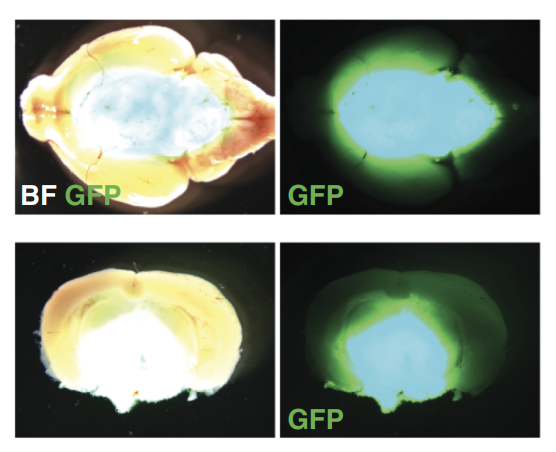
Representative brightfield (BF) and fluorescence (GFP) images of a GFP+ Foxr2-driven tumor (top, whole brain; bottom, coronal section). To enable bioluminescence imaging in vivo, a vector expressing Akaluc luciferase was codelivered. The vectors carrying Foxr2 and AkaLumine hydrochloride (15 mmol/L, 100 μL; i.p.; single dose) express green fluorescent protein (GFP) downstream of a modified 2A peptide (PQR), allowing immunochemical detection of tumor cells with GFP.
-
-
J Immunother Cancer
JNK knockdown enhances CAR-T cell cytotoxicity through elevated NFATc1-dependent transcription in preclinical ovarian cancer models. [Abstract]2025 Nov 18;13(11):e012968. PMID: 41253493 -
Stem Cell Res
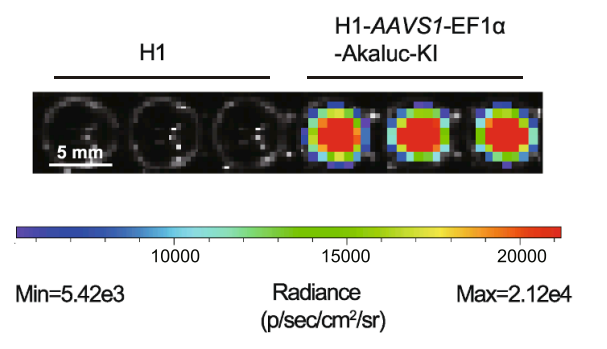
Generation of an Akaluc knock-in human embryonic stem cell reporter line using CRISPR-Cas9 technology. [Abstract]2021 Oct:56:102532. PMID: 34509917
AkaLumine purchased from MedChemExpress. Usage Cited in: Stem Cell Res. 2021 Oct:56:102532. [Abstract]
Akaluc activity was detected in vitro using bioluminescence imaging (BLI). Cells were dispersed and suspended by 100 μL PBS in a 96-well plate at a density of 2 × 10⁵. Added 100 µM AkaLumine hydrochloride and 5 mM ATP-mg, used the BLI to analyze.
AkaLumine purchased from MedChemExpress. Usage Cited in: Stem Cell Res. 2021 Oct:56:102532. [Abstract]
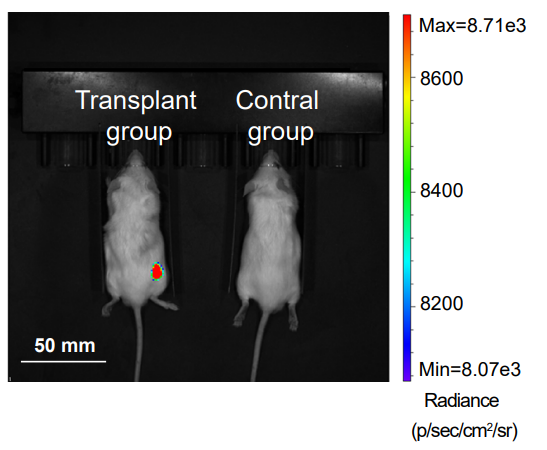
Akaluc activity was detected in vivo using bioluminescence imaging (BLI). 1 million cells were transplanted into femoral ditch of the SCID mice. After 1–2 month, we injected 30 mM, 100 μL AkaLumine hydrochloride for 15 min. Then, gas anaesthetized mice and used the IVIS Spectrum to analyze.
-
bioRxiv
Pharmacologic DPP-4 inhibition promotes CD8+ T cell metabolic fitness to enhance anti-tumor activity. [Abstract]2026 Apr 3:2026.03.31.715681. PMID: 41959339 -
bioRxiv
Atomic Layering Thermostable Antigen and Adjuvant (ALTA®) platform provides unique antigen delivery system through controlled release to improve immune response to vaccination. [Abstract]2026 Jan 5:2026.01.05.697591. PMID: 41542521 -


Purity & Documentation
References
[1]. Kuchimaru T, et al. A luciferin analogue generating near-infrared bioluminescence achieves highly sensitive deep-tissue imaging. Nat Commun. 2016 Jun 14;7:11856. [Content Brief]
[2]. Zhou M, et al. Generation of an Akaluc knock-in human embryonic stem cell reporter line using CRISPR-Cas9 technology. Stem Cell Res. 2021 Oct;56:102532. [Content Brief]

Calculators
Concentration (start) × Volume (start) = Concentration (final) × Volume (final)


AkaLumine Related Classifications
HY-112641 Related Classifications
 Powered by Bioz