



Afoxolaner (Standard)

Based on 1 Customer Validation
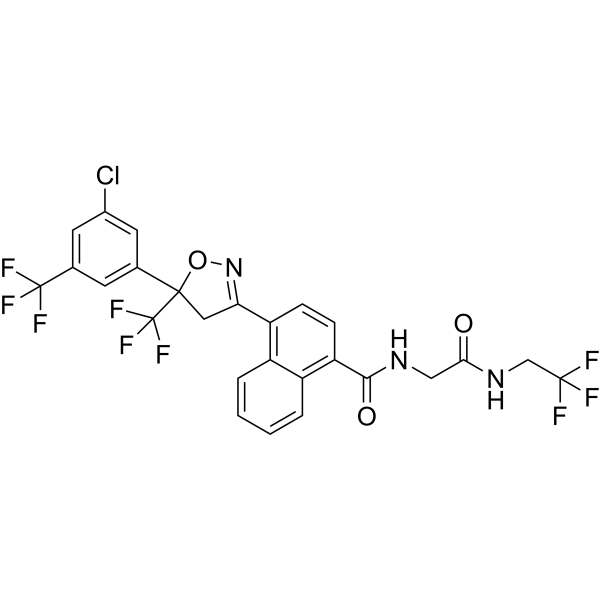
Afoxolaner (Standard) is the analytical standard of Afoxolaner. This product is intended for research and analytical applications. Afoxolaner is an orally active isoxazoline insecticide/acaricide against Ixodes scapularis in dogs. Afoxolaner acts on the insect γ-aminobutyric acid receptor (GABA) and glutamate receptors, inhibiting GABA & glutamate-regulated uptake of chloride ions, resulting in excess neuronal stimulation and death of the arthropod.
Nur für Forschungszwecke. Wir verkaufen nicht an Patienten.
- CAS. Nr.: 1093861-60-9
- Formel: C26H17ClF9N3O3
- Molecular Weight:625.87
-
Speicherung:
Please store the product under the recommended conditions in the Certificate of Analysis.


To place orders, for customer services and technical support, please contact: MedChemExpress USA
Tel: 609-228-6898 E-mail: [email protected] [email protected]


-
 Product Information
-
Chemical Information
- Reinheit & Dokumentation
-
 Help & FAQs





Product Information
The compound is the grade of analytical standard, which is the reference standard supplied assay. It is commonly used in qualitative, quantitative and methodological research experiments in HPLC, GC and MS.


Chemical Information
-
CAS. Nr. 1093861-60-9
-
Appearance Solid
-
Molecular Weight 625.87
-
Formel C26H17ClF9N3O3
-
Color White to off-white
-
SMILES
O=C(C1=C2C=CC=CC2=C(C3=NOC(C(F)(F)F)(C4=CC(C(F)(F)F)=CC(Cl)=C4)C3)C=C1)NCC(NCC(F)(F)F)=O
-
Versand
Room temperature in continental US; may vary elsewhere.
-
Speicherung
Please store the product under the recommended conditions in the Certificate of Analysis.


Reinheit & Dokumentation
-
SDS (393 KB)
- English - EN (393 KB)
- Français - FR (393 KB)
- Deutsch - DE (393 KB)
- Norwegian - NO (393 KB)
- Español - ES (393 KB)
- Swedish - SV (393 KB)
- Italian - IT (393 KB)
- Korean - KR (393 KB)
- Portuguese - PT (393 KB)
-
Handling Instructions (2659 KB)
Verweise
[1]. Mitchell EB, et al. Efficacy of afoxolaner against Ixodes scapularis ticks in dogs.Vet Parasitol. 2014 Apr 2;201(3-4):223-5. [Content Brief]
[2]. Beugnet F, et al. Afoxolaner against fleas: immediate efficacy and resultant mortality after short exposure on dogs.Parasite. 2014;21:42. [Content Brief]

Calculators
Konzentration (Stammlösung) × Volumen (Stammlösung) = Konzentration (Ziellösung) × Volumen (Ziellösung)


Afoxolaner (Standard) Related Classifications
HY-16974R Related Classifications
 Powered by Bioz