



Alirocumab
Based on 1 publication(s) in Google Scholar
Alirocumab is an anti-PCSK9 human monoclonal antibody. Alirocumab inhibits PCSK9. Alirocumab reduces NLRP3 inflammasome, regulates Nrf2/HO-1, HMGB1/NF-κB and Fractalkine/CX3CR1. Alirocumab increases the ability of the liver to bind LDL-cholesterol (LDL-C) and reduces levels of LDL-C in blood. Alirocumab improves atherosclerosis and inflammation.
Nur für Forschungszwecke. Wir verkaufen nicht an Patienten.
- Reinheit: 97.00%
- CAS. Nr.: 1245916-14-6
- Molecular Weight:146.24 kDa
-
Speicherung:
Please store the product under the recommended conditions in the Certificate of Analysis.

To place orders, for customer services and technical support, please contact: MedChemExpress USA
Tel: 609-228-6898 E-mail: [email protected] [email protected]


-
 Biologische Aktivität
-
Chemical Information
- Reinheit & Dokumentation
- Verweise
-
 Help & FAQs



Publications Citing Use of MedChemExpress (MCE) Alirocumab
More

Biologische Aktivität
Human IgG1 kappa
Human
PCSK9
Alirocumab (40 μg/mL, 24 h) alleviates basal PCSK9 overexpression in vascular smooth muscle cells (VSMCs) of obese insulin-resistant Zucker rats (OZR)[3].
Alirocumab (8 μg/mL, 72 h) attenuates Lp(a) secretion in primary human hepatocytes via inhibition of PCSK9[4].
Alirocumab (10 μg/mL, 24 h) inhibits lipid-induced inflammation in HepG2 cells[5].
MedChemExpress (MCE) has not independently confirmed the accuracy of these methods. They are for reference only.
-
Cell Line:HepG2 incubated with 0.5 mM cis-9-octadecenoic acid and 0.25 mM palmitic acid
-
Concentration:10 μg/mL
-
Incubation Time:24 h
-
Result:Decreased PCSK9 protein levels by 65.3%.
Attenuated increased IL-6, IL-1β, and TNFα protein levels.
Decreased p65-NF-κB phosphorylation.
Reduced the phosphorylation levels of AP-1 by 61.0%.
Decreased the phosphorylation levels of PI3K and AKT.
Decreased the mTOR protein phosphorylation levels by 46.2%.
Alirocumab (16 mg/kg/week, s.c., on day 0, day 7, and day 14) boosts antioxidant status and halts inflammation in rat model of sepsis-induced nephrotoxicity via modulation of Nrf2/HO-1, PCSK9/HMGB1/NF-ᴋB/NLRP3 and Fractalkine/CX3CR1 hubs[7].
Alirocumab (50 mg/kg, s.c., weekly prior to exposure to the liquid diets) attenuates ethanol-induced neuronal injury in the brain and oxidative stress in rats[8].
Alirocumab (1 mg/kg/week, s.c.) activates brown fat, increases hepatic uptake of cholesterol-rich TRL remnants, thereby lowering non-HDL-C, and increases HDL-C levels and cholesterol efflux capacity of HDL, further improving dyslipidemia in APOE*3-Leiden.CETP mice[9].
Alirocumab (10 mg/kg, s.c., 2 weeks) reduces lipoprotein(a) levels in nonhuman primates by lowering apolipoprotein(a) production rate[10].
Alirocumab (3-10 mg/kg, i.p., weekly for 16 weeks) reduces RAS, NLRP3 inflammasome, and cholecystokinin in lung tissue of obese mice[11].
MedChemExpress (MCE) has not independently confirmed the accuracy of these methods. They are for reference only.
-
Animal Model:Male albino Wistar rats model (LPS-intoxicated)[7]
-
Dosage:16 mg/kg/week
-
Administration:Subcutaneous injection (s.c.), on day 0, day 7, and day 14
-
Result:Mitigated LPS-mediated increments in serum creatinine and cystatin C, together with renal contents of both KIM-1 and NGAL.
Restored renal NGAL content to its normal values.
Boosted mRNA expression levels of both Nrf2 and HO-1 and renal TAC content (2.5, 2, and 3.2-folds, respectively).
Produced pronounced hampering in LPS-mediated elevation in mRNA expression levels of PCSK9 and RAGE, along with renal contents of PCSK9 and HMGB1 by 80.9 %, 49.6 %, 53.1 % and 59.8 %, respectively.
Resulted in a marked reduction in the protein expression of TLR4, MYD88, and NLRP3, along with mRNA expression levels of NF-ᴋB by 62.9 %, 58.1 %, 50.9 %, respectively.
Caused remarkable alleviation in LPS-mediated increment in TNF-α, IL-1β, and caspase-1 by 48.5 %, 68.3 % and 58.5 %, respectively.
Produced prominent downregulation in mRNA expression levels of CX3CL1 and CX3CR1 by 88.4 % and 87.5 %, respectively.
Exhibited prominent elevation in mRNA expression level of Bcl-2 (1.7-folds), along with a marked reduction in both mRNA expression level of Bax and renal caspase-3 content (by 66.7 % and 58.5 %, respectively) .
Regressed glomerular and tubular lesions.
| NCT Number | Sponsor | Condition | Start Date |
Phase

|
|---|---|---|---|---|
| NCT01329991 | Plexxikon| | 2011-05 | PHASE1 |
Unconjugated
The product can be reconstituted/diluted with sterile PBS or saline.
-
Human IgG1 kappa
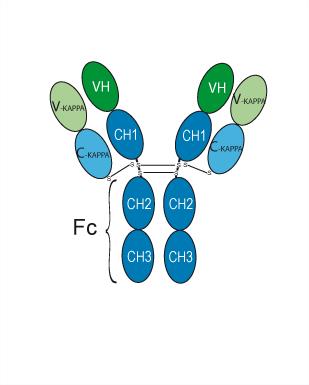
ELISA, FACS, Functional assay
-
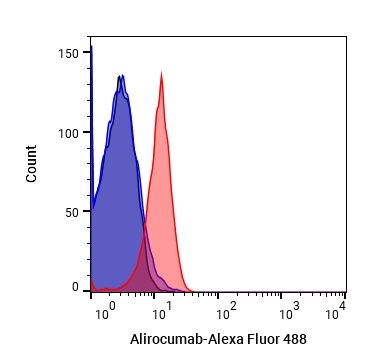 Flow Cytometry analysis of Hela cells labelling PCSK9 (red) with Alirocumab (anti-PCSK9) (HY-P9928). Goat Anti-Human IgG (Alexa Fluor 488) (HY-P83776) at a dilution of 1/1000 was used as the secondary antibody. Blue-Human IgG1 kappa (HY-P99001). Black-Unlabelled control, cells without incubation with primary antibody.


Chemical Information
-
CAS. Nr. 1245916-14-6
-
Appearance Liquid
-
Molecular Weight 146.24 kDa
-
Color Colorless to light yellow
-
SMILES
OC(CO)COP(O)(O)=O.[Na].[Na]
-
Synonyms
REGN 727; SAR 236553
-
Formulation
Please refer to the lot-specific COA for specific buffer information.
-
Speicherung
Please store the product under the recommended conditions in the Certificate of Analysis.


Publications (1)
-
Journal Impact Factor
-
Most Recent
-
Nat Commun
The Lin28b/Wnt5a axis drives pancreas cancer through crosstalk between cancer associated fibroblasts and tumor epithelium. [Abstract]2023 Oct 28;14(1):6885. PMID: 37898598


Reinheit & Dokumentation
-
Data Sheet (269 KB)
-
SDS (251 KB)
- English - EN (251 KB)
- Français - FR (251 KB)
- Deutsch - DE (251 KB)
- Norwegian - NO (251 KB)
- Español - ES (251 KB)
- Swedish - SV (251 KB)
- Italian - IT (251 KB)
- Korean - KR (251 KB)
- Portuguese - PT (251 KB)
-
Inhibitory Antibodies User Guide (603 KB)
Verweise
[1]. Markham A. Alirocumab: First Global Approval. Drugs. 2015;75(14):1699-1705. [Content Brief]
[2]. Tavori H, et al. Alirocumab: PCSK9 inhibitor for LDL cholesterol reduction. Expert Rev Cardiovasc Ther. 2014 Oct;12(10):1137-44. [Content Brief]
[3]. Barale C, et al. PCSK9 Expression in Vascular Smooth Muscle Cells: Role of Insulin Resistance and High Glucose. Int J Mol Sci. 2025 Jan 24;26(3):1003. [Content Brief]
[4]. Villard EF, et al. PCSK9 Modulates the Secretion But Not the Cellular Uptake of Lipoprotein(a) Ex Vivo: An Effect Blunted by Alirocumab. JACC Basic Transl Sci. 2016 Oct;1(6):419-427. [Content Brief]
[6]. Kühnast S, et al. Alirocumab inhibits atherosclerosis, improves the plaque morphology, and enhances the effects of a statin. J Lipid Res. 2014 Oct;55(10):2103-12. [Content Brief]
[7]. Hassan NF, et al. Alirocumab boosts antioxidant status and halts inflammation in rat model of sepsis-induced nephrotoxicity via modulation of Nrf2/HO-1, PCSK9/HMGB1/NF-ᴋB/NLRP3 and Fractalkine/CX3CR1 hubs. Biomed Pharmacother. 2024 Aug;177:116929. [Content Brief]
[8]. Wagner J, et al. PCSK9 inhibition attenuates alcohol-associated neuronal oxidative stress and cellular injury. Brain Behav Immun. 2024 Jul;119:494-506. [Content Brief]
[9]. Zhou E, et al. Beneficial effects of brown fat activation on top of PCSK9 inhibition with alirocumab on dyslipidemia and atherosclerosis development in APOE*3-Leiden.CETP mice. Pharmacol Res. 2021 May;167:105524. [Content Brief]
[10]. Croyal M, et al. PCSK9 inhibition with alirocumab reduces lipoprotein(a) levels in nonhuman primates by lowering apolipoprotein(a) production rate. Clin Sci (Lond). 2018 May 31;132(10):1075-1083. [Content Brief]
[11]. Liang L, et al. Statin administration or blocking PCSK9 alleviates airway hyperresponsiveness and lung fibrosis in high-fat diet-induced obese mice. Respir Res. 2024 May 18;25(1):213. [Content Brief]

Calculators
Konzentration (Stammlösung) × Volumen (Stammlösung) = Konzentration (Ziellösung) × Volumen (Ziellösung)


Alirocumab Related Classifications
HY-P9928 Related Classifications
 Powered by Bioz