



Alirocumab
Based on 1 publication(s) in Google Scholar
Alirocumab (REGN727) is an anti-PCSK9 human monoclonal antibody. Alirocumab inhibits PCSK9. Alirocumab reduces NLRP3 inflammasome, regulates Nrf2/HO-1, HMGB1/NF-κB and Fractalkine/CX3CR1. Alirocumab increases the ability of the liver to bind LDL-cholesterol (LDL-C) and reduces levels of LDL-C in blood. Alirocumab improves atherosclerosis and inflammation.
For research use only. We do not sell to patients.
- Purity : 97.00%
- CAS No.: 1245916-14-6
- Molecular Weight:146.24 kDa
-
Storage:
Please store the product under the recommended conditions in the Certificate of Analysis.

To place orders, for customer services and technical support, please contact: MedChemExpress USA
Tel: 609-228-6898 E-mail: [email protected] [email protected]


-
 Biological Activity
-
Chemical Information
- Protocols
- Purity & Documentation
- References
-
 Help & FAQs


-
HY-P9930
EvolocumabPCSK9 Inhibitor -
HY-P9908
AdalimumabTNF-α Inhibitor -
HY-P99187
BococizumabAnti-human PCSK9 Antibody -
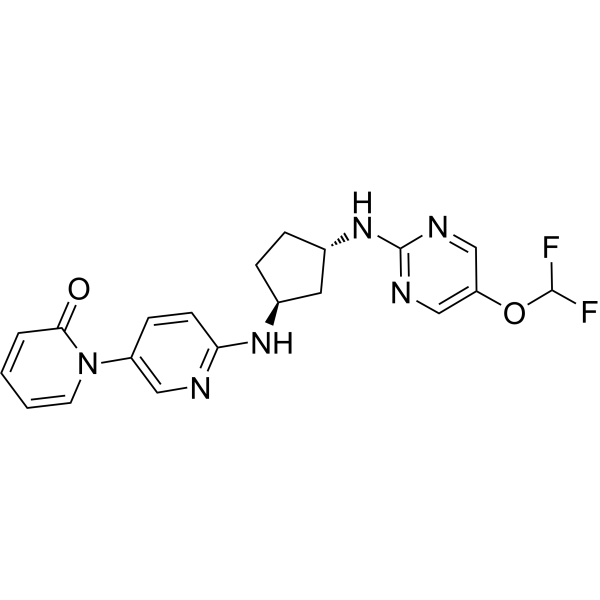
HY-148673
LaroprovstatPCSK9 Inhibitor -
HY-P9928A
Alirocumab (anti-PCSK9)PCSK9 Inhibitor -

HY-P9905
CetuximabEGFR Inhibitor -
HY-P9903
NivolumabPD-1 Inhibitor -
HY-P9917
TocilizumabIL-6R Neutralizing Antibody -
HY-114118
SemaglutideGLP-1R Agonist -
HY-108810
CanakinumabAnti-IL-1β Monoclonal Antibody -
HY-P9906
BevacizumabVEGF-A Inhibitor -

HY-P9927
SecukinumabIL-17A Antagonist


Biological Activity
Description
IC50 & Target
PCSK9
In Vitro
Alirocumab (40 μg/mL, 24 h) alleviates basal PCSK9 overexpression in vascular smooth muscle cells (VSMCs) of obese insulin-resistant Zucker rats (OZR)[3].
Alirocumab (8 μg/mL, 72 h) attenuates Lp(a) secretion in primary human hepatocytes via inhibition of PCSK9[4].
Alirocumab (10 μg/mL, 24 h) inhibits lipid-induced inflammation in HepG2 cells[5].
MedChemExpress (MCE) has not independently confirmed the accuracy of these methods. They are for reference only.
-
Cell Line:HepG2 incubated with 0.5 mM cis-9-octadecenoic acid and 0.25 mM palmitic acid
-
Concentration:10 μg/mL
-
Incubation Time:24 h
-
Result:Decreased PCSK9 protein levels by 65.3%.
Attenuated increased IL-6, IL-1β, and TNFα protein levels.
Decreased p65-NF-κB phosphorylation.
Reduced the phosphorylation levels of AP-1 by 61.0%.
Decreased the phosphorylation levels of PI3K and AKT.
Decreased the mTOR protein phosphorylation levels by 46.2%.
In Vivo
Alirocumab (16?mg/kg/week, s.c., on day 0, day 7, and day 14) boosts antioxidant status and halts inflammation in rat model of sepsis-induced nephrotoxicity via modulation of Nrf2/HO-1, PCSK9/HMGB1/NF-?B/NLRP3 and Fractalkine/CX3CR1 hubs[7].
Alirocumab (50 mg/kg, s.c., weekly prior to exposure to the liquid diets) attenuates ethanol-induced neuronal injury in the brain and oxidative stress in rats[8].
Alirocumab (1 mg/kg/week, s.c.) activates brown fat, increases hepatic uptake of cholesterol-rich TRL remnants, thereby lowering non-HDL-C, and increases HDL-C levels and cholesterol efflux capacity of HDL, further improving dyslipidemia in APOE*3-Leiden.CETP mice[9].
Alirocumab (10 mg/kg, s.c., 2 weeks) reduces lipoprotein(a) levels in nonhuman primates by lowering apolipoprotein(a) production rate[10].
Alirocumab (3-10 mg/kg, i.p., weekly for 16 weeks) reduces RAS, NLRP3 inflammasome, and cholecystokinin in lung tissue of obese mice[11].
MedChemExpress (MCE) has not independently confirmed the accuracy of these methods. They are for reference only.
-
Animal Model:Male albino Wistar rats model (LPS-intoxicated)[7]
-
Dosage:16 mg/kg/week
-
Administration:Subcutaneous injection (s.c.), on day 0, day 7, and day 14
-
Result:Mitigated LPS-mediated increments in serum creatinine and cystatin C, together with renal contents of both KIM-1 and NGAL.
Restored renal NGAL content to its normal values.
Boosted mRNA expression levels of both Nrf2 and HO-1 and renal TAC content (2.5, 2, and 3.2-folds, respectively).
Produced pronounced hampering in LPS-mediated elevation in mRNA expression levels of PCSK9 and RAGE, along with renal contents of PCSK9 and HMGB1 by 80.9 %, 49.6 %, 53.1 % and 59.8 %, respectively.
Resulted in a marked reduction in the protein expression of TLR4, MYD88, and NLRP3, along with mRNA expression levels of NF-ᴋB by 62.9 %, 58.1 %, 50.9 %, respectively.
Caused remarkable alleviation in LPS-mediated increment in TNF-α, IL-1β, and caspase-1 by 48.5 %, 68.3 % and 58.5 %, respectively.
Produced prominent downregulation in mRNA expression levels of CX3CL1 and CX3CR1 by 88.4 % and 87.5 %, respectively.
Exhibited prominent elevation in mRNA expression level of Bcl-2 (1.7-folds), along with a marked reduction in both mRNA expression level of Bax and renal caspase-3 content (by 66.7 % and 58.5 %, respectively) .
Regressed glomerular and tubular lesions.
Clinical Trial
| NCT Number | Sponsor | Condition | Start Date |
Phase

|
|---|---|---|---|---|
| NCT01329991 | 2011-05 | PHASE1 |
Application
ELISA, FACS, Functional assay
Verified Bioactivity
-
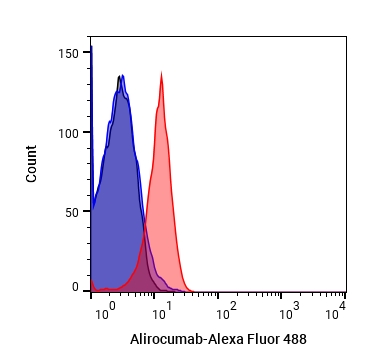 Flow Cytometry analysis of Hela cells labelling PCSK9 (red) with Alirocumab (anti-PCSK9) (HY-P9928). Goat Anti-Human IgG (Alexa Fluor 488) (HY-P83776) at a dilution of 1/1000 was used as the secondary antibody. Blue-Human IgG1 kappa (HY-P99001). Black-Unlabelled control, cells without incubation with primary antibody.


Product Details
-
CAS No. 1245916-14-6
-
Accession Q8NBP7
-
Synonyms REGN727; SAR 236553
-
Molecular Weight 146.24 kDa
-
Species Reactivity
Human
-
Conjugated
Unconjugated
-
Isotype
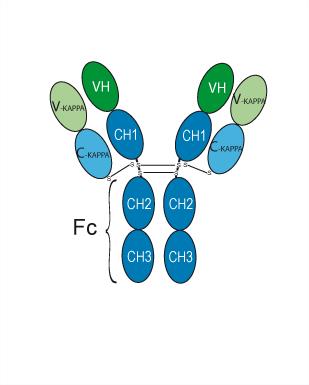
Human IgG1 kappa
-
Recommend Isotype Controls
-
Format
-
Human IgG1 kappa
-
Product Properties
-
Appearance
Liquid
-
Formulation
Please refer to the lot-specific COA for specific buffer information.
-
Purity
97.00%
-
Reconstitution
The product can be reconstituted/diluted with sterile PBS or saline.
-
Storage & Stability
Please store the product under the recommended conditions in the Certificate of Analysis.


Publications (1)
-
Journal Impact Factor
-
Most Recent
-
Nat Commun
The Lin28b/Wnt5a axis drives pancreas cancer through crosstalk between cancer associated fibroblasts and tumor epithelium. [Abstract]2023 Oct 28;14(1):6885. PMID: 37898598
Purity & Documentation


References
[1]. Markham A. Alirocumab: First Global Approval. Drugs. 2015;75(14):1699-1705. [Content Brief]
[2]. Tavori H, et al. Alirocumab: PCSK9 inhibitor for LDL cholesterol reduction. Expert Rev Cardiovasc Ther. 2014 Oct;12(10):1137-44. [Content Brief]
[3]. Barale C, et al. PCSK9 Expression in Vascular Smooth Muscle Cells: Role of Insulin Resistance and High Glucose. Int J Mol Sci. 2025 Jan 24;26(3):1003. [Content Brief]
[4]. Villard EF, et al. PCSK9 Modulates the Secretion But Not the Cellular Uptake of Lipoprotein(a) Ex Vivo: An Effect Blunted by Alirocumab. JACC Basic Transl Sci. 2016 Oct;1(6):419-427. [Content Brief]
[6]. Kühnast S, et al. Alirocumab inhibits atherosclerosis, improves the plaque morphology, and enhances the effects of a statin. J Lipid Res. 2014 Oct;55(10):2103-12. [Content Brief]
[7]. Hassan NF, et al. Alirocumab boosts antioxidant status and halts inflammation in rat model of sepsis-induced nephrotoxicity via modulation of Nrf2/HO-1, PCSK9/HMGB1/NF-ᴋB/NLRP3 and Fractalkine/CX3CR1 hubs. Biomed Pharmacother. 2024 Aug;177:116929. [Content Brief]
[8]. Wagner J, et al. PCSK9 inhibition attenuates alcohol-associated neuronal oxidative stress and cellular injury. Brain Behav Immun. 2024 Jul;119:494-506. [Content Brief]
[9]. Zhou E, et al. Beneficial effects of brown fat activation on top of PCSK9 inhibition with alirocumab on dyslipidemia and atherosclerosis development in APOE*3-Leiden.CETP mice. Pharmacol Res. 2021 May;167:105524. [Content Brief]
[10]. Croyal M, et al. PCSK9 inhibition with alirocumab reduces lipoprotein(a) levels in nonhuman primates by lowering apolipoprotein(a) production rate. Clin Sci (Lond). 2018 May 31;132(10):1075-1083. [Content Brief]
[11]. Liang L, et al. Statin administration or blocking PCSK9 alleviates airway hyperresponsiveness and lung fibrosis in high-fat diet-induced obese mice. Respir Res. 2024 May 18;25(1):213. [Content Brief]

Calculators
Concentration (start) × Volume (start) = Concentration (final) × Volume (final)


Alirocumab Related Classifications
HY-P9928 Related Classifications
 Powered by Bioz
Keywords
- Alirocumab
- 1245916-14-6
- REGN727
- SAR 236553
- REGN 727
- REGN-727
- SAR236553
- SAR 236553
- SAR-236553
- PCSK9
- NOD-like Receptor (NLR)
- Keap1-Nrf2
- HMG Family
- NF-κB
- CX3CR1
- Proprotein convertase subtilisin/kexin type 9
- High Mobility Group Family
- Nuclear factor-κB
- Nuclear factor-kappaB
- CX3C chemokine receptor1
- GPR13
- fractalkine receptor
- LDL
- hypercholesterolemia
- Inhibitor
- inhibitor
- inhibit