



BS3 Crosslinker disodium
Based on 3 publication(s) in Google Scholar
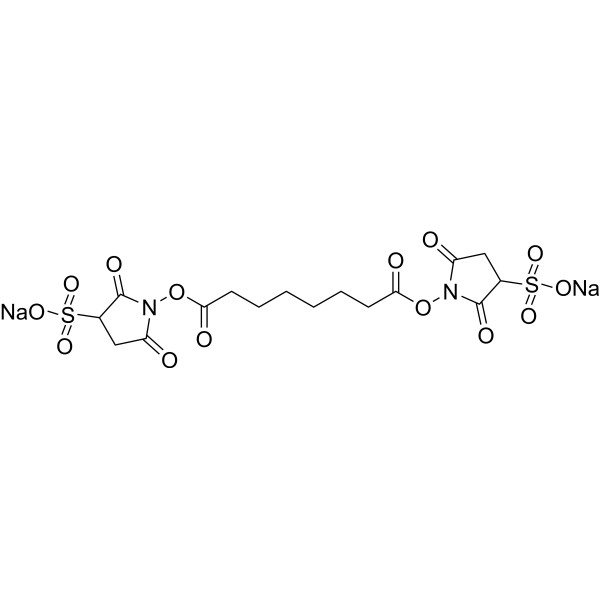
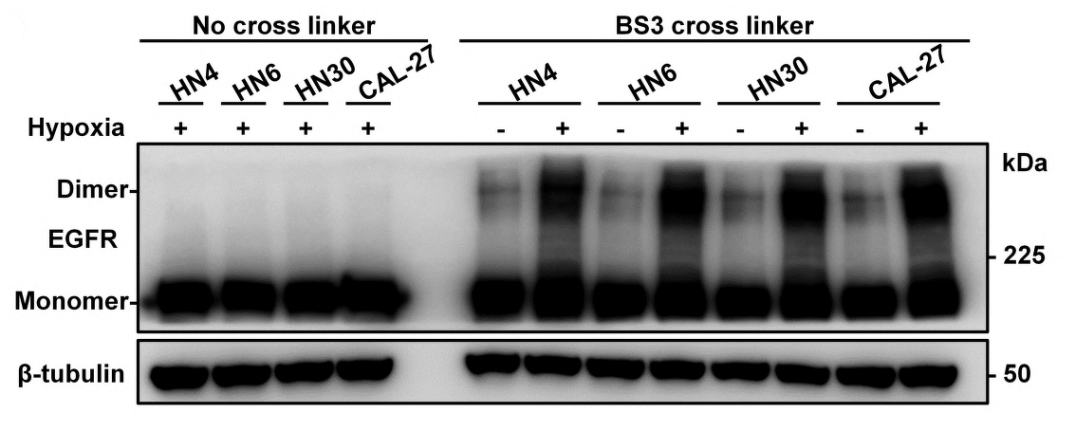
BS3 Crosslinker disodium is a cell-impermeable NHS ester crosslinker. BS3 Crosslinker disodium "covalently locks" two spatially adjacent proteins on the surface of living cells into a covalent complex, and the dimerization/oligomerization status is determined by observing molecular weight shifts via Western blot. BS3 Crosslinker disodium can crosslink EGFR and c-MET to assist in detecting and evaluating their dimerization status. It can be used in research related to oral cancer and glioblastoma.
Nur für Forschungszwecke. Wir verkaufen nicht an Patienten.
- Reinheit: 98.0%
- CAS. Nr.: 127634-19-9
- Formel: C16H18N2Na2O14S2
- Molecular Weight:572.43
-
Speicherung:
-20°C, sealed storage, away from moisture and light
* In solvent : -80°C, 6 months; -20°C, 1 month (sealed storage, away from moisture and light)

To place orders, for customer services and technical support, please contact: MedChemExpress USA
Tel: 609-228-6898 E-mail: [email protected] [email protected]


-
 Biologische Aktivität
-
Chemical Information
-
Lösungsmittel & Löslichkeit
- Reinheit & Dokumentation
- Verweise
-
 Help & FAQs


Publications Citing Use of MedChemExpress (MCE) BS3 Crosslinker disodium
More Customer Validation & Images

-
WB


Biologische Aktivität
Guide (The following is our recommended protocol. This protocol serves only as a guideline and should be modified according to your specific needs.)
Assay for Detecting Receptor Dimerization on Live Cell Surfaces Using BS3 Crosslinking Method[1][2]
1. Experimental Principle: BS3 Crosslinker is a water-soluble, membrane-impermeable homobifunctional amine-reactive crosslinker. The sulfo-NHS ester groups at its two ends undergo nucleophilic substitution reactions with the ε-amino groups of lysine residues on the surfaces of adjacent proteins, forming stable amide bonds, thereby covalently linking two protein subunits with a spatial distance ≤ 11.4 Å. The reaction is performed at 4°C, which can effectively "freeze" transient or stable receptor dimers/oligomers on the cell membrane. Subsequently, the molecular weight shift (monomer → dimer → oligomer) is detected by SDS-PAGE and immunoblotting to determine the dimerization status of the target protein.
2. Reagent Preparation:
2.1 Warm the vial: Before opening the BS3 Crosslinker vial, allow it to return to room temperature to prevent moisture entry (condensation).
2.2 Prepare fresh solution immediately: Immediately before use, dissolve BS3 Crosslinker in cold water or amine-free buffer (e.g., PBS or 20 mM HEPES, pH 7.5). Do not store stock solutions.
2.3 Buffer selection: Use buffers with a pH of 7.0-8.5 (e.g., PBS at pH 7.4). Avoid buffers containing primary amines (such as Tris or glycine) as they react with the crosslinker.
3. Reaction Procedures
3.1 Mix components: Add the freshly prepared BS3 Crosslinker solution to the protein sample to achieve a 10- to 20-fold molar excess of BS3 Crosslinker relative to the protein.
3.2 Incubation: Incubate the mixture at room temperature for 30 minutes (if the protein requires lower temperature, perform the incubation on ice).
3.3 Quench the reaction: Add a quenching buffer containing primary amines (e.g., 25-50 mM Tris, pH 7.5-8.0) to terminate the reaction, followed by incubation at room temperature for 15 minutes.
3.4 Purification/cleanup: If required for downstream experiments, remove unreacted residual BS3 Crosslinker by dialysis or gel filtration.
MedChemExpress (MCE) has not independently confirmed the accuracy of these methods. They are for reference only.


Chemical Information
-
CAS. Nr. 127634-19-9
-
Appearance Solid
-
Molecular Weight 572.43
-
Formel C16H18N2Na2O14S2
-
Color White to off-white
-
SMILES
O=C(ON1C(C(S(=O)(O[Na])=O)CC1=O)=O)CCCCCCC(ON2C(C(S(=O)(O[Na])=O)CC2=O)=O)=O
-
Versand
Room temperature in continental US; may vary elsewhere.
-
Speicherung
-20°C, sealed storage, away from moisture and light
* In solvent : -80°C, 6 months; -20°C, 1 month (sealed storage, away from moisture and light)


Publications (3)
-
Journal Impact Factor
-
Most Recent
-
Int J Oral Sci
LncRNA EUDAL shapes tumor cell response to hypoxia-induced constitutive EGFR activation and promotes chemoresistance in oral cancer. [Abstract]2025 Sep 12;17(1):64. PMID: 40940319
BS3 Crosslinker disodium purchased from MedChemExpress. Usage Cited in: Int J Oral Sci. 2025 Sep 12;17(1):64. [Abstract]
The EGFR dimerization assay of oral cancer cells with or without hypoxia treatment adopted BS3 Crosslinker disodium (BS3) as a cross-linking agent.
-
Biochem Biophys Res Commun
2026 Jul 30:824:153975. PMID: 42166810 -


Lösungsmittel & Löslichkeit
DMSO : 125 mg/mL (218.37 mM; Need ultrasonic; Hygroscopic DMSO has a significant impact on the solubility of product, please use newly opened DMSO)
Please refer to the solubility information to select the appropriate solvent. Once prepared, please aliquot and store the solution to prevent product inactivation from repeated freeze-thaw cycles.
Storage method and period of stock solution: -80°C, 6 months; -20°C, 1 month (sealed storage, away from moisture and light). When stored at -80°C, please use it within 6 months. When stored at -20°C, please use it within 1 month.
Please refer to the solubility information to select the appropriate solvent. Once prepared, please aliquot and store the solution to prevent product inactivation from repeated freeze-thaw cycles.
Storage method and period of stock solution: -80°C, 6 months; -20°C, 1 month (sealed storage, away from moisture and light). When stored at -80°C, please use it within 6 months. When stored at -20°C, please use it within 1 month.
Konzentration (Stammlösung) × Volumen (Stammlösung) = Konzentration (Ziellösung) × Volumen (Ziellösung)
Select the appropriate dissolution method based on your experimental animal and administration route.
- For the following dissolution methods, please ensure to first prepare a clear stock solution using an In Vitro approach and then sequentially add co-solvents:
- To ensure reliable experimental results, the clarified stock solution can be appropriately stored based on storage conditions. As for the working solution for In Vivo experiments, it is recommended to prepare freshly and use it on the same day.
- The percentages shown for the solvents indicate their volumetric ratio in the final prepared solution. If precipitation or phase separation occurs during preparation, heat and/or sonication can be used to aid dissolution.
Add each solvent one by one: 10% DMSO 40% PEG300 5% Tween-80 45% Saline
Solubility: ≥ 2.08 mg/mL (3.63 mM); Clear solution
This protocol yields a clear solution of ≥ 2.08 mg/mL (saturation unknown).
Taking 1 mL working solution as an example, add 100 μL DMSO stock solution (20.8 mg/mL) to 400 μL PEG300, and mix evenly; then add 50 μL Tween-80 and mix evenly; then add 450 μL Saline to adjust the volume to 1 mL.
Preparation of Saline: Dissolve 0.9 g sodium chloride in ddH₂O and dilute to 100 mL to obtain a clear Saline solution.
Add each solvent one by one: 10% DMSO 90% (20% SBE-β-CD in Saline)
Solubility: ≥ 2.08 mg/mL (3.63 mM); Clear solution
This protocol yields a clear solution of ≥ 2.08 mg/mL (saturation unknown).
Taking 1 mL working solution as an example, add 100 μL DMSO stock solution (20.8 mg/mL) to 900 μL 20% SBE-β-CD in Saline, and mix evenly.
Preparation of 20% SBE-β-CD in Saline (4°C, storage for one week): 2 g SBE-β-CD powder is dissolved in 10 mL Saline, completely dissolve until clear.
Please enter the basic information of animal experiments:
-
-
-
-
Recommended: Prepare an additional quantity of animals to account for potential losses during experiments.
Please enter your animal formula composition:
-
%DMSO +
Recommended: Keep the proportion of DMSO in working solution below 2% if your animal is weak.
-
%+
-
+%Tween-80 + +
-
%Saline +
The co-solvents required include: DMSO, . All of co-solvents are available by MedChemExpress (MCE). , Tween 80. All of co-solvents are available by MedChemExpress (MCE).
Working solution concentration: 0.22 mg/mL
Method for preparing stock solution: mg drug dissolved in μL DMSO. Stock solution concentration: mg/mL. * In solvent : -80°C, 6 months; -20°C, 1 month (sealed storage, away from moisture and light)
1. Take μL DMSO stock solution;
2. Add μL .
μL , mix evenly;
3. Then add μL Tween 80, mix evenly;
4. Then add μL
Please ensure that the stock solution in the first step is dissolved to a clear state, and add co-solvents in sequence. You can use ultrasonic heating (ultrasonic cleaner, recommended frequency 20-40 kHz), vortexing, etc. to assist dissolution.


Reinheit & Dokumentation
-
Data Sheet (275 KB)
-
SDS (393 KB)
- English - EN (393 KB)
- Français - FR (393 KB)
- Deutsch - DE (393 KB)
- Norwegian - NO (393 KB)
- Español - ES (393 KB)
- Swedish - SV (393 KB)
- Italian - IT (393 KB)
- Korean - KR (393 KB)
- Portuguese - PT (393 KB)
-
Handling Instructions (2659 KB)
Verweise
[1]. Chen S, et al. LncRNA EUDAL shapes tumor cell response to hypoxia-induced constitutive EGFR activation and promotes chemoresistance in oral cancer. International journal of oral science. 2025 Sep 12;17(1):64. [Content Brief]
[2]. Wang Y, et al. S-palmitoylation of c-MET by CK2α-mediated zDHHC15 phosphorylation drives glioblastoma stem cell tumorigenicity. Neuro-oncology. 2025 Sep 17;27(8):1972-1986. [Content Brief]


Complete Stock Solution Preparation Table
Please refer to the solubility information to select the appropriate solvent. Once prepared, please aliquot and store the solution to prevent product inactivation from repeated freeze-thaw cycles.
Storage method and period of stock solution: -80°C, 6 months; -20°C, 1 month (sealed storage, away from moisture and light). When stored at -80°C, please use it within 6 months. When stored at -20°C, please use it within 1 month.
| Optional Solvent | Concentration Solvent Mass | 1 mg | 5 mg | 10 mg | 25 mg |
|---|---|---|---|---|---|
| DMSO | 1 mM | 1.7469 mL | 8.7347 mL | 17.4694 mL | 43.6735 mL |
| 5 mM | 0.3494 mL | 1.7469 mL | 3.4939 mL | 8.7347 mL | |
| 10 mM | 0.1747 mL | 0.8735 mL | 1.7469 mL | 4.3673 mL | |
| 15 mM | 0.1165 mL | 0.5823 mL | 1.1646 mL | 2.9116 mL | |
| 20 mM | 0.0873 mL | 0.4367 mL | 0.8735 mL | 2.1837 mL | |
| 25 mM | 0.0699 mL | 0.3494 mL | 0.6988 mL | 1.7469 mL | |
| 30 mM | 0.0582 mL | 0.2912 mL | 0.5823 mL | 1.4558 mL | |
| 40 mM | 0.0437 mL | 0.2184 mL | 0.4367 mL | 1.0918 mL | |
| 50 mM | 0.0349 mL | 0.1747 mL | 0.3494 mL | 0.8735 mL | |
| 60 mM | 0.0291 mL | 0.1456 mL | 0.2912 mL | 0.7279 mL | |
| 80 mM | 0.0218 mL | 0.1092 mL | 0.2184 mL | 0.5459 mL | |
| 100 mM | 0.0175 mL | 0.0873 mL | 0.1747 mL | 0.4367 mL |


BS3 Crosslinker disodium Related Classifications
HY-124329A Related Classifications
 Powered by Bioz