



Fesoterodine

Based on 1 Customer Validation
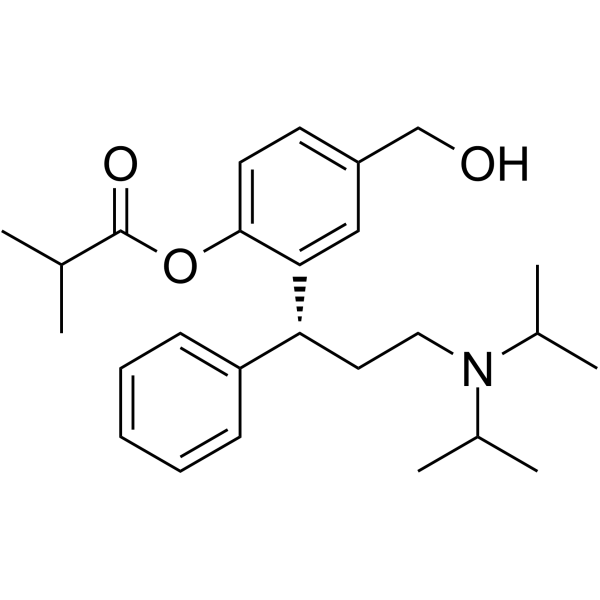
Fesoterodine is an orally active, nonsubtype selective, competitive muscarinic receptor (mAChR) antagonist with pKi values of 8.0, 7.7, 7.4, 7.3, 7.5 for M1, M2, M3, M4, M5 receptors, respectively. Fesoterodine is used for the overactive bladder (OAB).
Nur für Forschungszwecke. Wir verkaufen nicht an Patienten.
- Reinheit: 99.61%
- CAS. Nr.: 286930-02-7
- Formel: C26H37NO3
- Molecular Weight:411.58
-
Speicherung:
-20°C, stored under nitrogen
* The compound is unstable in solutions, freshly prepared is recommended.


-
 Biologische Aktivität
-
Chemical Information
-
Lösungsmittel & Löslichkeit
- Reinheit & Dokumentation
- Verweise
-
 Help & FAQs





Biologische Aktivität
|
mAChR1 |
mAChR3 |
mAChR4 |
mAChR5 |
Fesoterodine decreases micturition frequency, urgency severity and urgency incontinence episodes and increases the volume voided with each micturition[1].
After oral administration, Fesoterodine is rapidly and extensively hydrolysed in plasma by nonspecific esterases to Desfesoterodine (5-hydroxymethyl tolterodine; SPM 7605; HY-76569; an active metabolite of Fesoterodine)[3][4].
MedChemExpress (MCE) has not independently confirmed the accuracy of these methods. They are for reference only.
MedChemExpress (MCE) has not independently confirmed the accuracy of these methods. They are for reference only.
-
Animal Model:Bladders from female Sprague-Dawley rats (225-275 g)[3]
-
Dosage:0.01, 0.1 and 1 mg/kg
-
Administration:IV
-
Result:Reduced the micturition pressure and increased bladder capacity and ICIs at the lowest dose tested of 0.01 mg/kg.


Chemical Information
-
CAS. Nr. 286930-02-7
-
Appearance Viscous Liquid
-
Molecular Weight 411.58
-
Formel C26H37NO3
-
Color Colorless to light yellow
-
SMILES
O=C(C(C)C)OC1=CC=C(CO)C=C1[C@@H](C2=CC=CC=C2)CCN(C(C)C)C(C)C
-
Versand
Room temperature in continental US; may vary elsewhere.
-
Speicherung
-20°C, stored under nitrogen
* The compound is unstable in solutions, freshly prepared is recommended.


Lösungsmittel & Löslichkeit
DMSO : 100 mg/mL (242.97 mM; Need ultrasonic; Hygroscopic DMSO has a significant impact on the solubility of product, please use newly opened DMSO)
Ethanol : 50 mg/mL (121.48 mM; Need ultrasonic)
Please refer to the solubility information to select the appropriate solvent. The compound is unstable in solutions, freshly prepared is recommended.
Please refer to the solubility information to select the appropriate solvent. The compound is unstable in solutions, freshly prepared is recommended.
Konzentration (Stammlösung) × Volumen (Stammlösung) = Konzentration (Ziellösung) × Volumen (Ziellösung)
Select the appropriate dissolution method based on your experimental animal and administration route.
- For the following dissolution methods, please ensure to first prepare a clear stock solution using an In Vitro approach and then sequentially add co-solvents:
- To ensure reliable experimental results, the clarified stock solution can be appropriately stored based on storage conditions. As for the working solution for In Vivo experiments, it is recommended to prepare freshly and use it on the same day.
- The percentages shown for the solvents indicate their volumetric ratio in the final prepared solution. If precipitation or phase separation occurs during preparation, heat and/or sonication can be used to aid dissolution.
Add each solvent one by one: 10% EtOH 40% PEG300 5% Tween-80 45% Saline
Solubility: ≥ 2.75 mg/mL (6.68 mM); Clear solution
This protocol yields a clear solution of ≥ 2.75 mg/mL (saturation unknown).
Taking 1 mL working solution as an example, add 100 μL EtOH stock solution (27.5 mg/mL) to 400 μL PEG300, and mix evenly; then add 50 μL Tween-80 and mix evenly; then add 450 μL Saline to adjust the volume to 1 mL.
Preparation of Saline: Dissolve 0.9 g sodium chloride in ddH₂O and dilute to 100 mL to obtain a clear Saline solution.
Add each solvent one by one: 10% EtOH 90% (20% SBE-β-CD in Saline)
Solubility: ≥ 2.75 mg/mL (6.68 mM); Clear solution
This protocol yields a clear solution of ≥ 2.75 mg/mL (saturation unknown).
Taking 1 mL working solution as an example, add 100 μL EtOH stock solution (27.5 mg/mL) to 900 μL 20% SBE-β-CD in Saline, and mix evenly.
Preparation of 20% SBE-β-CD in Saline (4°C, storage for one week): 2 g SBE-β-CD powder is dissolved in 10 mL Saline, completely dissolve until clear.
Add each solvent one by one: 10% EtOH 90% Corn Oil
Solubility: ≥ 2.75 mg/mL (6.68 mM); Clear solution
This protocol yields a clear solution of ≥ 2.75 mg/mL (saturation unknown). If the continuous dosing period exceeds half a month, please choose this protocol carefully.
Taking 1 mL working solution as an example, add 100 μL EtOH stock solution (27.5 mg/mL) to 900 μL Corn oil, and mix evenly.
Add each solvent one by one: 10% DMSO 40% PEG300 5% Tween-80 45% Saline
Solubility: ≥ 2.5 mg/mL (6.07 mM); Clear solution
This protocol yields a clear solution of ≥ 2.5 mg/mL (saturation unknown).
Taking 1 mL working solution as an example, add 100 μL DMSO stock solution (25.0 mg/mL) to 400 μL PEG300, and mix evenly; then add 50 μL Tween-80 and mix evenly; then add 450 μL Saline to adjust the volume to 1 mL.
Preparation of Saline: Dissolve 0.9 g sodium chloride in ddH₂O and dilute to 100 mL to obtain a clear Saline solution.
Please enter the basic information of animal experiments:
-
-
-
-
Recommended: Prepare an additional quantity of animals to account for potential losses during experiments.
Please enter your animal formula composition:
-
%DMSO +
Recommended: Keep the proportion of DMSO in working solution below 2% if your animal is weak.
-
%+
-
+%Tween-80 + +
-
%Saline +
The co-solvents required include: DMSO, . All of co-solvents are available by MedChemExpress (MCE). , Tween 80. All of co-solvents are available by MedChemExpress (MCE).
Working solution concentration: 0.22 mg/mL
Method for preparing stock solution: mg drug dissolved in μL DMSO. Stock solution concentration: mg/mL. * The compound is unstable in solutions, freshly prepared is recommended.
1. Take μL DMSO stock solution;
2. Add μL .
μL , mix evenly;
3. Then add μL Tween 80, mix evenly;
4. Then add μL
Please ensure that the stock solution in the first step is dissolved to a clear state, and add co-solvents in sequence. You can use ultrasonic heating (ultrasonic cleaner, recommended frequency 20-40 kHz), vortexing, etc. to assist dissolution.


Reinheit & Dokumentation
-
Data Sheet (276 KB)
-
SDS (393 KB)
- English - EN (393 KB)
- Français - FR (393 KB)
- Deutsch - DE (393 KB)
- Norwegian - NO (393 KB)
- Español - ES (393 KB)
- Swedish - SV (393 KB)
- Italian - IT (393 KB)
- Korean - KR (393 KB)
- Portuguese - PT (393 KB)
-
Handling Instructions (2659 KB)
Verweise
[1]. Ellsworth P, et al. Fesoterodine for the treatment of urinary incontinence and overactive bladder. Ther Clin Risk Manag. 2009;5:869-76. Epub 2009 Nov 18. [Content Brief]
[2]. Didem Yilmaz-Oral, et al. The Beneficial Effect of Fesoterodine, a Competitive Muscarinic Receptor Antagonist on Erectile Dysfunction in Streptozotocin-induced Diabetic Rats [Content Brief]
[3]. Peter Ney, et al. Pharmacological Characterization of a Novel Investigational Antimuscarinic Drug, Fesoterodine, in Vitro and in Vivo. BJU Int. 2008 Apr;101(8):1036-42. [Content Brief]
[4]. Martin C Michel, et al. Fesoterodine: A Novel Muscarinic Receptor Antagonist for the Treatment of Overactive Bladder Syndrome. Expert Opin Pharmacother. 2008 Jul;9(10):1787-96. [Content Brief]


Complete Stock Solution Preparation Table
Please refer to the solubility information to select the appropriate solvent. The compound is unstable in solutions, freshly prepared is recommended.
| Optional Solvent | Concentration Solvent Mass | 1 mg | 5 mg | 10 mg | 25 mg |
|---|---|---|---|---|---|
| Ethanol / DMSO | 1 mM | 2.4297 mL | 12.1483 mL | 24.2966 mL | 60.7415 mL |
| 5 mM | 0.4859 mL | 2.4297 mL | 4.8593 mL | 12.1483 mL | |
| 10 mM | 0.2430 mL | 1.2148 mL | 2.4297 mL | 6.0742 mL | |
| 15 mM | 0.1620 mL | 0.8099 mL | 1.6198 mL | 4.0494 mL | |
| 20 mM | 0.1215 mL | 0.6074 mL | 1.2148 mL | 3.0371 mL | |
| 25 mM | 0.0972 mL | 0.4859 mL | 0.9719 mL | 2.4297 mL | |
| 30 mM | 0.0810 mL | 0.4049 mL | 0.8099 mL | 2.0247 mL | |
| 40 mM | 0.0607 mL | 0.3037 mL | 0.6074 mL | 1.5185 mL | |
| 50 mM | 0.0486 mL | 0.2430 mL | 0.4859 mL | 1.2148 mL | |
| 60 mM | 0.0405 mL | 0.2025 mL | 0.4049 mL | 1.0124 mL | |
| 80 mM | 0.0304 mL | 0.1519 mL | 0.3037 mL | 0.7593 mL | |
| 100 mM | 0.0243 mL | 0.1215 mL | 0.2430 mL | 0.6074 mL |


 Powered by Bioz