



Noscapine-13C,d3

Based on 1 Customer Validation
Noscapine-13C,d3 is a 13C- labeled and deuterated labeled Noscapine. Noscapine ((S,R)-Noscapine) is an orally active phthalideisoquinoline alkaloid with potent antitussive. Noscapine exerts its antitussive effects by activating sigma opioid receptors and is a non-competitive Bradykinin inhibitor. Noscapine disrupts microtubule dynamics, induces mitotic arrest and apoptosis. Noscapine possesses anticancer, neuroprotective, anti-inflammatory activities, and can cross the blood-brain barrier.
Nos produits utilisent uniquement pour la recherche. Nous ne vendons pas aux patients.
- CAS No.: 1217680-57-3
- Formule: C2113CH20D3NO7
- Masse moléculaire:417.43
-
Stockage:
-20°C, stored under nitrogen
* In solvent : -80°C, 6 months; -20°C, 1 month (stored under nitrogen)


To place orders, for customer services and technical support, please contact: MedChemExpress USA
Tel: 609-228-6898 E-mail: [email protected] [email protected]


-
 Activité biologique
-
Chemical Information
- Pureté et documentation
- Références
-
 Help & FAQs


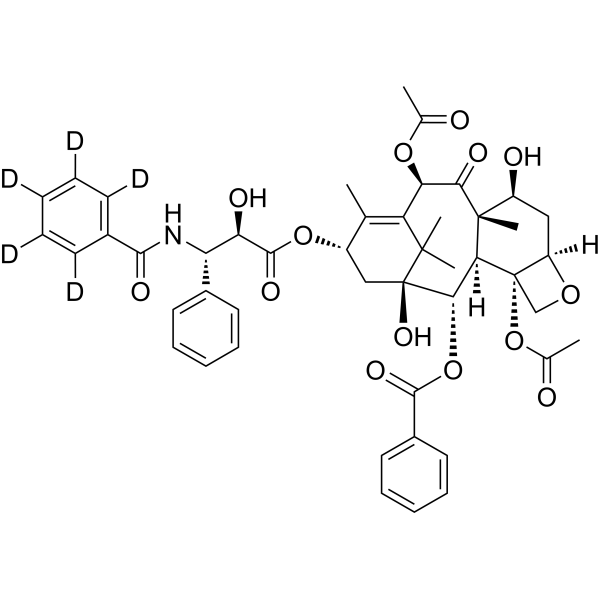

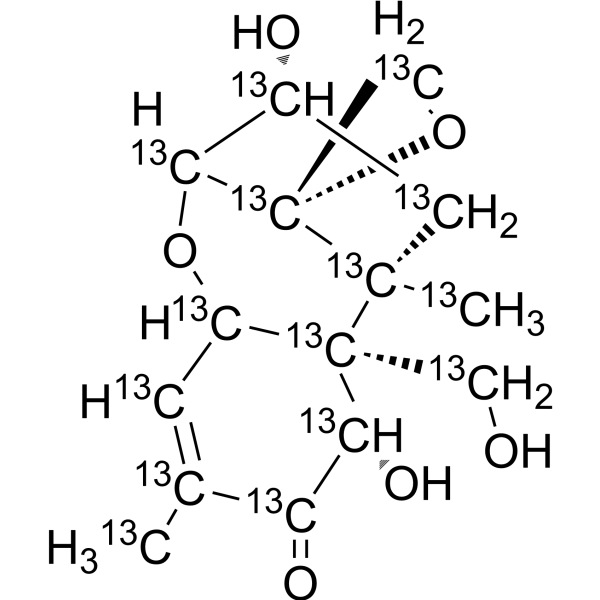
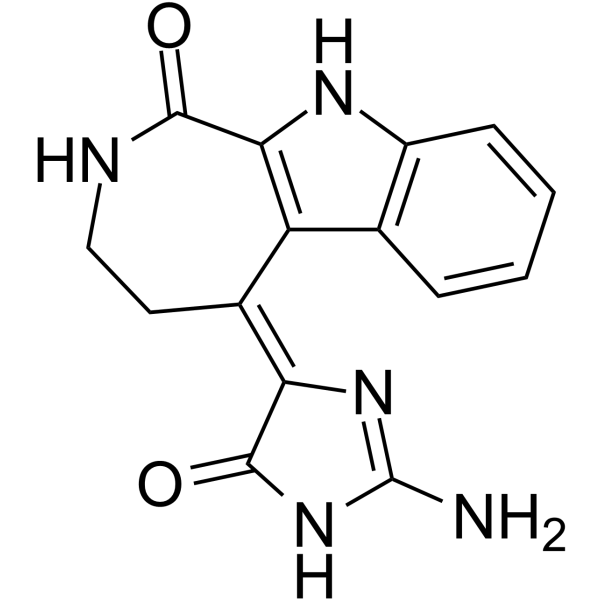
Voir tous les produits spécifiques à Isoform Opioid Receptor
More

Activité biologique
Stable heavy isotopes of hydrogen, carbon, and other elements have been incorporated into drug molecules, largely as tracers for quantitation during the drug development process. Deuteration has gained attention because of its potential to affect the pharmacokinetic and metabolic profiles of drugs[1].
Noscapine (0-1000 μM; 0-96 hours; rat C6 glioma cells) treatment inhibits cell viability of rat C6 glioma in vitro in a dose- and time-dependent manner. Noscapine inhibits the viability of rat C6 glioma cells with an IC50 of 250 μM at 72 hours[2].
Noscapine exposure causes abnormal S-phase reentry, increases mitotic arrest and results in excessive DNA accumulation[2].
Cylindromatosis increases the ability of noscapine to induce mitotic arrest and apoptosis. Cylindromatosis enhances the effect of noscapine on microtubule polymerization and promotes noscapine binding to microtubules[3].
MedChemExpress (MCE) has not independently confirmed the accuracy of these methods. They are for reference only.
1. This compound can be used as a tracer
2. This compound can be used as an internal standard for quantitative analysis by NMR, GC-MS, or LC-MS.


Chemical Information
-
CAS No. 1217680-57-3
-
Unlabeled Cas 128-62-1
-
Appearance Solid
-
Masse moléculaire 417.43
-
Formule C2113CH20D3NO7
-
SMILES
COC1=C(OCO2)C2=CC3=C1[C@@]([C@]4([H])C5=CC=C(OC)C(OC)=C5C(O4)=O)([H])N(CC3)[13C]([2H])([2H])[2H]
-
Livraison
Room temperature in continental US; may vary elsewhere.
-
Stockage
-20°C, stored under nitrogen
* In solvent : -80°C, 6 months; -20°C, 1 month (stored under nitrogen)


Pureté et documentation
Références
[1]. Russak EM, et al. Impact of Deuterium Substitution on the Pharmacokinetics of Pharmaceuticals. Ann Pharmacother. 2019 Feb;53(2):211-216. [Content Brief]
[2]. Jaren W Landen, et al. Noscapine Crosses the Blood-Brain Barrier and Inhibits Glioblastoma Growth. Clin Cancer Res. 2004 Aug 1;10(15):5187-201. [Content Brief]
[3]. Bianca Lokhorst, et al. Interaction of OTC Drug Noscapine and Acenocoumarol and Phenprocoumon. Br J Clin Pharmacol. 2019 May;85(5):1041-1043. [Content Brief]
[4]. Yunfan Yang, et al. CYLD Regulates Noscapine Activity in Acute Lymphoblastic Leukemia via a Microtubule-Dependent Mechanism. Theranostics. 2015 Mar 2;5(7):656-66. [Content Brief]
[5]. S A Ebrahimi, et al. Interaction of Noscapine With the Bradykinin Mediation of the Cough Response. Acta Physiol Hung. 2003;90(2):147-55. [Content Brief]
[6]. Vartika Tomar, et al. Noscapine and Its Analogs as Chemotherapeutic Agent: Current Updates. Curr Top Med Chem. 2017;17(2):174-188. [Content Brief]

Calculators
Concentration (start) × Volume (start) = Concentration (final) × Volume (final)


Noscapine-13C,d3 Related Classifications
HY-13716S Related Classifications
 Powered by Bioz