



Catharanthine Sulfate
Based on 3 publication(s) in Google Scholar
Catharanthine ((+)-3,4-Didehydrocoronaridine) Sulfate, a constituent of anticancer vinca alkaloids, inhibits voltage-operated L-type Ca2+ channel (VOCC). Catharanthine Sulfate has IC50s of 220 μM and 8 μM for VOCC currents in cardiomyocytes and vascular smooth muscle cells (VSMCs), respectively. Catharanthine Sulfate lowers blood pressure (BP), heart rate (HR). Catharanthine Sulfate has anti-cancer activity.
For research use only. We do not sell to patients.
- CAS No.: 153230-94-5
- Formula: C21H26N2O6S
- Molecular Weight:434.51
-
Storage:
Please store the product under the recommended conditions in the Certificate of Analysis.

To place orders, for customer services and technical support, please contact: MedChemExpress USA
Tel: 609-228-6898 E-mail: [email protected] [email protected]


-
 Biological Activity
-
Chemical Information
- Protocols
- Purity & Documentation
- References
-
 Help & FAQs


Publications Citing Use of MedChemExpress (MCE) Catharanthine Sulfate
More Customer Validation & Images

-
Cell Proliferation/Viability Assay
All Calcium Channel Isoforms
More

Biological Activity
Description
IC50 & Target
|
L-type calcium channel |
Cellular Effect
|
Cell Line

|
Type | Value | Description | References |
|---|---|---|---|---|
| HepG2 | IC50 |
>50 μM
Compound: Catharanthine sulfate
|
Cytotoxicity against adriamycin-resistant human HepG2 cells assessed as growth inhibition after 72 hrs by MTT assay
Cytotoxicity against adriamycin-resistant human HepG2 cells assessed as growth inhibition after 72 hrs by MTT assay
|
[PMID: 23708010] |
| HepG2 | IC50 |
>50 μM
Compound: Catharanthine sulfate
|
Cytotoxicity against human HepG2 cells assessed as growth inhibition after 72 hrs by MTT assay
Cytotoxicity against human HepG2 cells assessed as growth inhibition after 72 hrs by MTT assay
|
[PMID: 23708010] |
| K562 | IC50 |
>50 μM
Compound: Catharanthine sulfate
|
Cytotoxicity against human K562 cells assessed as growth inhibition after 72 hrs by MTT assay
Cytotoxicity against human K562 cells assessed as growth inhibition after 72 hrs by MTT assay
|
[PMID: 23708010] |
| MCF7 | IC50 |
>50 μM
Compound: Catharanthine sulfate
|
Cytotoxicity against human MCF7 cells assessed as growth inhibition after 72 hrs by MTT assay
Cytotoxicity against human MCF7 cells assessed as growth inhibition after 72 hrs by MTT assay
|
[PMID: 23708010] |
| MDA-MB-231 | IC50 |
>50 μM
Compound: Catharanthine sulfate
|
Cytotoxicity against human MDA-MB-231 cells assessed as growth inhibition after 72 hrs by MTT assay
Cytotoxicity against human MDA-MB-231 cells assessed as growth inhibition after 72 hrs by MTT assay
|
[PMID: 23708010] |
In Vivo
Catharanthine (40 mg/kg; ip; single dose) Sulfate with acute administration induces similar antidepressant-like activity in male and female mice at 1 h and 24 h[1].
Catharanthine (20 mg/kg; ip; for 14 consecutive days) Sulfate increases swimming time and decreases immobility time at D7 or D14 in mice[1].
MedChemExpress (MCE) has not independently confirmed the accuracy of these methods. They are for reference only.
-
Animal Model:13-week-old male SpragueDawley rats (300-350 g)[1]
-
Dosage:0.5-20 mg/kg
-
Administration:IV; single dose
-
Result:Evoked rapid, transient reductions in BP and HR (lasting ,2 minutes) at low doses (0.5–5 mg/kg), whereas at higher doses (10 and 20 mg/kg), the BP and HR reductions were sustained.


Chemical Information
-
CAS No. 153230-94-5
-
Molecular Weight 434.51
-
Formula C21H26N2O6S
-
SMILES
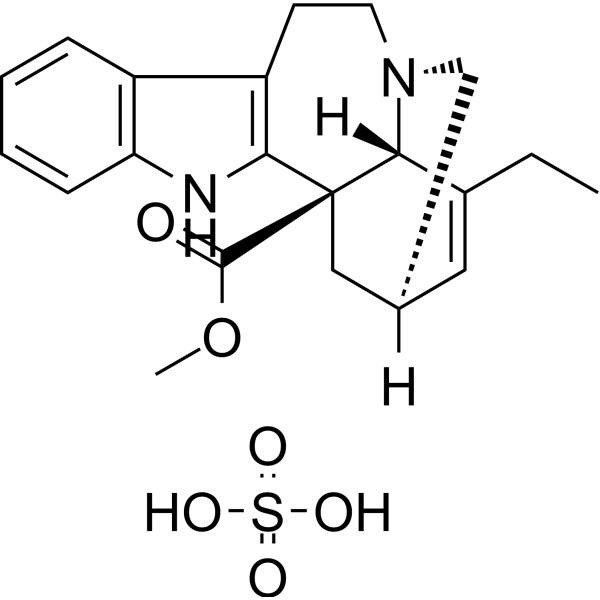
O=C([C@@]1(C2=C3C(C=CC=C4)=C4N2)[C@](C(CC)=C5)([H])[N@](CC3)C[C@]5([H])C1)OC.O=S(O)(O)=O
-
Synonyms
(+)-3,4-Didehydrocoronaridine Sulfate
-
Structure Classification
-
Initial Source
-
Shipping
Room temperature in continental US; may vary elsewhere.
-
Storage
Please store the product under the recommended conditions in the Certificate of Analysis.


Publications (3)
-
Journal Impact Factor
-
Most Recent
-
-
Cell Signal
2025 Jul:131:111779. PMID: 40164418 -
PLoS One
UHPLC-QTOF-MS/MS-based metabolomic discovery of anticancer compounds in ethanolic extracts of Ficus hispida L. f. [Abstract]2026 Mar 3;21(3):e0343411. PMID: 41774720
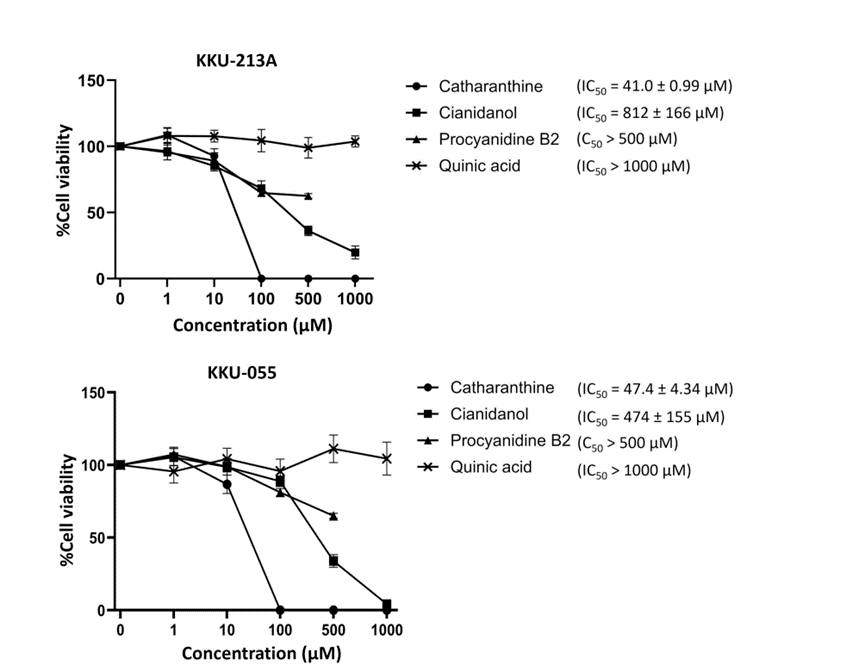
Catharanthine Sulfate purchased from MedChemExpress. Usage Cited in: PLoS One. 2026 Mar 3;21(3):e0343411. [Abstract]
KKU-213A and KKU-055 after treatment with 0, 1, 10, 100, 500, and 1,000 μM of Catharanthine, Cianidanol, Procyanidine B2, and Quinic acid for 72 h.


Purity & Documentation
References
[1]. Jadhav A, et al. Catharanthine dilates small mesenteric arteries and decreases heart rate and cardiac contractility by inhibition of voltage-operated calcium channels on vascular smooth muscle cells and cardiomyocytes. J Pharmacol Exp Ther. 2013 Jun;345(3):383-92. [Content Brief]
[2]. Hugo R Arias, et al. (+)-Catharanthine and (-)-18-methoxycoronaridine induce antidepressant-like activity in mice by differently recruiting serotonergic and norepinephrinergic neurotransmission. Eur J Pharmacol. 2023 Jan 15:939:175454. [Content Brief]

Calculators
Concentration (start) × Volume (start) = Concentration (final) × Volume (final)


Catharanthine Sulfate Related Classifications
HY-N0252B Related Classifications
 Powered by Bioz