



Catharanthine Tartrate
Based on 3 publication(s) in Google Scholar
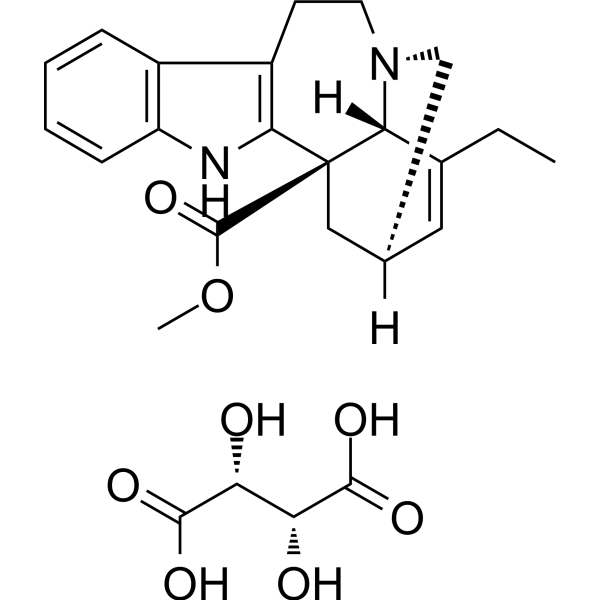
Catharanthine ((+)-3,4-Didehydrocoronaridine) Tartrate, a constituent of anticancer vinca alkaloids, inhibits voltage-operated L-type Ca2+ channel (VOCC). Catharanthine Tartrate has IC50s of 220 μM and 8 μM for VOCC currents in cardiomyocytes and vascular smooth muscle cells (VSMCs), respectively. Catharanthine Tartrate lowers blood pressure (BP), heart rate (HR). Catharanthine Tartrate has anti-cancer activity.
For research use only. We do not sell to patients.
- Purity : 98.88%
- CAS No.: 4168-17-6
- Formula: C25H30N2O8
- Molecular Weight:486.51
-
Storage:
4°C, sealed storage, away from moisture and light
* In solvent : -80°C, 6 months; -20°C, 1 month (sealed storage, away from moisture and light)

To place orders, for customer services and technical support, please contact: MedChemExpress USA
Tel: 609-228-6898 E-mail: [email protected] [email protected]


-
 Biological Activity
-
Chemical Information
-
Solvent & Solubility
- Protocols
- Purity & Documentation
- References
-
 Help & FAQs



Publications Citing Use of MedChemExpress (MCE) Catharanthine Tartrate
More Customer Validation & Images

-
Cell Proliferation/Viability Assay
All Calcium Channel Isoforms
More

Biological Activity
Description
IC50 & Target
|
L-type calcium channel |
In Vivo
Catharanthine (40 mg/kg; ip; single dose) Tartrate with acute administration induces similar antidepressant-like activity in male and female mice at 1 h and 24 h[1].
Catharanthine (20 mg/kg; ip; for 14 consecutive days) Tartrate increases swimming time and decreases immobility time at D7 or D14 in mice[1].
MedChemExpress (MCE) has not independently confirmed the accuracy of these methods. They are for reference only.
-
Animal Model:13-week-old male SpragueDawley rats (300-350 g)[1]
-
Dosage:0.5-20 mg/kg
-
Administration:IV; single dose
-
Result:Evoked rapid, transient reductions in BP and HR (lasting ,2 minutes) at low doses (0.5–5 mg/kg), whereas at higher doses (10 and 20 mg/kg), the BP and HR reductions were sustained.


Chemical Information
-
CAS No. 4168-17-6
-
Appearance Solid
-
Molecular Weight 486.51
-
Formula C25H30N2O8
-
Color Off-white to gray
-
SMILES
O=C([C@@]1(C2=C3C(C=CC=C4)=C4N2)[C@](C(CC)=C5)([H])[N@](CC3)C[C@]5([H])C1)OC.O[C@@H](C(O)=O)[C@H](C(O)=O)O
-
Synonyms
(+)-3,4-Didehydrocoronaridine Tartrate
-
Structure Classification
-
Initial Source
-
Shipping
Room temperature in continental US; may vary elsewhere.
-
Storage
4°C, sealed storage, away from moisture and light
* In solvent : -80°C, 6 months; -20°C, 1 month (sealed storage, away from moisture and light)


Publications (3)
-
Journal Impact Factor
-
Most Recent
-
-
Cell Signal
2025 Jul:131:111779. PMID: 40164418 -
PLoS One
UHPLC-QTOF-MS/MS-based metabolomic discovery of anticancer compounds in ethanolic extracts of Ficus hispida L. f. [Abstract]2026 Mar 3;21(3):e0343411. PMID: 41774720
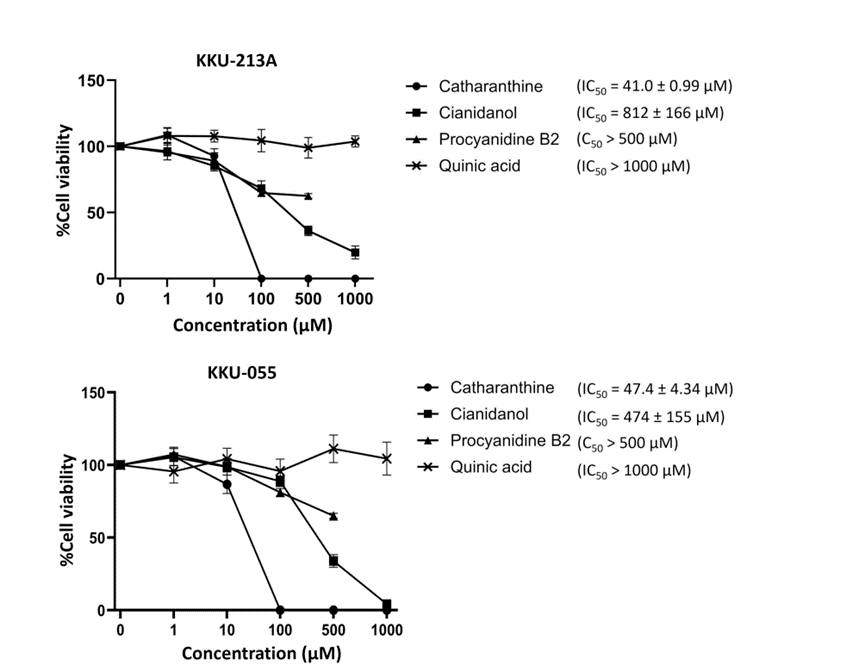
Catharanthine Tartrate purchased from MedChemExpress. Usage Cited in: PLoS One. 2026 Mar 3;21(3):e0343411. [Abstract]
KKU-213A and KKU-055 after treatment with 0, 1, 10, 100, 500, and 1,000 μM of Catharanthine, Cianidanol, Procyanidine B2, and Quinic acid for 72 h.


Solvent & Solubility
In Vitro:
DMSO : 100 mg/mL (205.55 mM; Need ultrasonic; Hygroscopic DMSO has a significant impact on the solubility of product, please use newly opened DMSO)
H2O : 5 mg/mL (10.28 mM; ultrasonic and warming and adjust pH to 3 with HCl and heat to 60°C)
Please refer to the solubility information to select the appropriate solvent. Once prepared, please aliquot and store the solution to prevent product inactivation from repeated freeze-thaw cycles.
Storage method and period of stock solution: -80°C, 6 months; -20°C, 1 month (sealed storage, away from moisture and light). When stored at -80°C, please use it within 6 months. When stored at -20°C, please use it within 1 month.
* Note: If you choose water as the stock solution, please dilute it to the working solution, then filter and sterilize it with a 0.22 μm filter before use.
Please refer to the solubility information to select the appropriate solvent. Once prepared, please aliquot and store the solution to prevent product inactivation from repeated freeze-thaw cycles.
Storage method and period of stock solution: -80°C, 6 months; -20°C, 1 month (sealed storage, away from moisture and light). When stored at -80°C, please use it within 6 months. When stored at -20°C, please use it within 1 month.
* Note: If you choose water as the stock solution, please dilute it to the working solution, then filter and sterilize it with a 0.22 μm filter before use.
Concentration (start) × Volume (start) = Concentration (final) × Volume (final)
In Vivo:
Select the appropriate dissolution method based on your experimental animal and administration route.
- For the following dissolution methods, please ensure to first prepare a clear stock solution using an In Vitro approach and then sequentially add co-solvents:
- To ensure reliable experimental results, the clarified stock solution can be appropriately stored based on storage conditions. As for the working solution for In Vivo experiments, it is recommended to prepare freshly and use it on the same day.
- The percentages shown for the solvents indicate their volumetric ratio in the final prepared solution. If precipitation or phase separation occurs during preparation, heat and/or sonication can be used to aid dissolution.
Add each solvent one by one: 10% DMSO 40% PEG300 5% Tween-80 45% Saline
Solubility: ≥ 2.5 mg/mL (5.14 mM); Clear solution
This protocol yields a clear solution of ≥ 2.5 mg/mL (saturation unknown).
Taking 1 mL working solution as an example, add 100 μL DMSO stock solution (25.0 mg/mL) to 400 μL PEG300, and mix evenly; then add 50 μL Tween-80 and mix evenly; then add 450 μL Saline to adjust the volume to 1 mL.
Preparation of Saline: Dissolve 0.9 g sodium chloride in ddH₂O and dilute to 100 mL to obtain a clear Saline solution.
Add each solvent one by one: 10% DMSO 90% (20% SBE-β-CD in Saline)
Solubility: ≥ 2.5 mg/mL (5.14 mM); Clear solution
This protocol yields a clear solution of ≥ 2.5 mg/mL (saturation unknown).
Taking 1 mL working solution as an example, add 100 μL DMSO stock solution (25.0 mg/mL) to 900 μL 20% SBE-β-CD in Saline, and mix evenly.
Preparation of 20% SBE-β-CD in Saline (4°C, storage for one week): 2 g SBE-β-CD powder is dissolved in 10 mL Saline, completely dissolve until clear.
In Vivo Dissolution Calculator
Please enter the basic information of animal experiments:
-
-
-
-
Recommended: Prepare an additional quantity of animals to account for potential losses during experiments.
Please enter your animal formula composition:
-
%DMSO +
Recommended: Keep the proportion of DMSO in working solution below 2% if your animal is weak.
-
%+
-
+%Tween-80 + +
-
%Saline +
The co-solvents required include: DMSO, . All of co-solvents are available by MedChemExpress (MCE). , Tween 80. All of co-solvents are available by MedChemExpress (MCE).
Working solution concentration: 0.22 mg/mL
Method for preparing stock solution: mg drug dissolved in μL DMSO. Stock solution concentration: mg/mL. * In solvent : -80°C, 6 months; -20°C, 1 month (sealed storage, away from moisture and light)
1. Take μL DMSO stock solution;
2. Add μL .
μL , mix evenly;
3. Then add μL Tween 80, mix evenly;
4. Then add μL
Please ensure that the stock solution in the first step is dissolved to a clear state, and add co-solvents in sequence. You can use ultrasonic heating (ultrasonic cleaner, recommended frequency 20-40 kHz), vortexing, etc. to assist dissolution.

Protocols
-
Ca2+ Staining Technique
Ca2+ staining is an experimental technique that utilizes specific fluorescent probes (such as Fluo-4 AM, Fura-2, etc.) to qualitatively or quantitatively detect dynamic changes in intracellular Ca2+ concentrations; this is achieved by monitoring the changes in fluorescent signals generated when these probes bind to free intracellular calcium ions. The underlying principle relies primarily on the presence of chelating groups within the probe's molecular structure that possess high affinity for calcium ions.


Purity & Documentation
-
Data Sheet (281 KB)
-
SDS (393 KB)
- English - EN (393 KB)
- Français - FR (393 KB)
- Deutsch - DE (393 KB)
- Norwegian - NO (393 KB)
- Español - ES (393 KB)
- Swedish - SV (393 KB)
- Italian - IT (393 KB)
- Korean - KR (393 KB)
- Portuguese - PT (393 KB)
-
Handling Instructions (2659 KB)
References
[1]. Jadhav A, et al. Catharanthine dilates small mesenteric arteries and decreases heart rate and cardiac contractility by inhibition of voltage-operated calcium channels on vascular smooth muscle cells and cardiomyocytes. J Pharmacol Exp Ther. 2013 Jun;345(3):383-92. [Content Brief]
[2]. Hugo R Arias, et al. (+)-Catharanthine and (-)-18-methoxycoronaridine induce antidepressant-like activity in mice by differently recruiting serotonergic and norepinephrinergic neurotransmission. Eur J Pharmacol. 2023 Jan 15:939:175454. [Content Brief]


Complete Stock Solution Preparation Table
Please refer to the solubility information to select the appropriate solvent. Once prepared, please aliquot and store the solution to prevent product inactivation from repeated freeze-thaw cycles.
Storage method and period of stock solution: -80°C, 6 months; -20°C, 1 month (sealed storage, away from moisture and light). When stored at -80°C, please use it within 6 months. When stored at -20°C, please use it within 1 month.
| Optional Solvent | Concentration Solvent Mass | 1 mg | 5 mg | 10 mg | 25 mg |
|---|---|---|---|---|---|
| H2O / DMSO | 1 mM | 2.0555 mL | 10.2773 mL | 20.5546 mL | 51.3864 mL |
| 5 mM | 0.4111 mL | 2.0555 mL | 4.1109 mL | 10.2773 mL | |
| 10 mM | 0.2055 mL | 1.0277 mL | 2.0555 mL | 5.1386 mL | |
| DMSO | 15 mM | 0.1370 mL | 0.6852 mL | 1.3703 mL | 3.4258 mL |
| 20 mM | 0.1028 mL | 0.5139 mL | 1.0277 mL | 2.5693 mL | |
| 25 mM | 0.0822 mL | 0.4111 mL | 0.8222 mL | 2.0555 mL | |
| 30 mM | 0.0685 mL | 0.3426 mL | 0.6852 mL | 1.7129 mL | |
| 40 mM | 0.0514 mL | 0.2569 mL | 0.5139 mL | 1.2847 mL | |
| 50 mM | 0.0411 mL | 0.2055 mL | 0.4111 mL | 1.0277 mL | |
| 60 mM | 0.0343 mL | 0.1713 mL | 0.3426 mL | 0.8564 mL | |
| 80 mM | 0.0257 mL | 0.1285 mL | 0.2569 mL | 0.6423 mL | |
| 100 mM | 0.0206 mL | 0.1028 mL | 0.2055 mL | 0.5139 mL |
* Note: If you choose water as the stock solution, please dilute it to the working solution, then filter and sterilize it with a 0.22 μm filter before use.


Catharanthine Tartrate Related Classifications
HY-N0252A Related Classifications
 Powered by Bioz