



Chicoric acid
Based on 4 publication(s) in Google Scholar
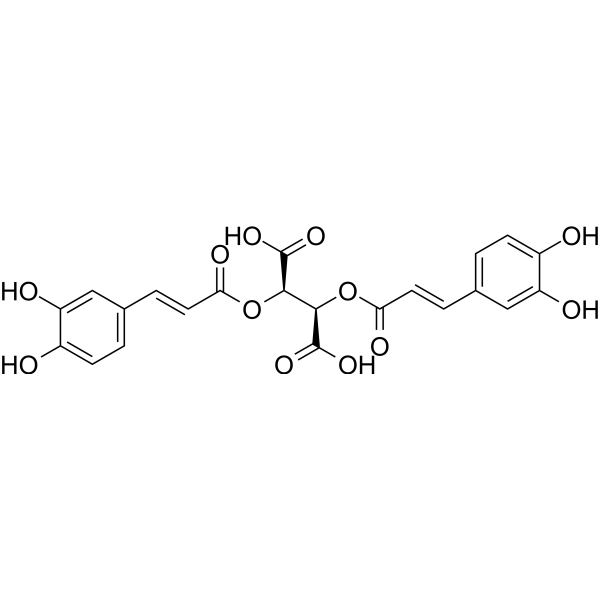
Chicoric acid (Cichoric acid), an orally active dicaffeyltartaric acid, induces reactive oxygen species (ROS) generation. Chicoric acid inhibits cell viability and induces mitochondria-dependent apoptosis in 3T3-L1 preadipocytes through ROS-mediated PI3K/Akt and MAPK signaling pathways. Chicoric acid increases glucose uptake, improves insulin resistance, and attenuates glucosamine-induced inflammation. Chicoric acid has antidiabetic properties and antioxidant, anti-inflammatory effects.
Nos produits utilisent uniquement pour la recherche. Nous ne vendons pas aux patients.
- Pureté: 99.86%
- CAS No.: 6537-80-0
- Formule: C22H18O12
- Masse moléculaire:474.37
-
Stockage:Powder -20°C, 3 years , 4°C, 2 years ; In solvent -80°C, 6 months , -20°C, 1 month

To place orders, for customer services and technical support, please contact: MedChemExpress USA
Tel: 609-228-6898 E-mail: [email protected] [email protected]


-
 Activité biologique
-
Chemical Information
-
Solvant et solubilité
- Pureté et documentation
- Références
-
 Help & FAQs
-

Antioxidant Compound Library
HY-L037
-
Anti-diabetic Compound Library
HY-L040
-
Medicine Food Homology Compound Library
HY-L055
-
Phenols Library
HY-L057
-
Orally Active Compound Library
HY-L061
-
Traditional Chinese Medicine Active Compound Library
HY-L065
-
Food-Sourced Compound Library
HY-L094
-
Anti-inflammatory Traditional Chinese Medicine Active Compound Library
HY-L114
-
Plant-Sourced Natural Product Library
HY-L115
-
Anti-Aging Natural Product Library
HY-L134
-
Cell Death Library
HY-L162
-
Anti-Drug-Resistant Compound Library
HY-L169
-
Radioprotector Library
HY-L178
-
Bioactive Compound Library Max
HY-L181
-
Natural Product Library Plus
HY-L021P
-
Bioactive Compound Library
HY-L001
-
Anti-Fibrosis Compound Library
HY-L185
-
Heat-Clearing and Detoxification Traditional Chinese Medicine Compound Library
HY-L194
-
Non-Alcoholic Fatty Liver Disease (NAFLD) Compound Library
HY-L199
-
High-Throughput Bioactive Compound Library
HY-L205
-
High-Throughput Natural Product Library
HY-L206
-
Ancient Chinese Classical Formulas Traditional Chinese Medicine Active Compound Library
HY-L209
-
Diarrhea-Related Traditional Chinese Medicine Active Compound Library
HY-L224
-
Mongolian Medicine Compound Library
HY-L238
-
Natural Product Diversity Scaffold Library
HY-L245
-
Lactylation Compound Library
HY-L249
-
Mass Spectrometry Natural Product Library
HY-L262
-
Natural Product and Natural Product-Like Compound Library
HY-L021M
-
Apoptosis Compound Library
HY-L003
-
Immunology/Inflammation Compound Library
HY-L007
-
Metabolism/Protease Compound Library
HY-L012
-
NF-κB Signaling Compound Library
HY-L014
-
Natural Product Library
HY-L021
-
Anti-Aging Compound Library
HY-L034


Publications Citing Use of MedChemExpress (MCE) Chicoric acid
More Customer Validation & Images

-
Bio/Physico-chemical Assay

-
Bio/Physico-chemical Assay

-
Bio/Physico-chemical Assay


Activité biologique
|
Cell Line

|
Type | Value | Description | References |
|---|---|---|---|---|
| CEM-SS | IC50 |
20.1 μM
Compound: 3 (-)-L-chichoric acid
|
Compound was evaluated for the cytoprotection of CEM-SS cells by XTT cytoprotection assay through the NCI AIDS Screen
Compound was evaluated for the cytoprotection of CEM-SS cells by XTT cytoprotection assay through the NCI AIDS Screen
|
[PMID: 10212126] |
| MT2 | EC50 |
0.81 μM
Compound: L-CA
|
Antiviral activity against HIV LAI infected in human MT2 cells assessed as protection against virus-induced cytopathic effect
Antiviral activity against HIV LAI infected in human MT2 cells assessed as protection against virus-induced cytopathic effect
|
[PMID: 20977258] |
| MT4 | CC50 |
115 μM
Compound: L-CA
|
Cytotoxicity against human MT4 cells by MTT assay
Cytotoxicity against human MT4 cells by MTT assay
|
[PMID: 18243421] |
| MT4 | CC50 |
115 μM
Compound: L-chicoric acid
|
Antiviral activity against HIV1 3B infected in human MT4 cells assessed as inhibition of virus-induced cytopathic effect by MTT assay
Antiviral activity against HIV1 3B infected in human MT4 cells assessed as inhibition of virus-induced cytopathic effect by MTT assay
|
[PMID: 20541944] |
| MT4 | EC50 |
12.7 μM
Compound: L-CA
|
Antiviral activity against HIV1 3B infected in human MT4 cells assessed as inhibition of virus-induced cytopathic effect by MTT assay
Antiviral activity against HIV1 3B infected in human MT4 cells assessed as inhibition of virus-induced cytopathic effect by MTT assay
|
[PMID: 18243421] |
| MT4 | EC50 |
12.7 μM
Compound: L-chicoric acid
|
Cytotoxicity gainst human MT4 cells after 3 days by MTT assay
Cytotoxicity gainst human MT4 cells after 3 days by MTT assay
|
[PMID: 20541944] |
| MT4 | EC50 |
21.2 μM
Compound: 3 (-)-L-chichoric acid
|
Concentration of compound required to protect 50% of cells against retroviral cytopathic effects in HIV-2 (ROD)
Concentration of compound required to protect 50% of cells against retroviral cytopathic effects in HIV-2 (ROD)
|
[PMID: 10212126] |
| MT4 | EC50 |
5.3 μM
Compound: 3 (-)-L-chichoric acid
|
Concentration of compound required to protect 50% of MT-4 cells against retroviral cytopathic effects by HIV-1 (IIIa)
Concentration of compound required to protect 50% of MT-4 cells against retroviral cytopathic effects by HIV-1 (IIIa)
|
[PMID: 10212126] |
| MT4 | IC50 |
45 μM
Compound: 3 (-)-L-chichoric acid
|
Concentration of compound required to reduce MT-4 cell viability by 50%
Concentration of compound required to reduce MT-4 cell viability by 50%
|
[PMID: 10212126] |
Chicoric acid (Cichoric acid; 10-200 μM; for 24, 48, and 72 h) causes a dose- and time-dependent decrease in cell viability[1].
Chicoric acid (100 μM; 48 h) induces apoptosis through caspase-3-dependent pathway[1].
Chicoric acid (100 μM; 48 h) decreases the protein level of p-Akt[1].
Chicoric acid (25, 50, 100 μM; for 24 hours) dramatically improves glucose uptake in a dose-dependent manner, and Chicoric acid further enhances insulin-induced (100 nM; 30 min) glucose uptake by 57.7% in HepG2 cells[2].
Chicoric acid (100 μM; for 24 hours) restores glucosamine-induced impairment of GLUT2 translocation through activating PI3K/Akt pathway in HepG2 cells[2].
Chicoric acid (100 μM) has no effects on HepG2 cell viability[2].
MedChemExpress (MCE) has not independently confirmed the accuracy of these methods. They are for reference only.
-
Cell Line:3T3-L1 preadipocytes
-
Concentration:10-200 μM
-
Incubation Time:24, 48, and 72 hours
-
Result:Had no effect on the viability of 3T3-L1 preadipocytes with 10-50 μM for 24 h, but significantly decreased cell viability with 100 μM and 200 μM.
-
Cell Line:3T3-L1 preadipocytes
-
Concentration:100 μM
-
Incubation Time:48 hours
-
Result:Demonstrated typical characteristics of apoptosis such as cell shrinkage, chromatin condensation, and the increased permeability of cell membranes after DAPI and AO/EB staining.
-
Cell Line:3T3-L1 preadipocytes
-
Concentration:100 μM
-
Incubation Time:48 hours
-
Result:Decreased the protein level of p-Akt in a dose- and time-dependent manner.
The protein level of total Akt was not affected
MedChemExpress (MCE) has not independently confirmed the accuracy of these methods. They are for reference only.
-
Animal Model:C57BL/6J mice with STZ (50 mg/kg; ip; for consecutive 5 days)[3]
-
Dosage:60 mg/kg
-
Administration:Drinking water; daily; for 4 weeks
-
Result:Inhibited pancreas apoptosis and adjusted islet function in diabetic mice, leading to an increase in insulin generation and secretion.
Regulated mitochondrial biogenesis, glycogen synthesis, and inhibited inflammation via activating antioxidant responses.
Showed a remarkable increase in body weight starting at week 7.


Chemical Information
-
CAS No. 6537-80-0
-
Appearance Solid
-
Masse moléculaire 474.37
-
Formule C22H18O12
-
Color White to yellow
-
SMILES
O=C(O)[C@H](OC(/C=C/C1=CC=C(O)C(O)=C1)=O)[C@@H](OC(/C=C/C2=CC=C(O)C(O)=C2)=O)C(O)=O
-
Synonyms
Cichoric acid; Dicaffeoyltartaric acid
-
Structure Classification
-
Initial Source
-
Livraison
Room temperature in continental US; may vary elsewhere.
-
Stockage
Powder -20°C 3 years 4°C 2 years In solvent -80°C 6 months -20°C 1 month


Publications (4)
-
Journal Impact Factor
-
Most Recent
-
Phytomedicine
Cichoric acid-loaded hydroxyapatite nanorods remodel the immune microenvironment to enhance bone regeneration. [Abstract]2026 Jan:150:157701. PMID: 41421279 -
Antioxidants (Basel)
Bioactive Extracts and Constituents from Taraxacum mongolicum: Antioxidant, Anti-Inflammatory, Enzyme-Inhibitory, and Molecular Docking Studies. [Abstract]2026 May 29;15(6):688. PMID: 42351994
Chicoric acid purchased from MedChemExpress. Usage Cited in: Antioxidants (Basel). 2026 May 29;15(6):688. [Abstract]
Antioxidant activities of T. mongolicum isolated components.
Chicoric acid purchased from MedChemExpress. Usage Cited in: Antioxidants (Basel). 2026 May 29;15(6):688. [Abstract]
Enzyme suppression activities of Taraxacum mongolicum isolated components.
Chicoric acid purchased from MedChemExpress. Usage Cited in: Antioxidants (Basel). 2026 May 29;15(6):688. [Abstract]
NO inhibitory activities of Taraxacum mongolicum isolated components.
-
Foods
Design of a Plant-Based Smoothie: Exploiting Ingredient Complementarity for a Diversified (Poly)phenolic Profile Quantified by Targeted LC-MS/MS Analysis. [Abstract]2026 Apr 9;15(8):1293. PMID: 42073181 -


Solvant et solubilité
DMSO : 100 mg/mL (210.81 mM; Need ultrasonic; Hygroscopic DMSO has a significant impact on the solubility of product, please use newly opened DMSO)
H2O : 100 mg/mL (210.81 mM; Need ultrasonic)
Please refer to the solubility information to select the appropriate solvent. Once prepared, please aliquot and store the solution to prevent product inactivation from repeated freeze-thaw cycles.
Storage method and period of stock solution: -80°C, 6 months; -20°C, 1 month. When stored at -80°C, please use it within 6 months. When stored at -20°C, please use it within 1 month.
* Note: If you choose water as the stock solution, please dilute it to the working solution, then filter and sterilize it with a 0.22 μm filter before use.
Please refer to the solubility information to select the appropriate solvent. Once prepared, please aliquot and store the solution to prevent product inactivation from repeated freeze-thaw cycles.
Storage method and period of stock solution: -80°C, 6 months; -20°C, 1 month. When stored at -80°C, please use it within 6 months. When stored at -20°C, please use it within 1 month.
* Note: If you choose water as the stock solution, please dilute it to the working solution, then filter and sterilize it with a 0.22 μm filter before use.
Concentration (start) × Volume (start) = Concentration (final) × Volume (final)


Pureté et documentation
-
Fiche technique (277 KB)
-
SDS (396 KB)
- English - EN (396 KB)
- Français - FR (396 KB)
- Deutsch - DE (396 KB)
- Norwegian - NO (396 KB)
- Español - ES (396 KB)
- Swedish - SV (396 KB)
- Italian - IT (396 KB)
- Korean - KR (396 KB)
- Portuguese - PT (396 KB)
-
Instruction de manipulation (2659 KB)
Références
[1]. Haifang Xiao, et al. Chicoric acid induces apoptosis in 3T3-L1 preadipocytes through ROS-mediated PI3K/Akt and MAPK signaling pathways. J Agric Food Chem. 2013 Feb 20;61(7):1509-20. [Content Brief]
[2]. Di Zhu, et al. Cichoric Acid Reverses Insulin Resistance and Suppresses Inflammatory Responses in the Glucosamine-Induced HepG2 Cells. J Agric Food Chem. 2015 Dec 30;63(51):10903-13. [Content Brief]
[3]. Di Zhu, et al. Cichoric acid improved hyperglycaemia and restored muscle injury via activating antioxidant response in MLD-STZ-induced diabetic mice. Food Chem Toxicol. 2017 Sep;107(Pt A):138-149. [Content Brief]


Complete Stock Solution Preparation Table
Please refer to the solubility information to select the appropriate solvent. Once prepared, please aliquot and store the solution to prevent product inactivation from repeated freeze-thaw cycles.
Storage method and period of stock solution: -80°C, 6 months; -20°C, 1 month. When stored at -80°C, please use it within 6 months. When stored at -20°C, please use it within 1 month.
| Optional Solvent | Concentration Solvent Mass | 1 mg | 5 mg | 10 mg | 25 mg |
|---|---|---|---|---|---|
| DMSO / H2O | 1 mM | 2.1081 mL | 10.5403 mL | 21.0806 mL | 52.7015 mL |
| 5 mM | 0.4216 mL | 2.1081 mL | 4.2161 mL | 10.5403 mL | |
| 10 mM | 0.2108 mL | 1.0540 mL | 2.1081 mL | 5.2701 mL | |
| 15 mM | 0.1405 mL | 0.7027 mL | 1.4054 mL | 3.5134 mL | |
| 20 mM | 0.1054 mL | 0.5270 mL | 1.0540 mL | 2.6351 mL | |
| 25 mM | 0.0843 mL | 0.4216 mL | 0.8432 mL | 2.1081 mL | |
| 30 mM | 0.0703 mL | 0.3513 mL | 0.7027 mL | 1.7567 mL | |
| 40 mM | 0.0527 mL | 0.2635 mL | 0.5270 mL | 1.3175 mL | |
| 50 mM | 0.0422 mL | 0.2108 mL | 0.4216 mL | 1.0540 mL | |
| 60 mM | 0.0351 mL | 0.1757 mL | 0.3513 mL | 0.8784 mL | |
| 80 mM | 0.0264 mL | 0.1318 mL | 0.2635 mL | 0.6588 mL | |
| 100 mM | 0.0211 mL | 0.1054 mL | 0.2108 mL | 0.5270 mL |
* Note: If you choose water as the stock solution, please dilute it to the working solution, then filter and sterilize it with a 0.22 μm filter before use.


Chicoric acid Related Classifications
HY-N0457 Related Classifications
 Powered by Bioz