



Eotaxin/CCL11 Protein, Human

Based on 1 Customer Validation
Eotaxin/CCL11 Protein, Human is a potent chemoattractant for eosinophil cells and provides a new mechanism to explain tissue eosinophilia.
- Species: Human
- Source: E. coli
-
Storage:Stored at -20°C for 2 years from date of receipt. After reconstitution, it is stable at 4°C for 1 week or -20°C for longer (with carrier protein). It is recommended to freeze aliquots at -20°C or -80°C for extended storage.


To place orders, for customer services and technical support, please contact: MedChemExpress USA
Tel: 609-228-6898 E-mail: [email protected] [email protected]


-
 Biological Activity
-
Technical Parameters
-
Product Properties
- Documentation
- References
- Help & FAQs




Biological Activity
Description
Eotaxin/CCL11 Protein, Human is a potent chemoattractant for eosinophil cells and provides a new mechanism to explain tissue eosinophilia.
Background
CCL11 is a small cytokine belonging to the CC chemokine family. CCL11 selectively recruits eosinophils by inducing their chemotaxis, and therefore, is implicated in allergicresponses[1]. It is produced by IFN-γ-stimulated endothelial cells and TNF-activated monocytes. CCL11 is a potent chemoattractant for eosinophils, basophils, and Th2 lymphocytes. CCL11 has a number of important biological functions in disease processes. It plays a critical role in allergic and nonallergic inflammatory reactions, such as mycobacterial and schistosomal induced granulomatosis[2].
In Vitro
CCL11 (0.1-100 nM, 48 h) can induce HMEC chemotaxis in a dose-dependent manner and can be blocked by 20 μg/mL of CCL11 mAb. However, CCL11 does not induce HMEC proliferation in vitro[3].
CCL11 (1-100 ng) can induce angiogenesis, with 78% at 100 ng and 63% at 10 ng but no significant angiogenic response was obtained at a dose of 1 ng in the chick CAM assay[3].
Verified Bioactivity
Full biological activity determined by a chemotaxis bioassay using human peripheral blood eosinophils is in a concentration range of 0.1-10.0 ng/ml.
MCE Validation Data
-
Purity - SDS-PAGE
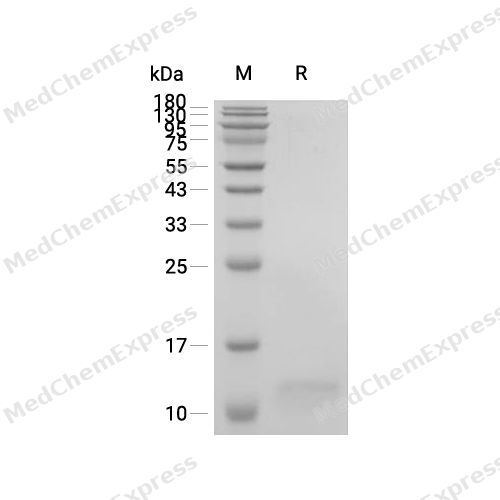
Purity - SDS-PAGE


Technical Parameters
-
Species Human
-
Source E. coli
-
Tag Tag Free
-
Accession
P51671 (G24-P97)
-
Molecular Construction
-
N-term
-
CCL11 (G24-P97)
Accession # P51671 -
C-term
-
-
Protein Length
Full Length of Mature Protein
-
Synonyms
CCL11; Eosinophil Chemotactic Protein; Prev. SCYA11; MGC22554; Eotaxin; Small-Inducible Cytokine A11; Small Inducible Cytokine Subfamily A (Cys-Cys), Member 11 (Eotaxin); C-C Motif Chemokine 11; Chemokine (C-C Motif) Ligand 11; C-C Motif Chemokine; C-C Mo
-
AA Sequence
GPASVPTTCCFNLANRKIPLQRLESYRRITSGKCPQKAVIFKTKLAKDICADPKKKWVQDSMKYLDQKSPTPKP
-
Predicted Molecular Mass
8.6 kDa
-
Molecular Weight
Approximately 10 kDa, based on SDS-PAGE under reducing conditions.
-
Purity
≥ 95%, as determined by reducing SDS-PAGE.


Product Properties
Lyophilized powder
Lyophilized from a 0.22 μm filtered solution of 20 mM PB, pH 7.4, 150 mM NaCl.
<1 EU/μg, determined by LAL method.
It is not recommended to reconstitute to a concentration less than 100 μg/mL in ddH2O. For long term storage it is recommended to add a carrier protein (0.1% BSA, 5% HSA, 10% FBS or 5% Trehalose).
Stored at -20°C for 2 years from date of receipt. After reconstitution, it is stable at 4°C for 1 week or -20°C for longer (with carrier protein). It is recommended to freeze aliquots at -20°C or -80°C for extended storage.
Room temperature in continental US; may vary elsewhere.


Documentation
-
Data Sheet (262 KB)
-
SDS (252 KB)
- English - EN (252 KB)
- Français - FR (252 KB)
- Deutsch - DE (252 KB)
- Norwegian - NO (252 KB)
- Español - ES (252 KB)
- Swedish - SV (252 KB)
- Italian - IT (252 KB)
- Korean - KR (252 KB)
- Portuguese - PT (252 KB)
-
Handling Instructions (2659 KB)


References
[1]. Antonio L. Teixeira, et al. Revisiting the Role of Eotaxin-1/CCL11 in Psychiatric Disorders. Front Psychiatry. 2018 Jun 14;9:241. [Content Brief]
[2]. Garcia-Zepeda EA, et al. Human eotaxin is a specific chemoattractant for eosinophil cells and provides a new mechanism to explain tissue eosinophilia. Nat Med. 1996 Apr;2(4):449-56. [Content Brief]
[3]. R Salcedo, et al. Eotaxin (CCL11) induces in vivo angiogenic responses by human CCR3+ endothelial cells. J Immunol. 2001 Jun 15;166(12):7571-8. [Content Brief]
[4]. Salcedo R, et al. Eotaxin (CCL11) induces in vivo angiogenic responses by human CCR3+ endothelial cells. J Immunol. 2001 Jun 15;166(12):7571-8. [Content Brief]
[5]. Sara S Cheng, et al. Eotaxin/CCL11 is a negative regulator of neutrophil recruitment in a murine model of endotoxemia.Exp Mol Pathol. 2002 Aug;73(1):1-8. [Content Brief]

Calculators
Concentration (start) × Volume (start) = Concentration (final) × Volume (final)


 Powered by Bioz

