



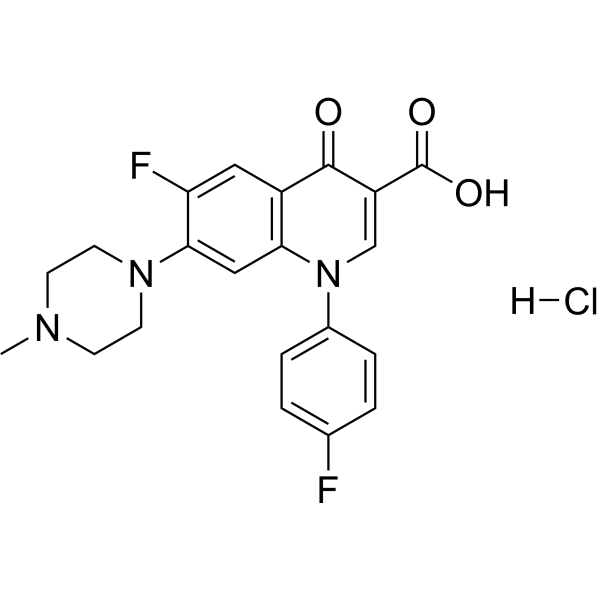
Difloxacin hydrochloride

Based on 1 Customer Validation
Difloxacin hydrochloride (A-56619 hydrochloride) is an orally active bactericidal agent. Difloxacin hydrochloride inhibits bacterial DNA gyrase. Difloxacin hydrochloride exhibits concentration-dependent bactericidal activity. Difloxacin hydrochloride shows strong in vitro activity against a variety of Gram-positive and Gram-negative bacteria. Difloxacin hydrochloride can be used in research related to colibacillosis and *Staphylococcus aureus* infections.
For research use only. We do not sell to patients.
- Purity : 99.52%
- CAS No.: 91296-86-5
- Formula: C21H20ClF2N3O3
- Molecular Weight:435.85
-
Storage:
4°C, sealed storage, away from moisture
* In solvent : -80°C, 6 months; -20°C, 1 month (sealed storage, away from moisture)

To place orders, for customer services and technical support, please contact: MedChemExpress USA
Tel: 609-228-6898 E-mail: [email protected] [email protected]


-
 Biological Activity
-
Chemical Information
-
Solvent & Solubility
- Purity & Documentation
- References
-
 Help & FAQs




All DNA/RNA Synthesis Isoforms
More

Biological Activity
Description
In Vitro
Difloxacin (24-48 h) hydrochloride inhibits and eliminates the field strain of E. coli O78 in vitro with an MIC of 0.02 µg/mL and an MBC of 0.04 µg/mL[1].
Difloxacin (0.04-12.5 µg/mL) hydrochloride exhibits 3.99% protein binding in normal chicken serum in vitro[1].
Difloxacin hydrochloride exhibits broad-spectrum in vitro antibacterial activity against clinical isolates of gram-positive (Staphylococcus aureus, Streptococcus pyogenes, Streptococcus pneumoniae, Streptococcus faecalis) and gram-negative (Escherichia coli, Klebsiella pneumoniae, Salmonella typhimurium, Proteus mirabilis, Proteus vulgaris, Serratia marcescens, Providencia stuartii, Pseudomonas aeruginosa) bacteria[2].
Difloxacin (1-25 μg/mL; 72 h) hydrochloride dose-dependently and reversibly inhibits ConA-induced proliferation of human peripheral blood mononuclear cells, with maximum inhibition when added within the first 24 h of culture, 92% cell viability at 25 μg/mL, and no reversal of inhibition with increased mitogen concentration[3].
MedChemExpress (MCE) has not independently confirmed the accuracy of these methods. They are for reference only.
Parmacokinetics
In Vivo
Difloxacin (administered via subcutaneous injection or oral route; twice daily; at 1 h and 5 h post-infection) hydrochloride exhibits an ED50 of 1.7 mg/kg per day for subcutaneous administration and 3.2 mg/kg per day for oral administration against lethal *Staphylococcus aureus* 10649 infection in CF-1 mice[2].
MedChemExpress (MCE) has not independently confirmed the accuracy of these methods. They are for reference only.
-
Animal Model:CF-1 (female, 20 g)[2]
-
Dosage:1.7 mg/kg per day (subcutaneous); 3.2 mg/kg per day (oral)
-
Administration:subcutaneous; twice daily; post-infection at 1 and 5 h; oral; twice daily; post-infection at 1 and 5 h
-
Result:Achieved an ED50 of 1.7 mg/kg per day via subcutaneous administration.
Achieved an ED50 of 3.2 mg/kg per day via oral administration.
-
Animal Model:CF-1 (female, 20 g)[2]
-
Dosage:5.2 mg/kg per day (subcutaneous); 8.7 mg/kg per day (oral)
-
Administration:subcutaneous; twice daily; post-infection at 1 and 5 h; oral; twice daily; post-infection at 1 and 5 h
-
Result:Achieved an ED50 of 5.2 mg/kg per day via subcutaneous administration.
Achieved an ED50 of 8.7 mg/kg per day via oral administration.
-
Animal Model:CF-1 (female, 20 g)[2]
-
Dosage:14.9 mg/kg per day (subcutaneous); 19.6 mg/kg per day (oral)
-
Administration:subcutaneous; twice daily; post-infection at 1 and 5 h; oral; twice daily; post-infection at 1 and 5 h
-
Result:Achieved an ED50 of 14.9 mg/kg per day via subcutaneous administration.
Achieved an ED50 of 19.6 mg/kg per day via oral administration.
-
Animal Model:CF-1 (female, 20 g)[2]
-
Dosage:2.2 mg/kg per day (subcutaneous); 3.9 mg/kg per day (oral)
-
Administration:subcutaneous; twice daily; post-infection at 1 and 5 h; oral; twice daily; post-infection at 1 and 5 h
-
Result:Achieved an ED50 of 2.2 mg/kg per day via subcutaneous administration.
Achieved an ED50 of 3.9 mg/kg per day via oral administration.
-
Animal Model:CF-1 (female, 20 g)[2]
-
Dosage:0.5 mg/kg per day (subcutaneous); 1.1 mg/kg per day (oral)
-
Administration:subcutaneous; twice daily; post-infection at 1 and 5 h; oral; twice daily; post-infection at 1 and 5 h
-
Result:Achieved an ED50 of 0.5 mg/kg per day via subcutaneous administration.
Achieved an ED50 of 1.1 mg/kg per day via oral administration.
-
Animal Model:CF-1 (female, 20 g)[2]
-
Dosage:1.6 mg/kg per day (subcutaneous); 1.4 mg/kg per day (oral)
-
Administration:subcutaneous; twice daily; post-infection at 24 and 28 h; oral; twice daily; post-infection at 24 and 28 h
-
Result:Achieved an ED50 of 1.6 mg/kg per day via subcutaneous administration.
Achieved an ED50 of 1.4 mg/kg per day via oral administration.
-
Animal Model:CF-1 (female, 20 g)[2]
-
Dosage:2.9 mg/kg per day (subcutaneous); 7.3 mg/kg per day (oral)
-
Administration:subcutaneous; twice daily; post-infection at 1 and 5 h; oral; twice daily; post-infection at 1 and 5 h
-
Result:Achieved an ED50 of 2.9 mg/kg per day via subcutaneous administration.
Achieved an ED50 of 7.3 mg/kg per day via oral administration.
-
Animal Model:CF-1 (female, 20 g)[2]
-
Dosage:4.2 mg/kg per day (subcutaneous); 14.9 mg/kg per day (oral)
-
Administration:subcutaneous; twice daily; post-infection at 1 and 5 h; oral; twice daily; post-infection at 1 and 5 h
-
Result:Achieved an ED50 of 4.2 mg/kg per day via subcutaneous administration.
Achieved an ED50 of 14.9 mg/kg per day via oral administration.
-
Animal Model:CF-1 (female, 20 g)[2]
-
Dosage:1.5 mg/kg per day (subcutaneous); 1.9 mg/kg per day (oral)
-
Administration:subcutaneous; twice daily; post-infection at 1 and 5 h; oral; twice daily; post-infection at 1 and 5 h
-
Result:Achieved an ED50 of 1.5 mg/kg per day via subcutaneous administration.
Achieved an ED50 of 1.9 mg/kg per day via oral administration.
-
Animal Model:CF-1 (female, 20 g)[2]
-
Dosage:3.7 mg/kg per day (subcutaneous); 4.9 mg/kg per day (oral)
-
Administration:subcutaneous; twice daily; post-infection at 1 and 5 h; oral; twice daily; post-infection at 1 and 5 h
-
Result:Achieved an ED50 of 3.7 mg/kg per day via subcutaneous administration.
Achieved an ED50 of 4.9 mg/kg per day via oral administration.
-
Animal Model:CF-1 (female, 20 g)[2]
-
Dosage:5.2 mg/kg per day (subcutaneous)
-
Administration:subcutaneous; twice daily; post-infection at 1 and 5 h
-
Result:Achieved an ED50 of 5.2 mg/kg per day via subcutaneous administration.


Chemical Information
-
CAS No. 91296-86-5
-
Appearance Solid
-
Molecular Weight 435.85
-
Formula C21H20ClF2N3O3
-
Color White to off-white
-
SMILES
O=C(C1=CN(C2=CC=C(F)C=C2)C3=C(C=C(F)C(N4CCN(C)CC4)=C3)C1=O)O.[H]Cl
-
Synonyms
A-56619 hydrochloride
-
Shipping
Room temperature in continental US; may vary elsewhere.
-
Storage
4°C, sealed storage, away from moisture
* In solvent : -80°C, 6 months; -20°C, 1 month (sealed storage, away from moisture)


Solvent & Solubility
In Vitro:
H2O : 5 mg/mL (11.47 mM; ultrasonic and warming and heat to 60°C)
Please refer to the solubility information to select the appropriate solvent. Once prepared, please aliquot and store the solution to prevent product inactivation from repeated freeze-thaw cycles.
Storage method and period of stock solution: -80°C, 6 months; -20°C, 1 month (sealed storage, away from moisture). When stored at -80°C, please use it within 6 months. When stored at -20°C, please use it within 1 month.
* Note: If you choose water as the stock solution, please dilute it to the working solution, then filter and sterilize it with a 0.22 μm filter before use.
Please refer to the solubility information to select the appropriate solvent. Once prepared, please aliquot and store the solution to prevent product inactivation from repeated freeze-thaw cycles.
Storage method and period of stock solution: -80°C, 6 months; -20°C, 1 month (sealed storage, away from moisture). When stored at -80°C, please use it within 6 months. When stored at -20°C, please use it within 1 month.
* Note: If you choose water as the stock solution, please dilute it to the working solution, then filter and sterilize it with a 0.22 μm filter before use.
Concentration (start) × Volume (start) = Concentration (final) × Volume (final)


Purity & Documentation
-
Data Sheet (290 KB)
-
SDS (394 KB)
- English - EN (394 KB)
- Français - FR (394 KB)
- Deutsch - DE (394 KB)
- Norwegian - NO (394 KB)
- Español - ES (394 KB)
- Swedish - SV (394 KB)
- Italian - IT (394 KB)
- Korean - KR (394 KB)
- Portuguese - PT (394 KB)
-
Handling Instructions (2659 KB)
References
[1]. Abo El-Ela FI, et al. Pharmacokinetics of difloxacin in healthy and E. coli-infected broiler chickens. Br Poult Sci. 2014;55(6):830-836. [Content Brief]
[2]. Fernandes PB, et al. In vivo evaluation of A-56619 (difloxacin) and A-56620: new aryl-fluoroquinolones. Antimicrob Agents Chemother. 1986;29(2):201-208. [Content Brief]
[3]. Gollapudi SV, et al. Aryl-fluoroquinolone derivatives A-56619 (difloxacin) and A-56620 inhibit mitogen-induced human mononuclear cell proliferation. Antimicrob Agents Chemother. 1986;30(3):390-394. [Content Brief]


Complete Stock Solution Preparation Table
Please refer to the solubility information to select the appropriate solvent. Once prepared, please aliquot and store the solution to prevent product inactivation from repeated freeze-thaw cycles.
Storage method and period of stock solution: -80°C, 6 months; -20°C, 1 month (sealed storage, away from moisture). When stored at -80°C, please use it within 6 months. When stored at -20°C, please use it within 1 month.
| Optional Solvent | Concentration Solvent Mass | 1 mg | 5 mg | 10 mg | 25 mg |
|---|---|---|---|---|---|
| H2O | 1 mM | 2.2944 mL | 11.4718 mL | 22.9437 mL | 57.3592 mL |
| 5 mM | 0.4589 mL | 2.2944 mL | 4.5887 mL | 11.4718 mL | |
| 10 mM | 0.2294 mL | 1.1472 mL | 2.2944 mL | 5.7359 mL |
* Note: If you choose water as the stock solution, please dilute it to the working solution, then filter and sterilize it with a 0.22 μm filter before use.


Difloxacin hydrochloride Related Classifications
HY-N7066 Related Classifications
 Powered by Bioz
Keywords
- Difloxacin
- 91296-86-5
- A-56619
- A56619
- A 56619
- Bacterial
- DNA/RNA Synthesis
- bacterial DNA gyrase
- Escherichia coli
- Gram-positive bacteria
- mammalian topoisomerase II
- Gram-negative bacteria
- bacterial topoisomerase IV
- eucaryotic alpha DNA polymerases
- eucaryotic beta DNA polymerases
- mycoplasma
- human peripheral blood mononuclear cells
- Inhibitor
- inhibitor
- inhibit