



PAA4
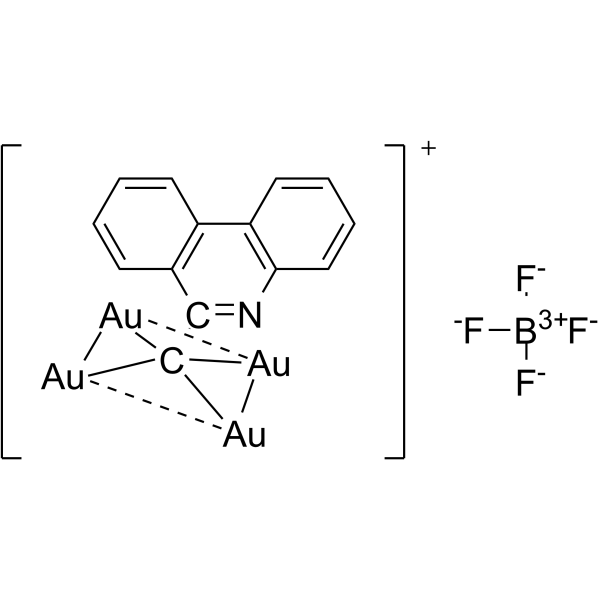
PAA4 is a hypercoordinate carbon-centered tetranuclear gold (I) cluster prodrug. PAA4 releases active Au (I) ions upon triggering by GSH (HY-D0187), and this process is accelerated in the acidic microenvironment of bladder cancer cells with high GSH expression. PAA4 inhibits the activities of cytosolic TrxR1 and mitochondrial TrxR2, inducing ROS accumulation, lipid peroxidation, ferroptosis, loss of mitochondrial membrane potential and DNA damage. PAA4 can be used in bladder cancer-related research.
For research use only. We do not sell to patients.
- Formula: C14H8Au4BF4N
- Molecular Weight:1064.89
-
Storage:
Please store the product under the recommended conditions in the Certificate of Analysis.

To place orders, for customer services and technical support, please contact: MedChemExpress USA
Tel: 609-228-6898 E-mail: [email protected] [email protected]


-
 Biological Activity
-
Chemical Information
- Protocols
- Purity & Documentation
- References
-
 Help & FAQs


All DNA/RNA Synthesis Isoforms
More

Biological Activity
Description
In Vitro
PAA4 (0-4.0 μM; 24 h) exerts selective cytotoxicity against human bladder cancer EJ cells (IC50 = 0.8 μM), compared with normal HUVEC cells (IC50 = 2.1 μM) and SV-HUC-1 cells (IC50 = 2.3 μM)[1].
PAA4 (1-4 μM; 6-8 h) induces ferroptosis in human bladder cancer EJ cells, as evidenced by increased PTGS2 expression, elevated lipid peroxidation levels, and other changes[1].
PAA4 (1.5 μM; 4-24 h) is efficiently internalized by human bladder cancer EJ cells, with an uptake rate of 30%, and approximately 10% of the gold localizes to mitochondria; at the same or lower concentrations, its cellular uptake rate is higher than that of the mononuclear gold (I) complex PA1[1].
PAA4 (1.5 μM; 4 h) releases active AuI ions in human bladder cancer EJ cells[1].
PAA4 (1.5 μM; 4 h) potently inhibits the activities of cytosolic TrxR1 and mitochondrial TrxR2 in human bladder cancer EJ cells, reducing their activities to 21% and 22% of that in the control group, respectively[1].
PAA4 (1.5-2.0 μM; 4 h) increases the intracellular ROS level in human bladder cancer EJ cells by 3.4-fold[1].
PAA4 (1-4 μM; 1-6 h) upregulates the pro-oxidative genes CYBA and CYBB, and induces DNA damage in human bladder cancer EJ cells[1].
PAA4 (1.5 μM; 4 h) induces loss of mitochondrial membrane potential in human bladder cancer EJ cells[1].
MedChemExpress (MCE) has not independently confirmed the accuracy of these methods. They are for reference only.
-
Cell Line:human bladder cancer EJ cells
-
Concentration:1, 2 and 4 μM
-
Incubation Time:6 h with or without pre-treatment for 2 hours with Deferoxamine (DFO) (HY-B1625) (100 μM) or N-Acetyl-L-cysteine (NAC) (HY-B0215) (3.0 mM).
-
Result:Increased PTGS2 expression, and reduced cytotoxicity upon pretreatment with ferroptosis inhibitors DFO or NAC.
In Vivo
PAA4 (1.5 μM; intravesical; once every other day; 5 total doses, 60 min incubation per dose) demonstrates potent in vivo anti-bladder cancer activity in the orthotopic model, drastically reducing tumor bioluminescence signal at 21 days, extending median survival beyond 50 days, inducing tumor ferroptosis, and exhibiting good biocompatibility with no detectable liver or kidney toxicity[1].
MedChemExpress (MCE) has not independently confirmed the accuracy of these methods. They are for reference only.
-
Animal Model:BALB/c nude mice (female, 4-6 weeks, ~18 g, air-pouch bladder cancer model)[1]
-
Dosage:1.5 μM
-
Administration:intra-pouch; single incubation; 30 min
-
Result:Reduced mean tumor volume to 564 mm3 after 22 days compared to 1067 mm3 in PBS control.
Extended median survival time to 36 days compared to 25 days in PBS control.
Showed no significant body weight loss.
-
Animal Model:BALB/c nude mice (female, 6-8 weeks, 16-18 g, orthotopic bladder cancer model)[1]
-
Dosage:1.5 μM
-
Administration:intravesical; once every other day; 5 total doses, 60 min incubation per dose
-
Result:Drastically reduced bioluminescence intensity (luciferase signal) at 21 days post-first treatment compared to PBS control.
Extended median survival time beyond 50 days, with over 50% survival at 50 days compared to 28 days in PBS control.
Showed no significant differences in blood levels of ALT, AST, ALP, BUN, and CRE from saline-treated controls.
Detected significant PTGS2 immunofluorescence in tumor sections, confirming ferroptosis induction.


Chemical Information
-
Molecular Weight 1064.89
-
Formula C14H8Au4BF4N
-
SMILES
[F-][B+3]([F-])([F-])[F-].C1(C(C234[Au]5[Au]2[Au]3[Au]45)=NC6=C7C=CC=C6)=C7C=CC=C1
-
Shipping
Room temperature in continental US; may vary elsewhere.
-
Storage
Please store the product under the recommended conditions in the Certificate of Analysis.


Purity & Documentation
References

Calculators
Concentration (start) × Volume (start) = Concentration (final) × Volume (final)


PAA4 Related Classifications
HY-149035 Related Classifications
 Powered by Bioz