



Kanamycin sulfate
Based on 29 publication(s) in Google Scholar
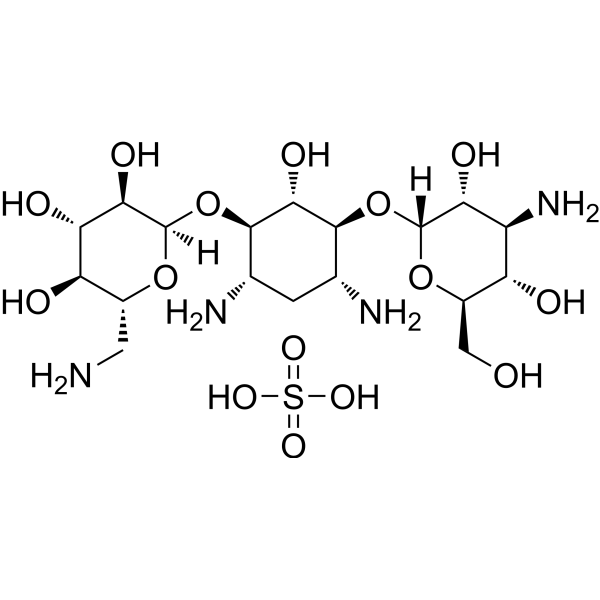
Kanamycin (Kanamycin A) sulfate is an orally active antibacterial (gram-negative/positive bacteria) agent, inhibits translocation and causes misencoding by binding to the 70 S ribosomal subunit. Kanamycin sulfate shows good inhibitory activity to both M. tuberculosis (sensitive and drug-resistant ) and K. pneumonia, which can be used in studies of tuberculosis and pneumonia.
For research use only. We do not sell to patients.
- Purity: 99.96%
- CAS No.: 25389-94-0
- Formula: C18H38N4O15S
- Molecular Weight:582.58
-
Storage:
4°C, sealed storage, away from moisture
* In solvent : -80°C, 6 months; -20°C, 1 month (sealed storage, away from moisture)


-
 Biological Activity
-
Chemical Information
-
Solvent & Solubility
- Purity & Documentation
- References
-
 Help & FAQs
-


Anti-Infection Compound Library
HY-L002
-
Immunology/Inflammation Compound Library
HY-L007
-
Natural Product Library
HY-L021
-
FDA-Approved Drug Library
HY-L022
-
Drug Repurposing Compound Library
HY-L035
-
Glycoside Compound Library
HY-L042
-
Antibacterial Compound Library
HY-L049
-
Anti-COVID-19 Compound Library
HY-L052
-
NMPA-Approved Drug Library
HY-L053
-
Orally Active Compound Library
HY-L061
-
FDA Approved & Pharmacopeial Drug Library
HY-L066
-
Antibiotics Library
HY-L067
-
Microbial Metabolite Library
HY-L084
-
Rare Diseases Drug Library
HY-L102
-
Heterocyclic Compound Library
HY-L138
-
Off-patent Drug Library
HY-L141
-
Anti-tuberculosis Compound Library
HY-L142
-
Anti-Drug-Resistant Compound Library
HY-L169
-
Bioactive Compound Library Max
HY-L181
-
MCE Bioactive Compound Library
HY-L001V
-
Natural Product Library Plus
HY-L021P
-
Drug Repurposing Compound Library Plus
HY-L035P
-
FDA-Approved Drug Library Plus
HY-L022P
-
FDA-Approved Drug Library Mini
HY-L022M
-
Natural Product and Natural Product-Like Compound Library
HY-L021M
-
Bioactive Compound Library
HY-L001
-
High-Throughput Bioactive Compound Library
HY-L205
-
High-Throughput Natural Product Library
HY-L206
-
Natural Product Diversity Scaffold Library
HY-L245
-
RNA Binding Bioactive Compound Library
HY-L248
-
Mass Spectrometry Natural Product Library
HY-L262


Publications Citing Use of MedChemExpress (MCE) Kanamycin sulfate
More- Science. 2026 Mar 19;391(6791):eadu7686. [Abstract]
- Exploration. 2025 Dec 18;5(6):20240396. [Abstract]
- Nat Microbiol. 2025 Nov;10(11):2949-2965. [Abstract]
- Adv Sci (Weinh). 2024 Aug;11(31):e2308307. [Abstract]
- Nucleic Acids Res. 2022 Dec 9;50(22):12951-12968. [Abstract]
- Sci Adv. 2023 Feb 17;9(7):eade4770. [Abstract]
- Food Chem. 2023 Mar 1:403:134399. [Abstract]
- Cell Death Dis. 2021 May 18;12(6):509. [Abstract]
- Int J Hydrogen Energy. 2018, 43(30), 13821-13828.
- J Med Chem. 2026 Jan 23. [Abstract]
- Chin Med. 2025 Oct 3;20(1):155. [Abstract]
- Microb Biotechnol. 2021 Nov;14(6):2538-2551. [Abstract]
- Commun Biol. 2025 Oct 6;8(1):1425. [Abstract]
- Int Immunopharmacol. 2025 May 21:159:114888. [Abstract]
- mLife. 2025 Apr 15;4(2):155-168. [Abstract]
- Aquat Toxicol. 2025 Feb 9:280:107284. [Abstract]
- BMC Microbiol. 2025 Apr 29;25(1):257. [Abstract]
- iScience. 2025 Nov 12;28(12):114030. [Abstract]
- Microbiol Spectr. 2025 Oct 16:e0160325. [Abstract]
- Microbiol Spectr. 2025 Aug 29:e0059025. [Abstract]
- ACS Infect Dis. 2025 Apr 1. [Abstract]
- J Periodontol. 2024 Sep;95(9):867-879. [Abstract]
- ACS Infect Dis. 2024 Apr 12;10(4):1327-1338. [Abstract]
- ACS Chem Biol. 2022 Jan 21;17(1):39-53. [Abstract]
- AMB Express. 2024 Dec 24;14(1):141. [Abstract]
- Vet Res Commun. 2024 Dec;48(6):3859-3872. [Abstract]
- Int J Med Microbiol. 2023 Mar 28;313(2):151578. [Abstract]
- bioRxiv. 2025 May 29.
- bioRxiv. 2025 January 19.
 Customer Validation & Images

-
Microbiological Assay
All Antibiotic Isoforms
More

Biological Activity
Kanamycin sulfate (0.1-100 μg/mL; 2 weeks) exhibits good antibacterial activity (MIC=1-5 μg/mL) to various strains of mycobacteria in vitro[1].
MedChemExpress (MCE) has not independently confirmed the accuracy of these methods. They are for reference only.
-
Cell Line:mycobacteria H37Rv, H2, H37RvR-PAS, Ravenel, Kirchbergand and BCG.
-
Concentration:0.1-100 μg/mL
-
Incubation Time:2 weeks
-
Result:Showed good antibacterial activity to various strains of mycobacteria (H37Rv, H2, H37RvR-PAS, Ravenel, and BCG) with MICs were 1 μg/mL and 5 μg/mL for strain of Kirchbergand.
Kanamycin sulfate (1.25, 5 mg/kg; s.c.; single (at 3 h after infection)) inhibits the multiplication of K. pneumonia DT-S in lung, trachea, and blood of mice and in proportion to the dose administration, and also increases the survival rate of mice[2].
MedChemExpress (MCE) has not independently confirmed the accuracy of these methods. They are for reference only.
-
Animal Model:Inbred strain normal mice (14-16 g; bovine tubercle bacilli (Ravenel strain) infected model)[1].
-
Dosage:2, 4 mg/kg
-
Administration:Subcutaneous injection; once daily, 6 times a week for 3 weeks.
-
Result:Exerted a marked effect to inhibit the multiplication of the tuberculosis in vivo, especially in the lung of mice.
-
Animal Model:Slc:ICR male mice (4-week-old; 18-24 g; K. pneumonia DT-S infection model (by the aerosol method))[2].
-
Dosage:1.25, 5 mg/kg
-
Administration:Subcutaneous administration; single (at 3 h after infection).
-
Result:Suppressed the growth of K. pneumonia DT-S in lung, trachea, and blood in proportion to the dose administration.
Resulted in 90% survival at 6 days after infection (negative control group: all died within 4 days), and cleared the K. pneumonia DT-S from lung, trachea, and blood of mice within 48 h (when dosage at 5 mg/kg).


Chemical Information
-
CAS No. 25389-94-0
-
Appearance Solid
-
Molecular Weight 582.58
-
Formula C18H38N4O15S
-
Color White to off-white
-
SMILES
OS(O)(=O)=O.O[C@H]1[C@](O[C@@H]2[C@@H](N)C[C@@H](N)[C@H](O[C@@]3([H])O[C@H](CO)[C@@H](O)[C@H](N)[C@H]3O)[C@H]2O)([H])O[C@H](CN)[C@@H](O)[C@@H]1O
-
Synonyms
Kanamycin A sulfate
-
Initial Source
Streptomyces kanamyceticus
-
Shipping
Room temperature in continental US; may vary elsewhere.
-
Storage
4°C, sealed storage, away from moisture
* In solvent : -80°C, 6 months; -20°C, 1 month (sealed storage, away from moisture)


Publications (29)
-
Journal Impact Factor
-
Most Recent
-
Science
Commensal-driven serotonin production modulates in vivo delivery of synthetic and viral vectors. [Abstract]2026 Mar 19;391(6791):eadu7686. PMID: 41855345 -
Exploration
A Bioorthogonal and Programmable Bacterial Delivery System for Spatiotemporally Targeted Therapy of Solid Tumors. [Abstract]2025 Dec 18;5(6):20240396. PMID: 41476656 -
Nat Microbiol
Mycobacterium tuberculosis-derived linoleic acid increases regulatory T cell function to promote bacterial survival within macrophages. [Abstract]2025 Nov;10(11):2949-2965. PMID: 41073667 -
Adv Sci (Weinh)
Aloperine Suppresses Cancer Progression by Interacting with VPS4A to Inhibit Autophagosome-lysosome Fusion in NSCLC. [Abstract]2024 Aug;11(31):e2308307. PMID: 39166458 -
Nucleic Acids Res
RNA granule-clustered mitochondrial aminoacyl-tRNA synthetases form multiple complexes with the potential to fine-tune tRNA aminoacylation. [Abstract]2022 Dec 9;50(22):12951-12968. PMID: 36503967 -
Sci Adv
Imaging of Escherichia coli K5 and glycosaminoglycan precursors via targeted metabolic labeling of capsular polysaccharides in bacteria. [Abstract]2023 Feb 17;9(7):eade4770. PMID: 36800421 -
Food Chem
Electrochemical sensor for detecting streptomycin in milk based on label-free aptamer chain and magnetic adsorption. [Abstract]2023 Mar 1:403:134399. PMID: 36182859 -
Cell Death Dis
Sodium/glucose cotransporter 1-dependent metabolic alterations induce tamoxifen resistance in breast cancer by promoting macrophage M2 polarization. [Abstract]2021 May 18;12(6):509. PMID: 34006822 -
-
J Med Chem
Discovery of 2-Chloro-pyrrolo[2,3- d]pyrimidin-4-one Derivatives as Protein Disulfide Isomerase Inhibitors with a Novel Allosteric-Covalent Binding Mode and Anti-Glioblastoma Activity. [Abstract]2026 Jan 23. PMID: 41574754 -
Chin Med
Synergistic potential of Berberine and Wogonin improved adipose inflammation and insulin resistance associated with obesity through HIF-α axis. [Abstract]2025 Oct 3;20(1):155. PMID: 41039626 -
Microb Biotechnol
Attenuator LRR - a regulatory tool for modulating gene expression in Gram-positive bacteria. [Abstract]2021 Nov;14(6):2538-2551. PMID: 33720523 -
Commun Biol
The acetyltransferase CysE modulates virulence and drug resistance of Mycobacterium tuberculosis by interfering with oxidative stress responses. [Abstract]2025 Oct 6;8(1):1425. PMID: 41053365 -
Int Immunopharmacol
Early-life antibiotic dysbiosis impairs microbial tryptophan- nicotinic acid metabolism exacerbating food allergy in adulthood. [Abstract]2025 May 21:159:114888. PMID: 40403504 -
mLife
Identification of a phenyl ester covalent inhibitor of caseinolytic protease and analysis of the ClpP1P2 inhibition in mycobacteria. [Abstract]2025 Apr 15;4(2):155-168. PMID: 40313980 -
Aquat Toxicol
Antibacterials exert toxic effects on aquatic organisms by inhibiting respiration, inducing oxidative stress, mitochondrial dysfunction and autophagy. [Abstract]2025 Feb 9:280:107284. PMID: 39951902 -
BMC Microbiol
Klebsiella pneumoniae under xylose pressure: the growth adaptation, antimicrobial susceptibility, global proteomics analysis and role of XylA and XylB proteins. [Abstract]2025 Apr 29;25(1):257. PMID: 40301709 -
iScience
2025 Nov 12;28(12):114030. PMID: 41377656 -
Microbiol Spectr
The adaptive growth and mechanisms of Klebsiella pneumoniae under sucrose and glucose exposure. [Abstract]2025 Oct 16:e0160325. PMID: 41099518 -
Microbiol Spectr
2025 Aug 29:e0059025. PMID: 40879403 -
ACS Infect Dis
Toward a Bactericidal Oral Drug Combination for the Treatment of Mycobacterium abscessus Lung Disease. [Abstract]2025 Apr 1. PMID: 40168319 -
J Periodontol
Gingipain and oncostatin M synergistically disrupt kidney tight junctions in periodontitis-associated acute kidney injury. [Abstract]2024 Sep;95(9):867-879. PMID: 38963713 -
ACS Infect Dis
Lusutrombopag as a Repurposing Drug in Combination with Aminoglycosides against Vancomycin-Resistant Enterococcus. [Abstract]2024 Apr 12;10(4):1327-1338. PMID: 38567846 -
ACS Chem Biol
Investigate Natural Product Indolmycin and the Synthetically Improved Analogue Toward Antimycobacterial Agents. [Abstract]2022 Jan 21;17(1):39-53. PMID: 34908399 -
AMB Express
Repurposing pinaverium bromide against Staphylococcus and its biofilms with new mechanisms. [Abstract]2024 Dec 24;14(1):141. PMID: 39718732
Kanamycin sulfate purchased from MedChemExpress. Usage Cited in: AMB Express. 2024 Dec 24;14(1):141. [Abstract]
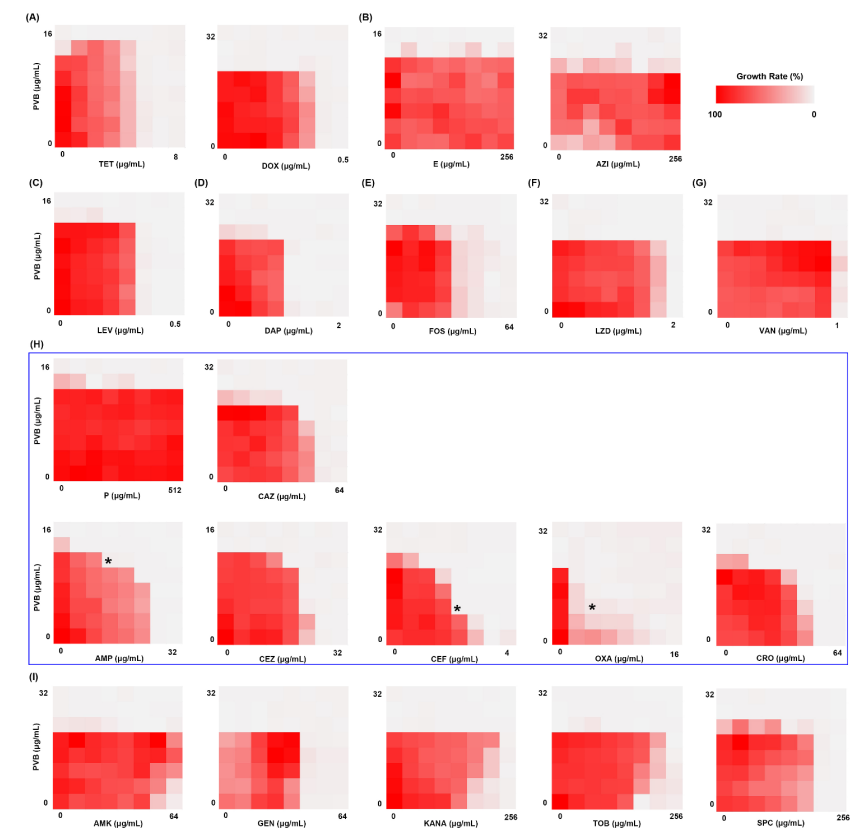
Combinational antimicrobial effects between PVB and conventional antibiotics against MRSA ATCC 43,300. TET, Tetracycline. DOX, Doxycycline. E, Erythromycin. AZI, Azithromycin. P, Penicillin. CAZ, Ceftazidime. AMP, Ampicillin. CEZ, Cefazolin. CEF, Cefotaxime. OXA, Oxacillin. CRO, Ceftriaxone. AMK, Amikacin. GEN, Gentamycin, KANA, Kanamycin. TOB, Tobramycin. SPC, Spectinomycin.
-
Vet Res Commun
Biological characterization of lipoic acid- and heme-dependent Escherichia coli small colony variants isolated from sheep in Xinjiang, China. [Abstract]2024 Dec;48(6):3859-3872. PMID: 39325108 -
Int J Med Microbiol
Antibacterial and antibiofilm efficacy of repurposing drug hexestrol against methicillin-resistant Staphylococcus aureus. [Abstract]2023 Mar 28;313(2):151578. PMID: 37001448 -
-


Solvent & Solubility
H2O : ≥ 25 mg/mL (42.91 mM)
DMSO : < 1 mg/mL (insoluble or slightly soluble)
* "≥" means soluble, but saturation unknown.
Please refer to the solubility information to select the appropriate solvent. Once prepared, please aliquot and store the solution to prevent product inactivation from repeated freeze-thaw cycles.
Storage method and period of stock solution: -80°C, 6 months; -20°C, 1 month (sealed storage, away from moisture). When stored at -80°C, please use it within 6 months. When stored at -20°C, please use it within 1 month.
* Note: If you choose water as the stock solution, please dilute it to the working solution, then filter and sterilize it with a 0.22 μm filter before use.
Please refer to the solubility information to select the appropriate solvent. Once prepared, please aliquot and store the solution to prevent product inactivation from repeated freeze-thaw cycles.
Storage method and period of stock solution: -80°C, 6 months; -20°C, 1 month (sealed storage, away from moisture). When stored at -80°C, please use it within 6 months. When stored at -20°C, please use it within 1 month.
* Note: If you choose water as the stock solution, please dilute it to the working solution, then filter and sterilize it with a 0.22 μm filter before use.
Concentration (start) × Volume (start) = Concentration (final) × Volume (final)
For the following dissolution methods, please prepare the working solution directly:
It is recommended to prepare fresh solutions and use them promptly within a short period of time.
The percentages shown for the solvents indicate their volumetric ratio in the final prepared solution. If precipitation or phase separation occurs during preparation, heat and/or sonication can be used to aid dissolution.
Add each solvent one by one: PBS
Solubility: 50 mg/mL (85.83 mM); Clear solution; Need ultrasonic
Add each solvent one by one: Saline
Solubility: 50 mg/mL (85.83 mM); Clear solution; Need ultrasonic
Please enter the basic information of animal experiments:
-
-
-
-
Recommended: Prepare an additional quantity of animals to account for potential losses during experiments.
Working solution concentration: 0.22 mg/mL
This product has good water solubility, please refer to the measured solubility data in water/PBS/Saline for details.


Purity & Documentation
-
Data Sheet (284 KB)
-
SDS (418 KB)
- English - EN (418 KB)
- Français - FR (418 KB)
- Deutsch - DE (418 KB)
- Norwegian - NO (418 KB)
- Español - ES (418 KB)
- Swedish - SV (418 KB)
- Italian - IT (418 KB)
- Portuguese - PT (418 KB)
-
Handling Instructions (2659 KB)
References
[1]. YANAGISAWA K, et al. Studies on kanamycin, a new antibiotic against tubercle bacilli. I. Effect on virulent tubercle bacilli in vitro and in mice. J Antibiot (Tokyo). 1957 Nov;10(6):233-5. [Content Brief]
[2]. Nishi T, et al. Experimental respiratory tract infection with Klebsiella pneumoniae DT-S in mice: chemotherapy with kanamycin. Antimicrob Agents Chemother. 1980 Mar;17(3):494-505. [Content Brief]
[3]. Misumi M, et al. Interaction of kanamycin and related antibiotics with the large subunit of ribosomes and the inhibition of translocation. Biochem Biophys Res Commun. 1978 Sep 29;84(2):358-65. [Content Brief]
[4]. Misumi M, et al. Mechanism of inhibition of translocation by kanamycin and viomycin: a comparative study with fusidic acid. Biochem Biophys Res Commun. 1980 Jan 29;92(2):647-54. [Content Brief]


Complete Stock Solution Preparation Table
Please refer to the solubility information to select the appropriate solvent. Once prepared, please aliquot and store the solution to prevent product inactivation from repeated freeze-thaw cycles.
Storage method and period of stock solution: -80°C, 6 months; -20°C, 1 month (sealed storage, away from moisture). When stored at -80°C, please use it within 6 months. When stored at -20°C, please use it within 1 month.
| Optional Solvent | Concentration Solvent Mass | 1 mg | 5 mg | 10 mg | 25 mg |
|---|---|---|---|---|---|
| H2O | 1 mM | 1.7165 mL | 8.5825 mL | 17.1650 mL | 42.9126 mL |
| 5 mM | 0.3433 mL | 1.7165 mL | 3.4330 mL | 8.5825 mL | |
| 10 mM | 0.1717 mL | 0.8583 mL | 1.7165 mL | 4.2913 mL | |
| 15 mM | 0.1144 mL | 0.5722 mL | 1.1443 mL | 2.8608 mL | |
| 20 mM | 0.0858 mL | 0.4291 mL | 0.8583 mL | 2.1456 mL | |
| 25 mM | 0.0687 mL | 0.3433 mL | 0.6866 mL | 1.7165 mL | |
| 30 mM | 0.0572 mL | 0.2861 mL | 0.5722 mL | 1.4304 mL | |
| 40 mM | 0.0429 mL | 0.2146 mL | 0.4291 mL | 1.0728 mL |
* Note: If you choose water as the stock solution, please dilute it to the working solution, then filter and sterilize it with a 0.22 μm filter before use.


 Powered by Bioz