



TCN 201
Based on 1 publication(s) in Google Scholar
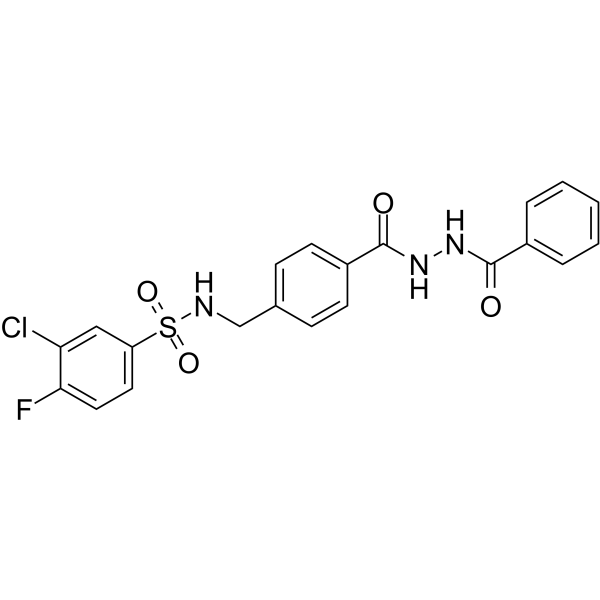
TCN 201 is a potent, selective and non-competitive antagonist of GluN1/GluN2A NMDA receptor, with a pIC50 of 6.8. TCN 201 is selective for GluN1/GluN2A NMDA receptor over GluN1/GluN2B NMDA receptor (pIC50<4.3).
Nos produits utilisent uniquement pour la recherche. Nous ne vendons pas aux patients.
- Pureté: 98.08%
- CAS No.: 852918-02-6
- Formule: C21H17ClFN3O4S
- Masse moléculaire:461.89
-
Stockage:
4°C, sealed storage, away from moisture and light
* The compound is unstable in solutions, freshly prepared is recommended.

To place orders, for customer services and technical support, please contact: MedChemExpress USA
Tel: 609-228-6898 E-mail: [email protected] [email protected]


-
 Activité biologique
-
Chemical Information
-
Solvant et solubilité
- Pureté et documentation
- Références
-
 Help & FAQs




Publications Citing Use of MedChemExpress (MCE) TCN 201
MoreVoir tous les produits spécifiques à Isoform iGluR
More

Activité biologique
|
NMDA Receptor |
|
Cell Line

|
Type | Value | Description | References |
|---|---|---|---|---|
| HEK-293T | IC50 |
109 nM
Compound: 2
|
Negative allosteric modulation of eGFP-fused human GluN2A receptor expressed in HEK293T cells assessed as inhibition of NMDA-induced channel current at -60 mV holding potential measured for 5 secs every 60 secs in presence of glycine by whole cell patch c
Negative allosteric modulation of eGFP-fused human GluN2A receptor expressed in HEK293T cells assessed as inhibition of NMDA-induced channel current at -60 mV holding potential measured for 5 secs every 60 secs in presence of glycine by whole cell patch c
|
[PMID: 28222314] |
TCN 201 (compound 1) is selective for GluN1/GluN2A NMDAR over GluN1/GluN2B NMDAR, with pIC50s of 6.8 and <4.3, respectively[1].
TCN 201 (10 μM) produces only slight inhibition of GluN1/GluN2B NMDAR-mediated currents in oocytes[2].
TCN 201 (10-30 μM) antagonism of NMDAR-mediated responses is both subtype- and glycine-dependent and more potent than TCN 213 in oocytes[2].
TCN 201 (0.1-100 μM) does not produce complete block of NMDAR-mediated responses in oocytes[2].
TCN 201 (10 μM) antagonism of NMDAR-mediated currents shows a negative correlation with their ifenprodil sensitivity in rat cortical neurons[2].
TCN 201 (1-9 μM) suppresses cortical spreading depression (CSD) in chick retina[3].
MedChemExpress (MCE) has not independently confirmed the accuracy of these methods. They are for reference only.
MedChemExpress (MCE) has not independently confirmed the accuracy of these methods. They are for reference only.


Chemical Information
-
CAS No. 852918-02-6
-
Appearance Solid
-
Masse moléculaire 461.89
-
Formule C21H17ClFN3O4S
-
Color White to off-white
-
SMILES
O=C(NNC(C1=CC=CC=C1)=O)C2=CC=C(CNS(=O)(C3=CC=C(F)C(Cl)=C3)=O)C=C2
-
Livraison
Room temperature in continental US; may vary elsewhere.
-
Stockage
4°C, sealed storage, away from moisture and light
* The compound is unstable in solutions, freshly prepared is recommended.


Publications (1)
-
Journal Impact Factor
-
Most Recent
-
J Clin Invest
METTL14-mediated m6A epitranscriptomic modification contributes to chemotherapy-induced neuropathic pain by stabilizing GluN2A expression via IGF2BP2. [Abstract]2024 Feb 6;134(6):e174847. PMID: 38319733


Solvant et solubilité
DMSO : 250 mg/mL (541.25 mM; Need ultrasonic; Hygroscopic DMSO has a significant impact on the solubility of product, please use newly opened DMSO)
Please refer to the solubility information to select the appropriate solvent. The compound is unstable in solutions, freshly prepared is recommended.
Please refer to the solubility information to select the appropriate solvent. The compound is unstable in solutions, freshly prepared is recommended.
Concentration (start) × Volume (start) = Concentration (final) × Volume (final)
Select the appropriate dissolution method based on your experimental animal and administration route.
- For the following dissolution methods, please ensure to first prepare a clear stock solution using an In Vitro approach and then sequentially add co-solvents:
- To ensure reliable experimental results, the clarified stock solution can be appropriately stored based on storage conditions. As for the working solution for In Vivo experiments, it is recommended to prepare freshly and use it on the same day.
- The percentages shown for the solvents indicate their volumetric ratio in the final prepared solution. If precipitation or phase separation occurs during preparation, heat and/or sonication can be used to aid dissolution.
Add each solvent one by one: 10% DMSO 40% PEG300 5% Tween-80 45% Saline
Solubility: ≥ 2.08 mg/mL (4.50 mM); Clear solution
This protocol yields a clear solution of ≥ 2.08 mg/mL (saturation unknown).
Taking 1 mL working solution as an example, add 100 μL DMSO stock solution (20.8 mg/mL) to 400 μL PEG300, and mix evenly; then add 50 μL Tween-80 and mix evenly; then add 450 μL Saline to adjust the volume to 1 mL.
Preparation of Saline: Dissolve 0.9 g sodium chloride in ddH₂O and dilute to 100 mL to obtain a clear Saline solution.
Add each solvent one by one: 10% DMSO 90% (20% SBE-β-CD in Saline)
Solubility: ≥ 2.08 mg/mL (4.50 mM); Clear solution
This protocol yields a clear solution of ≥ 2.08 mg/mL (saturation unknown).
Taking 1 mL working solution as an example, add 100 μL DMSO stock solution (20.8 mg/mL) to 900 μL 20% SBE-β-CD in Saline, and mix evenly.
Preparation of 20% SBE-β-CD in Saline (4°C, storage for one week): 2 g SBE-β-CD powder is dissolved in 10 mL Saline, completely dissolve until clear.
Please enter the basic information of animal experiments:
-
-
-
-
Recommended: Prepare an additional quantity of animals to account for potential losses during experiments.
Please enter your animal formula composition:
-
%DMSO +
Recommended: Keep the proportion of DMSO in working solution below 2% if your animal is weak.
-
%+
-
+%Tween-80 + +
-
%Saline +
The co-solvents required include: DMSO, . All of co-solvents are available by MedChemExpress (MCE). , Tween 80. All of co-solvents are available by MedChemExpress (MCE).
Working solution concentration: 0.22 mg/mL
Method for preparing stock solution: mg drug dissolved in μL DMSO. Stock solution concentration: mg/mL. * The compound is unstable in solutions, freshly prepared is recommended.
1. Take μL DMSO stock solution;
2. Add μL .
μL , mix evenly;
3. Then add μL Tween 80, mix evenly;
4. Then add μL
Please ensure that the stock solution in the first step is dissolved to a clear state, and add co-solvents in sequence. You can use ultrasonic heating (ultrasonic cleaner, recommended frequency 20-40 kHz), vortexing, etc. to assist dissolution.


Pureté et documentation
-
Fiche technique (273 KB)
-
SDS (393 KB)
- English - EN (393 KB)
- Français - FR (393 KB)
- Deutsch - DE (393 KB)
- Norwegian - NO (393 KB)
- Español - ES (393 KB)
- Swedish - SV (393 KB)
- Italian - IT (393 KB)
- Korean - KR (393 KB)
- Portuguese - PT (393 KB)
-
Instruction de manipulation (2659 KB)
Références
[1]. Bettini E, et, al. Identification and characterization of novel NMDA receptor antagonists selective for NR2A- over NR2B-containing receptors. J Pharmacol Exp Ther. 2010 Dec; 335(3): 636-44. [Content Brief]
[2]. Edman S, et, al. TCN 201 selectively blocks GluN2A-containing NMDARs in a GluN1 co-agonist dependent but non-competitive manner. Neuropharmacology. 2012 Sep; 63(3): 441-9. [Content Brief]
[3]. Bu F, et, al. NR2A contributes to genesis and propagation of cortical spreading depression in rats. Sci Rep. 2016 Mar 22;6:23576. [Content Brief]
[4]. Shatillo A, et, al. Involvement of NMDA receptor subtypes in cortical spreading depression in rats assessed by fMRI. Neuropharmacology. 2015 Jun; 93:164-70. [Content Brief]


Complete Stock Solution Preparation Table
Please refer to the solubility information to select the appropriate solvent. The compound is unstable in solutions, freshly prepared is recommended.
| Optional Solvent | Concentration Solvent Mass | 1 mg | 5 mg | 10 mg | 25 mg |
|---|---|---|---|---|---|
| DMSO | 1 mM | 2.1650 mL | 10.8251 mL | 21.6502 mL | 54.1254 mL |
| 5 mM | 0.4330 mL | 2.1650 mL | 4.3300 mL | 10.8251 mL | |
| 10 mM | 0.2165 mL | 1.0825 mL | 2.1650 mL | 5.4125 mL | |
| 15 mM | 0.1443 mL | 0.7217 mL | 1.4433 mL | 3.6084 mL | |
| 20 mM | 0.1083 mL | 0.5413 mL | 1.0825 mL | 2.7063 mL | |
| 25 mM | 0.0866 mL | 0.4330 mL | 0.8660 mL | 2.1650 mL | |
| 30 mM | 0.0722 mL | 0.3608 mL | 0.7217 mL | 1.8042 mL | |
| 40 mM | 0.0541 mL | 0.2706 mL | 0.5413 mL | 1.3531 mL | |
| 50 mM | 0.0433 mL | 0.2165 mL | 0.4330 mL | 1.0825 mL | |
| 60 mM | 0.0361 mL | 0.1804 mL | 0.3608 mL | 0.9021 mL | |
| 80 mM | 0.0271 mL | 0.1353 mL | 0.2706 mL | 0.6766 mL | |
| 100 mM | 0.0217 mL | 0.1083 mL | 0.2165 mL | 0.5413 mL |


TCN 201 Related Classifications
HY-13457 Related Classifications
 Powered by Bioz