



NMI 8739

Based on 1 Customer Validation
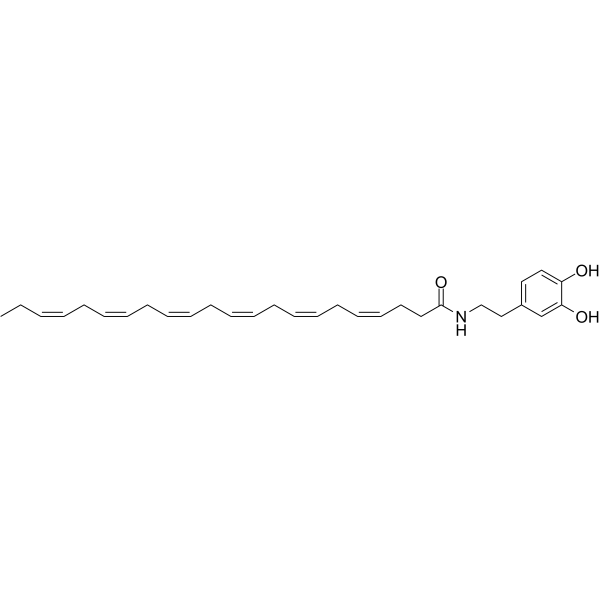
NMI 8739 is a dopamine D2 autoreceptor agonist, which is an amine conjugate of the DHA carrier and the neurotransmitter dopamine.
For research use only. We do not sell to patients.
- Purity : 99.91%
- CAS No.: 129024-87-9
- Formula: C30H41NO3
- Molecular Weight:463.65
-
Storage:
-20°C, protect from light
* In solvent : -80°C, 6 months; -20°C, 1 month (protect from light)

To place orders, for customer services and technical support, please contact: MedChemExpress USA
Tel: 609-228-6898 E-mail: [email protected] [email protected]


-
 Biological Activity
-
Chemical Information
-
Solvent & Solubility
- Purity & Documentation
- References
-
 Help & FAQs



All Dopamine Receptor Isoforms
More

Biological Activity
Description
Cellular Effect
|
Cell Line

|
Type | Value | Description | References |
|---|---|---|---|---|
| RBL-2H3 | IC50 |
>50 μM
Compound: 39
|
Antiallergic activity in rat RBL2H3 cells assessed as inhibition of DNP-HSA-mediated degranulation by measuring decrease in beta-hexosaminidase activity preincubated for 30 mins followed by DNP-HSA stimulation and measured after 30 mins by 4-nitrophenyl 2
Antiallergic activity in rat RBL2H3 cells assessed as inhibition of DNP-HSA-mediated degranulation by measuring decrease in beta-hexosaminidase activity preincubated for 30 mins followed by DNP-HSA stimulation and measured after 30 mins by 4-nitrophenyl 2
|
[PMID: 31618024] |
In Vitro
NMI 8739 is a dopamine D2 autoreceptor agonist[1], which is an amine conjugate of the DHA carrier and the neurotransmitter dopamine[2]. NMI 8739 reduces nitric oxide (NO) production in LPS-stimulated RAW264.7 Macrophages. NMI 8739 elicits concentration-dependent suppression of CCL-20, MCP-1 and IL-6 Release in RAW264.7 macrophages after LPS-stimulation. Production of PGE2 is concentration-dependently suppressed with a reduction of 25.3% at 100 nM NMI 8739 and a 75% reduction for 1 μM NMI 8739. 2 μM NMI 8739 significantly inhibits IL-6 and CCL-20 release up to 49% and 37%, respectively[3].
MedChemExpress (MCE) has not independently confirmed the accuracy of these methods. They are for reference only.


Chemical Information
-
CAS No. 129024-87-9
-
Appearance Oil
-
Molecular Weight 463.65
-
Formula C30H41NO3
-
Color Light yellow to yellow
-
SMILES
CC/C=C\C/C=C\C/C=C\C/C=C\C/C=C\C/C=C\CCC(NCCC1=CC=C(O)C(O)=C1)=O
-
Shipping
Room temperature in continental US; may vary elsewhere.
-
Storage
-20°C, protect from light
* In solvent : -80°C, 6 months; -20°C, 1 month (protect from light)


Solvent & Solubility
In Vitro:
Ethanol : 100 mg/mL (215.68 mM; Need ultrasonic)
DMSO : 65 mg/mL (140.19 mM; Need ultrasonic; Hygroscopic DMSO has a significant impact on the solubility of product, please use newly opened DMSO)
Please refer to the solubility information to select the appropriate solvent. Once prepared, please aliquot and store the solution to prevent product inactivation from repeated freeze-thaw cycles.
Storage method and period of stock solution: -80°C, 6 months; -20°C, 1 month (protect from light). When stored at -80°C, please use it within 6 months. When stored at -20°C, please use it within 1 month.
Please refer to the solubility information to select the appropriate solvent. Once prepared, please aliquot and store the solution to prevent product inactivation from repeated freeze-thaw cycles.
Storage method and period of stock solution: -80°C, 6 months; -20°C, 1 month (protect from light). When stored at -80°C, please use it within 6 months. When stored at -20°C, please use it within 1 month.
Concentration (start) × Volume (start) = Concentration (final) × Volume (final)
In Vivo:
Select the appropriate dissolution method based on your experimental animal and administration route.
- For the following dissolution methods, please ensure to first prepare a clear stock solution using an In Vitro approach and then sequentially add co-solvents:
- To ensure reliable experimental results, the clarified stock solution can be appropriately stored based on storage conditions. As for the working solution for In Vivo experiments, it is recommended to prepare freshly and use it on the same day.
- The percentages shown for the solvents indicate their volumetric ratio in the final prepared solution. If precipitation or phase separation occurs during preparation, heat and/or sonication can be used to aid dissolution.
Add each solvent one by one: 10% DMSO 40% PEG300 5% Tween-80 45% Saline
Solubility: ≥ 2.5 mg/mL (5.39 mM); Clear solution
This protocol yields a clear solution of ≥ 2.5 mg/mL (saturation unknown).
Taking 1 mL working solution as an example, add 100 μL DMSO stock solution (25.0 mg/mL) to 400 μL PEG300, and mix evenly; then add 50 μL Tween-80 and mix evenly; then add 450 μL Saline to adjust the volume to 1 mL.
Preparation of Saline: Dissolve 0.9 g sodium chloride in ddH₂O and dilute to 100 mL to obtain a clear Saline solution.
In Vivo Dissolution Calculator
Please enter the basic information of animal experiments:
-
-
-
-
Recommended: Prepare an additional quantity of animals to account for potential losses during experiments.
Please enter your animal formula composition:
-
%DMSO +
Recommended: Keep the proportion of DMSO in working solution below 2% if your animal is weak.
-
%+
-
+%Tween-80 + +
-
%Saline +
The co-solvents required include: DMSO, . All of co-solvents are available by MedChemExpress (MCE). , Tween 80. All of co-solvents are available by MedChemExpress (MCE).
Working solution concentration: 0.22 mg/mL
Method for preparing stock solution: mg drug dissolved in μL DMSO. Stock solution concentration: mg/mL. * In solvent : -80°C, 6 months; -20°C, 1 month (protect from light)
1. Take μL DMSO stock solution;
2. Add μL .
μL , mix evenly;
3. Then add μL Tween 80, mix evenly;
4. Then add μL
Please ensure that the stock solution in the first step is dissolved to a clear state, and add co-solvents in sequence. You can use ultrasonic heating (ultrasonic cleaner, recommended frequency 20-40 kHz), vortexing, etc. to assist dissolution.


Purity & Documentation
-
Data Sheet (267 KB)
-
SDS (393 KB)
- English - EN (393 KB)
- Français - FR (393 KB)
- Deutsch - DE (393 KB)
- Norwegian - NO (393 KB)
- Español - ES (393 KB)
- Swedish - SV (393 KB)
- Italian - IT (393 KB)
- Korean - KR (393 KB)
- Portuguese - PT (393 KB)
-
Handling Instructions (2659 KB)
References
[2]. Shashoua VE, et al. N-docosahexaenoyl, 3 hydroxytyramine: a dopaminergic compound that penetrates the blood-brain barrier and suppresses appetite. Life Sci. 1996;58(16):1347-57. [Content Brief]
[3]. Wang Y, et al. N-Docosahexaenoyl Dopamine, an Endocannabinoid-like Conjugate of Dopamine and the n-3 Fatty Acid Docosahexaenoic Acid, Attenuates Lipopolysaccharide-Induced Activation of Microglia and Macrophages via COX-2. ACS Chem Neurosci. 2017 Mar 15;8 [Content Brief]


Complete Stock Solution Preparation Table
Please refer to the solubility information to select the appropriate solvent. Once prepared, please aliquot and store the solution to prevent product inactivation from repeated freeze-thaw cycles.
Storage method and period of stock solution: -80°C, 6 months; -20°C, 1 month (protect from light). When stored at -80°C, please use it within 6 months. When stored at -20°C, please use it within 1 month.
| Optional Solvent | Concentration Solvent Mass | 1 mg | 5 mg | 10 mg | 25 mg |
|---|---|---|---|---|---|
| DMSO / Ethanol | 1 mM | 2.1568 mL | 10.7840 mL | 21.5680 mL | 53.9200 mL |
| 5 mM | 0.4314 mL | 2.1568 mL | 4.3136 mL | 10.7840 mL | |
| 10 mM | 0.2157 mL | 1.0784 mL | 2.1568 mL | 5.3920 mL | |
| 15 mM | 0.1438 mL | 0.7189 mL | 1.4379 mL | 3.5947 mL | |
| 20 mM | 0.1078 mL | 0.5392 mL | 1.0784 mL | 2.6960 mL | |
| 25 mM | 0.0863 mL | 0.4314 mL | 0.8627 mL | 2.1568 mL | |
| 30 mM | 0.0719 mL | 0.3595 mL | 0.7189 mL | 1.7973 mL | |
| 40 mM | 0.0539 mL | 0.2696 mL | 0.5392 mL | 1.3480 mL | |
| 50 mM | 0.0431 mL | 0.2157 mL | 0.4314 mL | 1.0784 mL | |
| 60 mM | 0.0359 mL | 0.1797 mL | 0.3595 mL | 0.8987 mL | |
| 80 mM | 0.0270 mL | 0.1348 mL | 0.2696 mL | 0.6740 mL | |
| 100 mM | 0.0216 mL | 0.1078 mL | 0.2157 mL | 0.5392 mL |


NMI 8739 Related Classifications
HY-101540 Related Classifications
 Powered by Bioz