



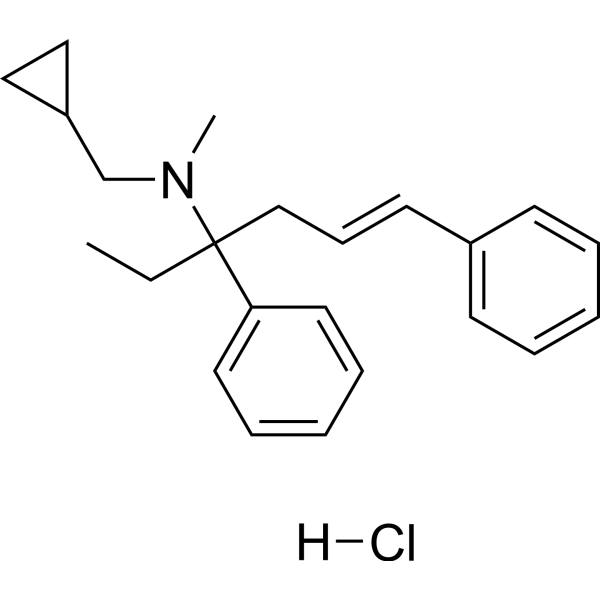
(R)-Igmesine hydrochloride

Based on 1 Customer Validation
(+)-Igmesine hydrochloride (JO1784) is an orally active and selective σ1 receptor ligand with an IC50 of 39 nM. (+)-Igmesine hydrochloride binds σ1 receptors to activate G-proteins and modulate Ca2+ uptake. (+)-Igmesine (hydrochloride) attenuates ischaemia-induced nitric oxide synthase activity and hyperactivity. (+)-Igmesine hydrochloride can be used for the research of duodenal ulcers, gastric ulcers, and cerebral ischaemia.
For research use only. We do not sell to patients.
- Purity : 99.0%
- Formula: C23H30ClN
- Molecular Weight:355.94
-
Storage:
-20°C, protect from light, stored under nitrogen
* In solvent : -80°C, 6 months; -20°C, 1 month (protect from light, stored under nitrogen)

To place orders, for customer services and technical support, please contact: MedChemExpress USA
Tel: 609-228-6898 E-mail: [email protected] [email protected]


-
 Biological Activity
-
Chemical Information
-
Solvent & Solubility
- Purity & Documentation
- References
-
 Help & FAQs


All Sigma Receptor Isoforms
More

Biological Activity
Description
IC50 & Target
[1]|
σ1 39 nM (IC50) |
In Vitro
(+)-Igmesine (1 nM-10 μM; 52 h) hydrochloride potently suppresses Phytohemagglutinin-P (HY-N7038A)-, Concanavalin A (HY-P2149)-, and pokeweed mitogen-stimulated proliferation of rat lymphocytes with reductions in tritiated thymidine uptake[4].
(+)-Igmesine (1 nM-10 μM; 40 min-52 h) hydrochloride exhibits dose-dependent suppression of rat neutrophil phagocytosis and mitogen-stimulated rat lymphocyte proliferation[4].
MedChemExpress (MCE) has not independently confirmed the accuracy of these methods. They are for reference only.
-
Cell Line:rat lymphocytes
-
Concentration:1 nM; 100 nM; 10 μM
-
Incubation Time:52 h
-
Result:Potently suppressed Phytohemagglutinin-P -, Concanavalin A-, and pokeweed mitogen-stimulated proliferation of rat lymphocytes with reductions in tritiated thymidine uptake.
In Vivo
(+)-Igmesine (p.o.; single dose) hydrochloride weakly protects rats from multiple models of gastric mucosal damage, with ED50 values ranging from 25.2 to 55.4 mg/kg p.o[1].
(+)-Igmesine (1-30 mg/kg; i.d.; single dose) hydrochloride does not exhibit gastric antisecretory activity in pylorus-ligated rats[1].
(+)-Igmesine (0.25-2 mg/kg; i.v.; single bolus) hydrochloride dose-dependently stimulates duodenal bicarbonate secretion in anesthetized rat[1].
(+)-Igmesine (25-100 mg/kg; p.o.; at 1, 24, and 48 hours post-surgery) hydrochloride provides statistically significant neuroprotection against ischaemia-induced hippocampal CA1 neuronal death in gerbils[2].
(+)-Igmesine (100 mg/kg; i.p.; at 30 minutes, 6, 24, and 48 hours post-surgery) hydrochloride significantly attenuates ischaemia-induced hyperactivity and increases in NO synthase activity in the hippocampus and brain stem of gerbils[2].
MedChemExpress (MCE) has not independently confirmed the accuracy of these methods. They are for reference only.
-
Animal Model:Sprague-Dawley (male, 180-220 g, cysteamine-induced duodenal ulcer)[1]
-
Dosage:1 mg/kg; 3 mg/kg; 10 mg/kg
-
Administration:p.o.; single dose
-
Result:Induced a dose-related decrease in ulcer index, with an ED50 of 4.14 mg/kg p.o.
Reduced the mean ulcer index from 33.2 mm2 to 9.7 mm2, a 71% reduction, at 10 mg/kg p.o.
Lost protective effect when pre-treated with haloperidol (1 or 3 mg/kg s.c.), BMY 14,802 (10 mg/kg p.o.), or devazepide (30 mg/kg p.o.).
-
Animal Model:Sprague-Dawley (male, 250-400 g, pylorus-ligated Shay rat preparation)[1]
-
Dosage:1 mg/kg; 3 mg/kg; 10 mg/kg; 30 mg/kg
-
Administration:i.d.; single dose
-
Result:Did not significantly modify free or total gastric acid concentration or output at any tested dose compared to control rats.
-
Animal Model:Sprague-Dawley (male, 250-400 g, anesthetized in situ duodenal perfusion model)[1]
-
Dosage:0.25 mg/kg; 0.5 mg/kg; 1 mg/kg; 2 mg/kg
-
Administration:i.v.; single bolus
-
Result:Induced a dose-related increase in duodenal bicarbonate output, with a threshold dose of 0.25 mg/kg i.v. and maximal response at 1 mg/kg i.v.
Increased bicarbonate output from a basal 7.60 μEq·cm-1·h-1 to a plateau of 14.8 μEq·cm-1·h-1 (P < 0.001) that lasted 2 hours at 1 mg/kg i.v.
Did not further increase secretion when dose was doubled to 2 mg/kg i.v.
Lost stimulatory effect when pre-treated with haloperidol (0.50 mg/kg i.v.), BMY 14,802 (5 mg/kg i.v.), hexamethonium (1 mg/kg i.v.), tetrodotoxin (5 μg/kg i.v.), devazepide (0.50 mg/kg i.v.), or bilateral truncal vagotomy.
Showed no significant change in stimulatory effect with atropine (0.25 mg/kg i.v.), SCH 23,390 (0.50 mg/kg i.v.), sulpiride (1 mg/kg i.v.), prazosin (0.50 mg/kg i.v.), yohimbine (2 mg/kg i.v.), naloxone (0.20 mg/kg i.v.), indomethacin (0.25 mg/kg i.v.), or intracerebroventricular devazepide (17 μg/rat).
-
Animal Model:Male Mongolian gerbils (at least 3 months old, weighing >60 g, 5-minute bilateral carotid occlusion surgery)[2]
-
Dosage:25 mg/kg; 50 mg/kg; 75 mg/kg; 100 mg/kg
-
Administration:p.o.; at 1, 24, and 48 hours post-surgery
-
Result:Provided partial neuroprotection against ischaemia-induced CA1 neuronal death at 25 mg/kg.
Provided significant neuroprotection against ischaemia-induced CA1 neuronal death (P < 0.03) at 50 mg/kg.
Provided significant neuroprotection against ischaemia-induced CA1 neuronal death (P < 0.01) at 75 mg/kg.
Provided significant neuroprotection against ischaemia-induced CA1 neuronal death (P < 0.005) at 100 mg/kg.
-
Animal Model:Male Mongolian gerbils (at least 3 months old, weighing >60 g, 5-minute bilateral carotid occlusion surgery)[2]
-
Dosage:100 mg/kg
-
Administration:i.p.; at 30 minutes, 6, 24, and 48 hours post-surgery
-
Result:Attenuated ischaemia-induced hyperactivity (statistically significant at P < 0.0018 to 0.02) observed between 2-7 hours post-occlusion.
Attenuated ischaemia-induced increases in NO synthase activity across multiple brain regions, with statistically significant attenuation in the hippocampus (P < 0.03) and brain stem (P < 0.05).


Chemical Information
-
Appearance Solid
-
Molecular Weight 355.94
-
Formula C23H30ClN
-
Color White to off-white
-
SMILES
[H]Cl.CN(CC1CC1)[C@@](C/C=C/C2=CC=CC=C2)(CC)C3=CC=CC=C3
-
Synonyms
(R)-JO 1784 hydrochloride
-
Shipping
Room temperature in continental US; may vary elsewhere.
-
Storage
-20°C, protect from light, stored under nitrogen
* In solvent : -80°C, 6 months; -20°C, 1 month (protect from light, stored under nitrogen)


Solvent & Solubility
In Vitro:
DMSO : 17.79 mg/mL (49.98 mM; Need ultrasonic and warming; Hygroscopic DMSO has a significant impact on the solubility of product, please use newly opened DMSO)
Please refer to the solubility information to select the appropriate solvent. Once prepared, please aliquot and store the solution to prevent product inactivation from repeated freeze-thaw cycles.
Storage method and period of stock solution: -80°C, 6 months; -20°C, 1 month (protect from light, stored under nitrogen). When stored at -80°C, please use it within 6 months. When stored at -20°C, please use it within 1 month.
Please refer to the solubility information to select the appropriate solvent. Once prepared, please aliquot and store the solution to prevent product inactivation from repeated freeze-thaw cycles.
Storage method and period of stock solution: -80°C, 6 months; -20°C, 1 month (protect from light, stored under nitrogen). When stored at -80°C, please use it within 6 months. When stored at -20°C, please use it within 1 month.
Concentration (start) × Volume (start) = Concentration (final) × Volume (final)


Purity & Documentation
-
Data Sheet (285 KB)
-
SDS (252 KB)
- English - EN (252 KB)
- Français - FR (252 KB)
- Deutsch - DE (252 KB)
- Norwegian - NO (252 KB)
- Español - ES (252 KB)
- Swedish - SV (252 KB)
- Italian - IT (252 KB)
- Korean - KR (252 KB)
- Portuguese - PT (252 KB)
-
Handling Instructions (2659 KB)
References
[1]. Pascaud XB, et al. Effects of a new sigma ligand, JO 1784, on cysteamine ulcers and duodenal alkaline secretion in rats. Gastroenterology. 1993;104(2):427-434. [Content Brief]
[2]. O'Neill M, et al. The sigma receptor ligand JO 1784 (igmesine hydrochloride) is neuroprotective in the gerbil model of global cerebral ischaemia. Eur J Pharmacol. 1995;283(1-3):217-225. [Content Brief]
[3]. Yoneda M, et al. Central action of sigma receptor ligand, JO 1784, to suppress CRF-induced inhibition of gastric function in conscious rats. Eur J Pharmacol. 1992;223(2-3):197-199. [Content Brief]
[4]. Song C, et al. Comparison between the effects of sigma receptor ligand JO 1784 and neuropeptide Y on immune functions. Eur J Pharmacol. 1998;345(1):79-87. [Content Brief]


Complete Stock Solution Preparation Table
Please refer to the solubility information to select the appropriate solvent. Once prepared, please aliquot and store the solution to prevent product inactivation from repeated freeze-thaw cycles.
Storage method and period of stock solution: -80°C, 6 months; -20°C, 1 month (protect from light, stored under nitrogen). When stored at -80°C, please use it within 6 months. When stored at -20°C, please use it within 1 month.
| Optional Solvent | Concentration Solvent Mass | 1 mg | 5 mg | 10 mg | 25 mg |
|---|---|---|---|---|---|
| DMSO | 1 mM | 2.8095 mL | 14.0473 mL | 28.0946 mL | 70.2366 mL |
| 5 mM | 0.5619 mL | 2.8095 mL | 5.6189 mL | 14.0473 mL | |
| 10 mM | 0.2809 mL | 1.4047 mL | 2.8095 mL | 7.0237 mL | |
| 15 mM | 0.1873 mL | 0.9365 mL | 1.8730 mL | 4.6824 mL | |
| 20 mM | 0.1405 mL | 0.7024 mL | 1.4047 mL | 3.5118 mL | |
| 25 mM | 0.1124 mL | 0.5619 mL | 1.1238 mL | 2.8095 mL | |
| 30 mM | 0.0936 mL | 0.4682 mL | 0.9365 mL | 2.3412 mL | |
| 40 mM | 0.0702 mL | 0.3512 mL | 0.7024 mL | 1.7559 mL |


(R)-Igmesine hydrochloride Related Classifications
HY-108515 Related Classifications
 Powered by Bioz