



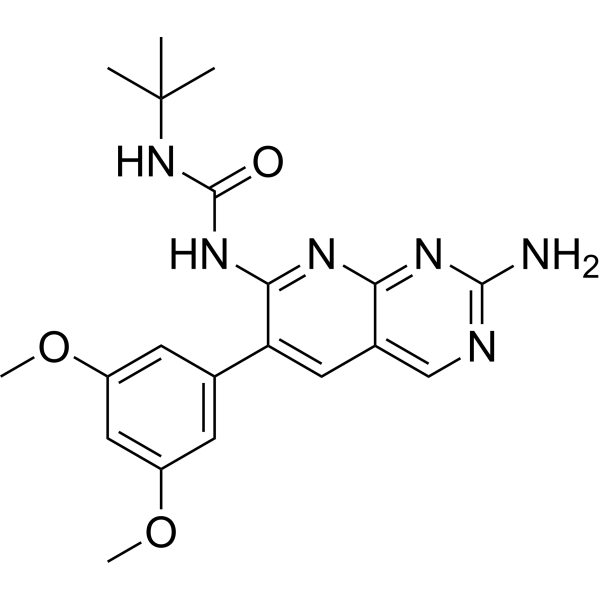
PD-166866
Based on 11 publication(s) in Google Scholar
PD166866 is a selective FGFR1 tyrosine kinase inhibitor with an IC50 of 52.4 nM.
For research use only. We do not sell to patients.
- Purity: 99.85%
- CAS No.: 192705-79-6
- Formula: C20H24N6O3
- Molecular Weight:396.44
-
Storage:Powder -20°C, 3 years , 4°C, 2 years ; In solvent -80°C, 2 years , -20°C, 1 year

To place orders, for customer services and technical support, please contact: MedChemExpress USA
Tel: 609-228-6898 E-mail: [email protected] [email protected]


-
 Biological Activity
-
Chemical Information
-
Solvent & Solubility
- Protocol
- Purity & Documentation
- References
-
 Help & FAQs
-


Reprogramming Compound Library
HY-L039
-
Anti-Lung Cancer Compound Library
HY-L075
-
Angiogenesis-Related Compound Library
HY-L088
-
Anti-Liver Cancer Compound Library
HY-L101
-
Human Metabolite Library
HY-L123
-
Anti-Prostate Cancer Compound Library
HY-L124
-
Heterocyclic Compound Library
HY-L138
-
Membrane Protein-targeted Compound Library
HY-L149
-
Membrane Receptor-targeted Compound Library
HY-L150
-
Highly Selective Inhibitors Library
HY-L158
-
Highly Selective Activators Library
HY-L159
-
Cytokine Inhibitors Library
HY-L161
-
Cell Death Library
HY-L162
-
Bioactive Compound Library Max
HY-L181
-
MCE Bioactive Compound Library
HY-L001V
-
Drug Repurposing Compound Library Plus
HY-L035P
-
Clinical Compound Library Plus
HY-L026P
-
Bioactive Compound Library
HY-L001
-
Anti-Fibrosis Compound Library
HY-L185
-
Anti-Brain Cancer Compound Library
HY-L188
-
Protein Kinase Compound Library
HY-L196
-
Cell Proliferation Compound Library
HY-L201
-
High-Throughput Bioactive Compound Library
HY-L205
-
Mass Spectrometry Human Metabolite Library
HY-L215
-
Anti-Infection Compound Library
HY-L002
-
Kinase Inhibitor Library
HY-L009
-
Protein Tyrosine Kinase Compound Library
HY-L016
-
Clinical Compound Library
HY-L026
-
Autophagy Compound Library
HY-L029
-
Drug Repurposing Compound Library
HY-L035


Publications Citing Use of MedChemExpress (MCE) PD-166866
More- Nat Commun. 2020 Jun 22;11(1):3162. [Abstract]
- Cell Death Dis. 2022 Aug 19;13(8):724. [Abstract]
- Cell Death Dis. 2022 Mar 28;13(3):275. [Abstract]
- Cell Death Dis. 2022 Feb 4;13(2):113. [Abstract]
- Phytomedicine. 2025 Nov 25:148:157421. [Abstract]
- Acta Pharmacol Sin. 2023 Nov;44(11):2282-2295. [Abstract]
- Cell Rep. 2024 Dec 30;44(1):115116. [Abstract]
- Exp Neurol. 2025 Oct:392:115357. [Abstract]
- bioRxiv. 2025 February 01.
- Research Square Print. 2023 Jan 4.
- Biochemistry for Health, NOVA University of Lisbon. 2019 Jul.


Biological Activity
|
FGFR1 52.4 nM (IC50) |
|
Cell Line

|
Type | Value | Description | References |
|---|---|---|---|---|
| C6 | IC50 |
>25 μM
Compound: 5
|
Inhibition of PDGF-dependent rat glioma C6 cell proliferation
Inhibition of PDGF-dependent rat glioma C6 cell proliferation
|
[PMID: 11063616] |
| HUVEC | IC50 |
0.1 μM
Compound: 5
|
Inhibition of microcapillary growth in HUVEC cells
Inhibition of microcapillary growth in HUVEC cells
|
[PMID: 11063616] |
| HUVEC | IC50 |
0.58 μM
Compound: 5
|
Inhibition of in vitro cell Human umbilical vein endothelial (HUVEC) cell proliferation
Inhibition of in vitro cell Human umbilical vein endothelial (HUVEC) cell proliferation
|
[PMID: 11063616] |
| HUVEC | IC50 |
1.1 μM
Compound: 5
|
Inhibition of Matrigel invasion assay in HUVEC cells
Inhibition of Matrigel invasion assay in HUVEC cells
|
[PMID: 11063616] |
| Ovarian cancer cell line | IC50 |
15 μM
Compound: 5
|
Inhibition of human ovarian carcinoma (A90) FGF-R overexpressing cell proliferation
Inhibition of human ovarian carcinoma (A90) FGF-R overexpressing cell proliferation
|
[PMID: 11063616] |
PD 166866 inhibits human full-length FGFR-1 tyrosine kinase with an IC50 value of 52.4 nM and is characterized as an ATP competitive inhibitor of the FGFR-1. PD 166866 is a potent inhibitor of FGFR autophosphorylation in NIH 3T3 cells expressing endogenous FGFR-1 and in L6 cells overexpressing the human FGFR-1 tyrosine kinase. PD 166866 also inhibits bFGF-induced tyrosine phosphorylation of the 44- and 42-kDa (ERK 1/2) mitogen-activated protein kinase isoforms in L6 cells. Daily exposure of PD 166866 to L6 cells at concentrations from 1 to 100 nM results in a concentration-related inhibition of bFGF-stimulated cell growth for 8 consecutive days with an IC50 value of 24 nM[1].
MedChemExpress (MCE) has not independently confirmed the accuracy of these methods. They are for reference only.


Chemical Information
-
CAS No. 192705-79-6
-
Appearance Solid
-
Molecular Weight 396.44
-
Formula C20H24N6O3
-
Color White to off-white
-
SMILES
O=C(NC(C)(C)C)NC1=NC2=NC(N)=NC=C2C=C1C3=CC(OC)=CC(OC)=C3
-
Shipping
Room temperature in continental US; may vary elsewhere.
-
Storage
Powder -20°C 3 years 4°C 2 years In solvent -80°C 2 years -20°C 1 year


Publications (11)
-
Journal Impact Factor
-
Most Recent
-
Nat Commun
Interactome analysis reveals that lncRNA HULC promotes aerobic glycolysis through LDHA and PKM2. [Abstract]2020 Jun 22;11(1):3162. PMID: 32572027 -
Cell Death Dis
Lenvatinib for effectively treating antiangiogenic drug-resistant nasopharyngeal carcinoma. [Abstract]2022 Aug 19;13(8):724. PMID: 35985991 -
Cell Death Dis
Hepatic deficiency of selenoprotein S exacerbates hepatic steatosis and insulin resistance. [Abstract]2022 Mar 28;13(3):275. PMID: 35347118 -
Cell Death Dis
Tumour cell apoptosis modulates the colorectal cancer immune microenvironment via interleukin-8-dependent neutrophil recruitment. [Abstract]2022 Feb 4;13(2):113. PMID: 35121727 -
Phytomedicine
Membrane cholesterol-dependent dual VEGFR2/FGFR1 inhibition by ginsenoside Rg3 to overcome gefitinib resistance in NSCLC. [Abstract]2025 Nov 25:148:157421. PMID: 41192258 -
Acta Pharmacol Sin
ATF4 renders human T-cell acute lymphoblastic leukemia cell resistance to FGFR1 inhibitors through amino acid metabolic reprogramming. [Abstract]2023 Nov;44(11):2282-2295. PMID: 37280363 -
Cell Rep
IMPDH2 dephosphorylation under FGFR signaling promotes S-phase progression and tumor growth. [Abstract]2024 Dec 30;44(1):115116. PMID: 39739531 -
Exp Neurol
FGFR1 agonists alleviate pathology and cognitive impairment in an Alzheimer's disease mouse model. [Abstract]2025 Oct:392:115357. PMID: 40562341 -
-
-


Solvent & Solubility
DMSO : 3.33 mg/mL (8.40 mM; ultrasonic and warming and heat to 60°C; Hygroscopic DMSO has a significant impact on the solubility of product, please use newly opened DMSO)
Please refer to the solubility information to select the appropriate solvent. Once prepared, please aliquot and store the solution to prevent product inactivation from repeated freeze-thaw cycles.
Storage method and period of stock solution: -80°C, 2 years; -20°C, 1 year. When stored at -80°C, please use it within 2 years. When stored at -20°C, please use it within 1 year.
Please refer to the solubility information to select the appropriate solvent. Once prepared, please aliquot and store the solution to prevent product inactivation from repeated freeze-thaw cycles.
Storage method and period of stock solution: -80°C, 2 years; -20°C, 1 year. When stored at -80°C, please use it within 2 years. When stored at -20°C, please use it within 1 year.
Concentration (start) × Volume (start) = Concentration (final) × Volume (final)
Select the appropriate dissolution method based on your experimental animal and administration route.
- For the following dissolution methods, please ensure to first prepare a clear stock solution using an In Vitro approach and then sequentially add co-solvents:
- To ensure reliable experimental results, the clarified stock solution can be appropriately stored based on storage conditions. As for the working solution for In Vivo experiments, it is recommended to prepare freshly and use it on the same day.
- The percentages shown for the solvents indicate their volumetric ratio in the final prepared solution. If precipitation or phase separation occurs during preparation, heat and/or sonication can be used to aid dissolution.
Add each solvent one by one: 10% DMSO 90% (20% SBE-β-CD in Saline)
Solubility: ≥ 1 mg/mL (2.52 mM); Clear solution
This protocol yields a clear solution of ≥ 1 mg/mL (saturation unknown).
Taking 1 mL working solution as an example, add 100 μL DMSO stock solution (10.0 mg/mL) to 900 μL 20% SBE-β-CD in Saline, and mix evenly.
Preparation of 20% SBE-β-CD in Saline (4°C, storage for one week): 2 g SBE-β-CD powder is dissolved in 10 mL Saline, completely dissolve until clear.
For the following dissolution methods, please prepare the working solution directly:
It is recommended to prepare fresh solutions and use them promptly within a short period of time.
The percentages shown for the solvents indicate their volumetric ratio in the final prepared solution. If precipitation or phase separation occurs during preparation, heat and/or sonication can be used to aid dissolution.
Add each solvent one by one: 0.5% CMC-Na/saline water
Solubility: 3.33 mg/mL (8.40 mM); Suspended solution; Need ultrasonic and warming and heat to 40°C
Please enter the basic information of animal experiments:
-
-
-
-
Recommended: Prepare an additional quantity of animals to account for potential losses during experiments.
Please enter your animal formula composition:
-
%DMSO +
Recommended: Keep the proportion of DMSO in working solution below 2% if your animal is weak.
-
%+
-
+%Tween-80 + +
-
%Saline +
The co-solvents required include: DMSO, . All of co-solvents are available by MedChemExpress (MCE). , Tween 80. All of co-solvents are available by MedChemExpress (MCE).
Working solution concentration: 0.22 mg/mL
Method for preparing stock solution: mg drug dissolved in μL DMSO. Stock solution concentration: mg/mL.
1. Take μL DMSO stock solution;
2. Add μL .
μL , mix evenly;
3. Then add μL Tween 80, mix evenly;
4. Then add μL
Please ensure that the stock solution in the first step is dissolved to a clear state, and add co-solvents in sequence. You can use ultrasonic heating (ultrasonic cleaner, recommended frequency 20-40 kHz), vortexing, etc. to assist dissolution.

Protocol
PD 166866 is dissolved in DMSO. PD 166866 or vehicle (0.5% DMSO, final concentration) are added every day to triplicate cultures of cells together with 25 ng/mL bFGF to stimulate FGF-driven growth. In some experiments, PD 166866 is added every day to triplicate cultures of cells together with 30 ng/mL PDGF-BB to stimulate PDGF-driven growth. Cell number is measured by Coulter counting on days 1, 3, 6 or 8 after drug exposure[1]
MedChemExpress (MCE) has not independently confirmed the accuracy of these methods. They are for reference only.


Purity & Documentation
-
Data Sheet (277 KB)
-
SDS (396 KB)
- English - EN (396 KB)
- Français - FR (396 KB)
- Deutsch - DE (396 KB)
- Norwegian - NO (396 KB)
- Español - ES (396 KB)
- Swedish - SV (396 KB)
- Italian - IT (396 KB)
- Korean - KR (396 KB)
- Portuguese - PT (396 KB)
-
Handling Instructions (2659 KB)
References
[1]. Panek RL, et al. In vitro biological characterization and antiangiogenic effects of PD 166866, a selective inhibitor of the FGF-1 receptor tyrosine kinase. J Pharmacol Exp Ther. 1998 Jul;286(1):569-77. [Content Brief]
[2]. Thompson AM, Connolly CJ, Hamby JM, et al. 3-(3,5-Dimethoxyphenyl)-1,6-naphthyridine-2,7-diamines and related 2-urea derivatives are potent and selective inhibitors of the FGF receptor-1 tyrosine kinase. J Med Chem. 2000;43(22):4200-4211. [Content Brief]


Complete Stock Solution Preparation Table
Please refer to the solubility information to select the appropriate solvent. Once prepared, please aliquot and store the solution to prevent product inactivation from repeated freeze-thaw cycles.
Storage method and period of stock solution: -80°C, 2 years; -20°C, 1 year. When stored at -80°C, please use it within 2 years. When stored at -20°C, please use it within 1 year.
| Optional Solvent | Concentration Solvent Mass | 1 mg | 5 mg | 10 mg | 25 mg |
|---|---|---|---|---|---|
| DMSO | 1 mM | 2.5224 mL | 12.6122 mL | 25.2245 mL | 63.0612 mL |
| 5 mM | 0.5045 mL | 2.5224 mL | 5.0449 mL | 12.6122 mL |


PD-166866 Related Classifications
HY-101296 Related Classifications
 Powered by Bioz