



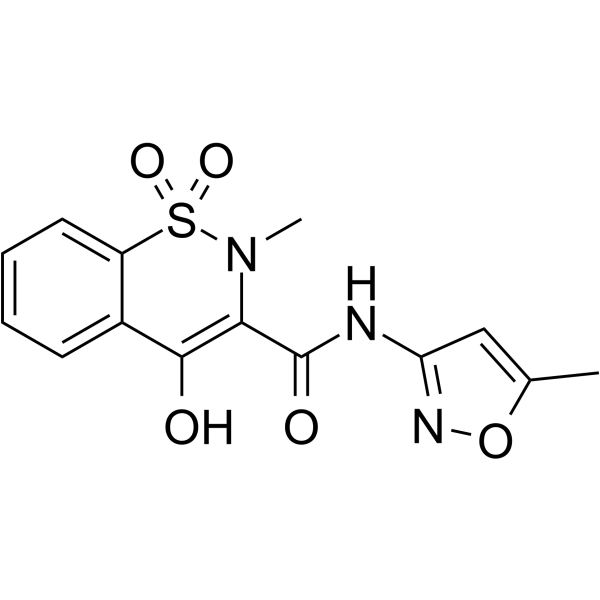
Isoxicam

Based on 1 Customer Validation
Isoxicam is an orally active nonsteroidal anti-inflammatory compound and a COX-1/COX-2 inhibitor. Isoxicam exhibits potent anti-inflammatory activity in rat models of inflammation and significantly lower ulcerogenic risk. Isoxicam can be used for the study of inflammatory diseases and rheumatic disorders.
Nos produits utilisent uniquement pour la recherche. Nous ne vendons pas aux patients.
- Pureté : 99.83%
- CAS No.: 34552-84-6
- Formule: C14H13N3O5S
- Masse moléculaire:335.34
-
Stockage:Powder -20°C, 3 years , 4°C, 2 years ; In solvent -80°C, 2 years , -20°C, 1 year

To place orders, for customer services and technical support, please contact: MedChemExpress USA
Tel: 609-228-6898 E-mail: [email protected] [email protected]


-
 Activité biologique
-
Chemical Information
-
Solvant et solubilité
- Protocole
- Pureté et documentation
- Références
-
 Help & FAQs


-
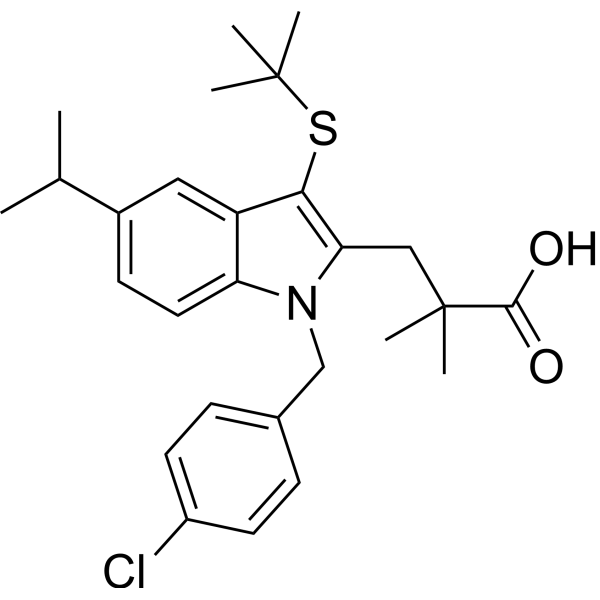
HY-14166
MK-886FLAP Inhibitor -
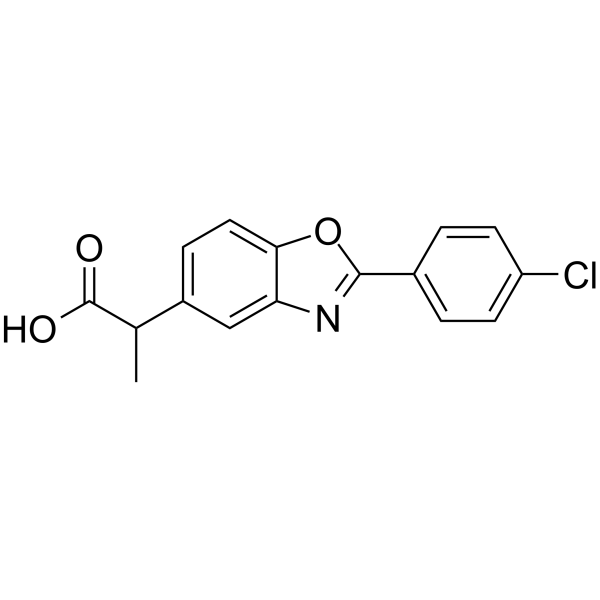
HY-13568
BenoxaprofenNonsteroidal Anti-inflammatory Agent -

HY-B1130R
Isoxicam (Standard)COX Inhibitor -
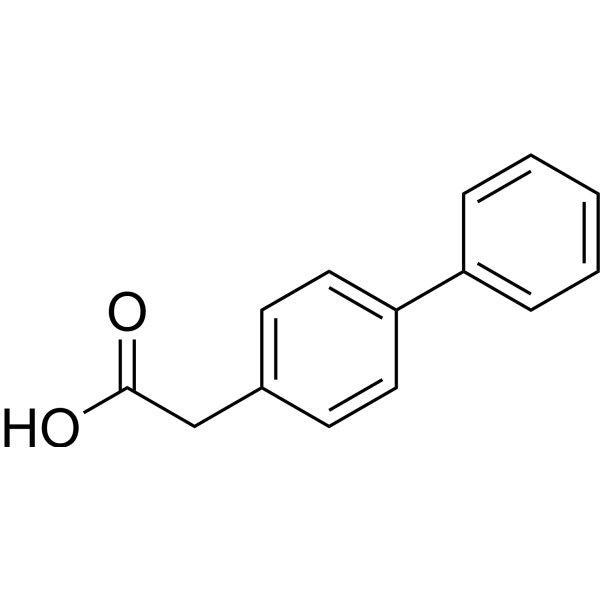
HY-B0641
FelbinacNon-steroidal Anti-Inflammatory Agent -

HY-14166R
MK-886 (Standard)FLAP Inhibitor -

HY-B0641R
Felbinac (Standard)Non-steroidal Anti-Inflammatory Agent -

HY-13568R
Benoxaprofen (Standard)Anti-inflammatory/Antipyretic Compound


Activité biologique
Description
IC50 & Target
[1]|
COX-1 |
COX-2 |
In Vivo
Isoxicam (0.391-50 mg/kg; p.o.; daily, alternate days; days 1-20, days 14-27) exhibits dose-dependent prophylactic and therapeutic anti-arthritic activity in adjuvant-induced polyarthritis in rats, with prolonged activity detectable after treatment cessation[2].
Isoxicam (125-1000 mg/kg; p.o.) has significantly lower gastric and intestinal ulcerogenic potential than comparator anti-inflammatory drugs, with gastric ulcer incidence ED50 252 mg/kg and intestinal ulcer incidence ED50 822 mg/kg, showing no mortality at tested doses[2].
MedChemExpress (MCE) has not independently confirmed the accuracy of these methods. They are for reference only.
-
Animal Model:Charles River (Sprague-Dawley derived) (male, 150 g); Charles River (Sprague-Dawley derived) adrenalectomized (male, 150 g, used 1 week post-operation, maintained on 0.9% saline or hydrocortisone acetate 0.25 mg/animal)[2]
-
Dosage:6.25 mg/kg; 12.5 mg/kg; 25.0 mg/kg; 50.0 mg/kg
-
Administration:p.o.
-
Result:Inhibited carrageenin-induced rat paw edema by 4-45% at 6.25-50.0 mg/kg when dosed 1, 3, 19, or 24 hours before challenge.
Reduced edema by 24% at 25 mg/kg in adrenalectomized rats and by 65% when combined with hydrocortisone acetate.
-
Animal Model:Charles River-Lewis (male, 150 g)[2]
-
Dosage:0.391 mg/kg; 1.56 mg/kg; 3.12 mg/kg; 6.25 mg/kg; 25.0 mg/kg; 50.0 mg/kg
-
Administration:p.o.; daily (days 1-20, days 14-27); alternate days (days 1-20, days 14-27)
-
Result:Improved body weight gain and reduced hind paw weight, thymus atrophy, and adrenal hypertrophy in a dose-dependent manner under daily prophylactic dosing at 1.56, 6.25, and 25.0 mg/kg.
Attenuated hind paw swelling and organ weight abnormalities under alternate-day prophylactic dosing at 1.56, 6.25, and 25.0 mg/kg.
Diminished body weight loss and hind paw edema under daily and alternate-day therapeutic dosing at 1.56, 6.25, and 25.0 mg/kg.
Retained significantly lower hind paw displacement than phenylbutazone at 6.25, 25, and 50 mg/kg on days 28, 35, and 42 after cessation of prophylactic dosing.
Maintained detectable plasma levels 37-42% lower at 48 h than at 24 h after alternate-day dosing at 6.25 and 25.0 mg/kg.
Showed no significant effects at 0.391 mg/kg in the prophylactic regimen.
-
Animal Model:Charles River (Sprague-Dawley derived) (male, 145-200 g, 24-hour fasted, gastric ulcer evaluation)
Charles River (Sprague-Dawley derived) (male, 180 g, intestinal ulcer evaluation)[2] -
Dosage:125 mg/kg; 250 mg/kg; 500 mg/kg; 1000 mg/kg
700 mg/kg; 800 mg/kg; 900 mg/kg; 1000 mg/kg -
Administration:p.o.
-
Result:Induced gastric ulceration with 40% incidence at 125 mg/kg and 100% incidence at 1000 mg/kg, yielding gastric ulcer ED50 of 252 mg/kg and severity EDom of 333 mg/kg.
Produced intestinal ulceration with 17% incidence at 700 mg/kg and 100% incidence at 1000 mg/kg, yielding intestinal ulcer ED50 of 822 mg/kg and severity EDom of 1009 mg/kg.


Chemical Information
-
CAS No. 34552-84-6
-
Appearance Solid
-
Masse moléculaire 335.34
-
Formule C14H13N3O5S
-
Color White to off-white
-
SMILES
O=C(C1=C(O)C2=CC=CC=C2S(N1C)(=O)=O)NC3=NOC(C)=C3
-
Livraison
Room temperature in continental US; may vary elsewhere.
-
Stockage
Powder -20°C 3 years 4°C 2 years In solvent -80°C 2 years -20°C 1 year


Solvant et solubilité
In Vitro:
DMSO : 3.33 mg/mL (9.93 mM; Need ultrasonic; Hygroscopic DMSO has a significant impact on the solubility of product, please use newly opened DMSO)
Please refer to the solubility information to select the appropriate solvent. Once prepared, please aliquot and store the solution to prevent product inactivation from repeated freeze-thaw cycles.
Storage method and period of stock solution: -80°C, 2 years; -20°C, 1 year. When stored at -80°C, please use it within 2 years. When stored at -20°C, please use it within 1 year.
Please refer to the solubility information to select the appropriate solvent. Once prepared, please aliquot and store the solution to prevent product inactivation from repeated freeze-thaw cycles.
Storage method and period of stock solution: -80°C, 2 years; -20°C, 1 year. When stored at -80°C, please use it within 2 years. When stored at -20°C, please use it within 1 year.
Concentration (start) × Volume (start) = Concentration (final) × Volume (final)


Pureté et documentation
-
Fiche technique (280 KB)
-
SDS (393 KB)
- English - EN (393 KB)
- Français - FR (393 KB)
- Deutsch - DE (393 KB)
- Norwegian - NO (393 KB)
- Español - ES (393 KB)
- Swedish - SV (393 KB)
- Italian - IT (393 KB)
- Korean - KR (393 KB)
- Portuguese - PT (393 KB)
-
Instruction de manipulation (2659 KB)
Références


Complete Stock Solution Preparation Table
Please refer to the solubility information to select the appropriate solvent. Once prepared, please aliquot and store the solution to prevent product inactivation from repeated freeze-thaw cycles.
Storage method and period of stock solution: -80°C, 2 years; -20°C, 1 year. When stored at -80°C, please use it within 2 years. When stored at -20°C, please use it within 1 year.
| Optional Solvent | Concentration Solvent Mass | 1 mg | 5 mg | 10 mg | 25 mg |
|---|---|---|---|---|---|
| DMSO | 1 mM | 2.9820 mL | 14.9102 mL | 29.8205 mL | 74.5512 mL |
| 5 mM | 0.5964 mL | 2.9820 mL | 5.9641 mL | 14.9102 mL |


Isoxicam Related Classifications
HY-B1130 Related Classifications
 Powered by Bioz