



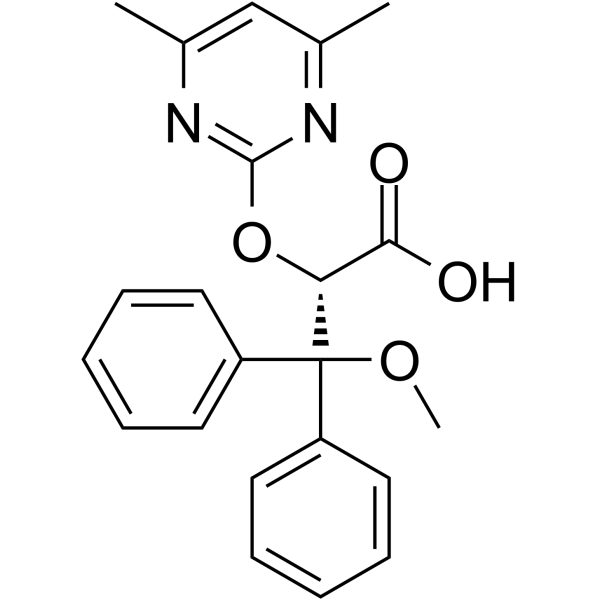
Ambrisentan
Based on 2 publication(s) in Google Scholar
Ambrisentan is a selective ET type A receptor (ETAR) antagonist.
For research use only. We do not sell to patients.
- Purity: 99.95%
- CAS No.: 177036-94-1
- Formula: C22H22N2O4
- Molecular Weight:378.42
-
Storage:Powder -20°C, 3 years , 4°C, 2 years ; In solvent -80°C, 2 years , -20°C, 1 year

To place orders, for customer services and technical support, please contact: MedChemExpress USA
Tel: 609-228-6898 E-mail: [email protected] [email protected]


-
 Biological Activity
-
Chemical Information
-
Solvent & Solubility
- Protocol
- Purity & Documentation
- References
-
 Help & FAQs
-

Anti-diabetic Compound Library
HY-L040
-
Anti-Cardiovascular Disease Compound Library
HY-L046
-
NMPA-Approved Drug Library
HY-L053
-
Orally Active Compound Library
HY-L061
-
Neurotransmitter Receptor Compound Library
HY-L062
-
FDA Approved & Pharmacopeial Drug Library
HY-L066
-
Drug-Induced Liver Injury (DILI) Compound Library
HY-L076
-
Angiogenesis-Related Compound Library
HY-L088
-
Rare Diseases Drug Library
HY-L102
-
EMA-Approved Drug Library
HY-L116
-
Anti-Pulmonary Fibrosis Compound Library
HY-L125
-
Coagulation and Anti-coagulation Compound Library
HY-L136
-
Heterocyclic Compound Library
HY-L138
-
Pain-Related Compound Library
HY-L139
-
Withdrawn Drug Compound Library
HY-L140
-
Off-patent Drug Library
HY-L141
-
Antihypertensive Compound Library
HY-L145
-
Membrane Protein-targeted Compound Library
HY-L149
-
Membrane Receptor-targeted Compound Library
HY-L150
-
Highly Selective Inhibitors Library
HY-L158
-
Bioactive Compound Library Max
HY-L181
-
MCE Bioactive Compound Library
HY-L001V
-
Drug Repurposing Compound Library Plus
HY-L035P
-
FDA-Approved Drug Library Plus
HY-L022P
-
FDA-Approved Drug Library Mini
HY-L022M
-
Bioactive Compound Library
HY-L001
-
High-Throughput Bioactive Compound Library
HY-L205
-
Lactylation Compound Library
HY-L249
-
GPCR/G Protein Compound Library
HY-L006
-
FDA-Approved Drug Library
HY-L022
-
Drug Repurposing Compound Library
HY-L035


Publications Citing Use of MedChemExpress (MCE) Ambrisentan
More Customer Validation & Images

-
RT-PCR

-
WB

-
In Vivo Efficacy Study

-
Histological Imaging/Staining

-
In Vivo Efficacy Study


Biological Activity
|
ETA |
|
Cell Line

|
Type | Value | Description | References |
|---|---|---|---|---|
| CHO | IC50 |
1 nM
Compound: 83
|
Displacement of [125I]-ET-1 from human ETA receptor expressed in CHO cell membranes after 2 hrs by scintillation counting
Displacement of [125I]-ET-1 from human ETA receptor expressed in CHO cell membranes after 2 hrs by scintillation counting
|
[PMID: 27321813] |
| CHO | IC50 |
1190 nM
Compound: rac-2
|
Antagonist activity towards human recombinant Endothelin B receptor expressed in chinese hamster ovary (CHO) cells determined using [125I]ET1 as radioligand
Antagonist activity towards human recombinant Endothelin B receptor expressed in chinese hamster ovary (CHO) cells determined using [125I]ET1 as radioligand
|
[PMID: 15139756] |
| CHO | IC50 |
195 nM
Compound: 83
|
Displacement of [125I]-ET-1 from human ETB receptor expressed in CHO cell membranes after 2 hrs by scintillation counting
Displacement of [125I]-ET-1 from human ETB receptor expressed in CHO cell membranes after 2 hrs by scintillation counting
|
[PMID: 27321813] |
| CHO | IC50 |
21.7 nM
Compound: rac-2
|
Antagonist activity towards human recombinant Endothelin A receptor expressed in chinese hamster ovary (CHO) cells determined using [125I]ET1 as radioligand
Antagonist activity towards human recombinant Endothelin A receptor expressed in chinese hamster ovary (CHO) cells determined using [125I]ET1 as radioligand
|
[PMID: 15139756] |
| HepG2 | EC50 |
31.6 μM
Compound: Ambrisentan
|
Activation of human PXR expressed in human HepG2 (DPX-2) cells after 24 hrs by luciferase reporter gene based luminescent analysis
Activation of human PXR expressed in human HepG2 (DPX-2) cells after 24 hrs by luciferase reporter gene based luminescent analysis
|
[PMID: 20966043] |
| HepG2 | EC50 |
31.6 μM
Compound: Ambrisentan
|
Activation of human PXR expressed in human HepG2 (DPX-2) cells assessed as induction of CYP3A4 after 24 hrs by luminescent analysis
Activation of human PXR expressed in human HepG2 (DPX-2) cells assessed as induction of CYP3A4 after 24 hrs by luminescent analysis
|
[PMID: 20966043] |
Ambrisentan is an endothelin type A receptor antagonist[1]. Ambrisentan induces Nrf2 activation. Endothelial permeability increased in BMEC monolayers at 24 h of hypoxia exposure and compared to vehicle control, Ambrisentan attenuates hypoxia-induced BMEC leak. These results are reversed when prior to treatment BMEC are transfected with siRNA against Nrf2[2].
MedChemExpress (MCE) has not independently confirmed the accuracy of these methods. They are for reference only.
MedChemExpress (MCE) has not independently confirmed the accuracy of these methods. They are for reference only.
| NCT Number | Sponsor | Condition | Start Date |
Phase
|
|---|---|---|---|---|
| NCT01329991 | Plexxikon| | 2011-05 | PHASE1 |


Chemical Information
-
CAS No. 177036-94-1
-
Appearance Solid
-
Molecular Weight 378.42
-
Formula C22H22N2O4
-
Color White to off-white
-
SMILES
O=C([C@H](C(OC)(C1=CC=CC=C1)C2=CC=CC=C2)OC3=NC(C)=CC(C)=N3)O
-
Synonyms
BSF 208075; LU 208075
-
Shipping
Room temperature in continental US; may vary elsewhere.
-
Storage
Powder -20°C 3 years 4°C 2 years In solvent -80°C 2 years -20°C 1 year


Publications (2)
-
Journal Impact Factor
-
Most Recent
-
J Mol Cell Cardiol
Induction of GLI1 by miR-27b-3p/FBXW7/KLF5 pathway contributes to pulmonary arterial hypertension. [Abstract]2022 Oct:171:16-29. PMID: 35810662
Ambrisentan purchased from MedChemExpress. Usage Cited in: J Mol Cell Cardiol. 2022 Oct:171:16-29. [Abstract]
Ambrisentan (AM; 0.2 mg/kg; PO; daily for 4 weeks) decreased the mRNA level of miR-27b-3p in lung tissues in MCT-induced PAH rats.
Ambrisentan purchased from MedChemExpress. Usage Cited in: J Mol Cell Cardiol. 2022 Oct:171:16-29. [Abstract]
Ambrisentan (AM; 0.2 mg/kg; PO; daily for 4 weeks) decreased the protein level of KLF5, GLI1 in lung tissues in MCT-induced PAH rats.
Ambrisentan purchased from MedChemExpress. Usage Cited in: J Mol Cell Cardiol. 2022 Oct:171:16-29. [Abstract]
Ambrisentan (AM; 0.2 mg/kg; PO; daily for 4 weeks) reduced the increase of RVSP and the elevations of RV/(LV + S) in MCT-induced PAH rats.
Ambrisentan purchased from MedChemExpress. Usage Cited in: J Mol Cell Cardiol. 2022 Oct:171:16-29. [Abstract]
Ambrisentan (AM; 0.2 mg/kg; PO; daily for 4 weeks) reduced PASMC proliferation of pulmonary arterioles in MCT-induced PAH rats.
Ambrisentan purchased from MedChemExpress. Usage Cited in: J Mol Cell Cardiol. 2022 Oct:171:16-29. [Abstract]
Ambrisentan (AM; 0.2 mg/kg; PO; daily for 4 weeks) reduced pulmonary arterioles medial wall thickness, proportion of muscularized arteries in MCT-induced PAH rats.
-


Solvent & Solubility
DMSO : 100 mg/mL (264.26 mM; Need ultrasonic; Hygroscopic DMSO has a significant impact on the solubility of product, please use newly opened DMSO)
Ethanol : 7.14 mg/mL (18.87 mM; Need ultrasonic)
Please refer to the solubility information to select the appropriate solvent. Once prepared, please aliquot and store the solution to prevent product inactivation from repeated freeze-thaw cycles.
Storage method and period of stock solution: -80°C, 2 years; -20°C, 1 year. When stored at -80°C, please use it within 2 years. When stored at -20°C, please use it within 1 year.
Please refer to the solubility information to select the appropriate solvent. Once prepared, please aliquot and store the solution to prevent product inactivation from repeated freeze-thaw cycles.
Storage method and period of stock solution: -80°C, 2 years; -20°C, 1 year. When stored at -80°C, please use it within 2 years. When stored at -20°C, please use it within 1 year.
Concentration (start) × Volume (start) = Concentration (final) × Volume (final)
Select the appropriate dissolution method based on your experimental animal and administration route.
- For the following dissolution methods, please ensure to first prepare a clear stock solution using an In Vitro approach and then sequentially add co-solvents:
- To ensure reliable experimental results, the clarified stock solution can be appropriately stored based on storage conditions. As for the working solution for In Vivo experiments, it is recommended to prepare freshly and use it on the same day.
- The percentages shown for the solvents indicate their volumetric ratio in the final prepared solution. If precipitation or phase separation occurs during preparation, heat and/or sonication can be used to aid dissolution.
Add each solvent one by one: 10% DMSO 40% PEG300 5% Tween-80 45% Saline
Solubility: ≥ 2.5 mg/mL (6.61 mM); Clear solution
This protocol yields a clear solution of ≥ 2.5 mg/mL (saturation unknown).
Taking 1 mL working solution as an example, add 100 μL DMSO stock solution (25.0 mg/mL) to 400 μL PEG300, and mix evenly; then add 50 μL Tween-80 and mix evenly; then add 450 μL Saline to adjust the volume to 1 mL.
Preparation of Saline: Dissolve 0.9 g sodium chloride in ddH₂O and dilute to 100 mL to obtain a clear Saline solution.
Add each solvent one by one: 10% EtOH 40% PEG300 5% Tween-80 45% Saline
Solubility: ≥ 0.71 mg/mL (1.88 mM); Clear solution
This protocol yields a clear solution of ≥ 0.71 mg/mL (saturation unknown).
Taking 1 mL working solution as an example, add 100 μL EtOH stock solution (7.1 mg/mL) to 400 μL PEG300, and mix evenly; then add 50 μL Tween-80 and mix evenly; then add 450 μL Saline to adjust the volume to 1 mL.
Preparation of Saline: Dissolve 0.9 g sodium chloride in ddH₂O and dilute to 100 mL to obtain a clear Saline solution.
Add each solvent one by one: 10% EtOH 90% (20% SBE-β-CD in Saline)
Solubility: ≥ 0.71 mg/mL (1.88 mM); Clear solution
This protocol yields a clear solution of ≥ 0.71 mg/mL (saturation unknown).
Taking 1 mL working solution as an example, add 100 μL EtOH stock solution (7.1 mg/mL) to 900 μL 20% SBE-β-CD in Saline, and mix evenly.
Preparation of 20% SBE-β-CD in Saline (4°C, storage for one week): 2 g SBE-β-CD powder is dissolved in 10 mL Saline, completely dissolve until clear.
Add each solvent one by one: 10% EtOH 90% Corn Oil
Solubility: ≥ 0.71 mg/mL (1.88 mM); Clear solution
This protocol yields a clear solution of ≥ 0.71 mg/mL (saturation unknown). If the continuous dosing period exceeds half a month, please choose this protocol carefully.
Taking 1 mL working solution as an example, add 100 μL EtOH stock solution (7.1 mg/mL) to 900 μL Corn oil, and mix evenly.
For the following dissolution methods, please prepare the working solution directly:
It is recommended to prepare fresh solutions and use them promptly within a short period of time.
The percentages shown for the solvents indicate their volumetric ratio in the final prepared solution. If precipitation or phase separation occurs during preparation, heat and/or sonication can be used to aid dissolution.
Add each solvent one by one: 0.5% CMC-Na/saline water
Solubility: 12.5 mg/mL (33.03 mM); Suspended solution; Need ultrasonic
Please enter the basic information of animal experiments:
-
-
-
-
Recommended: Prepare an additional quantity of animals to account for potential losses during experiments.
Please enter your animal formula composition:
-
%DMSO +
Recommended: Keep the proportion of DMSO in working solution below 2% if your animal is weak.
-
%+
-
+%Tween-80 + +
-
%Saline +
The co-solvents required include: DMSO, . All of co-solvents are available by MedChemExpress (MCE). , Tween 80. All of co-solvents are available by MedChemExpress (MCE).
Working solution concentration: 0.22 mg/mL
Method for preparing stock solution: mg drug dissolved in μL DMSO. Stock solution concentration: mg/mL.
1. Take μL DMSO stock solution;
2. Add μL .
μL , mix evenly;
3. Then add μL Tween 80, mix evenly;
4. Then add μL
Please ensure that the stock solution in the first step is dissolved to a clear state, and add co-solvents in sequence. You can use ultrasonic heating (ultrasonic cleaner, recommended frequency 20-40 kHz), vortexing, etc. to assist dissolution.

Protocol
Unless otherwise stated, for each BMEC experiment cells are randomly divided into 4 groups: (1) normoxia vehicle control (Nx-CTRL); (2) normoxia-treated; (3) hypoxia (24 h) control (Hx-CTRL) and (4) hypoxia (24 h) treated. As previously described, Nrf2 activators are added 24 h prior to any hypoxic exposures. Cell treatments are; Protandim (100 μg/mL), methazolamide (125 μg/mL, nifedipine (7 μg/mL) or Ambrisentan (40 μg/mL). In addition, some cells are treated with Nrf2 siRNA. In these experiments, siRNA is added 24 h prior to drug treatments. The rationale for 24 h hypoxia exposure for BMEC is to ensure that cells remained transfected with siRNA for the pre-treatment of drugs (24 h in normoxia) and during the 24 h hypoxia exposure. Data is collected from at least three separate cell culture preparations on three separate days (n=9)[2].
MedChemExpress (MCE) has not independently confirmed the accuracy of these methods. They are for reference only.
Mice[1]
A total of 13 male FLS-ob/ob mice (age, 8 wk; body weight, 42.88 g±1.74 g) are used. At the age of 12 wk, male FLS-ob/ob mice are randomly assigned to the Ambrisentan (n=8) or control (n= 5) group. Intragastric gavage administration is carried out in conscious animals with an appropriately sized gastric tube. Ambrisentan (2.5 mg/kg per day) is orally administered every afternoon for 4 wk as a bolus through a gastric tube. Water is administered to the control group. At week 4, animals are fasted for 4 h and tail vein blood is drawn and subjected to blood glucose determination. Animals are killed by pentobarbital anesthesia injection after 4 wk and blood is collected from the right ventricle. Plasma samples are frozen and stored at -80°C Liver and visceral fat are then weighed, snap-frozen in liquid nitrogen, and stored at -80°C. Additional liver specimens are fixed in 10% buffered formalin and embedded in paraffin for histological analysis.
MedChemExpress (MCE) has not independently confirmed the accuracy of these methods. They are for reference only.


Purity & Documentation
-
Data Sheet (284 KB)
-
SDS (418 KB)
- English - EN (418 KB)
- Français - FR (418 KB)
- Deutsch - DE (418 KB)
- Norwegian - NO (418 KB)
- Español - ES (418 KB)
- Swedish - SV (418 KB)
- Italian - IT (418 KB)
- Korean - KR (418 KB)
- Portuguese - PT (418 KB)
-
Handling Instructions (2659 KB)
References
[1]. Okamoto T, et al. Antifibrotic effects of Ambrisentan, an endothelin-A receptor antagonist, in a non-alcoholic steatohepatitis mouse model. World J Hepatol. 2016 Aug 8;8(22):933-41. [Content Brief]
[2]. Lisk C, et al. Nrf2 activation: a potential strategy for the prevention of acute mountain sickness. Free Radic Biol Med. 2013 Oct;63:264-73. [Content Brief]


Complete Stock Solution Preparation Table
Please refer to the solubility information to select the appropriate solvent. Once prepared, please aliquot and store the solution to prevent product inactivation from repeated freeze-thaw cycles.
Storage method and period of stock solution: -80°C, 2 years; -20°C, 1 year. When stored at -80°C, please use it within 2 years. When stored at -20°C, please use it within 1 year.
| Optional Solvent | Concentration Solvent Mass | 1 mg | 5 mg | 10 mg | 25 mg |
|---|---|---|---|---|---|
| Ethanol / DMSO | 1 mM | 2.6426 mL | 13.2128 mL | 26.4257 mL | 66.0642 mL |
| 5 mM | 0.5285 mL | 2.6426 mL | 5.2851 mL | 13.2128 mL | |
| 10 mM | 0.2643 mL | 1.3213 mL | 2.6426 mL | 6.6064 mL | |
| 15 mM | 0.1762 mL | 0.8809 mL | 1.7617 mL | 4.4043 mL | |
| DMSO | 20 mM | 0.1321 mL | 0.6606 mL | 1.3213 mL | 3.3032 mL |
| 25 mM | 0.1057 mL | 0.5285 mL | 1.0570 mL | 2.6426 mL | |
| 30 mM | 0.0881 mL | 0.4404 mL | 0.8809 mL | 2.2021 mL | |
| 40 mM | 0.0661 mL | 0.3303 mL | 0.6606 mL | 1.6516 mL | |
| 50 mM | 0.0529 mL | 0.2643 mL | 0.5285 mL | 1.3213 mL | |
| 60 mM | 0.0440 mL | 0.2202 mL | 0.4404 mL | 1.1011 mL | |
| 80 mM | 0.0330 mL | 0.1652 mL | 0.3303 mL | 0.8258 mL | |
| 100 mM | 0.0264 mL | 0.1321 mL | 0.2643 mL | 0.6606 mL |


Ambrisentan Related Classifications
HY-13209 Related Classifications
 Powered by Bioz