



Pinosylvin

Based on 1 Customer Validation
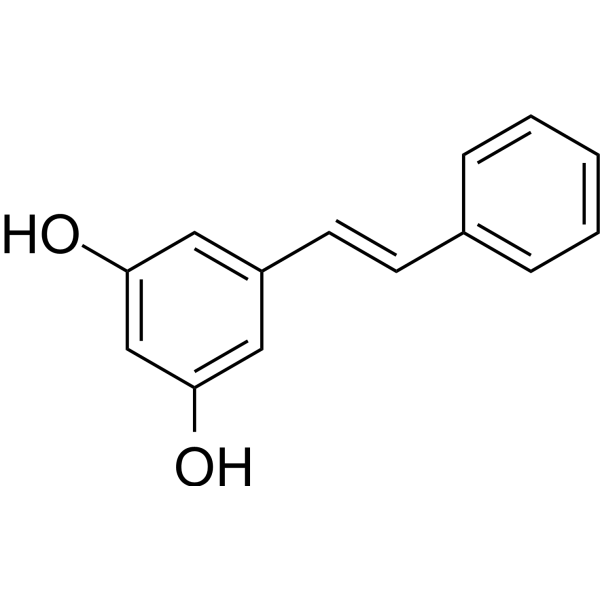
Pinosylvin is a?pre-infectious stilbenoid toxin?isolated from the heartwood of Pinus species, has anti-bacterial activities. Pinosylvin is a resveratrol analogue, can induce cell apoptosis and autophapy in leukemia cells.
For research use only. We do not sell to patients.
- Purity: 99.94%
- CAS No.: 22139-77-1
- Formula: C14H12O2
- Molecular Weight:212.24
-
Storage:
4°C, protect from light
* In solvent : -80°C, 6 months; -20°C, 1 month (protect from light)

To place orders, for customer services and technical support, please contact: MedChemExpress USA
Tel: 609-228-6898 E-mail: [email protected] [email protected]


-
 Biological Activity
-
Chemical Information
-
Solvent & Solubility
- Purity & Documentation
- References
-
 Help & FAQs
-

Anti-Infection Compound Library
HY-L002
-
Apoptosis Compound Library
HY-L003
-
Natural Product Library
HY-L021
-
Anti-Cancer Compound Library
HY-L025
-
Autophagy Compound Library
HY-L029
-
Lipid Compound Library
HY-L043
-
Antibacterial Compound Library
HY-L049
-
Phenols Library
HY-L057
-
Traditional Chinese Medicine Active Compound Library
HY-L065
-
Anti-Blood Cancer Compound Library
HY-L079
-
Anti-Cancer Natural Product Library
HY-L107
-
Plant-Sourced Natural Product Library
HY-L115
-
Anti-Pulmonary Fibrosis Compound Library
HY-L125
-
Cell Death Library
HY-L162
-
Anti-Hematopathy Compound Library
HY-L171
-
Bioactive Compound Library Max
HY-L181
-
MCE Bioactive Compound Library
HY-L001V
-
Natural Product Library Plus
HY-L021P
-
Natural Product and Natural Product-Like Compound Library
HY-L021M
-
Bioactive Compound Library
HY-L001
-
Miao Ethnicity Medicine Compound Library
HY-L190
-
PBCRBS Traditional Chinese Medicine Compound Library
HY-L193
-
Non-Alcoholic Fatty Liver Disease (NAFLD) Compound Library
HY-L199
-
RO5 Drug-like Natural Product Library
HY-L200
-
High-Throughput Bioactive Compound Library
HY-L205
-
High-Throughput Natural Product Library
HY-L206
-
Ancient Chinese Classical Formulas Traditional Chinese Medicine Active Compound Library
HY-L209
-
Biotoxin Library
HY-L220
-
Antitussive and Antiasthmatic Traditional Chinese Medicine Active Compound Library
HY-L223
-
Diarrhea-Related Traditional Chinese Medicine Active Compound Library
HY-L224
-
Mongolian Medicine Compound Library
HY-L238
-
Tonifying Traditional Chinese Medicine Monomer Compound Library
HY-L246
-
RNA Binding Bioactive Compound Library
HY-L248
-
Mass Spectrometry Natural Product Library
HY-L262




Biological Activity
|
Cell Line

|
Type | Value | Description | References |
|---|---|---|---|---|
| HEK293 | IC50 |
>10 μM
Compound: 1
|
Antagonist activity at human TRPV1 expressed in HEK293 cells assessed as inhibition of allyl isothiocyanate-induced increase of intracellular calcium level
Antagonist activity at human TRPV1 expressed in HEK293 cells assessed as inhibition of allyl isothiocyanate-induced increase of intracellular calcium level
|
[PMID: 26750258] |
| HEK293 | IC50 |
12.1 μM
Compound: 1
|
Antagonist activity at rat TRPA1 expressed in HEK293 cells assessed as inhibition of allyl isothiocyanate-induced increase of intracellular calcium level
Antagonist activity at rat TRPA1 expressed in HEK293 cells assessed as inhibition of allyl isothiocyanate-induced increase of intracellular calcium level
|
[PMID: 26750258] |
| J774 | IC50 |
16.6 μM
Compound: 1
|
Antiinflammatory activity in mouse J774 cells assessed as reduction in LPS-induced nitric oxide production after 24 hrs by Griess assay
Antiinflammatory activity in mouse J774 cells assessed as reduction in LPS-induced nitric oxide production after 24 hrs by Griess assay
|
[PMID: 29726680] |
| J774 | IC50 |
32.1 μM
Compound: 1
|
Antiinflammatory activity in mouse J774 cells assessed as reduction in LPS-induced IL6 expression after 24 hrs by ELISA
Antiinflammatory activity in mouse J774 cells assessed as reduction in LPS-induced IL6 expression after 24 hrs by ELISA
|
[PMID: 29726680] |
| J774 | IC50 |
38.7 μM
Compound: 1
|
Antiinflammatory activity in mouse J774 cells assessed as reduction in LPS-induced MCP1 expression after 24 hrs by ELISA
Antiinflammatory activity in mouse J774 cells assessed as reduction in LPS-induced MCP1 expression after 24 hrs by ELISA
|
[PMID: 29726680] |
| RAW264.7 | IC50 |
10.6 μM
Compound: Pinosylvin
|
inhibitory concentration against PGE-2 production in LPS-stimulated RAW264.7 cells
inhibitory concentration against PGE-2 production in LPS-stimulated RAW264.7 cells
|
[PMID: 15501064] |
| U-87MG ATCC | IC50 |
88.96 μM
Compound: Pinosylvin
|
Antitumor activity against human U87 cells assessed as reduction in cell viability incubated for 48 hrs by CCK-8 assay
Antitumor activity against human U87 cells assessed as reduction in cell viability incubated for 48 hrs by CCK-8 assay
|
[PMID: 38493731] |
Pinosylvin (0-100 μM; 24 hours) is cytotoxic to THP‐1 and U937 cells, exhibits an IC50 value of 20-30 μM in leukemia cells, the maximal cytotoxic effect occurred at 100 μM following incubation for 24?hr[3]. Pinosylvin (0-100 μM; 24 hours) enhances the number of annexin V+?and PI+?cells in the U937 population at 50 μM, increases annexin V+?and PI+ cells in the THP‐1 population at 100 μM[3]. Pinosylvin (0-100 μM; 24 hours) promotes autophagy in leukemia cells by enhancing the level of LC3‐II and p62/SQSTM1 degradation in leukemia cells[3].
MedChemExpress (MCE) has not independently confirmed the accuracy of these methods. They are for reference only.
-
Cell Line:Leukemia cells
-
Concentration:0 μM; 0.1 μM; 1 μM; 10 μM; 50 μM; 100 μM
-
Incubation Time:24 hours
-
Result:Was cytotoxic to leukemia cells at high concentrations.
-
Cell Line:U937 and THP‐1 cells
-
Concentration:0 μM; 0.1 μM; 1 μM; 10 μM; 50 μM; 100 μM
-
Incubation Time:24 hours
-
Result:Induced apoptosis cell number in U937 and THP‐1 cells.
-
Cell Line:U937 and THP‐1 cells
-
Concentration:0 μM; 0.1 μM; 1 μM; 10 μM; 50 μM; 100 μM
-
Incubation Time:24 hours
-
Result:Induced autophagy in leukemia cells.
MedChemExpress (MCE) has not independently confirmed the accuracy of these methods. They are for reference only.


Chemical Information
-
CAS No. 22139-77-1
-
Appearance Solid
-
Molecular Weight 212.24
-
Formula C14H12O2
-
Color White to off-white
-
SMILES
OC1=CC(/C=C/C2=CC=CC=C2)=CC(O)=C1
-
Structure Classification
-
Initial Source
-
Shipping
Room temperature in continental US; may vary elsewhere.
-
Storage
4°C, protect from light
* In solvent : -80°C, 6 months; -20°C, 1 month (protect from light)


Solvent & Solubility
DMSO : 100 mg/mL (471.16 mM; Need ultrasonic; Hygroscopic DMSO has a significant impact on the solubility of product, please use newly opened DMSO)
Please refer to the solubility information to select the appropriate solvent. Once prepared, please aliquot and store the solution to prevent product inactivation from repeated freeze-thaw cycles.
Storage method and period of stock solution: -80°C, 6 months; -20°C, 1 month (protect from light). When stored at -80°C, please use it within 6 months. When stored at -20°C, please use it within 1 month.
Please refer to the solubility information to select the appropriate solvent. Once prepared, please aliquot and store the solution to prevent product inactivation from repeated freeze-thaw cycles.
Storage method and period of stock solution: -80°C, 6 months; -20°C, 1 month (protect from light). When stored at -80°C, please use it within 6 months. When stored at -20°C, please use it within 1 month.
Concentration (start) × Volume (start) = Concentration (final) × Volume (final)
Select the appropriate dissolution method based on your experimental animal and administration route.
- For the following dissolution methods, please ensure to first prepare a clear stock solution using an In Vitro approach and then sequentially add co-solvents:
- To ensure reliable experimental results, the clarified stock solution can be appropriately stored based on storage conditions. As for the working solution for In Vivo experiments, it is recommended to prepare freshly and use it on the same day.
- The percentages shown for the solvents indicate their volumetric ratio in the final prepared solution. If precipitation or phase separation occurs during preparation, heat and/or sonication can be used to aid dissolution.
Add each solvent one by one: 10% DMSO 40% PEG300 5% Tween-80 45% Saline
Solubility: ≥ 2.5 mg/mL (11.78 mM); Clear solution
This protocol yields a clear solution of ≥ 2.5 mg/mL (saturation unknown).
Taking 1 mL working solution as an example, add 100 μL DMSO stock solution (25.0 mg/mL) to 400 μL PEG300, and mix evenly; then add 50 μL Tween-80 and mix evenly; then add 450 μL Saline to adjust the volume to 1 mL.
Preparation of Saline: Dissolve 0.9 g sodium chloride in ddH₂O and dilute to 100 mL to obtain a clear Saline solution.
Add each solvent one by one: 10% DMSO 90% (20% SBE-β-CD in Saline)
Solubility: ≥ 2.5 mg/mL (11.78 mM); Clear solution
This protocol yields a clear solution of ≥ 2.5 mg/mL (saturation unknown).
Taking 1 mL working solution as an example, add 100 μL DMSO stock solution (25.0 mg/mL) to 900 μL 20% SBE-β-CD in Saline, and mix evenly.
Preparation of 20% SBE-β-CD in Saline (4°C, storage for one week): 2 g SBE-β-CD powder is dissolved in 10 mL Saline, completely dissolve until clear.
Please enter the basic information of animal experiments:
-
-
-
-
Recommended: Prepare an additional quantity of animals to account for potential losses during experiments.
Please enter your animal formula composition:
-
%DMSO +
Recommended: Keep the proportion of DMSO in working solution below 2% if your animal is weak.
-
%+
-
+%Tween-80 + +
-
%Saline +
The co-solvents required include: DMSO, . All of co-solvents are available by MedChemExpress (MCE). , Tween 80. All of co-solvents are available by MedChemExpress (MCE).
Working solution concentration: 0.22 mg/mL
Method for preparing stock solution: mg drug dissolved in μL DMSO. Stock solution concentration: mg/mL. * In solvent : -80°C, 6 months; -20°C, 1 month (protect from light)
1. Take μL DMSO stock solution;
2. Add μL .
μL , mix evenly;
3. Then add μL Tween 80, mix evenly;
4. Then add μL
Please ensure that the stock solution in the first step is dissolved to a clear state, and add co-solvents in sequence. You can use ultrasonic heating (ultrasonic cleaner, recommended frequency 20-40 kHz), vortexing, etc. to assist dissolution.


Purity & Documentation
-
Data Sheet (274 KB)
-
SDS (394 KB)
- English - EN (394 KB)
- Français - FR (394 KB)
- Deutsch - DE (394 KB)
- Norwegian - NO (394 KB)
- Español - ES (394 KB)
- Swedish - SV (394 KB)
- Italian - IT (394 KB)
- Korean - KR (394 KB)
- Portuguese - PT (394 KB)
-
Handling Instructions (2659 KB)
References
[1]. Lee SK, et al. Antibacterial and antifungal activity of pinosylvin, a constituent of pine.Fitoterapia. 2005 Mar;76(2):258-60. [Content Brief]
[2]. Roupe KA, et al. Pharmacokinetics of selected stilbenes: rhapontigenin, piceatannol and pinosylvin in rats.J Pharm Pharmacol. 2006 Nov;58(11):1443-50. [Content Brief]
[3]. Song J, et al. Pinosylvin enhances leukemia cell death via down-regulation of AMPKα expression. Phytother Res. 2018 Oct;32(10):2097-2104. [Content Brief]


Complete Stock Solution Preparation Table
Please refer to the solubility information to select the appropriate solvent. Once prepared, please aliquot and store the solution to prevent product inactivation from repeated freeze-thaw cycles.
Storage method and period of stock solution: -80°C, 6 months; -20°C, 1 month (protect from light). When stored at -80°C, please use it within 6 months. When stored at -20°C, please use it within 1 month.
| Optional Solvent | Concentration Solvent Mass | 1 mg | 5 mg | 10 mg | 25 mg |
|---|---|---|---|---|---|
| DMSO | 1 mM | 4.7116 mL | 23.5582 mL | 47.1165 mL | 117.7912 mL |
| 5 mM | 0.9423 mL | 4.7116 mL | 9.4233 mL | 23.5582 mL | |
| 10 mM | 0.4712 mL | 2.3558 mL | 4.7116 mL | 11.7791 mL | |
| 15 mM | 0.3141 mL | 1.5705 mL | 3.1411 mL | 7.8527 mL | |
| 20 mM | 0.2356 mL | 1.1779 mL | 2.3558 mL | 5.8896 mL | |
| 25 mM | 0.1885 mL | 0.9423 mL | 1.8847 mL | 4.7116 mL | |
| 30 mM | 0.1571 mL | 0.7853 mL | 1.5705 mL | 3.9264 mL | |
| 40 mM | 0.1178 mL | 0.5890 mL | 1.1779 mL | 2.9448 mL | |
| 50 mM | 0.0942 mL | 0.4712 mL | 0.9423 mL | 2.3558 mL | |
| 60 mM | 0.0785 mL | 0.3926 mL | 0.7853 mL | 1.9632 mL | |
| 80 mM | 0.0589 mL | 0.2945 mL | 0.5890 mL | 1.4724 mL | |
| 100 mM | 0.0471 mL | 0.2356 mL | 0.4712 mL | 1.1779 mL |


Pinosylvin Related Classifications
HY-N2387 Related Classifications
 Powered by Bioz