



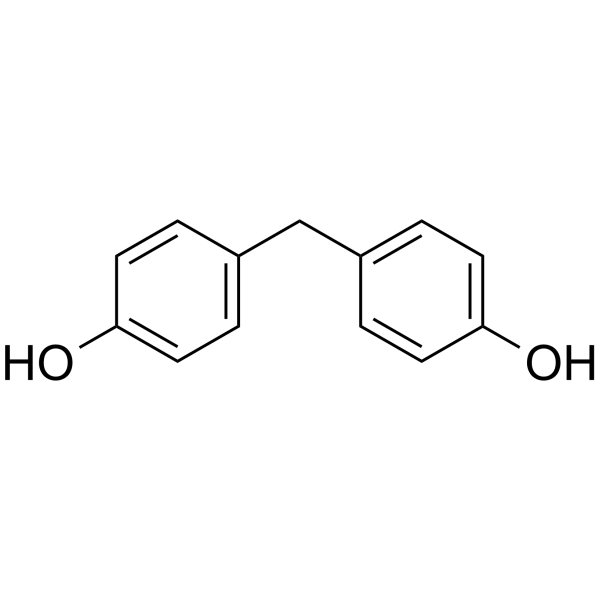
Bisphenol F

Based on 1 Customer Validation
Bisphenol F is an orally active endocrine disruptor. Bisphenol F promotes ROS generation, upregulates p-AKT/p-GSK3β, and induces Apoptosis. Bisphenol F interferes with glucose metabolism, affects neurodevelopment and reproductive function. Bisphenol F reduces social novelty preference in mouse offspring. Bisphenol F can be used in bone, blood, and fat-related studies. Bisphenol F is used as a substitute for Bisphenol A (HY-18260).
商品は「研究用試薬」です。人や動物の医療用・臨床診断用・食品用の製品ではありません。
研究用途以外に使用した場合、当社は一切の責任を負いかねます。
- 純度: 99.93%
- CAS 番号: 620-92-8
- 分子式: C13H12O2
- 分子量:200.24
-
保管条件:Powder -20°C, 3 years , 4°C, 2 years ; In solvent -80°C, 6 months , -20°C, 1 month


-
 生物活性
生物活性
-
化学情報
-
溶剤 & 溶解度
- 純度とドキュメンテーション
- 参考文献
-
 Help & FAQs
-

Apoptosis Compound Library
HY-L003
-
Immunology/Inflammation Compound Library
HY-L007
-
Metabolism/Protease Compound Library
HY-L012
-
NF-κB Signaling Compound Library
HY-L014
-
PI3K/Akt/mTOR Compound Library
HY-L015
-
Protein Tyrosine Kinase Compound Library
HY-L016
-
Stem Cell Signaling Compound Library
HY-L017
-
Wnt/Hedgehog/Notch Compound Library
HY-L020
-
Natural Product Library
HY-L021
-
Autophagy Compound Library
HY-L029
-
Anti-Aging Compound Library
HY-L034
-
Differentiation Inducing Compound Library
HY-L038
-
Oxygen Sensing Compound Library
HY-L045
-
Anti-Cardiovascular Disease Compound Library
HY-L046
-
Medicine Food Homology Compound Library
HY-L055
-
Phenols Library
HY-L057
-
Glycolysis Compound Library
HY-L058
-
Cytoskeleton Compound Library
HY-L060
-
Orally Active Compound Library
HY-L061
-
Glutamine Metabolism Compound Library
HY-L064
-
Traditional Chinese Medicine Active Compound Library
HY-L065
-
Neuroprotective Compound Library
HY-L070
-
Anti-Pancreatic Cancer Compound Library
HY-L077
-
Anti-Cancer Metabolism Compound Library
HY-L083
-
Angiogenesis-Related Compound Library
HY-L088
-
Glucose Metabolism Compound Library
HY-L092
-
Antidepressant Compound Library
HY-L108
-
Anti-inflammatory Traditional Chinese Medicine Active Compound Library
HY-L114
-
Plant-Sourced Natural Product Library
HY-L115
-
Human Metabolite Library
HY-L123
-
Osteogenesis Compound Library
HY-L131
-
Pain-Related Compound Library
HY-L139
-
Mitochondrial Protection Compound Library
HY-L144
-
Metabolic Enzyme Compound Library
HY-L146
-
Cell Death Library
HY-L162
-
Multi-Target Compound Library
HY-L176
-
Bioactive Compound Library Max
HY-L181
-
MCE Bioactive Compound Library
HY-L001V
-
Natural Product Library Plus
HY-L021P
-
Natural Product and Natural Product-Like Compound Library
HY-L021M
-
Bioactive Compound Library
HY-L001
-
Miao Ethnicity Medicine Compound Library
HY-L190
-
Protein Kinase Compound Library
HY-L196
-
Non-Alcoholic Fatty Liver Disease (NAFLD) Compound Library
HY-L199
-
RO5 Drug-like Natural Product Library
HY-L200
-
Cell Proliferation Compound Library
HY-L201
-
High-Throughput Bioactive Compound Library
HY-L205
-
High-Throughput Natural Product Library
HY-L206
-
Ancient Chinese Classical Formulas Traditional Chinese Medicine Active Compound Library
HY-L209
-
Tonifying Traditional Chinese Medicine Monomer Compound Library
HY-L246
-
Lactylation Compound Library
HY-L249
-
Drug Fragment Library
HY-L904




生物活性
|
GSK-3β |
|
Cell Line

|
Type | Value | Description | References |
|---|---|---|---|---|
| HEK293 | EC50 |
909 nM
Compound: 2
|
Agonist activity at FLAG-tagged ERalpha (unknown origin) expressed in HEK293 cells assessed as induction of ER-alpha-mediated transcriptional activity by luciferase reporter gene assay
Agonist activity at FLAG-tagged ERalpha (unknown origin) expressed in HEK293 cells assessed as induction of ER-alpha-mediated transcriptional activity by luciferase reporter gene assay
|
[PMID: 30940565] |
| HEK293 | EC50 |
>10000 nM
Compound: 2
|
Selective estrogen receptor down-regulator activity at FLAG-tagged ERalpha (unknown origin) expressed in HEK293 cells assessed as induction of ERalpha degradation by luciferase reporter gene assay
Selective estrogen receptor down-regulator activity at FLAG-tagged ERalpha (unknown origin) expressed in HEK293 cells assessed as induction of ERalpha degradation by luciferase reporter gene assay
|
[PMID: 30940565] |
| HEK293 | IC50 |
>10000 nM
Compound: 2
|
Antagonist activity at FLAG-tagged ERalpha (unknown origin) expressed in HEK293 cells assessed as reduction in E2-induced ER-alpha-mediated transcriptional activity by luciferase reporter gene assay
Antagonist activity at FLAG-tagged ERalpha (unknown origin) expressed in HEK293 cells assessed as reduction in E2-induced ER-alpha-mediated transcriptional activity by luciferase reporter gene assay
|
[PMID: 30940565] |
| HEK293 | EC50 |
237 μM
Compound: 1
|
Agonist activity at MT1 receptor (unknown origin) expressed in HEK293 cells by Fluo-8 dye-based calcium assay
Agonist activity at MT1 receptor (unknown origin) expressed in HEK293 cells by Fluo-8 dye-based calcium assay
|
[PMID: 31204226] |
| HEK293 | EC50 |
244 μM
Compound: 1
|
Agonist activity at MT2 receptor (unknown origin) expressed in HEK293 cells by Fluo-8 dye-based calcium assay
Agonist activity at MT2 receptor (unknown origin) expressed in HEK293 cells by Fluo-8 dye-based calcium assay
|
[PMID: 31204226] |
| HeLa S3 | IC50 |
>10 μM
Compound: 15
|
Cytotoxicity against human HeLa S3 cells assessed as cell viability incubated for 48 hrs by microscopic analysis
Cytotoxicity against human HeLa S3 cells assessed as cell viability incubated for 48 hrs by microscopic analysis
|
[PMID: 35704432] |
Bisphenol F (0-100 µM; 24 h) significantly reduces cell viability, induces oxidative stress (increased ROS, decreased antioxidant enzyme activity) in human granulosa KGN cells[1].
Bisphenol F (0.1-10 µM; 24 h) significantly inhibits proliferation via apoptosis induction in human osteoblasts, reducing alkaline phosphatase activity and mineralization capacity[2].
Bisphenol F (0.1-500 µg/mL; 1-24 h) induces ROS in human red blood cells[3].
Bisphenol F (10 nM-1 µM; 12 d) inhibits late differentiation gene expression and reduces lipid accumulation in 3T3-L1 preadipocytes[4].
MedChemExpress (MCE) has not independently confirmed the accuracy of these methods. They are for reference only.
-
Cell Line:Murine 3T3-L1 preadipocytes
-
Concentration:10 nM, 1 µM
-
Incubation Time:12 d
-
Result:Downregulated the mRNA levels of Cfd and Plin at day 12 of differentiation.
Bisphenol F (100 µg/kg; i.g.; every other day; 5 months) improves glucose tolerance, insulin sensitivity, inhibits hepatic gluconeogenesis, and increases TCA cycle metabolites in high-fat diet-fed mice[7].
Bisphenol F (50 µg/kg; s.c.; daily) decreases social novelty preference in C57BL/6J mouse offspring without affecting anxiety/depression-like behaviors[8].
MedChemExpress (MCE) has not independently confirmed the accuracy of these methods. They are for reference only.
-
Animal Model:Male C57BL/6J mice (8-10 weeks old, ~25 g); high-fat diet model[7]
-
Dosage:100 µg/kg
-
Administration:Gavage (i.g.); every other day; 5 months
-
Result:Reduced fasting blood glucose by ~20% in HFD mice.
Enhanced insulin signaling in skeletal muscle (p-AKT/p-GSK3β upregulation), and decreased hepatic G6pase/Pepck mRNA expression by ~40-50%.


化学情報
-
CAS 番号 620-92-8
-
性状 Solid
-
分子量 200.24
-
分子式 C13H12O2
-
Color White to off-white
-
SMILES
OC1=CC=C(CC2=CC=C(O)C=C2)C=C1
-
別名
BPF; 4,4'-Dihydroxydiphenylmethane
-
Structure Classification
-
Initial Source
-
輸送条件
Room temperature in continental US; may vary elsewhere.
-
保管条件
Powder -20°C 3 years 4°C 2 years In solvent -80°C 6 months -20°C 1 month


溶剤 & 溶解度
DMSO : 100 mg/mL (499.40 mM; Need ultrasonic; Hygroscopic DMSO has a significant impact on the solubility of product, please use newly opened DMSO)
Please refer to the solubility information to select the appropriate solvent. Once prepared, please aliquot and store the solution to prevent product inactivation from repeated freeze-thaw cycles.
Storage method and period of stock solution: -80°C, 6 months; -20°C, 1 month. When stored at -80°C, please use it within 6 months. When stored at -20°C, please use it within 1 month.
Please refer to the solubility information to select the appropriate solvent. Once prepared, please aliquot and store the solution to prevent product inactivation from repeated freeze-thaw cycles.
Storage method and period of stock solution: -80°C, 6 months; -20°C, 1 month. When stored at -80°C, please use it within 6 months. When stored at -20°C, please use it within 1 month.
濃度 (開始) × 体積 (開始) = 濃度 (終了) × 体積 (終了)
Select the appropriate dissolution method based on your experimental animal and administration route.
- For the following dissolution methods, please ensure to first prepare a clear stock solution using an In Vitro approach and then sequentially add co-solvents:
- To ensure reliable experimental results, the clarified stock solution can be appropriately stored based on storage conditions. As for the working solution for In Vivo experiments, it is recommended to prepare freshly and use it on the same day.
- The percentages shown for the solvents indicate their volumetric ratio in the final prepared solution. If precipitation or phase separation occurs during preparation, heat and/or sonication can be used to aid dissolution.
Add each solvent one by one: 10% DMSO 40% PEG300 5% Tween-80 45% Saline
Solubility: ≥ 2.5 mg/mL (12.49 mM); Clear solution
This protocol yields a clear solution of ≥ 2.5 mg/mL (saturation unknown).
Taking 1 mL working solution as an example, add 100 μL DMSO stock solution (25.0 mg/mL) to 400 μL PEG300, and mix evenly; then add 50 μL Tween-80 and mix evenly; then add 450 μL Saline to adjust the volume to 1 mL.
Preparation of Saline: Dissolve 0.9 g sodium chloride in ddH₂O and dilute to 100 mL to obtain a clear Saline solution.
Add each solvent one by one: 10% DMSO 90% (20% SBE-β-CD in Saline)
Solubility: ≥ 2.5 mg/mL (12.49 mM); Clear solution
This protocol yields a clear solution of ≥ 2.5 mg/mL (saturation unknown).
Taking 1 mL working solution as an example, add 100 μL DMSO stock solution (25.0 mg/mL) to 900 μL 20% SBE-β-CD in Saline, and mix evenly.
Preparation of 20% SBE-β-CD in Saline (4°C, storage for one week): 2 g SBE-β-CD powder is dissolved in 10 mL Saline, completely dissolve until clear.
Please enter the basic information of animal experiments:
-
-
-
-
Recommended: Prepare an additional quantity of animals to account for potential losses during experiments.
Please enter your animal formula composition:
-
%DMSO +
Recommended: Keep the proportion of DMSO in working solution below 2% if your animal is weak.
-
%+
-
+%Tween-80 + +
-
%Saline +
The co-solvents required include: DMSO, . All of co-solvents are available by MedChemExpress (MCE). , Tween 80. All of co-solvents are available by MedChemExpress (MCE).
Working solution concentration: 0.22 mg/mL
Method for preparing stock solution: mg drug dissolved in μL DMSO. Stock solution concentration: mg/mL.
1. Take μL DMSO stock solution;
2. Add μL .
μL , mix evenly;
3. Then add μL Tween 80, mix evenly;
4. Then add μL
Please ensure that the stock solution in the first step is dissolved to a clear state, and add co-solvents in sequence. You can use ultrasonic heating (ultrasonic cleaner, recommended frequency 20-40 kHz), vortexing, etc. to assist dissolution.


純度とドキュメンテーション
-
データシート (276 KB)
-
SDS (762 KB)
- English - EN (762 KB)
- Français - FR (762 KB)
- Deutsch - DE (762 KB)
- Norwegian - NO (762 KB)
- Español - ES (762 KB)
- Swedish - SV (762 KB)
- Italian - IT (762 KB)
- Portuguese - PT (762 KB)
-
取扱説明書 (2659 KB)
参考文献
[1]. Huang M, et al. Bisphenol A and its analogues bisphenol S, bisphenol F and bisphenol AF induce oxidative stress and biomacromolecular damage in human granulosa KGN cells. Chemosphere. 2020 Aug;253:126707. [Content Brief]
[2]. García-Recio E, et al. Effects of bisphenol F, bisphenol S, and bisphenol AF on cultured human osteoblasts. Arch Toxicol. 2023 Jul;97(7):1899-1905. [Content Brief]
[3]. Maćczak A, et al. Bisphenol A, bisphenol S, bisphenol F and bisphenol AF induce different oxidative stress and damage in human red blood cells (in vitro study). Toxicol In Vitro. 2017 Jun;41:143-149. [Content Brief]
[4]. Drobna Z, et al. Bisphenol F has different effects on preadipocytes differentiation and weight gain in adult mice as compared with Bisphenol A and S. Toxicology. 2019 May 15;420:66-72. [Content Brief]
[5]. Kim Y, et al. Mechanism of Bisphenol F Affecting Motor System and Motor Activity in Zebrafish. Toxics. 2023 May 24;11(6):477. [Content Brief]
[6]. Li B, et al. Effect of bisphenol F on reproductive function in F1 generation male mice and its potential mechanisms. Environ Pollut. 2025 Feb 15;367:125546. [Content Brief]
[7]. Lv Z, et al. In vivo hypoglycemic effects of bisphenol F exposure in high-fat diet mice. Chemosphere. 2023 Jan;311(Pt 1):137066. [Content Brief]
[8]. Moon HJ, et al. Effects of prenatal bisphenol S and bisphenol F exposure on behavior of offspring mice. Anim Cells Syst (Seoul). 2023 Oct 11;27(1):260-271. [Content Brief]


Complete Stock Solution Preparation Table
Please refer to the solubility information to select the appropriate solvent. Once prepared, please aliquot and store the solution to prevent product inactivation from repeated freeze-thaw cycles.
Storage method and period of stock solution: -80°C, 6 months; -20°C, 1 month. When stored at -80°C, please use it within 6 months. When stored at -20°C, please use it within 1 month.
| Optional Solvent | Concentration Solvent Mass | 1 mg | 5 mg | 10 mg | 25 mg |
|---|---|---|---|---|---|
| DMSO | 1 mM | 4.9940 mL | 24.9700 mL | 49.9401 mL | 124.8502 mL |
| 5 mM | 0.9988 mL | 4.9940 mL | 9.9880 mL | 24.9700 mL | |
| 10 mM | 0.4994 mL | 2.4970 mL | 4.9940 mL | 12.4850 mL | |
| 15 mM | 0.3329 mL | 1.6647 mL | 3.3293 mL | 8.3233 mL | |
| 20 mM | 0.2497 mL | 1.2485 mL | 2.4970 mL | 6.2425 mL | |
| 25 mM | 0.1998 mL | 0.9988 mL | 1.9976 mL | 4.9940 mL | |
| 30 mM | 0.1665 mL | 0.8323 mL | 1.6647 mL | 4.1617 mL | |
| 40 mM | 0.1249 mL | 0.6243 mL | 1.2485 mL | 3.1213 mL | |
| 50 mM | 0.0999 mL | 0.4994 mL | 0.9988 mL | 2.4970 mL | |
| 60 mM | 0.0832 mL | 0.4162 mL | 0.8323 mL | 2.0808 mL | |
| 80 mM | 0.0624 mL | 0.3121 mL | 0.6243 mL | 1.5606 mL | |
| 100 mM | 0.0499 mL | 0.2497 mL | 0.4994 mL | 1.2485 mL |


 Powered by Bioz