



KRA-533
Based on 2 publication(s) in Google Scholar
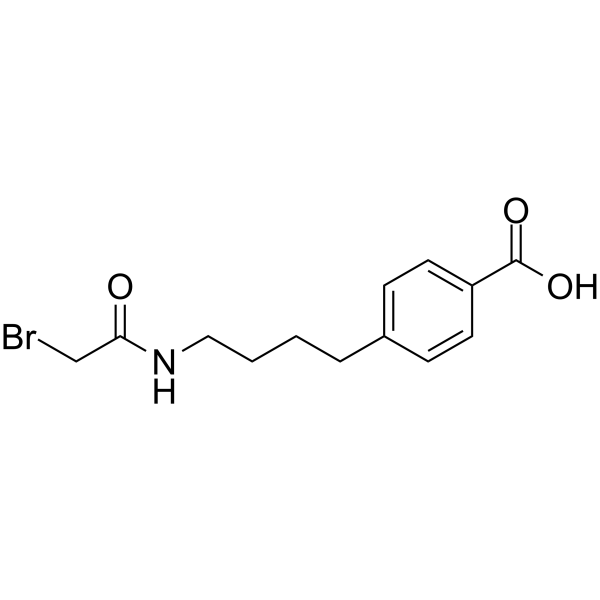
KRA-533 is a potent KRAS agonist. KRA-533 binds to the GTP/GDP binding pocket in the KRAS protein to prevent GTP cleavage, resulting in the accumulation of constitutively active GTP-bound KRAS that triggers both apoptotic and autophagic cell death pathways in cancer cells.
Nos produits utilisent uniquement pour la recherche. Nous ne vendons pas aux patients.
- Pureté : 98.73%
- CAS No.: 10161-87-2
- Formule: C13H16BrNO3
- Masse moléculaire:314.18
-
Stockage:Powder -20°C, 3 years ; In solvent -80°C, 6 months , -20°C, 1 month

To place orders, for customer services and technical support, please contact: MedChemExpress USA
Tel: 609-228-6898 E-mail: [email protected] [email protected]


-
 Activité biologique
-
Chemical Information
-
Solvant et solubilité
- Protocole
- Pureté et documentation
- Références
-
 Help & FAQs


-
HY-90006
5-FluorouracilThymidylate Synthase Inhibitor -
HY-Y0873
PEG300Neutral Polymer -
HY-10993
AdavosertibWee1 Inhibitor -
HY-15298
GrazoprevirHCV Protease Inhibitor -
HY-153346
ElironrasibKRAS-G12C(ON) Inhibitor -
HY-128876
CBP/p300-IN-3p300/CBP Inhibitor -
HY-13963
ZCL278Cdc42 Inhibitor -
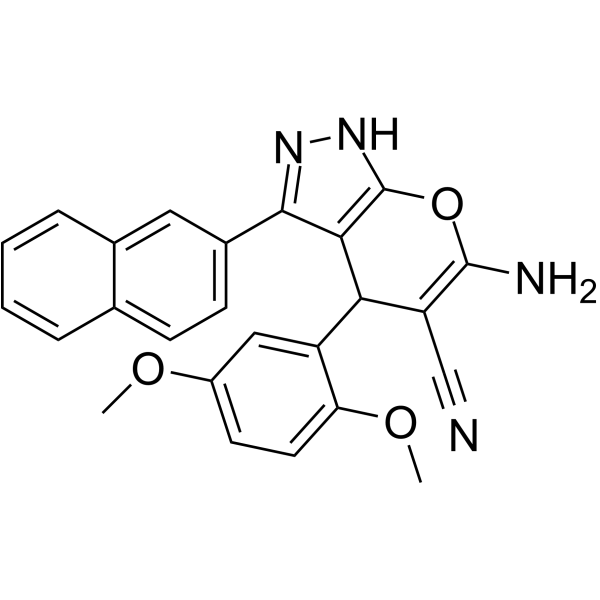
HY-12873
RBC8RALA/RALB Inhibitor -
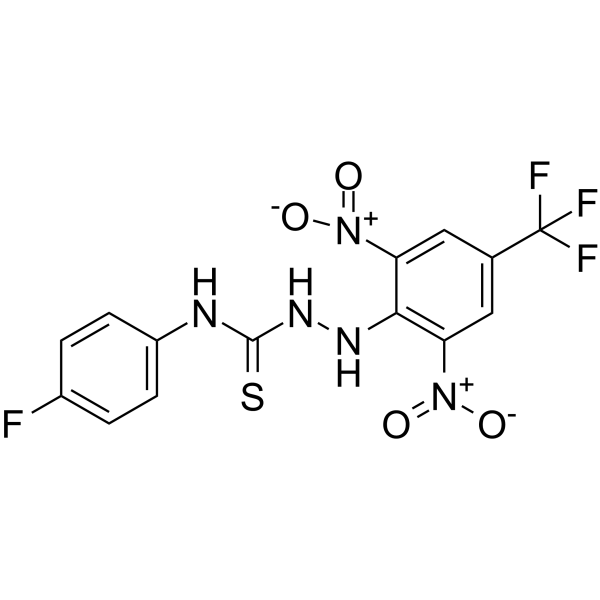
HY-15717
Kobe2602Ras-Raf Interaction Inhibitor -
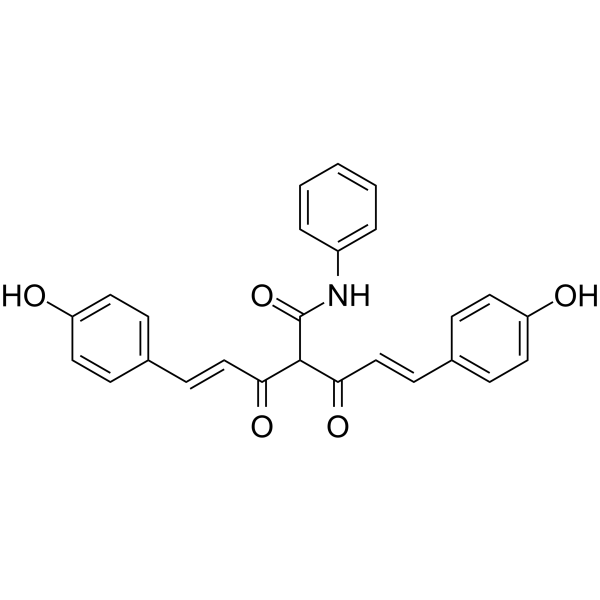
HY-120793
CMC2.24Ras/MMPs Inhibitor
Publications Citing Use of MedChemExpress (MCE) KRA-533
More

Activité biologique
Description
IC50 & Target
KRAS[1]
In Vitro
KRA-533 (10 μM; 48 hours; HCC827 cells) enhances KRAS activity to a greater extent[1].
?
KRA-533 (0~15 μM; 48 hours; H157 cells) enhances KRAS activity in a dose-dependent manner, which is associated increased levels of pERK, ratio of active caspase 3/procaspase 3 and PARP cleavage, leading to apoptotic cell death[1].
?
KRA-533 (10 μM; 10 days; H292 cells) mediates cell growth suppression than those without KRAS mutation. KRA-533 (5~15 μM) can directly bind to WT, G12C, G12D and G13D mutant KRAS proteins. KRA-533 activates WT KRAS to increase its activity in a dose-dependent manner. KRA-533 further enhances the activities of active KRAS mutants[1].
MedChemExpress (MCE) has not independently confirmed the accuracy of these methods. They are for reference only.
-
Cell Line:HCC827 cells
-
Concentration:10 μM
-
Incubation Time:48 hours
-
Result:Enhanced KRAS activity to a greater extent.
-
Cell Line:H157 cells
-
Concentration:0~15 μM
-
Incubation Time:48 hours
-
Result:Enhanced KRAS activity in a dose-dependent manner, which was associated increased levels of pERK, ratio of active caspase 3/procaspase 3 and PARP cleavage, leading to apoptotic cell death.
In Vivo
? KRA-533 shows optimal therapeutic index between 7.5 mg/kg and 30 mg/kg doses[1].
MedChemExpress (MCE) has not independently confirmed the accuracy of these methods. They are for reference only.
-
Animal Model:Nu/Nu nude mice (mutant KRAS xenografts)[1]
-
Dosage:0~30 mg/kg
-
Administration:i.p.; 28 days
-
Result:Suppressed tumor growth in a dose-dependent manner in lung cancer mutant KRAS xenografts and induced apoptosis and autophagy in tumor tissues in a dose-dependent manner.


Chemical Information
-
CAS No. 10161-87-2
-
Appearance Solid
-
Masse moléculaire 314.18
-
Formule C13H16BrNO3
-
Color Off-white to light brown
-
SMILES
O=C(O)C1=CC=C(CCCCNC(CBr)=O)C=C1
-
Livraison
Room temperature in continental US; may vary elsewhere.
-
Stockage
Powder -20°C 3 years In solvent -80°C 6 months -20°C 1 month


Publications (2)
-
Journal Impact Factor
-
Most Recent
-
Proc Natl Acad Sci U S A
Pan-ErbB inhibition impairs cognition via disrupting myelination and aerobic glycolysis in oligodendrocytes. [Abstract]2024 Nov 5;121(45):e2405152121. PMID: 39475641 -
Cell Signal
ARTN drives ABCB1-mediated chemoresistance in gastric cancer cells by promoting ELK4 phosphorylation. [Abstract]2026 Oct:146:112668. PMID: 42285190


Solvant et solubilité
In Vitro:
DMSO : 250 mg/mL (795.72 mM; Need ultrasonic; Hygroscopic DMSO has a significant impact on the solubility of product, please use newly opened DMSO)
Please refer to the solubility information to select the appropriate solvent. Once prepared, please aliquot and store the solution to prevent product inactivation from repeated freeze-thaw cycles.
Storage method and period of stock solution: -80°C, 6 months; -20°C, 1 month. When stored at -80°C, please use it within 6 months. When stored at -20°C, please use it within 1 month.
Please refer to the solubility information to select the appropriate solvent. Once prepared, please aliquot and store the solution to prevent product inactivation from repeated freeze-thaw cycles.
Storage method and period of stock solution: -80°C, 6 months; -20°C, 1 month. When stored at -80°C, please use it within 6 months. When stored at -20°C, please use it within 1 month.
Concentration (start) × Volume (start) = Concentration (final) × Volume (final)


Pureté et documentation
-
Fiche technique (271 KB)
-
SDS (251 KB)
- English - EN (251 KB)
- Français - FR (251 KB)
- Deutsch - DE (251 KB)
- Norwegian - NO (251 KB)
- Español - ES (251 KB)
- Swedish - SV (251 KB)
- Italian - IT (251 KB)
- Korean - KR (251 KB)
- Portuguese - PT (251 KB)
-
Instruction de manipulation (2659 KB)
Références


Complete Stock Solution Preparation Table
Please refer to the solubility information to select the appropriate solvent. Once prepared, please aliquot and store the solution to prevent product inactivation from repeated freeze-thaw cycles.
Storage method and period of stock solution: -80°C, 6 months; -20°C, 1 month. When stored at -80°C, please use it within 6 months. When stored at -20°C, please use it within 1 month.
| Optional Solvent | Concentration Solvent Mass | 1 mg | 5 mg | 10 mg | 25 mg |
|---|---|---|---|---|---|
| DMSO | 1 mM | 3.1829 mL | 15.9144 mL | 31.8289 mL | 79.5722 mL |
| 5 mM | 0.6366 mL | 3.1829 mL | 6.3658 mL | 15.9144 mL | |
| 10 mM | 0.3183 mL | 1.5914 mL | 3.1829 mL | 7.9572 mL | |
| 15 mM | 0.2122 mL | 1.0610 mL | 2.1219 mL | 5.3048 mL | |
| 20 mM | 0.1591 mL | 0.7957 mL | 1.5914 mL | 3.9786 mL | |
| 25 mM | 0.1273 mL | 0.6366 mL | 1.2732 mL | 3.1829 mL | |
| 30 mM | 0.1061 mL | 0.5305 mL | 1.0610 mL | 2.6524 mL | |
| 40 mM | 0.0796 mL | 0.3979 mL | 0.7957 mL | 1.9893 mL | |
| 50 mM | 0.0637 mL | 0.3183 mL | 0.6366 mL | 1.5914 mL | |
| 60 mM | 0.0530 mL | 0.2652 mL | 0.5305 mL | 1.3262 mL | |
| 80 mM | 0.0398 mL | 0.1989 mL | 0.3979 mL | 0.9947 mL | |
| 100 mM | 0.0318 mL | 0.1591 mL | 0.3183 mL | 0.7957 mL |


KRA-533 Related Classifications
HY-138188 Related Classifications
 Powered by Bioz