



Lixumistat hydrochloride
Based on 1 publication(s) in Google Scholar
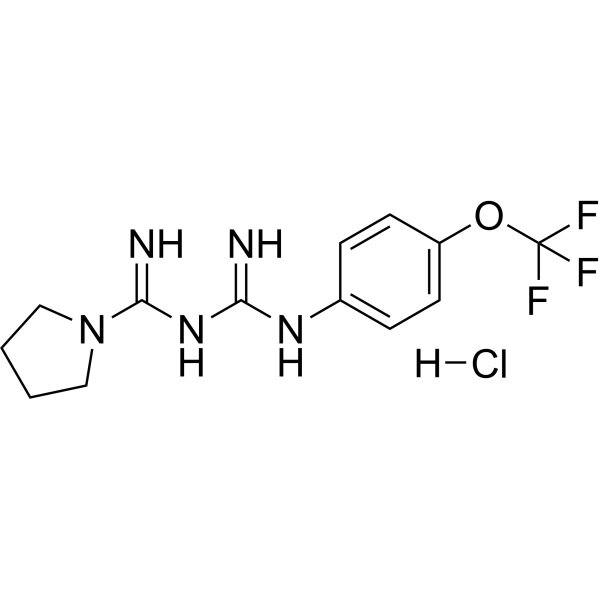
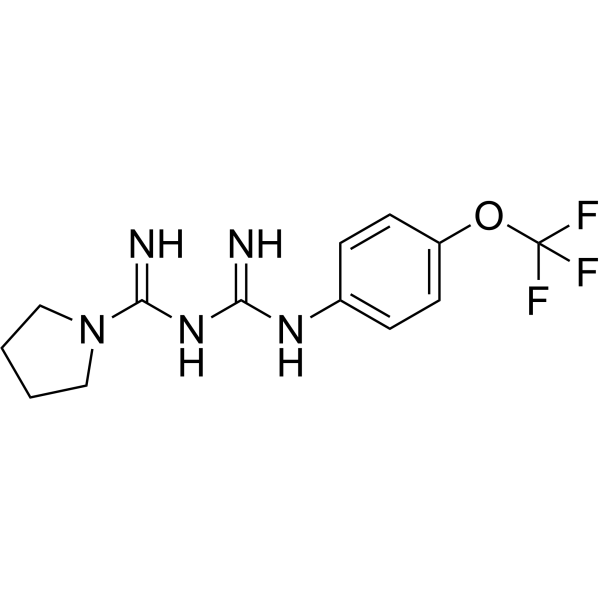
Lixumistat (IM156) hydrochloride is a potent and orally active AMPK activator and OXPHOS inhibitor. Lixumistat hydrochloride strongly activates AMPK, while it lacks the systemic metabolic regulatory effects of classic metformin, such as hypoglycemic and weight-lowering activities. Lixumistat hydrochloride exhibits significant therapeutic effects on cognitive decline associated with brain aging and pulmonary fibrosis.
For research use only. We do not sell to patients.
- Purity : 99.25%
- CAS No.: 1422365-52-3
- Formula: C13H17ClF3N5O
- Molecular Weight:351.76
-
Storage:
-20°C, sealed storage, away from moisture
* In solvent : -80°C, 6 months; -20°C, 1 month (sealed storage, away from moisture)

To place orders, for customer services and technical support, please contact: MedChemExpress USA
Tel: 609-228-6898 E-mail: [email protected] [email protected]


-
 Biological Activity
-
Chemical Information
-
Solvent & Solubility
- Purity & Documentation
- References
-
 Help & FAQs


Publications Citing Use of MedChemExpress (MCE) Lixumistat hydrochloride
MoreAll AMPK Isoforms
More

Biological Activity
Description
IC50 & Target
In Vitro
Lixumistat (15 μM; 26 h) hydrochloride potently inhibits TGFβ1-induced mitochondrial oxidative phosphorylation reprogramming in WI-38 human embryonic lung fibroblasts, with an IC50 of 14.7 μM, and does not alter TGFβ1-induced glycolytic changes[2].
Lixumistat (7.5-30 μM; 26-48 h) hydrochloride inhibits TGFβ1-induced myofibroblast differentiation (α-SMA expression, IC50 = 21.3 μM) and collagen deposition (IC50 = 13.2 μM) in a dose-dependent manner in WI-38 human embryonic lung fibroblasts without reducing cell viability[2].
Lixumistat (0.31-10 μM; 2-8 h) hydrochloride potently and rapidly induces the phosphorylation of AMPK at the Thr172 site in NIH3T3 mouse fibroblasts[3].
Lixumistat (10 μM; 0-4 h) hydrochloride promotes the proteasome-dependent degradation of PER2 and CRY1 proteins in NIH3T3 mouse fibroblasts when co-incubated with Cycloheximide (HY-12320)[3].
MedChemExpress (MCE) has not independently confirmed the accuracy of these methods. They are for reference only.
-
Cell Line:NIH3T3 cells
-
Concentration:0.31, 0.62, 1.25, 2.5, 5, 10 μM (dose-response); 10 μM (time-course)
-
Incubation Time:4 h (dose-response); 2, 4, 8 h (time-course)
-
Result:Dose-dependently stimulated AMPK phosphorylation, with significant increases observed at concentrations ≥ 1.25 μM after 4 h incubation.
Increased AMPK phosphorylation in a time-dependent manner, with significant elevations detected as early as 2 h after treatment with 10 μM.
In Vivo
Lixumistat (10-30 mg/kg; i.g.; once daily for 14 consecutive days) hydrochloride dose-dependently alleviates pulmonary fibrosis and inflammatory responses in male C57BL/6 mice[2].
MedChemExpress (MCE) has not independently confirmed the accuracy of these methods. They are for reference only.
-
Animal Model:C57BL/6J (male and female, 20~22 months of age)[1]
-
Dosage:50 mg/kg
-
Administration:p.o.; daily; 2 months
-
Result:Significantly improved age-related cognitive decline in aged C57BL/6J mice, with a 23.2% increase in novel object recognition discrimination ratio, 27.4% increase in spatial working memory %SAP, 47.3% increase in contextual fear memory freezing level, and 91.6% increase in hippocampal pAMPK relative intensity compared to controls
-
Animal Model:C57BL/6 (male, 6-7 weeks of age, bleomycin-induced pulmonary fibrosis)[2]
-
Dosage:10 mg/kg; 30 mg/kg
-
Administration:i.g.; daily; 14 days
-
Result:Attenuated body weight loss, with significant improvements observed on study days 19 and 21.
Reduced bleomycin-induced increases in lung weight at both doses, with greater efficacy at 30 mg/kg.
Significantly reduced modified Ashcroft fibrosis scores.


Chemical Information
-
CAS No. 1422365-52-3
-
Appearance Solid
-
Molecular Weight 351.76
-
Formula C13H17ClF3N5O
-
Color White to off-white
-
SMILES
N=C(N1CCCC1)NC(NC2=CC=C(OC(F)(F)F)C=C2)=N.[H]Cl
-
Synonyms
HL271; IM156 hydrochloride; HL156A hydrochloride
-
Shipping
Room temperature in continental US; may vary elsewhere.
-
Storage
-20°C, sealed storage, away from moisture
* In solvent : -80°C, 6 months; -20°C, 1 month (sealed storage, away from moisture)


Publications (1)
-
Journal Impact Factor
-
Most Recent
-
Cell Death Discov
Long-term adaptation of lymphoma cell lines to hypoxia is mediated by diverse molecular mechanisms that are targetable with specific inhibitors. [Abstract]2025 Feb 18;11(1):65. PMID: 39966387


Solvent & Solubility
In Vitro:
DMSO : 41.67 mg/mL (118.46 mM; Need ultrasonic; Hygroscopic DMSO has a significant impact on the solubility of product, please use newly opened DMSO)
Please refer to the solubility information to select the appropriate solvent. Once prepared, please aliquot and store the solution to prevent product inactivation from repeated freeze-thaw cycles.
Storage method and period of stock solution: -80°C, 6 months; -20°C, 1 month (sealed storage, away from moisture). When stored at -80°C, please use it within 6 months. When stored at -20°C, please use it within 1 month.
Please refer to the solubility information to select the appropriate solvent. Once prepared, please aliquot and store the solution to prevent product inactivation from repeated freeze-thaw cycles.
Storage method and period of stock solution: -80°C, 6 months; -20°C, 1 month (sealed storage, away from moisture). When stored at -80°C, please use it within 6 months. When stored at -20°C, please use it within 1 month.
Concentration (start) × Volume (start) = Concentration (final) × Volume (final)


Purity & Documentation
-
Data Sheet (278 KB)
-
SDS (252 KB)
- English - EN (252 KB)
- Français - FR (252 KB)
- Deutsch - DE (252 KB)
- Norwegian - NO (252 KB)
- Español - ES (252 KB)
- Swedish - SV (252 KB)
- Italian - IT (252 KB)
- Korean - KR (252 KB)
- Portuguese - PT (252 KB)
-
Handling Instructions (2659 KB)
References
[1]. Bang E, et al. The Improving Effect of HL271, a Chemical Derivative of Metformin, a Popular Drug for Type II Diabetes Mellitus, on Aging-induced Cognitive Decline. Exp Neurobiol. 2018;27(1):45-56. [Content Brief]
[2]. Willette RN, et al. Modulation of Oxidative Phosphorylation with IM156 Attenuates Mitochondrial Metabolic Reprogramming and Inhibits Pulmonary Fibrosis. J Pharmacol Exp Ther. 2021;379(3):290-300. [Content Brief]
[3]. Row H, et al. HL271, a novel chemical compound derived from metformin, differs from metformin in its effects on the circadian clock and metabolism. Biochem Biophys Res Commun. 2016;469(3):783-789. [Content Brief]


Complete Stock Solution Preparation Table
Please refer to the solubility information to select the appropriate solvent. Once prepared, please aliquot and store the solution to prevent product inactivation from repeated freeze-thaw cycles.
Storage method and period of stock solution: -80°C, 6 months; -20°C, 1 month (sealed storage, away from moisture). When stored at -80°C, please use it within 6 months. When stored at -20°C, please use it within 1 month.
| Optional Solvent | Concentration Solvent Mass | 1 mg | 5 mg | 10 mg | 25 mg |
|---|---|---|---|---|---|
| DMSO | 1 mM | 2.8428 mL | 14.2142 mL | 28.4285 mL | 71.0712 mL |
| 5 mM | 0.5686 mL | 2.8428 mL | 5.6857 mL | 14.2142 mL | |
| 10 mM | 0.2843 mL | 1.4214 mL | 2.8428 mL | 7.1071 mL | |
| 15 mM | 0.1895 mL | 0.9476 mL | 1.8952 mL | 4.7381 mL | |
| 20 mM | 0.1421 mL | 0.7107 mL | 1.4214 mL | 3.5536 mL | |
| 25 mM | 0.1137 mL | 0.5686 mL | 1.1371 mL | 2.8428 mL | |
| 30 mM | 0.0948 mL | 0.4738 mL | 0.9476 mL | 2.3690 mL | |
| 40 mM | 0.0711 mL | 0.3554 mL | 0.7107 mL | 1.7768 mL | |
| 50 mM | 0.0569 mL | 0.2843 mL | 0.5686 mL | 1.4214 mL | |
| 60 mM | 0.0474 mL | 0.2369 mL | 0.4738 mL | 1.1845 mL | |
| 80 mM | 0.0355 mL | 0.1777 mL | 0.3554 mL | 0.8884 mL | |
| 100 mM | 0.0284 mL | 0.1421 mL | 0.2843 mL | 0.7107 mL |


Lixumistat hydrochloride Related Classifications
HY-136093 Related Classifications
 Powered by Bioz