



Mexiletine
Based on 2 publication(s) in Google Scholar
Mexiletine is an orally effective antiarrhythmic agent which has also been found to be effective for myotonia and neuropathic pain. Mexiletine exerts its efficacy through blocking sodium channels (IC50 : 75±8 μM for tonic block, 23.6±2.8 μM for use-dependent block), therefore can be used for cardiovascular and neurological research.
For research use only. We do not sell to patients.
- Purity : 99.92%
- CAS No.: 31828-71-4
- Formula: C11H17NO
- Molecular Weight:179.26
-
Storage:Pure form -20°C, 3 years , 4°C, 2 years ; In solvent -80°C, 6 months , -20°C, 1 month


To place orders, for customer services and technical support, please contact: MedChemExpress USA
Tel: 609-228-6898 E-mail: [email protected] [email protected]


-
 Biological Activity
-
Chemical Information
-
Solvent & Solubility
- Protocols
- Purity & Documentation
- References
-
 Help & FAQs


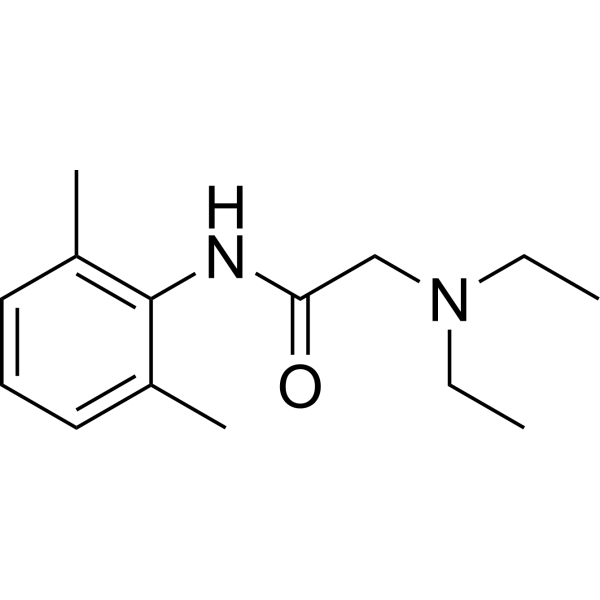
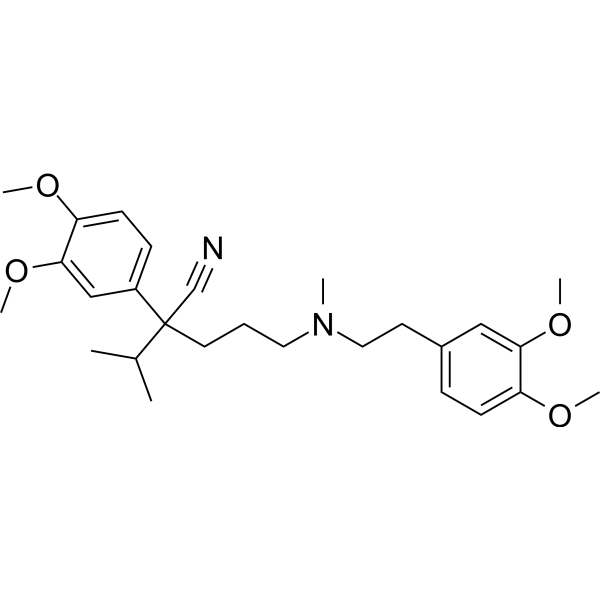
Publications Citing Use of MedChemExpress (MCE) Mexiletine
More

Biological Activity
Description
IC50 & Target
IC50: 75±8 μM for tonic block, 23.6±2.8 μM for use-dependent block (sodium channel of HEK293 transfected with hNav1.5 plasmid)[2]
Cellular Effect
|
Cell Line

|
Type | Value | Description | References |
|---|---|---|---|---|
| CHO | IC50 |
173 μM
Compound: 36
|
Inhibition of of human TREK1 expressed in CHO cells assessed as reduction in channel currents
Inhibition of of human TREK1 expressed in CHO cells assessed as reduction in channel currents
|
[PMID: 26588045] |
| CHO | IC50 |
97.3 μM
Compound: 36
|
Inhibition of of TASK1 (unknown origin) expressed in CHO cells assessed as reduction in channel currents
Inhibition of of TASK1 (unknown origin) expressed in CHO cells assessed as reduction in channel currents
|
[PMID: 26588045] |
| HEK293 | IC50 |
11 μM
Compound: 1, mexiletine
|
Blockade of human Nav1.7 channel expressed in HEK293 cells by FRET assay
Blockade of human Nav1.7 channel expressed in HEK293 cells by FRET assay
|
[PMID: 18243692] |
| HEK293 | IC50 |
13 μM
Compound: Mexiletine
|
Inhibition of human recombinant Nav1.5 channel expressed in HEK293 cells by whole cell voltage clamp technique
Inhibition of human recombinant Nav1.5 channel expressed in HEK293 cells by whole cell voltage clamp technique
|
[PMID: 18501613] |
| HEK293 | IC50 |
2.9 μM
Compound: Mexiletine
|
Inhibition of human recombinant Nav1.2 channel expressed in HEK293 cells by whole cell voltage clamp technique
Inhibition of human recombinant Nav1.2 channel expressed in HEK293 cells by whole cell voltage clamp technique
|
[PMID: 18501613] |
| HEK293 | IC50 |
340 μM
Compound: Mexiletine
|
Inhibition of fully inactivated human sodium channel Nav1.7 expressed in human HEK293 cells by patch-clamp electrophysiological assay
Inhibition of fully inactivated human sodium channel Nav1.7 expressed in human HEK293 cells by patch-clamp electrophysiological assay
|
[PMID: 21634377] |
| HEK293 | IC50 |
420 μM
Compound: Mexiletine
|
Blockade of human full-length NaV1.5 expressed in HEK293 cells co-transfected with pCD8-IRES-hbeta1 assessed as 0.1 Hz of half-maximal tonic-induced channel current at -120 mV holding potential after 36 to 72 hrs by patch clamp assay
Blockade of human full-length NaV1.5 expressed in HEK293 cells co-transfected with pCD8-IRES-hbeta1 assessed as 0.1 Hz of half-maximal tonic-induced channel current at -120 mV holding potential after 36 to 72 hrs by patch clamp assay
|
[PMID: 22191686] |
| HEK293 | IC50 |
56 mM
Compound: mexiletine
|
Antagonist activity at 20% inactivated human sodium channel Nav1.7 expressed in human HEK293 cells by patch-clamp electrophysiological assay
Antagonist activity at 20% inactivated human sodium channel Nav1.7 expressed in human HEK293 cells by patch-clamp electrophysiological assay
|
[PMID: 22209205] |
| HEK293 | IC50 |
56 μM
Compound: Mexiletine
|
Inhibition of human recombinant Nav1.8 channel expressed in HEK293 cells by whole cell voltage clamp technique
Inhibition of human recombinant Nav1.8 channel expressed in HEK293 cells by whole cell voltage clamp technique
|
[PMID: 18501613] |
| HEK293 | IC50 |
56 μM
Compound: Mexiletine
|
Inhibition of 20% inactivated human sodium channel Nav1.7 expressed in human HEK293 cells by patch-clamp electrophysiological assay
Inhibition of 20% inactivated human sodium channel Nav1.7 expressed in human HEK293 cells by patch-clamp electrophysiological assay
|
[PMID: 21634377] |
| HEK293 | IC50 |
58 μM
Compound: Mexiletine
|
Blockade of human full-length NaV1.5 expressed in HEK293 cells co-transfected with pCD8-IRES-hbeta1 assessed as 10 Hz of use-dependent-induced channel current at -120 mV holding potential after 36 to 72 hrs by patch clamp assay
Blockade of human full-length NaV1.5 expressed in HEK293 cells co-transfected with pCD8-IRES-hbeta1 assessed as 10 Hz of use-dependent-induced channel current at -120 mV holding potential after 36 to 72 hrs by patch clamp assay
|
[PMID: 22191686] |
| HepG2 | EC50 |
2 mM
Compound: Mexiletine
|
Cytotoxicity against human HepG2 cells assessed as cell viability after 2 hrs by MTT assay
Cytotoxicity against human HepG2 cells assessed as cell viability after 2 hrs by MTT assay
|
[PMID: 22191686] |
| iPSC-CM | EC50 |
1.8 μM
Compound: 1
|
Antiarrhythmic activity in patient-derived hiPSC-CMs carrying LQT3 mutation assessed as shortening of action potential duration
Antiarrhythmic activity in patient-derived hiPSC-CMs carrying LQT3 mutation assessed as shortening of action potential duration
|
[PMID: 33942619] |
| iPSC-CM | EC50 |
20.4 μM
Compound: 1
|
Antiarrhythmic activity in hiPSC-CMs assessed as prolongation of action potential
Antiarrhythmic activity in hiPSC-CMs assessed as prolongation of action potential
|
[PMID: 33942619] |
In Vitro
Mexiletine (10µM, 48 h) increases peak INa and late INa in HEK293A cells transfected with SCN5A-WT or SCN5A-1795insD while Mexiletine (10µM, 5 min) blocks the late INa[3].
MedChemExpress (MCE) has not independently confirmed the accuracy of these methods. They are for reference only. Further protocols information, click here.
In Vivo
MedChemExpress (MCE) has not independently confirmed the accuracy of these methods. They are for reference only.
-
Animal Model:Male Sprague-Dawley rats with Oxaliplatin (HY-17371)-induced neuropathic pain [4]
-
Dosage:Oxaliplatin (4 mg /kg) and Mexiletine(10, 30, 100 mg/kg)
-
Administration:Oxaliplatin, Intraperitoneal injection (i.p.)in days 1, 2, 8, 9, 15, 16, 22, and 23; Mexiletine, Oral gavage (p.o.), acute administration
-
Result:100 mg/kg completely reversed the reduction of 50% paw withdrawal threshold by Oxaliplatin at 60 min after administration in the von Frey test, completely reversed the increase of number of withdrawal responses at 60 and 120 min after administration in the acetone test.
30 mg/kg partly reversed the symptom and 10 mg/kg did not reverse any symptom. The effect disappeared by 180 min after administration.


Chemical Information
-
CAS No. 31828-71-4
-
Appearance Liquid (Density: 0.979±0.06 g/cm3)
-
Molecular Weight 179.26
-
Formula C11H17NO
-
Color Colorless to light yellow
-
SMILES
CC(COC1=C(C=CC=C1C)C)N
-
Synonyms
KOE-1173
-
Shipping
Room temperature in continental US; may vary elsewhere.
-
Storage
Pure form -20°C 3 years 4°C 2 years In solvent -80°C 6 months -20°C 1 month


Publications (2)
-
Journal Impact Factor
-
Most Recent
-
Clin Chem
Discovering Cross-Reactivity in Urine Drug Screening Immunoassays through Large-Scale Analysis of Electronic Health Records. [Abstract]2019 Dec;65(12):1522-1531. PMID: 31578215 -


Solvent & Solubility
In Vitro:
DMSO : ≥ 175 mg/mL (976.24 mM; Hygroscopic DMSO has a significant impact on the solubility of product, please use newly opened DMSO)
* "≥" means soluble, but saturation unknown.
Please refer to the solubility information to select the appropriate solvent. Once prepared, please aliquot and store the solution to prevent product inactivation from repeated freeze-thaw cycles.
Storage method and period of stock solution: -80°C, 6 months; -20°C, 1 month. When stored at -80°C, please use it within 6 months. When stored at -20°C, please use it within 1 month.
Please refer to the solubility information to select the appropriate solvent. Once prepared, please aliquot and store the solution to prevent product inactivation from repeated freeze-thaw cycles.
Storage method and period of stock solution: -80°C, 6 months; -20°C, 1 month. When stored at -80°C, please use it within 6 months. When stored at -20°C, please use it within 1 month.
Concentration (start) × Volume (start) = Concentration (final) × Volume (final)
In Vivo:
The following protocol is derived from the literature and is for reference only. It is recommended to first try a small sample.
In Vivo Dissolution Calculator
Please enter the basic information of animal experiments:
-
-
-
-
Recommended: Prepare an additional quantity of animals to account for potential losses during experiments.
Working solution concentration: 0.22 mg/mL

Protocols
-
Cell Cytotoxicity Assay
Cytotoxicity assays are usually based on the assessment of cell membrane damage, which can also be indirectly detected by measuring cell viability. Detection methods include MTT assay, CKK-8 assay, LDH assay and ATP assay, etc.


Purity & Documentation
-
Data Sheet (284 KB)
-
SDS (392 KB)
- English - EN (392 KB)
- Français - FR (392 KB)
- Deutsch - DE (392 KB)
- Norwegian - NO (392 KB)
- Español - ES (392 KB)
- Swedish - SV (392 KB)
- Italian - IT (392 KB)
- Korean - KR (392 KB)
- Portuguese - PT (392 KB)
-
Handling Instructions (2659 KB)
References
[1]. Campbell RW, et al. Mexiletine. N Engl J Med. 1987,316(1):29-34. [Content Brief]
[2]. De Bellis M, et al. Combined modifications of mexiletine pharmacophores for new lead blockers of Na(v)1.4 channels. Biophys J. 2013,104(2):344-54. [Content Brief]
[3]. Nasilli G, et al. Mexiletine reverses oxaliplatin-induced neuropathic pain in rats. J Pharmacol Sci. 2010;112(4):473-6. [Content Brief]
[4]. Egashira N, et al. Mexiletine reverses oxaliplatin-induced neuropathic pain in rats. J Pharmacol Sci. 2010,112(4):473-6. [Content Brief]


Complete Stock Solution Preparation Table
Please refer to the solubility information to select the appropriate solvent. Once prepared, please aliquot and store the solution to prevent product inactivation from repeated freeze-thaw cycles.
Storage method and period of stock solution: -80°C, 6 months; -20°C, 1 month. When stored at -80°C, please use it within 6 months. When stored at -20°C, please use it within 1 month.
| Optional Solvent | Concentration Solvent Mass | 1 mg | 5 mg | 10 mg | 25 mg |
|---|---|---|---|---|---|
| DMSO | 1 mM | 5.5785 mL | 27.8924 mL | 55.7849 mL | 139.4622 mL |
| 5 mM | 1.1157 mL | 5.5785 mL | 11.1570 mL | 27.8924 mL | |
| 10 mM | 0.5578 mL | 2.7892 mL | 5.5785 mL | 13.9462 mL | |
| 15 mM | 0.3719 mL | 1.8595 mL | 3.7190 mL | 9.2975 mL | |
| 20 mM | 0.2789 mL | 1.3946 mL | 2.7892 mL | 6.9731 mL | |
| 25 mM | 0.2231 mL | 1.1157 mL | 2.2314 mL | 5.5785 mL | |
| 30 mM | 0.1859 mL | 0.9297 mL | 1.8595 mL | 4.6487 mL | |
| 40 mM | 0.1395 mL | 0.6973 mL | 1.3946 mL | 3.4866 mL | |
| 50 mM | 0.1116 mL | 0.5578 mL | 1.1157 mL | 2.7892 mL | |
| 60 mM | 0.0930 mL | 0.4649 mL | 0.9297 mL | 2.3244 mL | |
| 80 mM | 0.0697 mL | 0.3487 mL | 0.6973 mL | 1.7433 mL | |
| 100 mM | 0.0558 mL | 0.2789 mL | 0.5578 mL | 1.3946 mL |


Mexiletine Related Classifications
HY-119521 Related Classifications
 Powered by Bioz