



NCGC00378430
Based on 2 publication(s) in Google Scholar
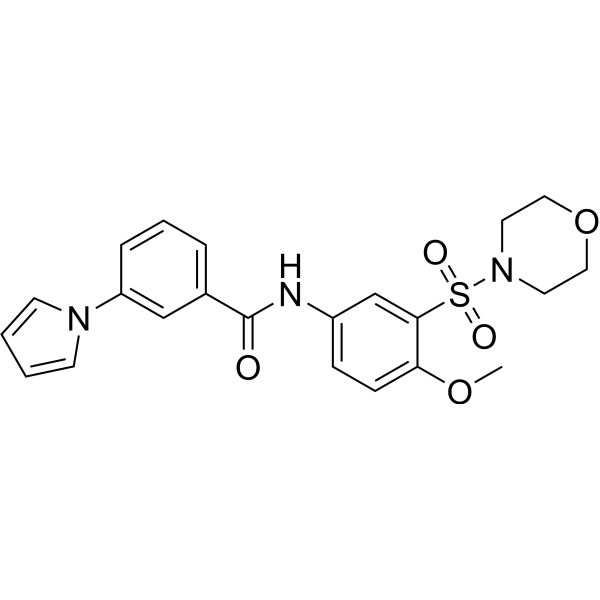
NCGC00378430 is a potent SIX1/EYA2 interaction inhibitor. NCGC00378430 partially reverses transcriptional and metabolic profiles mediated by SIX1 overexpression and reverses SIX1-induced TGF-β signaling and epithelial-mesenchymal transition (EMT). NCGC00378430 inhibits SIX1-mediated breast cancer metastasis in a mouse model.
Nur für Forschungszwecke. Wir verkaufen nicht an Patienten.
- Reinheit : 99.36%
- CAS. Nr.: 920650-00-6
- Formel: C22H23N3O5S
- Molecular Weight:441.50
-
Speicherung:Powder -20°C, 3 years , 4°C, 2 years ; In solvent -80°C, 6 months , -20°C, 1 month

To place orders, for customer services and technical support, please contact: MedChemExpress USA
Tel: 609-228-6898 E-mail: [email protected] [email protected]


-
 Biologische Aktivität
-
Chemical Information
-
Lösungsmittel & Löslichkeit
- Protokoll
- Reinheit & Dokumentation
- Verweise
-
 Help & FAQs


Publications Citing Use of MedChemExpress (MCE) NCGC00378430
More

Biologische Aktivität
Beschreibung
In Vitro
NCGC00378430 is a potent SIX1/EYA2 interaction inhibitor with an IC50 of 52 μM in the Alphascreen assay[1].
NCGC00378430 (20 μM; 3 days) blocks TGF-β induced activation of p-Smad3, upregulation of FN1, and downregulation of E-CAD in T47D cells[1].
NCGC00378430 (10 μM; 3 days) reverses the Sine oculis homeobox homolog 1 (SIX1)-induced increase in p-SMAD3 and does not alter total E-CAD levels. NCGC00378430 restores membranous E-CAD in MCF7-SIX1 cells, along with inhibiting FN1 expression[1].
NCGC00378430 (10 or 20 μM) disrupts SIX1-EYA2 interaction in breast cancer cells (MCF7, T47D, MDA-MB-231 cells)[1].
NCGC00378430 (10 μM; for 3 days) partially reverses SIX1-mediated transcriptional and metabolic signatures in MCF7 breast tumor cells[1].
MedChemExpress (MCE) has not independently confirmed the accuracy of these methods. They are for reference only.
-
Cell Line:T47D cells
-
Concentration:20 μM
-
Incubation Time:3 days
-
Result:Blocked TGF-β induced activation of p-Smad3, upregulation of FN1, and downregulation of E-CAD.
In Vivo
NCGC00378430 (20 mg/kg; IV) has a T1/2α of 0.25 hours[1].
MedChemExpress (MCE) has not independently confirmed the accuracy of these methods. They are for reference only.
-
Animal Model:6-8 week old NSG mice with MCF7 tumor cells[1]
-
Dosage:25 mg/kg
-
Administration:Local Injection to the site of tumor; every other day; from day 3 until the day 21
-
Result:Dramatically decreased distant metastatic burden compared to vehicle treatment.
Had no growth inhibitory effect.
-
Animal Model:Mice[1]
-
Dosage:20 mg/kg (Pharmacokinetic Analysis)
-
Administration:IV
-
Result:Had a T1/2α of 0.25 hours, a CL of 6.19 L/hr•kg, a Vss of 4.08 L/kg, a Cmax of 6703 ng/mL and an AUC of 3234 ng/mL•hr.


Chemical Information
-
CAS. Nr. 920650-00-6
-
Appearance Solid
-
Molecular Weight 441.50
-
Formel C22H23N3O5S
-
Color White to off-white
-
SMILES
O=C(NC1=CC=C(OC)C(S(=O)(N2CCOCC2)=O)=C1)C3=CC=CC(N4C=CC=C4)=C3
-
Versand
Room temperature in continental US; may vary elsewhere.
-
Speicherung
Powder -20°C 3 years 4°C 2 years In solvent -80°C 6 months -20°C 1 month


Publications (2)
-
Journal Impact Factor
-
Most Recent
-
Oncogene
Cooperation between SIX1 and DHX9 transcriptionally regulates integrin-focal adhesion signaling mediated metastasis and sunitinib resistance in KIRC. [Abstract]2024 Sep;43(39):2951-2969. PMID: 39174859 -
Int Immunopharmacol
Six1 promotes alveolar epithelium senescence in pulmonary fibrosis through regulating Tp53. [Abstract]2025 Sep 23:166:115554. PMID: 40991995


Lösungsmittel & Löslichkeit
In Vitro:
DMSO : 100 mg/mL (226.50 mM; Need ultrasonic; Hygroscopic DMSO has a significant impact on the solubility of product, please use newly opened DMSO)
Please refer to the solubility information to select the appropriate solvent. Once prepared, please aliquot and store the solution to prevent product inactivation from repeated freeze-thaw cycles.
Storage method and period of stock solution: -80°C, 6 months; -20°C, 1 month. When stored at -80°C, please use it within 6 months. When stored at -20°C, please use it within 1 month.
Please refer to the solubility information to select the appropriate solvent. Once prepared, please aliquot and store the solution to prevent product inactivation from repeated freeze-thaw cycles.
Storage method and period of stock solution: -80°C, 6 months; -20°C, 1 month. When stored at -80°C, please use it within 6 months. When stored at -20°C, please use it within 1 month.
Konzentration (Stammlösung) × Volumen (Stammlösung) = Konzentration (Ziellösung) × Volumen (Ziellösung)
In Vivo:
Select the appropriate dissolution method based on your experimental animal and administration route.
- For the following dissolution methods, please ensure to first prepare a clear stock solution using an In Vitro approach and then sequentially add co-solvents:
- To ensure reliable experimental results, the clarified stock solution can be appropriately stored based on storage conditions. As for the working solution for In Vivo experiments, it is recommended to prepare freshly and use it on the same day.
- The percentages shown for the solvents indicate their volumetric ratio in the final prepared solution. If precipitation or phase separation occurs during preparation, heat and/or sonication can be used to aid dissolution.
Add each solvent one by one: 10% DMSO 40% PEG300 5% Tween-80 45% Saline
Solubility: ≥ 2.5 mg/mL (5.66 mM); Clear solution
This protocol yields a clear solution of ≥ 2.5 mg/mL (saturation unknown).
Taking 1 mL working solution as an example, add 100 μL DMSO stock solution (25.0 mg/mL) to 400 μL PEG300, and mix evenly; then add 50 μL Tween-80 and mix evenly; then add 450 μL Saline to adjust the volume to 1 mL.
Preparation of Saline: Dissolve 0.9 g sodium chloride in ddH₂O and dilute to 100 mL to obtain a clear Saline solution.
Add each solvent one by one: 10% DMSO 90% (20% SBE-β-CD in Saline)
Solubility: ≥ 2.5 mg/mL (5.66 mM); Suspended solution
This protocol yields a suspended solution of ≥ 2.5 mg/mL (saturation unknown). Suspended solution can be used for oral and intraperitoneal injection.
Taking 1 mL working solution as an example, add 100 μL DMSO stock solution (25.0 mg/mL) to 900 μL 20% SBE-β-CD in Saline, and mix evenly.
Preparation of 20% SBE-β-CD in Saline (4°C, storage for one week): 2 g SBE-β-CD powder is dissolved in 10 mL Saline, completely dissolve until clear.
In Vivo Dissolution Calculator
Please enter the basic information of animal experiments:
-
-
-
-
Recommended: Prepare an additional quantity of animals to account for potential losses during experiments.
Please enter your animal formula composition:
-
%DMSO +
Recommended: Keep the proportion of DMSO in working solution below 2% if your animal is weak.
-
%+
-
+%Tween-80 + +
-
%Saline +
The co-solvents required include: DMSO, . All of co-solvents are available by MedChemExpress (MCE). , Tween 80. All of co-solvents are available by MedChemExpress (MCE).
Working solution concentration: 0.22 mg/mL
Method for preparing stock solution: mg drug dissolved in μL DMSO. Stock solution concentration: mg/mL.
1. Take μL DMSO stock solution;
2. Add μL .
μL , mix evenly;
3. Then add μL Tween 80, mix evenly;
4. Then add μL
Please ensure that the stock solution in the first step is dissolved to a clear state, and add co-solvents in sequence. You can use ultrasonic heating (ultrasonic cleaner, recommended frequency 20-40 kHz), vortexing, etc. to assist dissolution.


Reinheit & Dokumentation
-
Data Sheet (287 KB)
-
SDS (254 KB)
- English - EN (254 KB)
- Français - FR (254 KB)
- Deutsch - DE (254 KB)
- Norwegian - NO (254 KB)
- Español - ES (254 KB)
- Swedish - SV (254 KB)
- Italian - IT (254 KB)
- Korean - KR (254 KB)
- Portuguese - PT (254 KB)
-
Handling Instructions (2659 KB)
Verweise


Complete Stock Solution Preparation Table
Please refer to the solubility information to select the appropriate solvent. Once prepared, please aliquot and store the solution to prevent product inactivation from repeated freeze-thaw cycles.
Storage method and period of stock solution: -80°C, 6 months; -20°C, 1 month. When stored at -80°C, please use it within 6 months. When stored at -20°C, please use it within 1 month.
| Optional Solvent | Concentration Solvent Mass | 1 mg | 5 mg | 10 mg | 25 mg |
|---|---|---|---|---|---|
| DMSO | 1 mM | 2.2650 mL | 11.3250 mL | 22.6501 mL | 56.6251 mL |
| 5 mM | 0.4530 mL | 2.2650 mL | 4.5300 mL | 11.3250 mL | |
| 10 mM | 0.2265 mL | 1.1325 mL | 2.2650 mL | 5.6625 mL | |
| 15 mM | 0.1510 mL | 0.7550 mL | 1.5100 mL | 3.7750 mL | |
| 20 mM | 0.1133 mL | 0.5663 mL | 1.1325 mL | 2.8313 mL | |
| 25 mM | 0.0906 mL | 0.4530 mL | 0.9060 mL | 2.2650 mL | |
| 30 mM | 0.0755 mL | 0.3775 mL | 0.7550 mL | 1.8875 mL | |
| 40 mM | 0.0566 mL | 0.2831 mL | 0.5663 mL | 1.4156 mL | |
| 50 mM | 0.0453 mL | 0.2265 mL | 0.4530 mL | 1.1325 mL | |
| 60 mM | 0.0378 mL | 0.1888 mL | 0.3775 mL | 0.9438 mL | |
| 80 mM | 0.0283 mL | 0.1416 mL | 0.2831 mL | 0.7078 mL | |
| 100 mM | 0.0227 mL | 0.1133 mL | 0.2265 mL | 0.5663 mL |


NCGC00378430 Related Classifications
HY-138657 Related Classifications
 Powered by Bioz